- Light and color covers impressionism, fauvism, and watercolor.
- Shape and feeling gathers expressionism, cubism, and surrealism.
- Decoration runs from art nouveau to art deco and stained glass.
- Prints and paper bring ukiyo-e, linocut, and paper collage.
You type artistic, hoping for character, and the machine hands back a beautiful picture of nothing much. The twelve styles below each carry a name, a few things the eye can check, and a prompt that says them plainly.
How to read a style on sight
First
The light
What is the light doing? Ask whether it breaks into dabs, sits flat and even, or glows through colored glass.
Second
The shapes
How are the forms built? True to the eye, bent out of true by feeling, cut into facets, or wrapped in plant-like curves.
Third
The color
Ask what the palette serves: nature, raw emotion, or pure decoration.
And then
No history needed
Three checks are enough to name a manner; the dates belong to museums.
Light and color
Impressionism
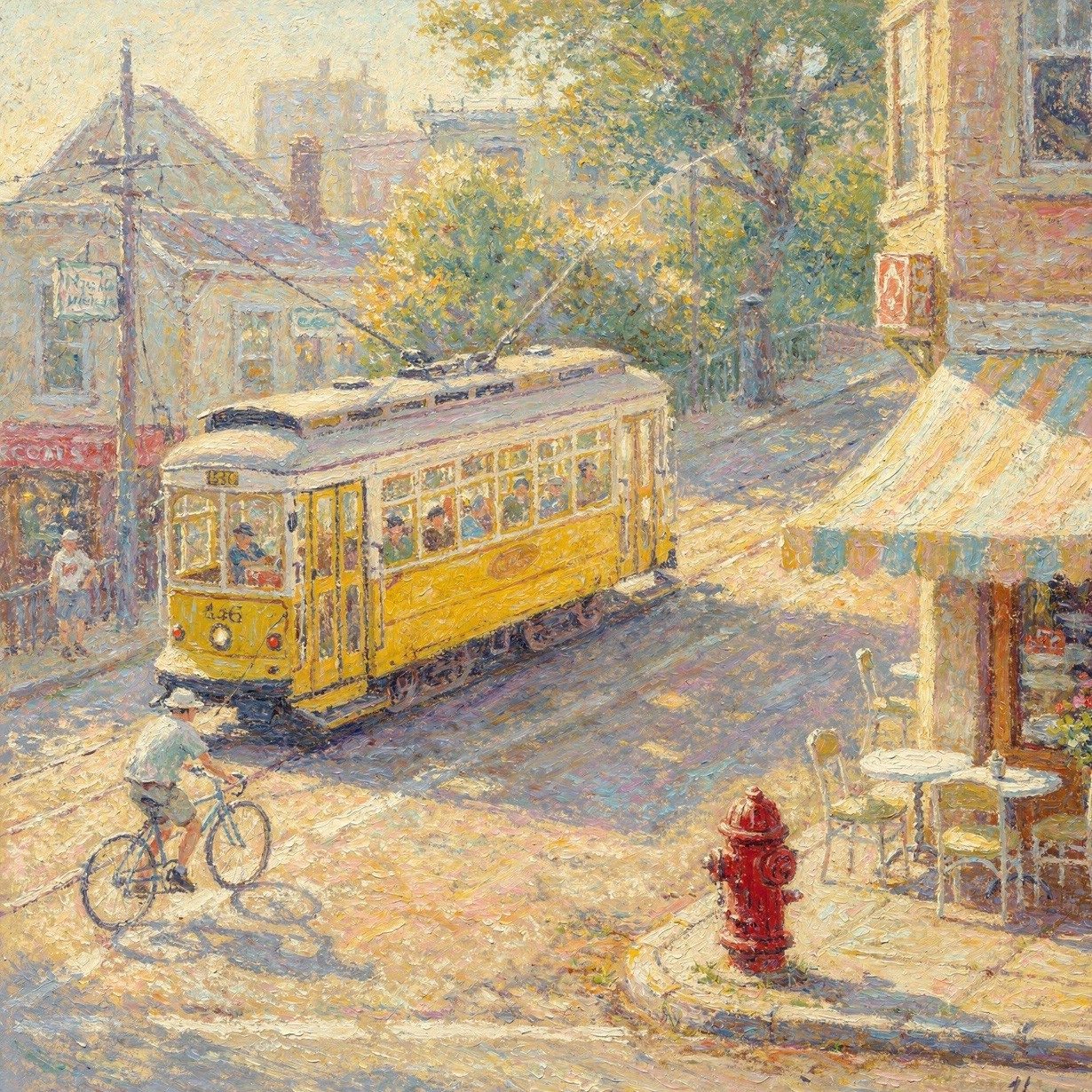
The first impressionist exhibition opened in Paris in 1874, grown from the work Claude Monet and painters near him had been doing since the early 1860s. Look for rapid, broken brushwork in separate dabs, and sunlight that trembles on the pavement instead of sitting still.
Impressionist street
Create an impressionist painting of a yellow streetcar climbing a hilly street past a corner café with a striped awning, a cyclist and a fire hydrant. Use short, broken brushstrokes and shimmering dabs of pastel color, sunlight trembling on the pavement, outlines dissolving into the warm air of a summer morning. Keep the whole scene airy and luminous. No text, no letters, no signature.
Fauvism
A Paris group that included Henri Matisse and André Derain showed these pictures at the Salon d’Automne in 1905. Color stops obeying nature: bold patches straight from the tube, wild loose dabs, and forms simplified until they edge toward abstraction.
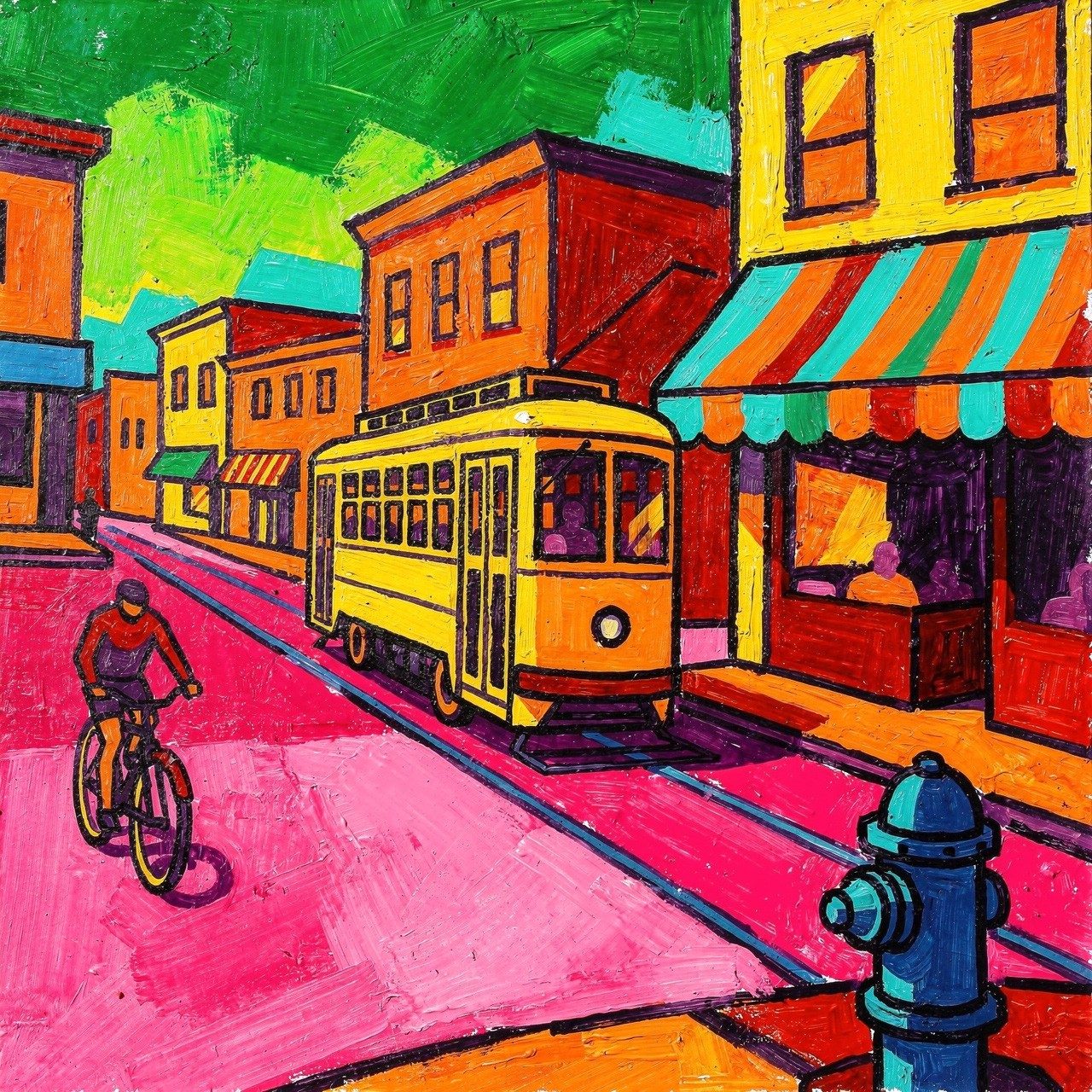
Fauvist street colors
Create a fauvist painting of a yellow streetcar climbing a hilly street past a corner café with a striped awning, a cyclist and a fire hydrant. Explode the scene into wild, saturated colors chosen for joy, not realism: a pink street, a green sky, thick flat patches of pure pigment bounded by energetic dark outlines. Everything stays flat, bright and triumphant. No text, no letters, no signature.
Watercolor
The paint itself is water-soluble and semi-transparent, so the white of the paper glows through every wash. In the wet-on-wet technique, color runs into color, and the brightest highlights are often just the paper left unpainted.
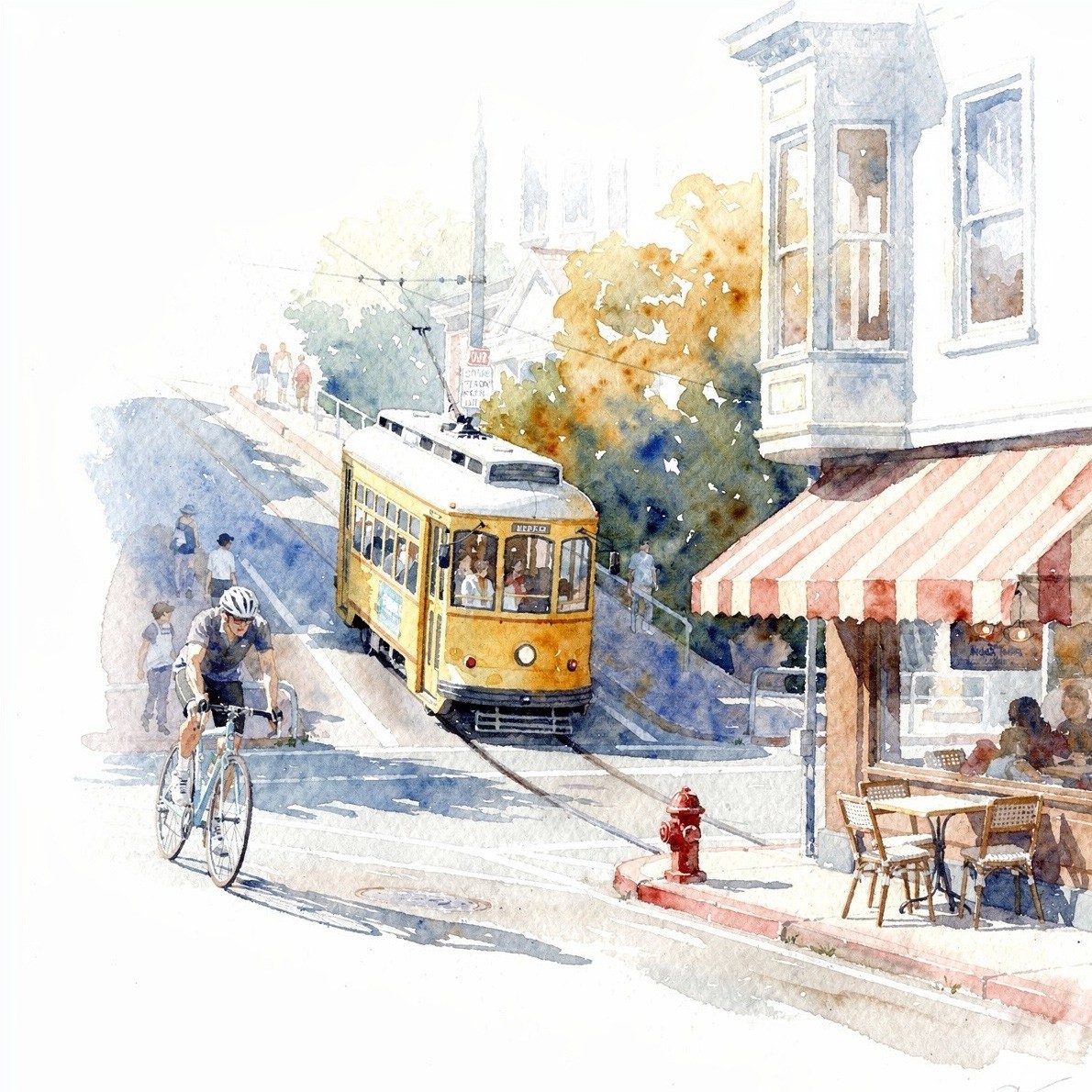
Watercolor street scene
Create a watercolor painting of a yellow streetcar climbing a hilly street past a corner café with a striped awning, a cyclist and a fire hydrant. Paint it in translucent washes with soft wet edges, let blues and warm ochres bleed gently into each other, keep the white paper as highlights, and show the lightness of a bright afternoon. The scene should stay airy, fresh and full of light. No text, no letters, no signature.
Shape and feeling
Expressionism
The term begins with modern painters working in Germany in the early twentieth century, and feeling comes before likeness. Colors run intense and off-nature, forms bend out of true, and the paint goes on thick and freely textured.
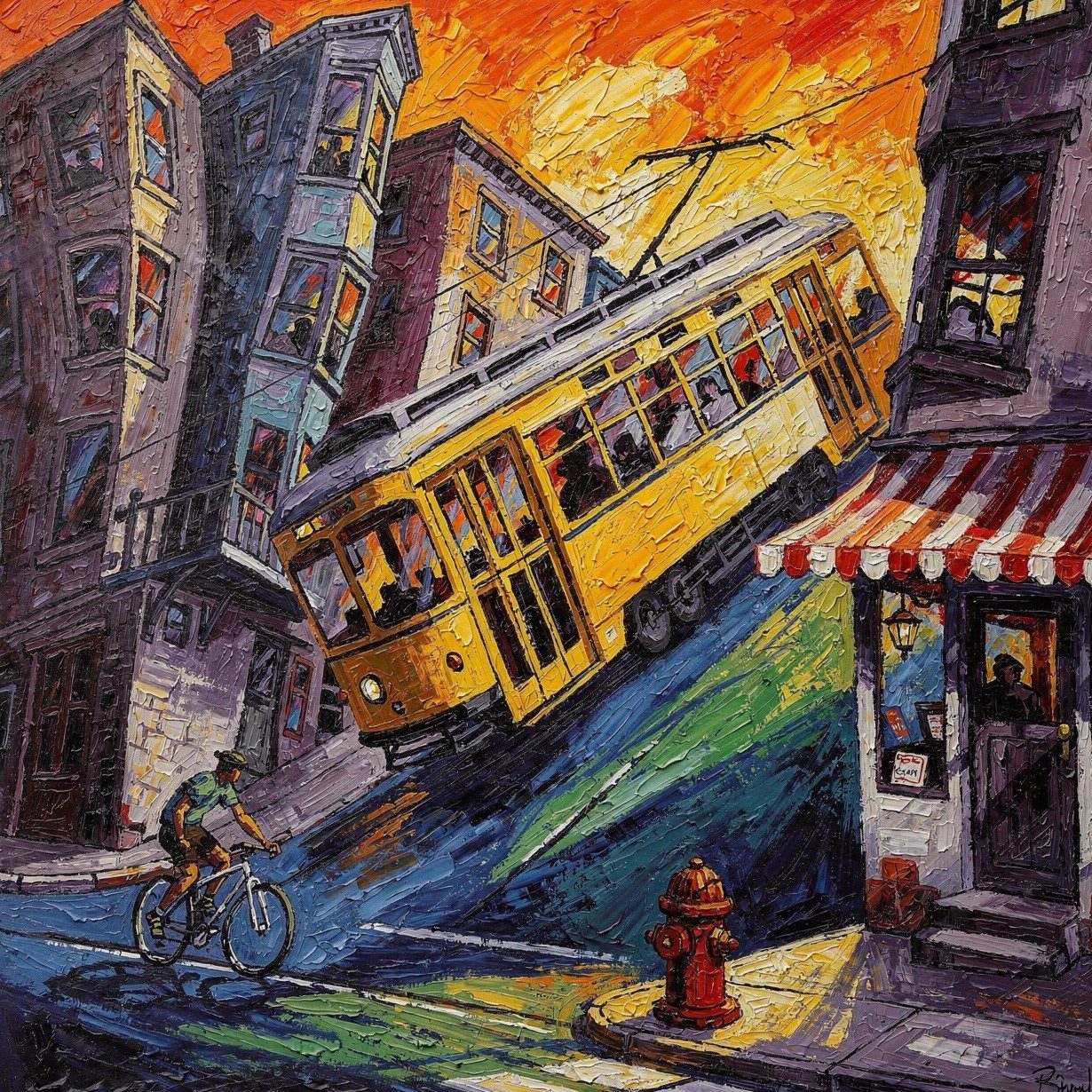
Expressionist street
Create an expressionist painting of a yellow streetcar climbing a hilly street past a corner café with a striped awning, a cyclist and a fire hydrant. Distort the buildings so they lean and sway, thicken the paint into rough impasto ridges, and push the colors beyond reality: burning oranges, bruised purples, electric shadows. The whole street should feel charged with nervous, emotional energy. No text, no letters, no signature.
Cubism
Pablo Picasso and Georges Braque built this one together around 1907 and 1908. A single picture holds several viewpoints at once: forms break into angular facets, and the canvas stays flat instead of faking depth.
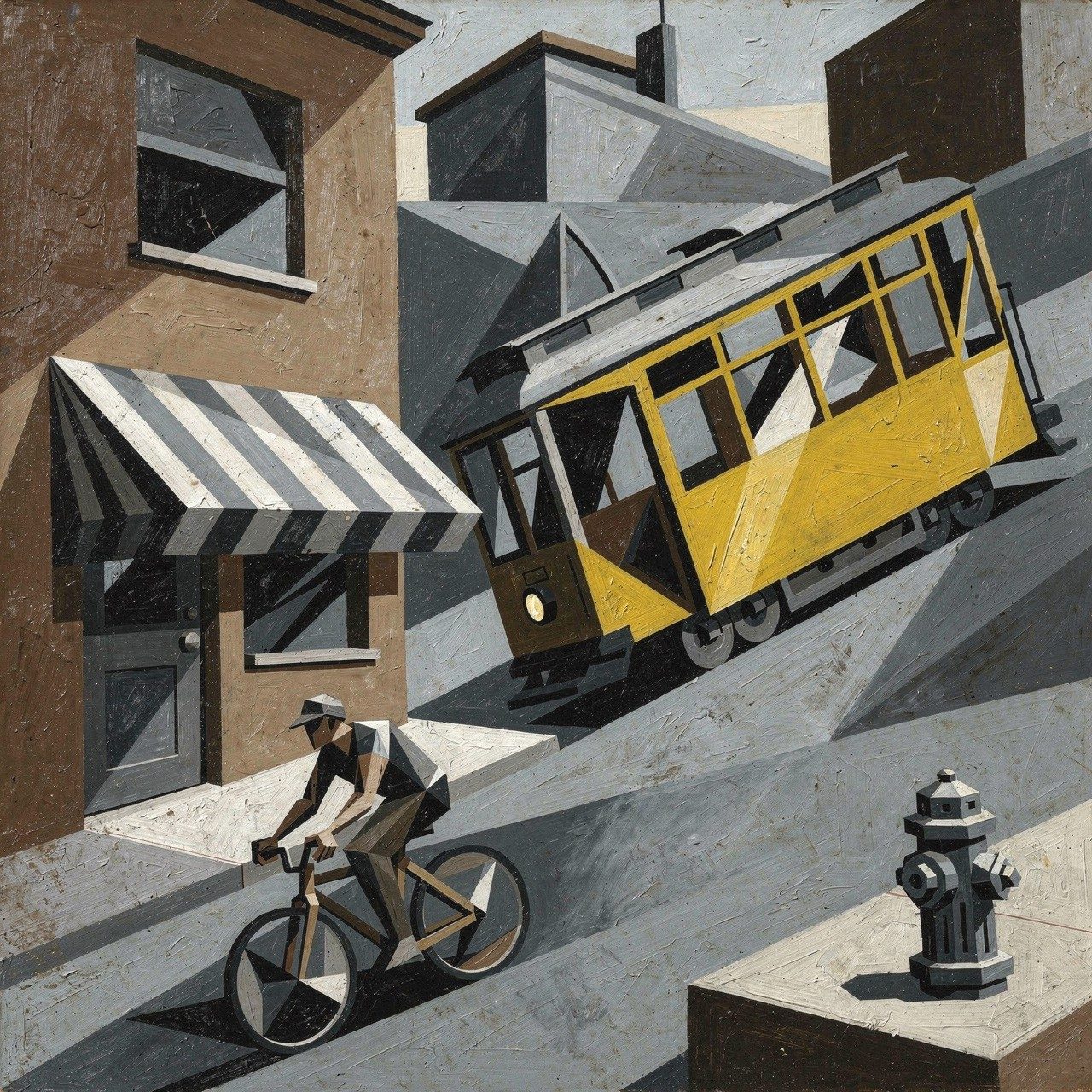
Cubist street
Create a cubist painting of a yellow streetcar climbing a hilly street past a corner café with a striped awning, a cyclist and a fire hydrant. Break every form into angular geometric facets, show the street from several viewpoints at once, and assemble the fragments in muted browns, grays and slate blues with a few sharp accents. The result should feel like one picture made of many overlapping planes. No text, no letters, no signature.
Surrealism
The poet Guillaume Apollinaire coined the word in 1917, and the movement’s manifesto gave it its rules in 1924. Dream logic takes over: everyday things meet in impossible company, and the strange gets painted with a calm, uncanny beauty.
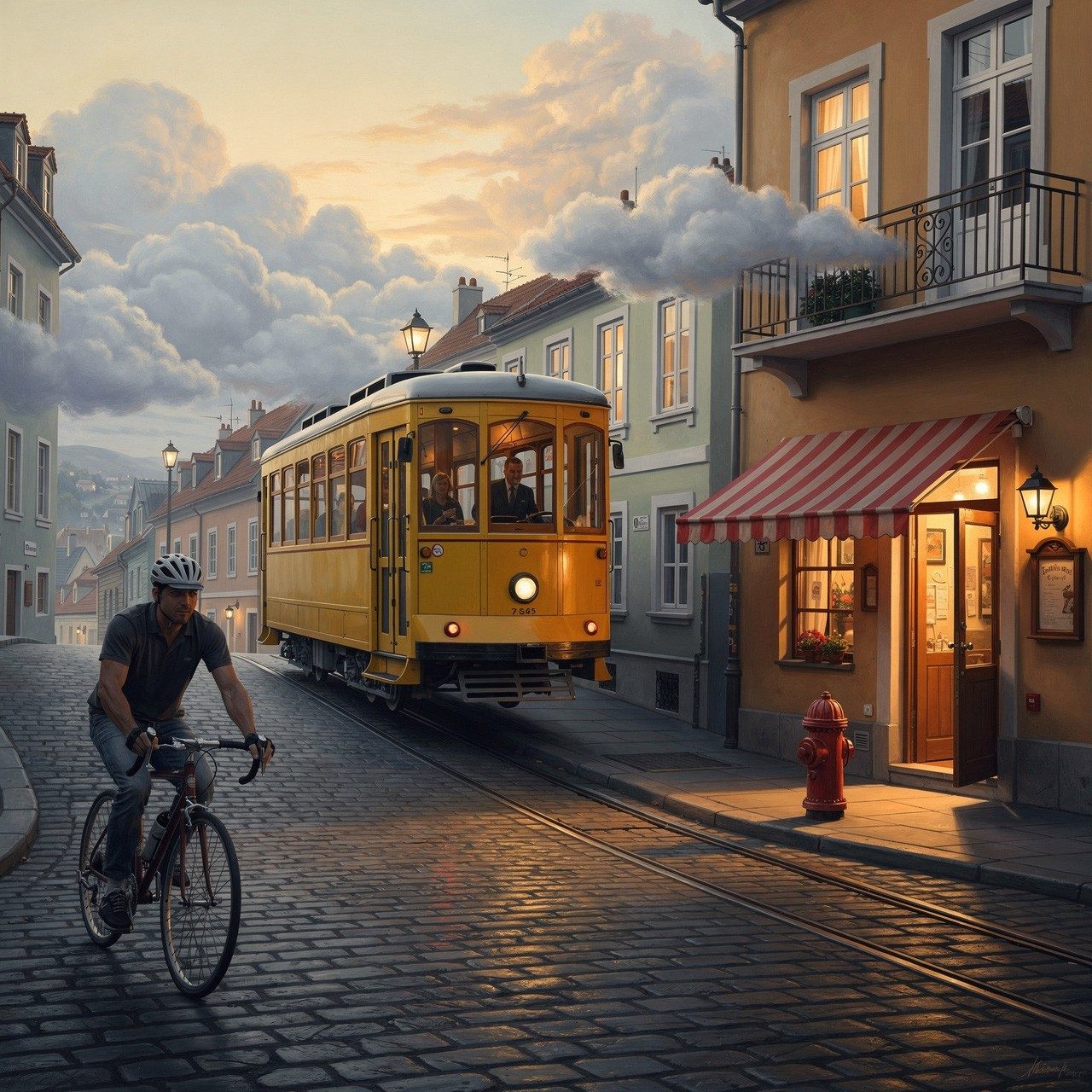
Surrealist street
Create a surrealist painting of a yellow streetcar climbing a hilly street past a corner café with a striped awning, a cyclist and a fire hydrant. Let the dream take over: the streetcar floats a hand’s width above the rails, improbable clouds drift below the rooftops, and a soft golden glow pours from the café door. Paint it with smooth, almost photographic precision, so the impossible feels calm. No text, no letters, no signature.
Decorative styles
Art nouveau
It spread through the 1890s and reached a wide public at the Paris Exposition Universelle of 1900. The whole scene wraps itself in sinuous lines and flowing organic shapes borrowed from plant forms: stems, curves, and ornamental frames.
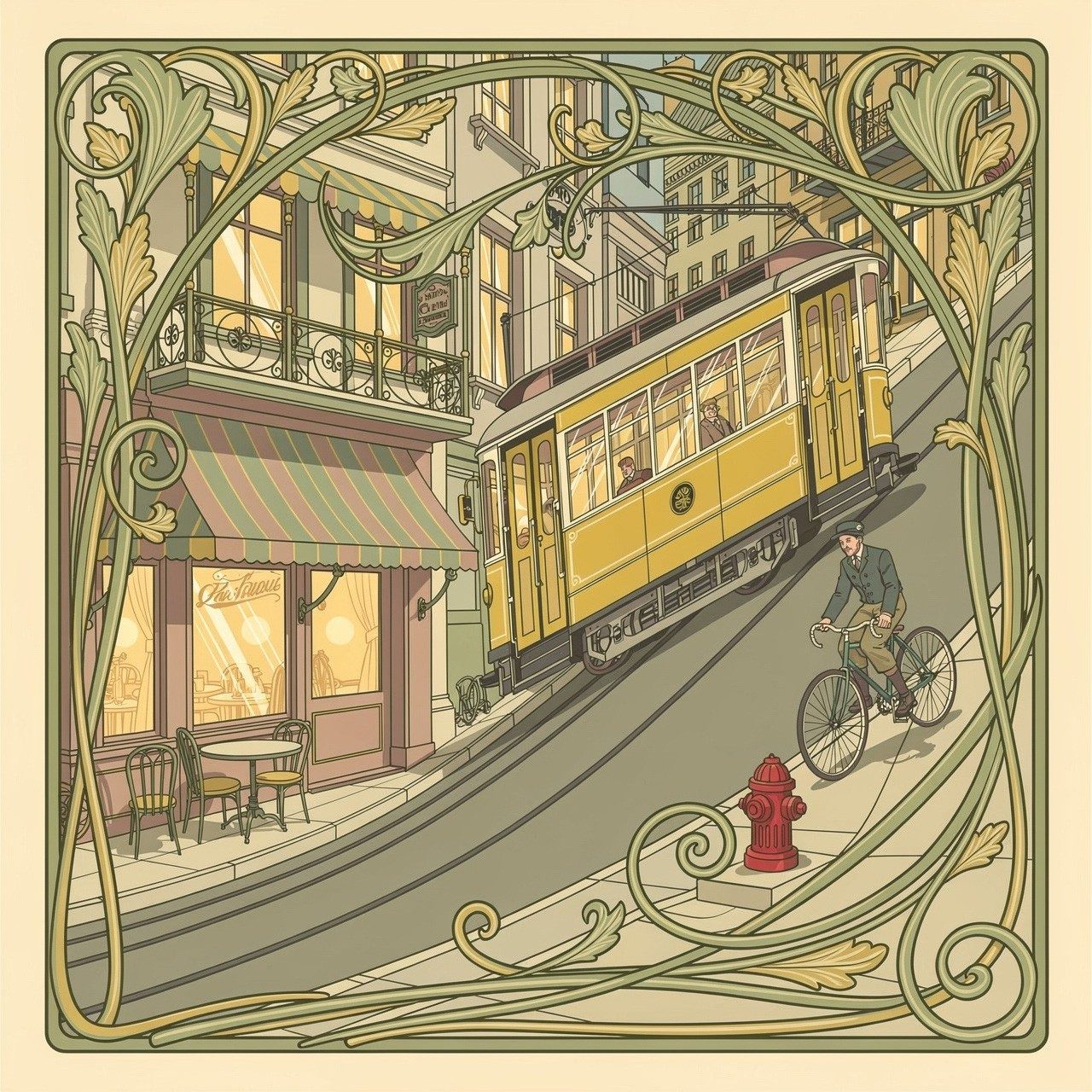
Art nouveau street
Create an art nouveau illustration of a yellow streetcar climbing a hilly street past a corner café with a striped awning, a cyclist and a fire hydrant. Wrap the whole scene in sinuous, plant-like lines: wrought iron curves, flowing stems and whiplash motifs framing the streetcar, flat muted colors of sage, gold and dusty rose. The image should feel like a decorative panel, elegant and ornamental. No text, no letters, no signature.
Art deco
The name points back to the Paris exhibition of 1925, and the look ran through the 1920s and 1930s. Geometry takes charge: sleek ordered shapes, flatter and more angular than art nouveau, its surfaces fragmented and geometric.
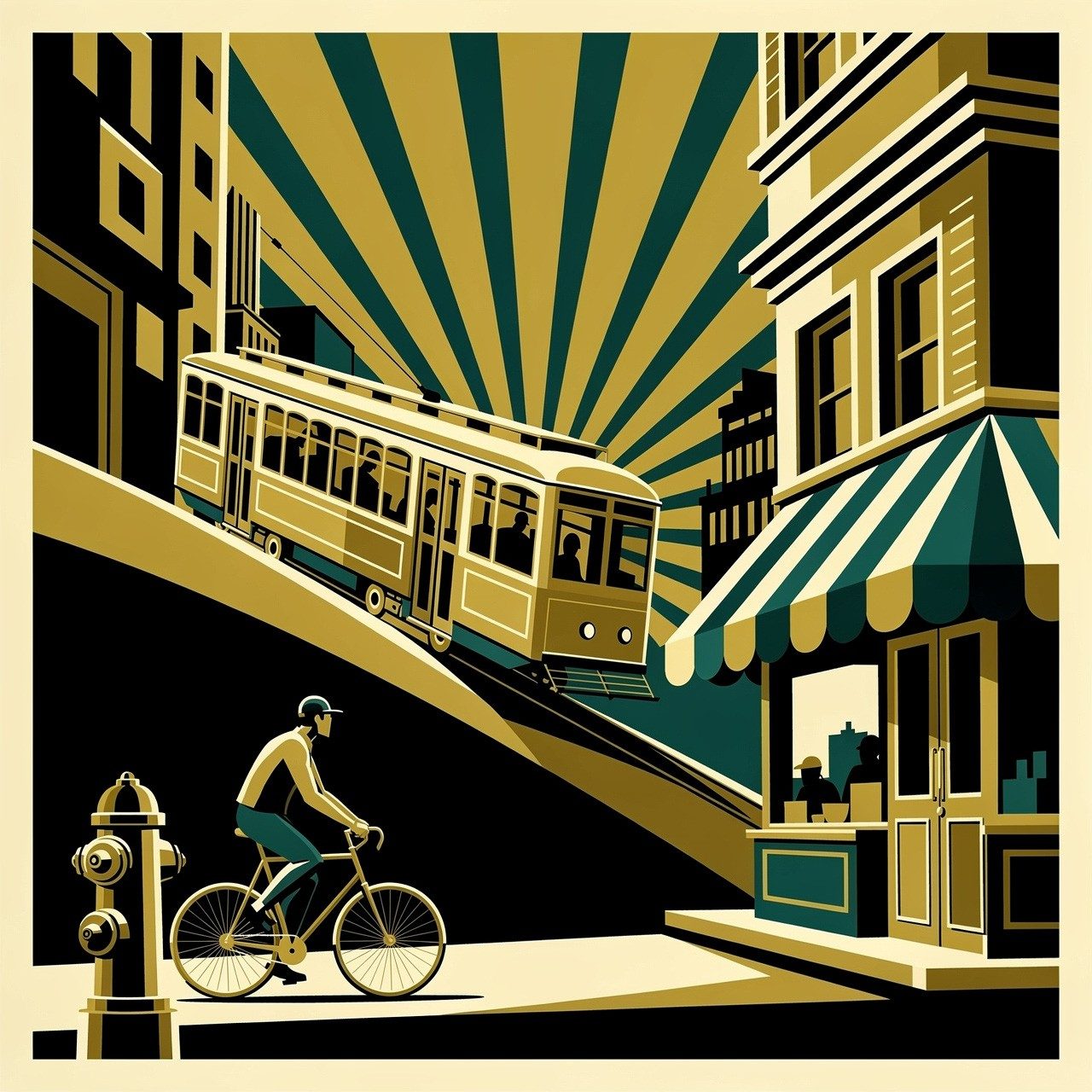
Art deco street
Create an art deco poster-style image of a yellow streetcar climbing a hilly street past a corner café with a striped awning, a cyclist and a fire hydrant. Streamline every shape into sleek geometry, arrange the composition with symmetrical sunburst rays behind the streetcar, and keep a bold palette of black, gold, cream and deep teal. Flat, polished and grandly elegant. No text, no letters, no signature.
Stained glass
A monk, Theophilus, described the craft in a manual written between about 1110 and 1140. The picture is built like a mosaic, from many separate pieces of colored glass held by metal strips, and it lives on the light that passes through.
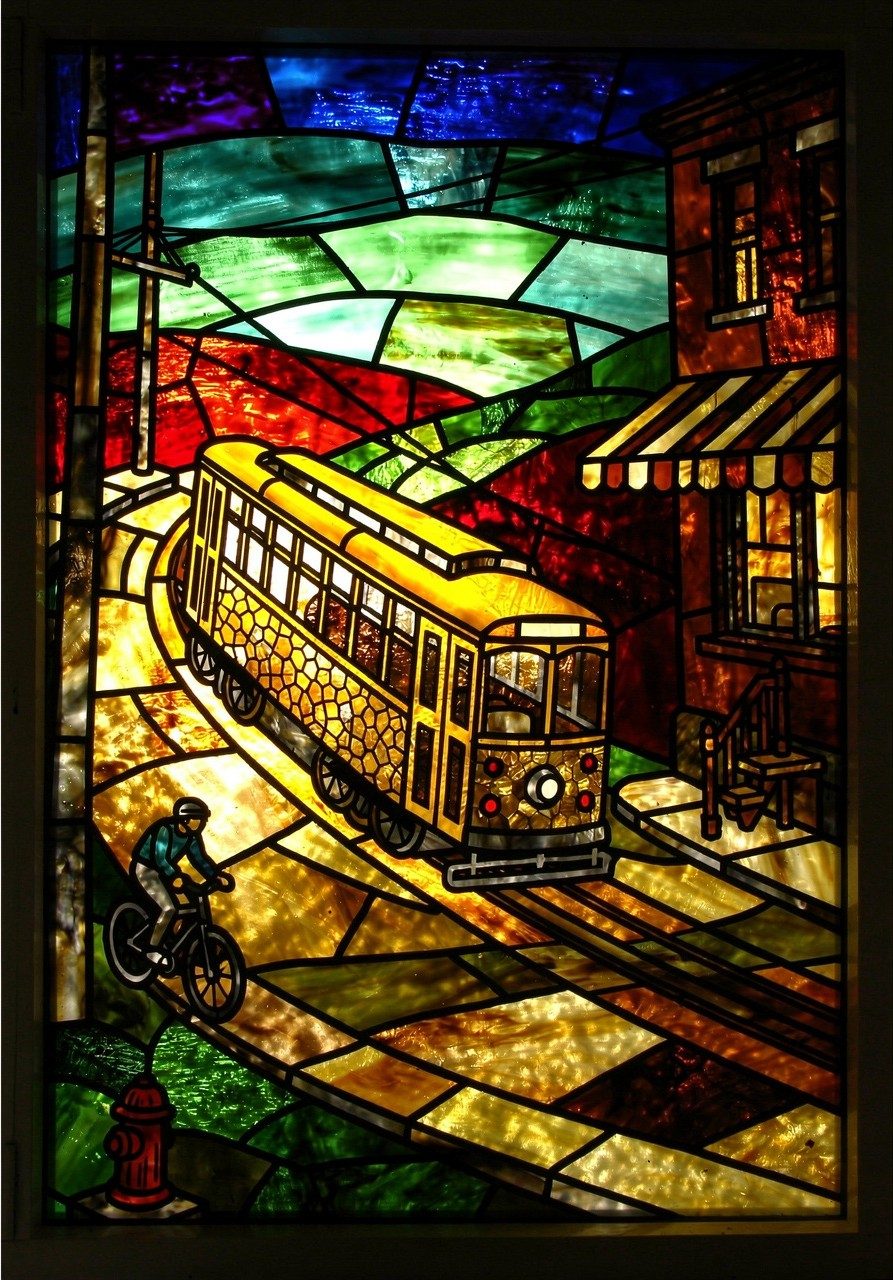
Stained glass street
Create a stained glass window of a yellow streetcar climbing a hilly street past a corner café with a striped awning, a cyclist and a fire hydrant. Divide the scene into glass panels held by thick black lead lines, jewel tones glowing as if lit from behind: ruby red, cobalt blue, emerald green and amber gold, the streetcar rendered in amber glass with mosaic texture. The whole window should glow softly. No text, no letters, no signature.
Prints and paper
Ukiyo-e woodblock print
Japan’s Edo period made these sheets, and from 1765 a new printing method produced single sheets in a full range of colors. Each color prints from its own carved block, sometimes twenty of them, leaving flat areas of color on mulberry paper.
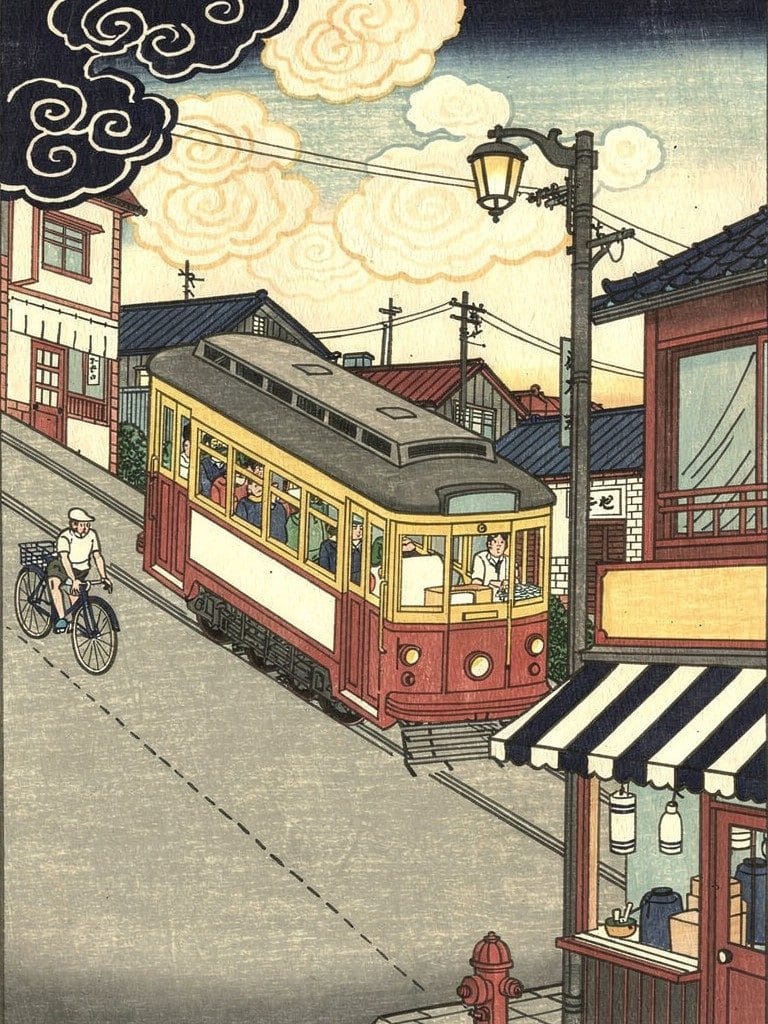
Woodblock print street
Create a Japanese ukiyo-e woodblock print of a yellow streetcar climbing a hilly street past a corner café with a striped awning, a cyclist and a fire hydrant. Print it with flat color areas bounded by bold carved outlines, stylized curling clouds, and visible wood grain on cream paper. Keep the palette of indigo blue, brick red, warm cream and soft black, and the streetcar may turn brick red to suit the style. No text, no letters, no seal.
Linocut
Linoleum began as a floor covering in the nineteenth century, and artists made it a print surface in the twentieth. The soft block cuts in any direction, the slightly textured surface takes ink evenly, and the print comes out in bold shapes.
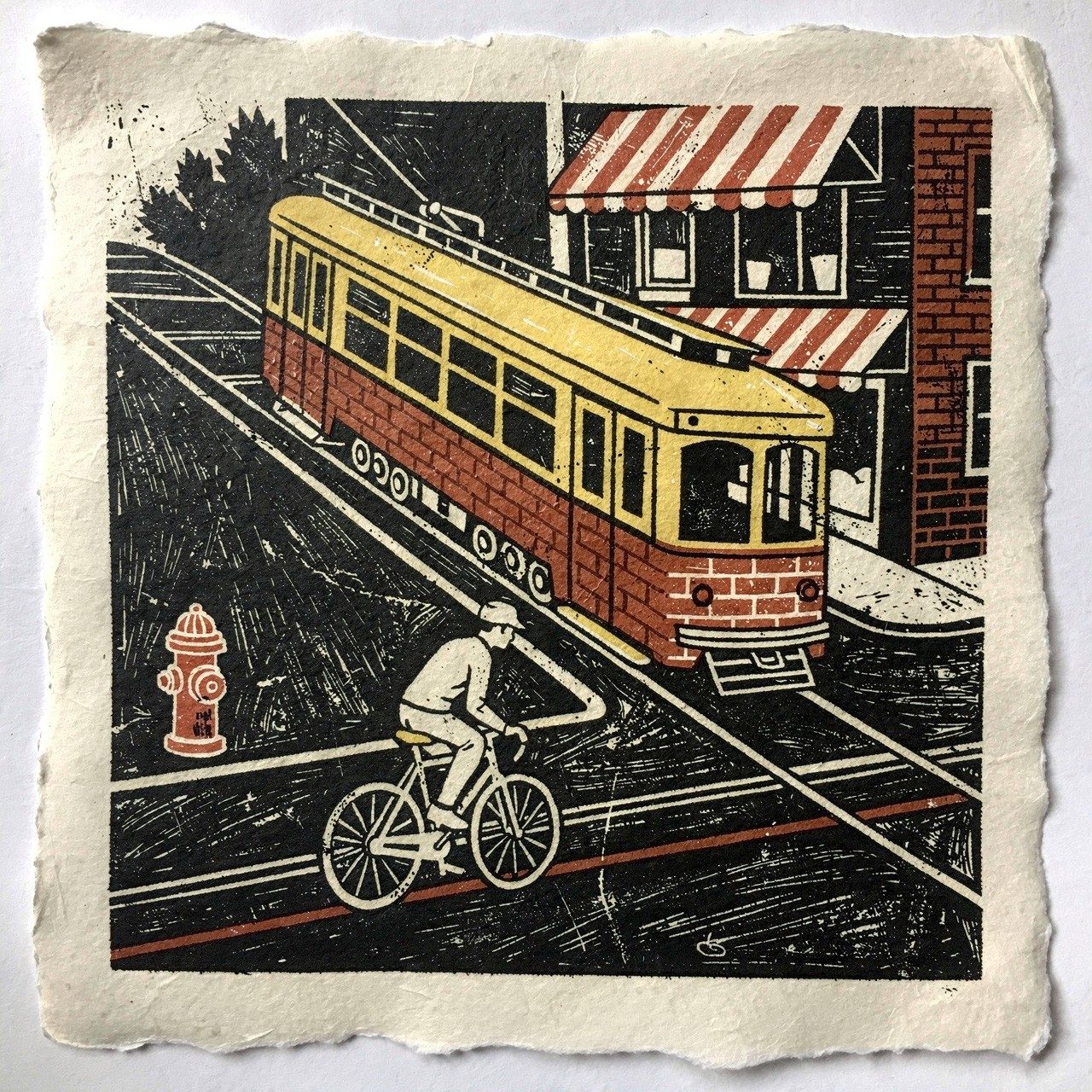
Linocut street
Create a linocut relief print of a yellow streetcar climbing a hilly street past a corner café with a striped awning, a cyclist and a fire hydrant. Carve bold black shapes into rough, visible gouge marks, print on textured paper with slightly wobbly edges, and limit the palette to black, cream and brick red, the streetcar printed in brick red and cream. The result should feel hand-pulled and rustic. No text, no letters, no signature.
Paper collage
The word is French, pasted papers, and artists first took the technique up in the early twentieth century. The picture is assembled from pieces of paper arranged and stuck down one over another, with room for paint or drawing in the same work.
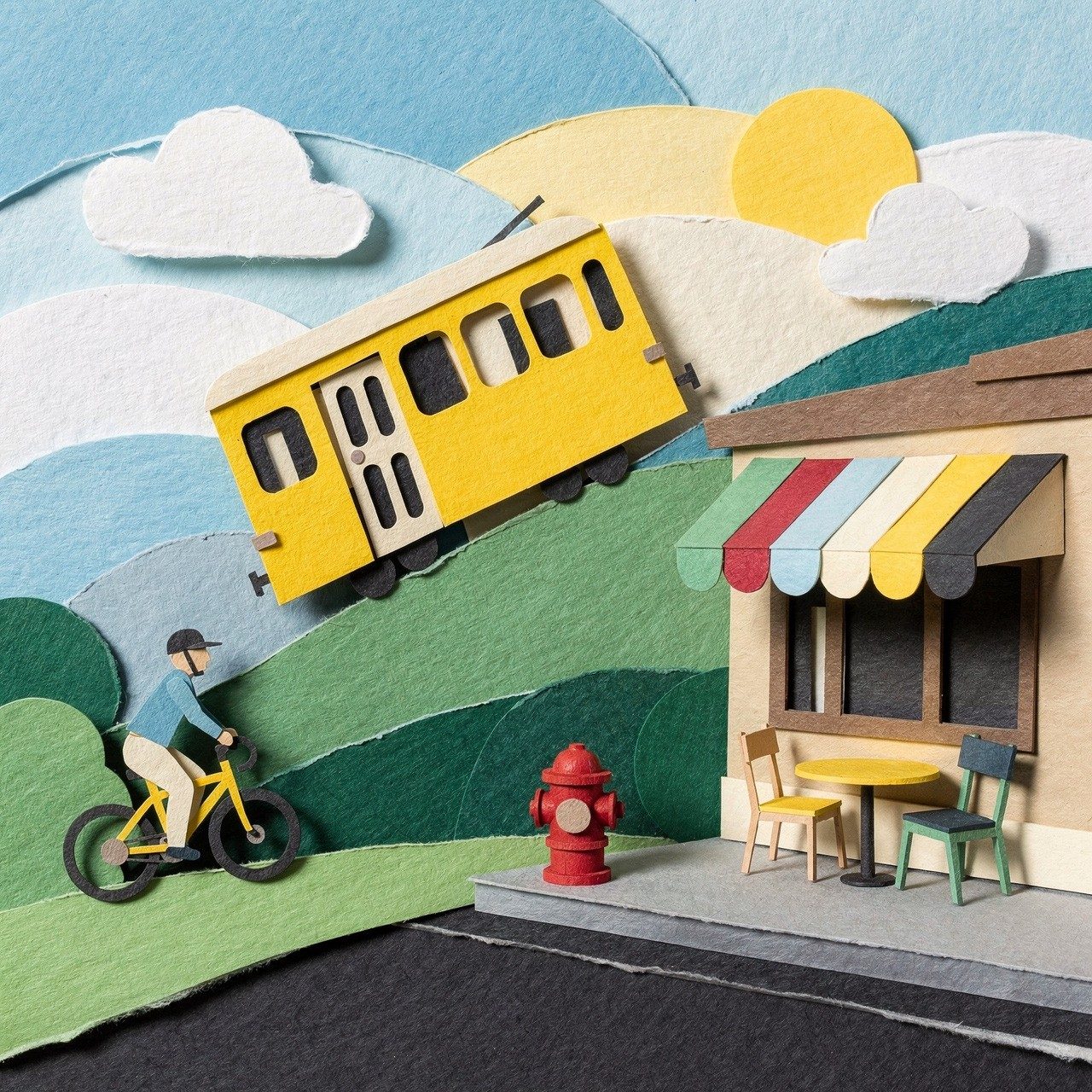
Paper collage street
Create a paper cut-out collage of a yellow streetcar climbing a hilly street past a corner café with a striped awning, a cyclist and a fire hydrant. Build the scene from layered shapes of textured colored paper, torn and scissor-cut edges visible, soft drop shadows between the layers, playful tilted hills and a sunny sky made of overlapping paper circles. Keep it cheerful, handmade and full of depth. No text, no letters, no signature.
Which art style fits your project?
| Your project | Pick this style | The trait that decides |
|---|---|---|
| Book cover | Art nouveau | Plant-like framing lines give a cover an ornamental, finished edge. |
| Kids’ room poster | Paper collage | Bright paper shapes laid in flat layers stay light and friendly. |
| Logo | Art deco | Skip the transparent washes: they thin out at small sizes, and clean geometry stays sharp. |
| Product label | Linocut | A few flat colors and bold shapes survive a crowded shelf. |
| Social post | Fauvism | Saturated color chosen for effect, not realism, catches a fast eye. |
| Wall print | Impressionism | Shimmering light and open-air subjects hold up at full size. |
How to ask Niki for the picture
-
Create an image
Pick the format first with the three buttons in the chat, portrait, landscape or square; square is the right one for this street. Then paste the prompt on our AI image page. Niki paints the street from it. Stray lettering does slip in: the woodblock print and the linocut above both needed a quick second message in that same chat. If any sneaks in, say so there and Niki removes it.
-
Keep the style, change the subject
The style sentences travel well. Keep them as written, swap the streetcar for your subject, and the family look stays. For subjects beyond this street, our image prompt examples hold ready-made lines.
-
Or start from your photo
Send a picture of your own and describe the change in plain words. The same style sentences restyle it, and the free trial includes a few messages.
Niki warns you
Copyright law “does not protect artistic style as a separate element of a work,” the U.S. Copyright Office writes in its 2024 report. The Act “may, however, provide a remedy where the output of an ‘in the style of’ request ends up replicating not just the artist’s style but protectible elements of a particular work.” So describe the manner itself, and keep a living artist’s name out of the prompt. This is general information, not legal advice.
Niki
AI image generator
“Send me one of these twelve prompts, or your own style sentences, and I paint your street that way. If a photo of yours deserves a new manner, send it along: I restyle it while you keep the direction.”
Three style questions, answered
May a prompt ask for a specific artist’s style?
Style itself is not protected, as the warning above says. A copy of protectible parts of a particular work can bring a remedy, and other laws can reach unfair or deceptive copying. Name the traits, then, and leave the artist’s name out. For what you own in a finished image, our article on whether you can sell AI art covers that side.
How do I keep one look across several pictures?
Write the style sentences once and keep them identical while the subject changes; the closer you hold to them, the steadier the look tends to stay. Working in one conversation helps too, and every picture there can be reworked.
Which style should you try first?
Linocut. Flat shapes, two or three colors, and bold outlines make a picture easy to check against the style. Watercolor is the gentler second choice.
Your street, painted your way
Pick a family above, send its prompt to Niki, and keep the picture you like once it lands.
Sources
- Copyright and Artificial Intelligence, Part 1: Digital Replicas, U.S. Copyright Office, July 2024.
- 17 U.S.C. 102, U.S. Copyright Office.
- Art terms glossary, Tate.
- Woodblock Prints in the Ukiyo-e Style, The Metropolitan Museum of Art, October 2003.
- Stained glass, Encyclopaedia Britannica.