

- Many employers never ask for one, and a resume alone can make your case.
- On a federal application, the form itself lists required and optional documents.
- A short one is enough; our guide on how long a cover letter should be sets the target.
Ben has filled in a whole online application and finds, at the final step, a cover letter field marked optional. The posting decides; a quick read of its wording tells you which case you are in.
Let the Posting Decide Whether You Need a Cover Letter
Each of the four cases below calls for its own move; the basics of what a cover letter is are in our plain-language guide.
The posting requests a letter
Write one
CareerOneStop is blunt: when the job posting asks for a cover letter, you need to write one.
Our advice
The posting says optional
Send a short one
CareerOneStop calls a letter a good idea in this case; North Dakota’s career office would send one unless the employer expressly bars it.
You were asked to email a resume
Let the email serve
The body of your email can serve as the letter, CareerOneStop notes.
The employer said resume only
Skip the letter
York College’s slide lists two cases apart: a prospective employer who indicates resume only, and a letter that would add no advantage, with online applications as its example.
When the Field Says Optional: Ben’s Letter
Ben Carter and LumenPath Analytics are fictional; Natalie‘s replies are hers, word for word.
Ben asks Natalie
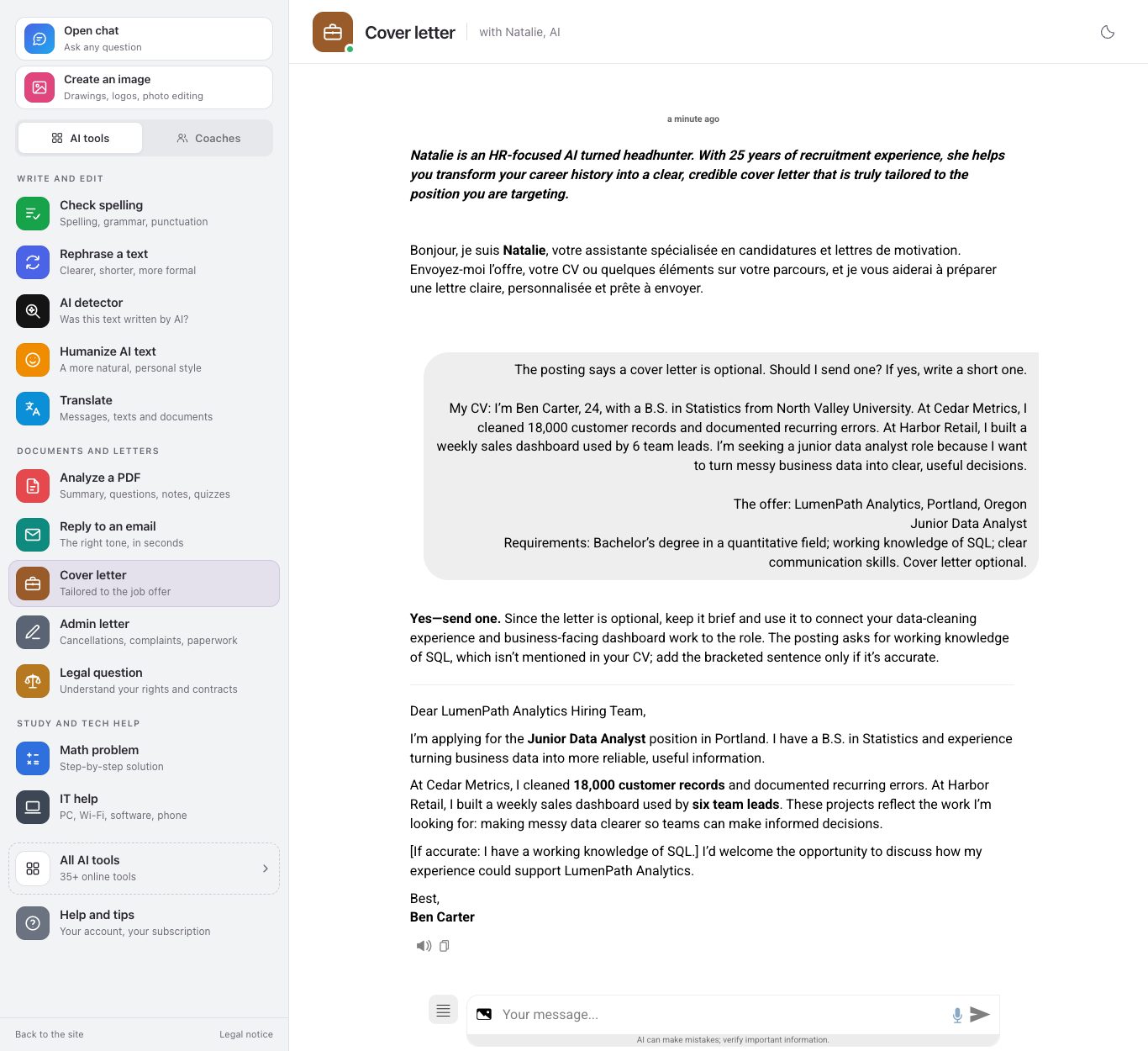
The cover letter is listed as optional on my posting. Should I send one?
“Yes, send one. Since the letter is optional, keep it brief and use it to connect your data-cleaning experience and business-facing dashboard work to the role. The posting asks for working knowledge of SQL, which isn’t mentioned in your CV; add the bracketed sentence only if it’s accurate.”
The letter Natalie wrote
Dear LumenPath Analytics Hiring Team,
I’m applying for the Junior Data Analyst position in Portland. I have a B.S. in Statistics and experience turning business data into more reliable, useful information.
At Cedar Metrics, I cleaned 18,000 customer records and documented recurring errors. At Harbor Retail, I built a weekly sales dashboard used by six team leads. These projects reflect the work I’m looking for: making messy data clearer so teams can make informed decisions.
[If accurate: I have a working knowledge of SQL.] I’d welcome the opportunity to discuss how my experience could support LumenPath Analytics.
Best,
Ben Carter
The SQL sentence sits in brackets because Ben’s resume does not mention the skill; Natalie adds it only if it is accurate.
What the Letter Adds That the Resume Does Not Say
So Ben asked Natalie what his letter added that his resume did not.
Natalie’s answer
“It explains why you’re pursuing data analysis: to turn messy business data into useful decisions.”
“It connects your record-cleaning and dashboard work to the Junior Data Analyst role.”
CareerOneStop’s list for an optional field names more uses: a letter can highlight your fit for the job, explain an employment gap, or show special interest in the job and the employer.
Our cover letter examples collect finished letters in the same shape for other situations.
Natalie’s warning
Two mistakes sink an optional letter: padding it with experience you do not have, and sending one after an employer asked for a resume only. Natalie writes from what you give her alone, never inventing a diploma, a skill, or a motivation.
Natalie
AI cover letter assistant
“If the posting leaves the choice to you, send a short letter built on your real record. Give me the posting and your background, and I pick the two to four arguments that carry it.”
Decided to send one? Natalie drafts it
Paste in the posting and tell her about your background; the AI cover letter generator then returns a letter ready to review, free to try with no sign-up.
Frequently Asked Questions
Can I apply without a cover letter?
Yes. Plenty of employers never ask for one. Skip it for good when the posting calls for a resume only, or when the form offers no field for it.
Do jobs actually want a cover letter?
The ones that do say so: when the posting asks you for a letter, it stops being optional. Others never ask at all; James Madison University’s career center describes both applications where a letter is required and applications where it is offered as an option.
What if the application form has no spot for a cover letter?
Then the form has answered for you: leave it out. York College’s career office gives online applications as its own example of a letter that adds nothing; when a form does offer an optional field, a short letter highlighting your fit is worth a few minutes.
Sources
- CareerOneStop: how to write a cover letter, sponsored by the U.S. Department of Labor.
- OPM USA Staffing: the documents page for a federal announcement.
- Cover letter guidance from the Pancratz Career Development Center, University of North Dakota.
- When to write a cover letter, slide deck, career office of York College (CUNY).
- Cover letters and letters of inquiry, career center of James Madison University.
Your posting, your call, your letter
Alex reads the posting with you and drafts whatever it calls for, in the Nation AI chat.