
In short
“AI search engine” actually covers three different families of tools: answer engines that cite their sources (Perplexity, Ask Brave, Qwant’s Chat AI), classic search engines supercharged with AI (Google AI Overviews and AI Mode, in the United States since 2024 and March 2025, Qwant Flash Answers) and AI assistants that can search the web (ChatGPT, Claude, Gemini, Mistral’s Vibe, Nation AI).
The free tier is real, but deep research is rationed drop by drop. Measured on September 10, 2026 on the official pages: “Up to 5x free” web searches on Mistral, “practically unlimited” basic searches on Perplexity, web search included in Claude’s $0 free plan. The simple everyday question, though, almost always stays free.
To choose, three criteria are enough: do you want cited sources, European hosting for your data, or a conversation without creating an account, as on the Nation AI chat? This article’s picker points you to the right family in four questions.
You are looking for an “AI search engine”, but the search itself drowns you in names: Perplexity, Google’s AI Mode, ChatGPT, Gemini, Le Chat renamed Vibe, Brave, Qwant, Claude… These tools do not do the same job at all, and picking one without understanding the difference is the surest way to end up back on whatever you were already using. This article lays it out: what an AI search engine really is, the three families hiding behind the label, what the free tier actually gives you (measured at the source on September 10, 2026) and how to choose yours for the way you search.
What is an AI search engine?
An AI search engine is a tool that replaces the list of links with a written answer. You ask a question in natural language, say “what is the deadline to dispute a bank charge”, and instead of ten blue links you get a composed piece of text, often with its sources attached. Under the hood, three parts chain together: a large language model (the generative AI that understands and writes), a retrieval mechanism (a web index or queries sent to engines) and an assembly step that feeds the model the relevant documents so it answers from fresh facts instead of its training memories.
The difference with a classic engine fits in one sentence: Google or Bing rank pages, an AI engine writes an answer from those pages. The classic engine indexes the web and returns existing resources, ranked by relevance; you are the one who reads, compares and concludes. The AI engine reads for you and concludes for you, which saves a enormous amount of time… when it is not wrong. The difference with a “bare” chatbot like ChatGPT matters just as much: without web access, a generative AI answers from what it memorized during training, and its knowledge stops at a cutoff date. The same assistant with search turned on checks the news before answering.
Search engine or generative AI: the real border Generative AI is the technology (writing, summarizing, composing from a learned corpus). The AI search engine is a product that plugs that technology into real-time retrieval. That is why ChatGPT is an assistant turned engine the moment search is switched on, and why Claude, Gemini or Nation AI can answer breaking-news questions as soon as they browse the web. For a full picture of AI families, our article on what generative AI is details how the models work.
The three families behind the label
Sorting tools by family is the only way to keep your bearings, because players move from one family to another with every announcement. Here is the split that matches the market as of September 2026.

| Family | What it is | Examples in 2026 | Strength | Limit |
|---|---|---|---|---|
| Answer engines | An engine built to write the answer, with sources visible right from the home screen | Perplexity, Ask Brave, Qwant’s Chat AI | Traceable answers, critical thinking preserved | Less known, habits to change |
| Classic engines supercharged with AI | Your usual engine, topped with an AI summary above the results | Google AI Overviews and AI Mode, Qwant Flash Answers | No habit change, free | The summary takes over, the source moves out of sight |
| AI assistants with web search | A chatbot that gets web search added or built in | ChatGPT, Claude, Gemini, Mistral’s Vibe, Nation AI | Conversation, follow-ups, writing and analysis on top of search | Quotas, accounts, search is not always the heart of the product |
Answer engines: source first
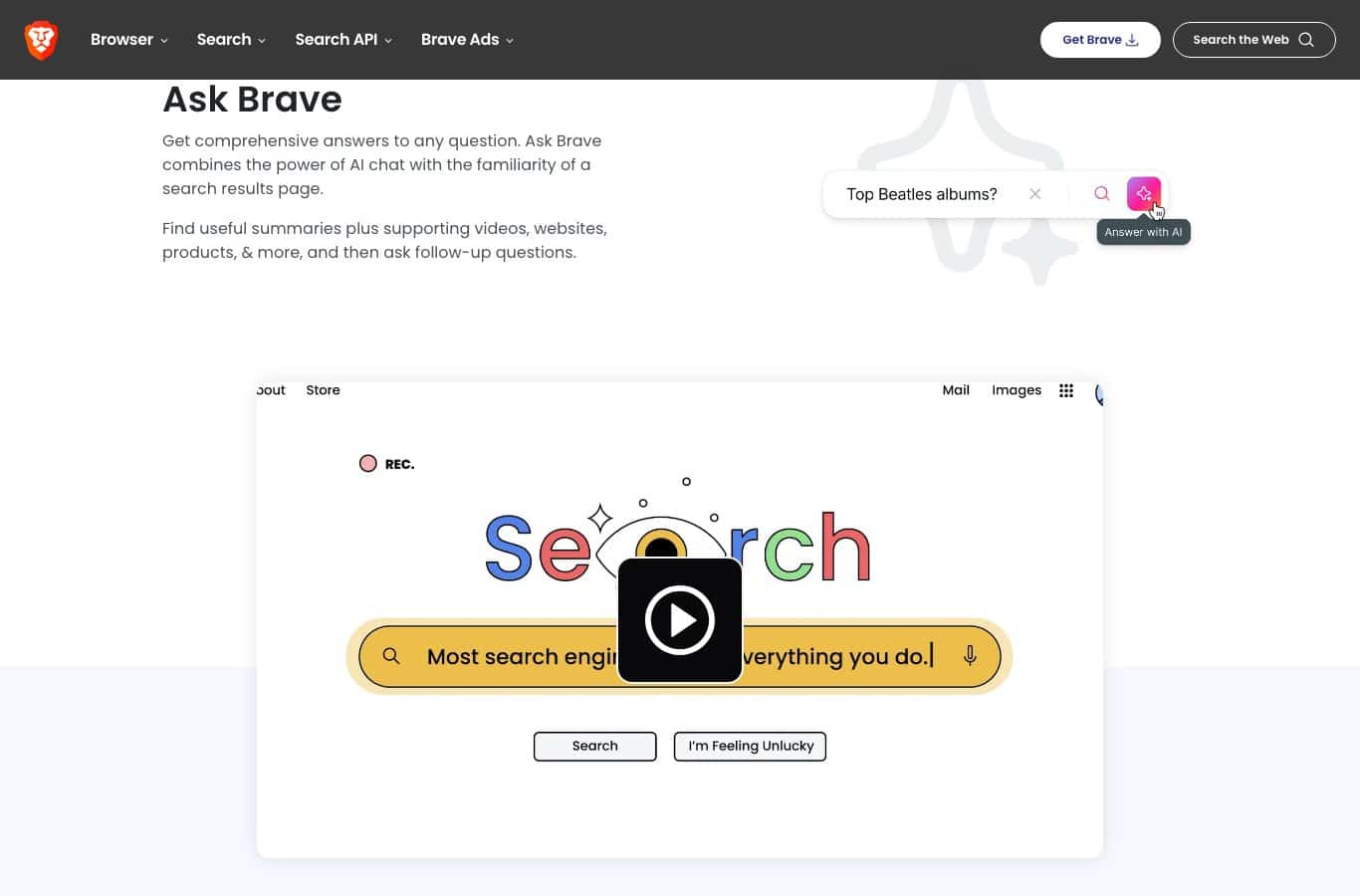
Perplexity popularized the format: one question, one written answer, and below it the numbered links used to build it. Its help center promises “practically unlimited basic searches” on the free plan, while the advanced (“Pro”) searches are rationed and most of the firepower sits behind the subscription. Brave makes the opposite bet, discretion: its page presents “Ask Brave”, which “combines the power of AI chat with the familiarity of a search results page”, with its own independent index and the promise that “Brave Search doesn’t profile you.” Qwant completes the picture with its Chat AI, which we cover below. If you want to take Perplexity further, our complete guide to Perplexity and how it differs from ChatGPT details how it works.
Classic engines supercharged with AI: the imposed summary
Since May 2024, Google Search in the United States has shown AI Overviews (a generated summary above the results, when Google judges it useful) and, since March 5, 2025, it has offered AI Mode, a fully conversational search powered by Gemini. Qwant follows the same logic with its “Flash Answers”, presented on its homepage as a way to save time. This family’s advantage is obvious: you change nothing about your habits. The drawback is the space the summary takes: the source is no longer the first thing you see.
AI assistants with search: the Swiss army knife
ChatGPT, Claude, Gemini, Mistral’s Vibe or Nation AI belong to this third family: they are conversational assistants, built to write, summarize, translate or explain, that can also search the web to answer about current events. Search is one feature among many, sometimes free with no visible limit (Google), sometimes strictly metered (Mistral: “Up to 5x free” web searches on the free tier). This is the family to favor if your needs go beyond the occasional one-off question.
How far the free tier really goes (2026 measurements)
Here is the table comparisons never give you: what each tool actually gives away for free, measured on the official pages on September 10, 2026, and what stays behind the paywall. The market’s shared logic is simple: the simple everyday answer is free; deep research, long reasoning and frontier models are rationed.

| Tool | What the free tier gives (measured September 10, 2026) | What stays paid | Measured price |
|---|---|---|---|
| Google AI Mode and AI Overviews | Built into Search, at no extra cost, on mobile and desktop | Advanced features of the Gemini ecosystem (frontier models, larger quotas) | Included in Search |
| Perplexity | “Practically unlimited basic searches” (help center), cited sources | “Pro” searches in limited quantity, advanced models, Deep Research | Grid not measured: the pricing page was behind an antibot at measurement time |
| Ask Brave | AI answers in the results page, independent index, no profiling | Premium features of the browser and the subscription | Not measured |
| Qwant’s Chat AI | Chat reachable from the engine, “The Chat AI answers your questions without trying to track you down” | The group’s professional offerings | Not measured |
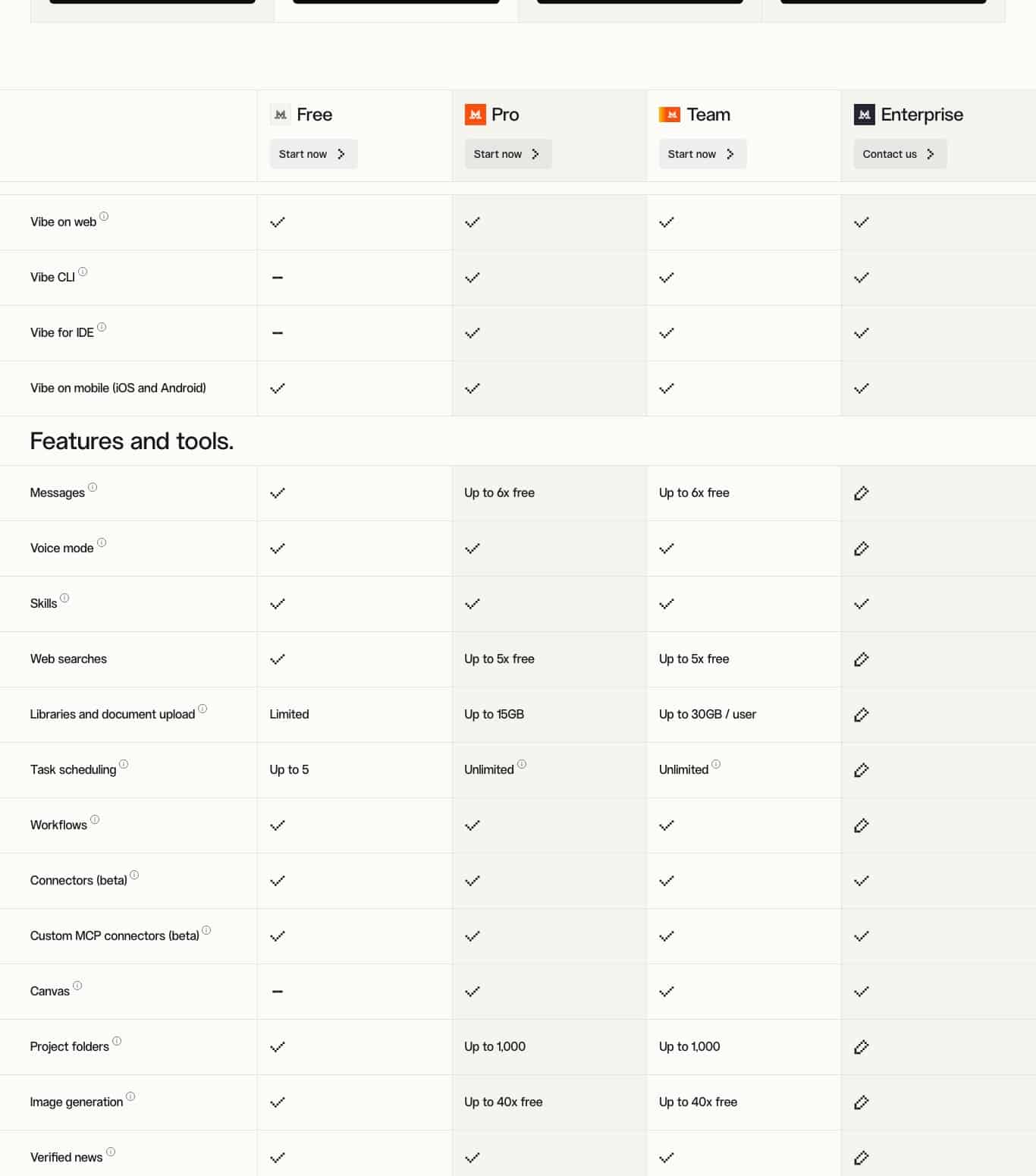
| Mistral’s Vibe (formerly Le Chat) | “Limited messages and web searches”: “Up to 6x free” messages, “Up to 5x free” web searches, “Up to 40x free” image generations | Unlimited searches and messages, more image generations, API credits | Pro at $14.99 per month on the official page (students: $5.99) |
| ChatGPT | Web search with cited sources included in the free tier (per OpenAI) | Advanced reasoning, frontier models, advanced voice mode | Paid Plus subscription |
| Claude | Free plan at $0 including web search, limits reset on rolling five-hour windows | Frontier models, larger limits, agentic features | Pro at $17 per month on annual billing, $20 monthly (measured September 9, 2026) |
| Nation AI | “Accessible free of charge, and without creating an account”, with OpenAI’s GPT-5 and GPT-4 models | Heavy use (portal subscription) | Freemium |
The wall is not search, it is deep research
Read the table across its rows: nobody charges for the simple everyday question. What sells is deep research (Deep Research), the “Pro” searches that consult more sources, and the long reasoning of frontier models. Mistral writes it plainly in its grid: the free tier gives “Up to 5x free” web searches, and its Pro plan promises “More messages and web searches” plus more image generations. Perplexity rations its advanced searches the same way. Claude includes web search in its free plan but paces it on five-hour windows. If your usage is occasional, none of this shows; if search is a daily work tool for you, the free tier runs out fast.
The habit to keep A quota figure measured in September 2026 will have aged three months from now: vendors adjust their offers constantly, sometimes differently depending on the page’s language. Before committing, open the official pricing page in your language and currency, and trust what it says that day.
Google: AI Overviews and AI Mode
On March 5, 2025, Google announced AI Mode and AI Overviews for Search, “an early experiment in Labs”, alongside an upgrade of the generated summaries that have appeared above American results since I/O in May 2024. “AI Mode is a new generative AI experiment in Google Search”, writes Robby Stein, VP of Product for Google Search, on the official blog; it “expands what AI Overviews can do with more advanced reasoning, thinking and multimodal capabilities”, and Google says the Overviews are “now used by more than a billion people”. The summaries do not appear on every query: Google shows them when it judges they help.
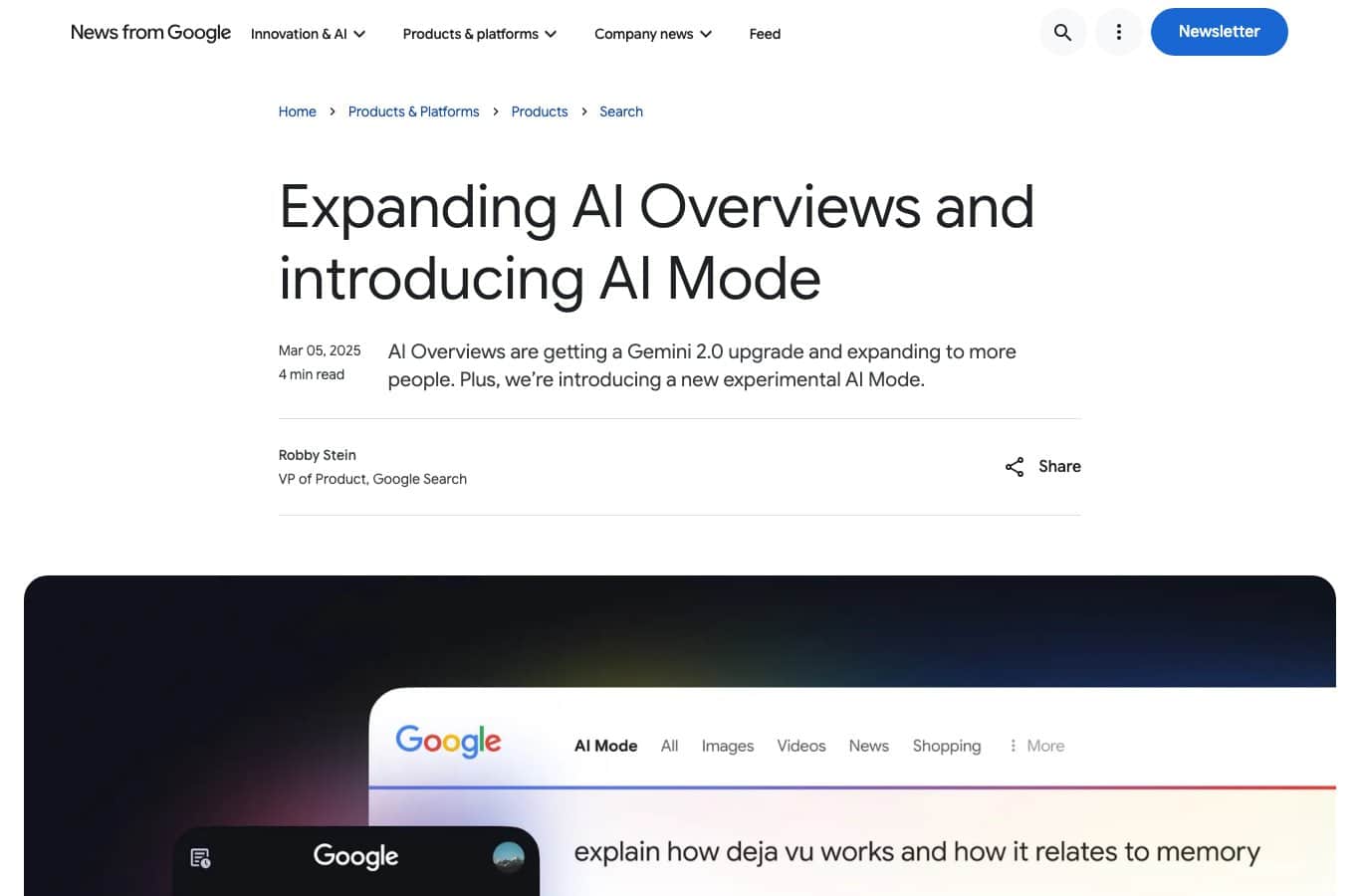
In practice, AI Mode is free and built in: it opens from the results page (the “AI Mode” filter next to the All, Images, News tabs) or directly at google.com/search?udm=50. For the user, the change is a shift in posture: you stop scanning links, you read an answer and push back on it. Two points deserve attention. First, Search Console now gives site owners control over their presence in these AI features: the topic concerns brands deeply, and we dedicated a complete guide to visibility in AI answer engines to it. Second, AI Mode inherits Gemini’s strengths and flaws: very fluent, sometimes wrong with confidence, exactly like its competitors.
The European and no-account options
The query “private AI search engine” keeps coming back in autocomplete. In 2026 there are three answers, each for a different reason.
Qwant: the French engine that added a Chat AI
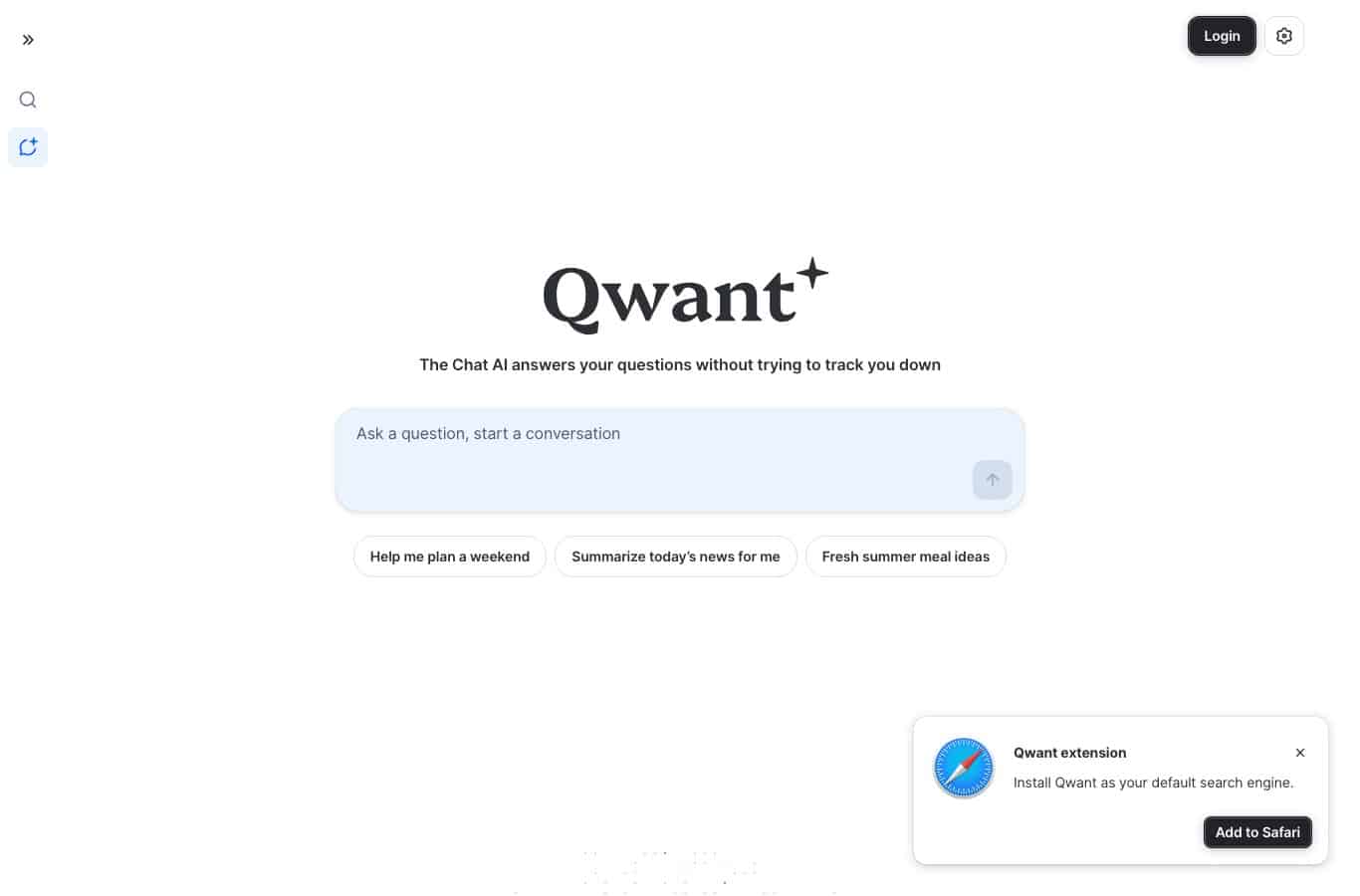
The independent French engine now shows a “Chat AI” and “Flash Answers” on its homepage. Its dedicated page promises that “The Chat AI answers your questions without trying to track you down”, and lists three commitments: “No selling of your personal data”, “Qwant does not retain your search data”, “French search engine, hosted in Europe”. For sovereign search, it is the only complete combination in the lineup: a real index, an AI chat, and a European legal framework.
Mistral: the French assistant that became Vibe
The Chat of Paris-based Mistral is now called Vibe on its pricing page, which states that “Mistral’s Free plan provides limited access to Vibe, including our latest models, chat, search, creation”. The free tier is explicitly metered: “Up to 6x free” messages, “Up to 5x free” web searches, “Up to 40x free” image generations. The Pro plan is shown at $14.99 per month (students: $5.99). It is the most complete European option for a general-purpose assistant, with models designed in France.
Nation AI: chat in English, no account needed
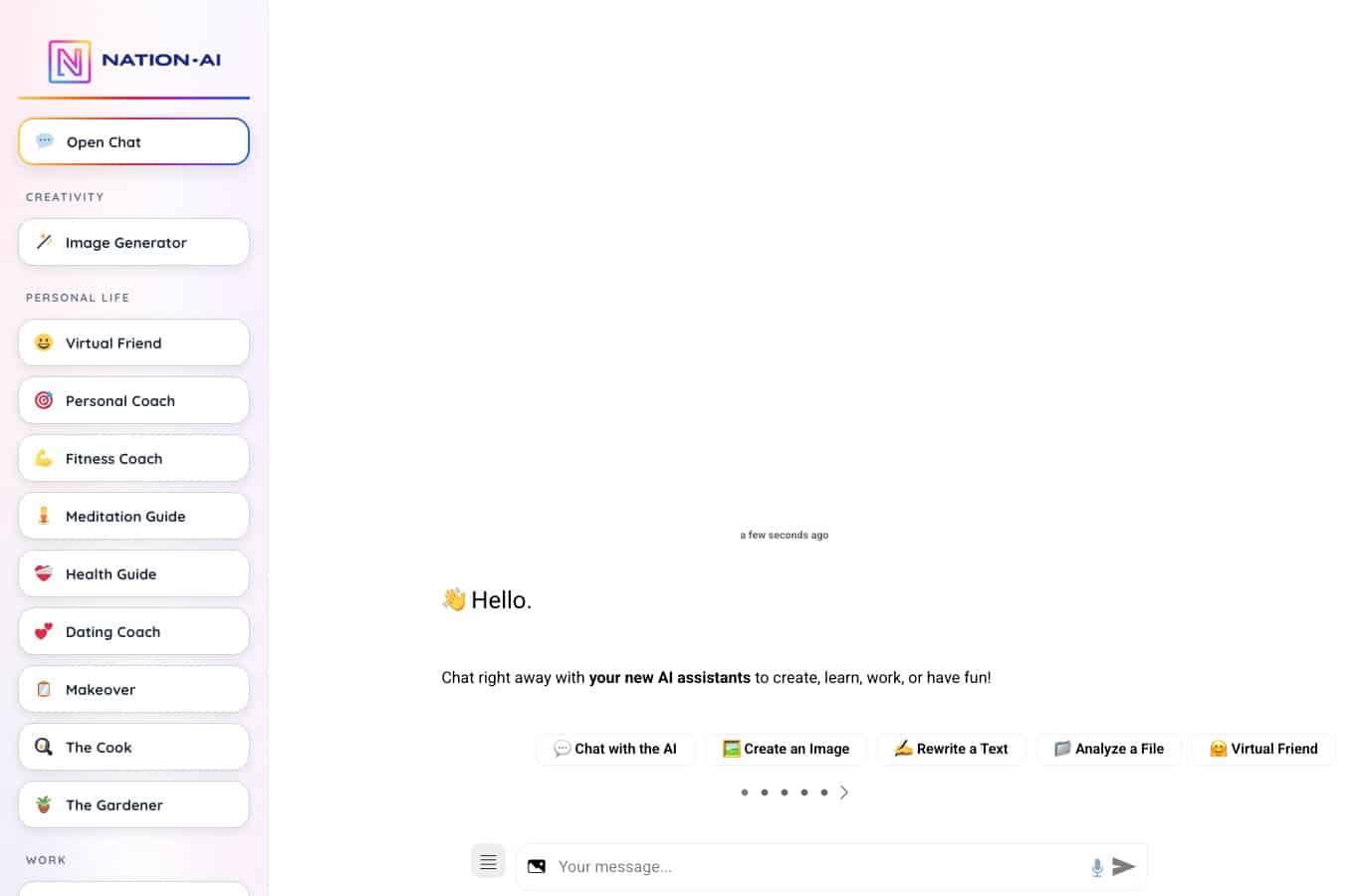
Every tool above eventually asks for an account. Nation AI, the assistant of nation.ai, bets the other way: it is “accessible free of charge, and without creating an account”, running OpenAI’s GPT-5 and GPT-4 models. Full disclosure: it is not a search engine, it is a conversational assistant, with guided pre-prompt buttons (rephrase, summarize, translate…) that write the instruction for you. To ask a question and get a written answer with no sign-up formalities, it is the shortest path.
Which one to choose: the picker
Four questions are enough to tell the families apart. The picker below grounds its answer in the measurements table above; it ranks nothing, it points you according to your situation.
The AI search engine picker
Four questions, one recommendation. The figures quoted are those of the September 10, 2026 measurements table.
Your recommendation
Waiting: answer the four questions, then click Show my recommendation.
At least one answer is missing: complete the four questions to get a recommendation.
The picker grounds its answer in four profiles, and copies the matching card on screen. Each one is a real usage situation, not a ranking:
Fact-checking profile: Perplexity and Ask Brave
You want a written answer and, right below it, the links it stands on. Answer engines are built exactly for that.
- Perplexity: “practically unlimited basic searches” on the free plan, numbered sources under the answer.
- Brave: “Ask Brave” keeps the results page in the background, independent index, no advertising profile.
- The habit: open at least one of the cited sources before passing the information along.
Keep-your-habits profile: Google’s AI Mode
You already use Google every day and do not want one more service to manage. AI Overviews and AI Mode have been built into Search in the United States since May 2024 and March 2025, free.
- No new sign-up: your usual Google account is enough.
- AI Mode (a dedicated tab or google.com/search?udm=50) chains follow-up questions, in text, by voice or with images.
- AI Overviews only appear when Google judges them useful.
Data-in-Europe profile: Qwant and Mistral’s Vibe
Data hosting and European law come before everything else. Two French players cover the need.
- Qwant: “French search engine, hosted in Europe”, “No selling of your personal data”, with Chat AI and Flash Answers.
- Mistral Vibe: French assistant, metered free tier (“Up to 5x free” web searches), Pro at $14.99 per month.
- The habit: check on each service’s page where your conversations are processed.
No-account profile: Nation AI
Above all you want to ask a question and get a written answer, without creating an account or managing quota windows.
- Free trial with no sign-up, interface fully in English.
- Guided pre-prompt buttons (rephrase, summarize, translate): the instruction is written for you.
- Honest framing: it is a conversational assistant, not an engine with an index; for source traceability, cross it with an answer engine.
One last criterion often breaks ties: language. Every tool listed answers in English, but not all are designed for the US market. Perplexity and Brave are; the Google ecosystem adapts to your account’s language; Qwant and Nation AI put European hosting forward. And if your need is mostly writing, summarizing or translating rather than searching, our panorama of AI tools and our selection of the best free AIs await your curiosity, just like our alternatives to ChatGPT.
The limits they all share
No family escapes three structural limits, worth knowing before you make an AI engine your only source of information.
Hallucination, always possible
An AI engine writes a plausible answer; it does not “know” that it is true. It can invent a figure, a date, a source, with perfect confidence. Engines that cite their sources reduce that risk (the answer is anchored in real documents), they do not eliminate it: reading remains your responsibility. The defense is simple and free: on any important fact, open the cited source, and cross-check with a second one. For the quantified anecdote, our articles on detecting AI writing detail these mechanisms.
Freshness and index coverage
The quality of an AI answer depends on the freshness of the documents the tool consulted. A slowly updated index, a page changed since its last crawl, yesterday’s news: those are the blind spots. It is also why two AI engines can answer the same question differently on the same day: they did not read the same things.
Sensitive topics: health, money, law
On YMYL topics (health, finance, law), the written answer of an AI engine never replaces a professional or an official source. Use the engine to learn the vocabulary and frame the question, then confirm on institutional sites or with a professional. That is exactly the discipline we apply in our own guides, like our AI legal assistant that frames what is possible and what requires a lawyer.
How to ask an AI engine well
A well-questioned AI engine changes quality. The method is the same as for a chatbot, with one nuance: no need to state the date, the engine knows it; no need to demand sources, it shows them; concentrate your instruction on context and format instead.
- Say who you are and why you are searching. “I’m a tenant in Chicago and I want to know whether…” produces a better-targeted answer than the same bare question.
- Specify the expected format. “Answer in three points”, “in a table”, “in ten lines maximum”: the model complies.
- Frame the scope. “US only”, “official sources only”, “no commercial content”.
- Push back instead of rephrasing. Conversation is the AI engine’s strength: “this second source says something else, who is right?” beats a brand-new search.
- Let the instruction be written for you. Our prompt generator builds the complete question from your need; the result pastes into any AI engine.
Express definition An AI search engine is a product that plugs a generative AI into real-time retrieval to write a sourced answer. A generative AI is the underlying technology, able to write without consulting anything. The first is a service, the second an engine: retrieval is what makes the difference.
FAQ
What is the difference between a search engine and generative AI?
A search engine (Google, Bing, Qwant) indexes the web and returns a list of ranked pages: you are the one who reads and concludes. A generative AI (models like GPT, Gemini, Mistral) writes text from what it learned during training, without consulting the web in real time. An AI search engine combines the two: the technology writes, retrieval supplies up-to-date documents, and the answer shows up with its sources.
What is the best free AI search engine?
There is no absolute best, only a best per use. For an answer with verifiable sources: Perplexity or Ask Brave. To change nothing about your habits: Google’s AI Overviews and AI Mode, free in the United States since 2024 and March 2025. For data hosted in Europe: Qwant and Mistral’s Vibe. To chat without creating an account: Nation AI. Our picker, above, decides in four questions.
Is there a private or European AI search engine?
Yes. Qwant is the most complete European engine: its own index, Chat AI and Flash Answers, hosted in Europe, no selling of personal data. Brave takes the no-profiling route with its own independent index. Mistral, a Paris company, offers the Vibe assistant (formerly Le Chat) with a metered free tier. None has Google’s coverage, but all answer in English with a European framework or a privacy-first index.
Is Claude a search engine?
No. Claude is an AI assistant developed by Anthropic. It can search the web: its $0 free plan includes web search, with limits that reset on rolling five-hour windows (measured September 9, 2026). But search is a feature of the assistant, not its core. Our article on Claude’s languages and settings details its access, pricing and limits.
Is Google’s AI Mode free?
Yes. Introduced on March 5, 2025 and rolled out since, AI Mode is built into Google Search, on mobile and desktop, at no extra cost: it opens from the results page or directly at google.com/search?udm=50. What Google charges for are the advanced features of its Gemini ecosystem, not AI Mode itself.
Can you use an AI search engine without creating an account?
Yes, in several cases. Google’s AI Mode works with your usual Google account, no new sign-up. Nation AI can be tried with no account at all, straight in the browser. Conversely, Perplexity, ChatGPT, Claude and Mistral’s Vibe ask for an account for the full experience (history, sync), even though their basic tiers are free.
Can AI search engines be wrong?
Yes, all of them, including the most rigorous about sources. Three errors repeat: hallucination (invented but plausible information), the stale source (a page crawled before its update) and misinterpretation (an answer true elsewhere but wrong in your context). The defense costs nothing: open one cited source in two, cross-check important facts, and keep a professional for health, money and law topics.
What is a Chinese AI search engine?
The phrase mostly points to DeepSeek, the Chinese AI assistant whose app integrates web search. It is more a conversational assistant than an engine: search is a feature, not the product. Before trusting it with personal questions, check where your conversations are hosted and under which legal framework, as you would for any service: that is exactly the “data in Europe” reflex of our picker.
In summary
The “AI search engine” is not one product, it is three: answer engines that cite their sources, classic engines supercharged with AI, of which Google’s AI Mode is the American example since March 2025, and assistants that search the web. The free tier comfortably covers the occasional everyday question; it stops at deep research, metered everywhere. And the choice depends less on the power of the models than on two personal questions: where your data goes, and whether you are willing to create an account.
Ask your question in English, no sign-up
Nation AI is not a search engine: it is a conversational assistant that answers your questions in English, free of charge and without creating an account, with guided instructions to rephrase, summarize or translate. Try it on the Nation AI chat.
To go further: explore all of Nation’s AI tools, the selection of the best free AIs, our alternatives to ChatGPT, or go back to basics with our guide on how to use ChatGPT.
Sources and measurements: Google’s official blog (AI Mode announcement, March 5, 2025); Mistral pricing page and Qwant Chat AI page, measured on September 10, 2026; Brave Search page, measured on September 10, 2026; Perplexity help center (free plan), consulted September 10, 2026; Claude grid measured September 9, 2026; Nation AI /chat/ page (free, no sign-up). Quotas and prices change: check the official pages before deciding.