The short version

A generative AI is an AI that creates content : text, images, sound, video or code. “Classic” AI sorts, ranks and predicts ; generative AI produces.
It works by statistics : trained on huge amounts of data, it estimates the most likely continuation (the next word, the next pixel).
ChatGPT, opened to the public on November 30, 2022, turned this technology into an everyday tool. Today it is everywhere : chatbots, image generators, summarizing tools.
You can try one free, in English with Nation AI, without choosing between dozens of tools.
“Generative AI” : the phrase is everywhere, in the news, on packaging, in advertising. Yet ask ten people to define it and you will get ten different answers, and many still confuse artificial intelligence in general with this family of tools that can write, draw or sing for you.
This page sets things out clearly : the exact definition, the difference with “classic” AI, how it works without jargon, the four main families of uses, the limits you should know before you start, and what the law says in 2026. At the end, a short interactive test tells you which type of generative AI matches your need, with the tool to try it right away.
Generative AI : the definition, in plain words
Lawmakers now treat generative AI as its own category. In Europe, the AI Act (Regulation (EU) 2024/1689) defines what counts as an AI system and, since August 2, 2026, requires AI-generated or manipulated content to be identifiable as such. In plain words, a generative AI is a technology that creates new content : text, images or sound produced from huge amounts of data.
Three words in this definition deserve a closer look.
“Creates” : the machine does not fetch an existing document, it produces something that did not exist yet, sentence by sentence or pixel by pixel. When you ask a chatbot to write an email, there is no template email stored anywhere : every word is computed at the moment you ask.
“New content” : text, image, sound, video, but also computer code, tables, slides, subtitles. This is what sets these tools apart from AI systems that do not produce content (see below).
“From huge amounts of data” : the model has “read” or “seen” millions, even billions of examples (web pages, images, recordings) during training. It does not learn by heart : it learns statistical regularities, how words follow one another, how shapes are drawn. That is why the same model can move from poetry to spreadsheets : it has seen so much of both that it can reproduce the habits of each genre.
A useful precision : “generative AI” is not a single product. It is a family of technology, just like “electric motors”. ChatGPT is one product of this family, Gemini is another, Nation AI is another : different models, the same principle. Knowing this spares you a lot of confusion : when a comparison says one tool is “better”, it only means better for one model, one price and one moment in time.
What is the difference between AI and generative AI ?
Everyone asks this question, and the confusion is legitimate : generative AI IS artificial intelligence, but a specific branch. Artificial intelligence is the general field : systems able to perform tasks that used to require human intelligence (recognizing, classifying, predicting, planning). Generative AI is the branch that, on top of that, produces content.
The simplest way to remember the difference : classic AI answers a question like “what is this ?” (is this email spam ? will this customer churn ? which song is this ?), while generative AI answers a request like “do it for me” (write this email, draw this logo, summarize this document).
| Aspect | “Classic” AI (analytic) | Generative AI |
|---|---|---|
| What it does | Classifies, ranks, predicts, detects | Creates brand-new content |
| Question it answers | “Is this… ?” “Which one ?” | “Write, draw, summarize…” |
| Typical output | A label, a score, a decision | A text, an image, a sound, a video |
| Everyday examples | Spam filters, movie recommendations, bank fraud detection | Chatbots, image generators, summarizing and rephrasing tools |
| Visible result | Invisible to the user (a decision is made) | Visible and directly usable |
The two worlds often meet inside a single product : a webmail uses classic AI to filter spam and generative AI to offer to draft the reply. It is not one or the other, it is one AND the other.
How it works, without the jargon
You do not need mathematics to understand the principle. Four steps are enough.
- Training. The model “reads” (or “sees”) immense collections of data : billions of sentences for a language model, millions of images for a visual model. At this stage nobody gives it rules : it adjusts its parameters to better predict what comes next.
- The model. The result of this training is a giant neural network, a statistical machine with billions of parameters. For text generation, the “Transformer” architecture, described in 2017 by Google researchers in the paper “Attention Is All You Need“, is the basis of today’s models.
- The prompt. This is your instruction, what you type. It shapes everything : the quality of the answer largely depends on how precise the request is (role, context, task, format). People say “prompt” for text as well as for images.
- The generation. The model produces the answer element by element : word after word for text, area after area for an image. Each element is chosen statistically, based on everything that came before.

The next-word example
To understand text, the key is the statistical principle behind every language model : the model is asked to estimate, from the beginning of a sentence, which word is most likely to come next. In other words, your chatbot does not “know” what it will answer : it computes, word by word, the most plausible continuation, a bit like your keyboard suggests three words when you type a text message, but with a model millions of times richer.
This detail explains both the strengths and the flaws of these tools : the fluency (the model chains words with statistical ease), the apparent creativity (it combines regularities that were never assembled in that order), but also the confident mistakes : if the most “plausible” continuation is wrong, the model will still produce it, in the same confident tone.
What about images, sound, video ?
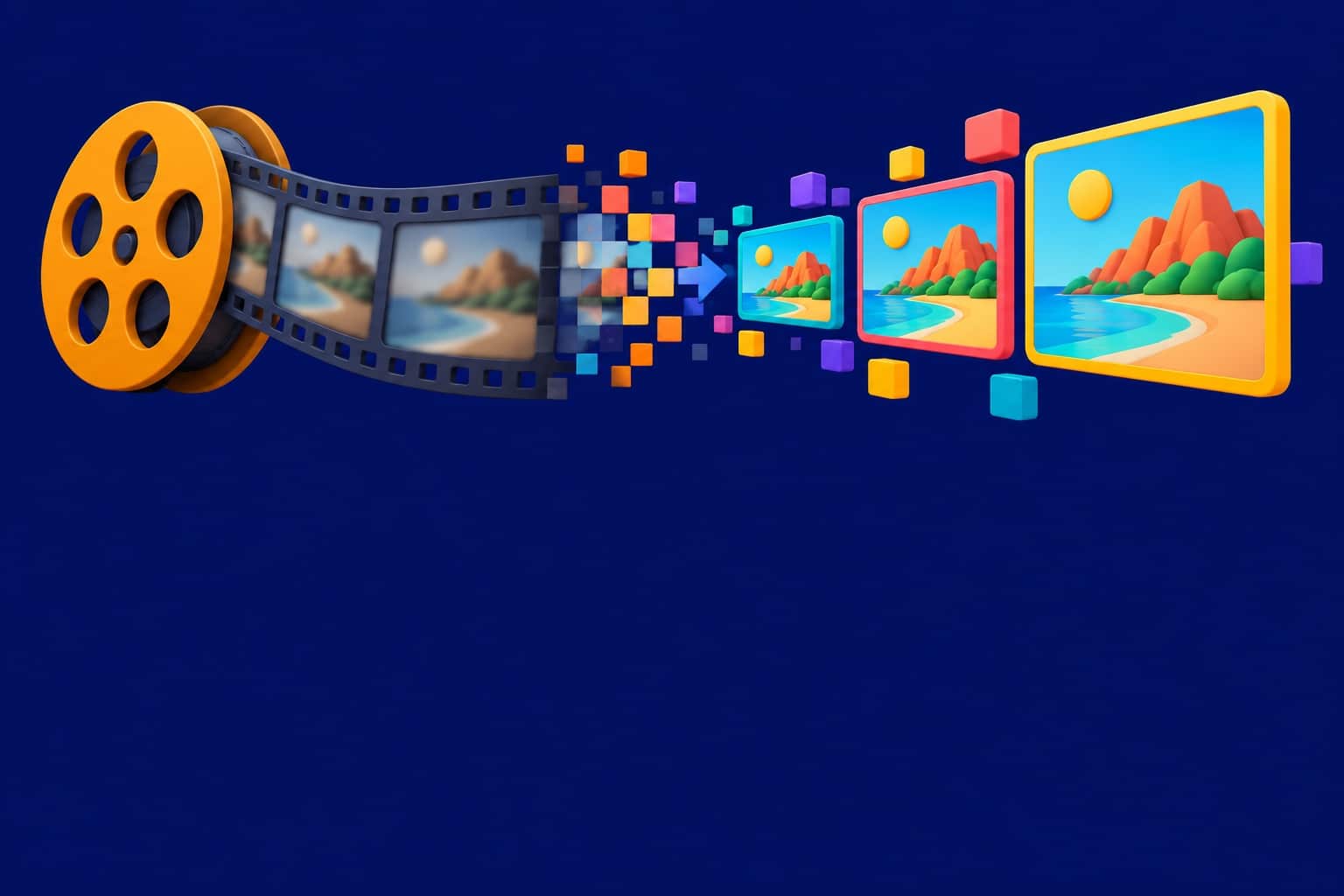
The principle stays statistical, but the techniques differ. For images, a historic step came in 2014 when Ian Goodfellow and his co-authors introduced “generative adversarial networks” (GANs) : two networks compete, one manufactures images, the other learns to spot the manufactured ones, and the duo improves each other. Ten years of research later, the images have become clean enough to fool a quick glance, which is exactly why transparency rules matter. Today’s “diffusion” models follow another logic : they learn to remove noise from an image, step by step, until a coherent picture matching your description appears. Sound and voice work on similar principles, applied to waveforms. Video combines both worlds : generating images that stay coherent from one frame to the next, over time.
Three concrete examples to picture it
Still abstract ? Three everyday situations show exactly what “generating” means.
Example 1 : the delicate email. You have to decline an invitation while staying courteous. You write : “Draft a polite email declining an invitation to a trade show on October 15, offering a meeting in November, on a warm tone.” Within seconds, the AI produces a complete email : greeting, argued refusal, counter-proposal, sign-off. It did not look up a “template email” in a database : it assembled, word by word, the most plausible answer given your request and everything it has learned about the “polite refusal email” genre.
Example 2 : the 40-page document. You paste the text of a report (or upload the file) and ask : “Summarize this document in ten bullet points, keeping the key figures.” The AI reads the whole thing, selects what matters and writes a fresh summary. Watch out for the safety reflex : the figures in the summary must be checked against the original document, because a badly copied statistic will come across with the same confidence as an exact one.
Example 3 : the illustration. You describe “a flat, minimal illustration of a robot planting a tree, cream background, orange and purple accents” : the image generator builds the picture area by area, with no photo of a robot or a tree in its memory. Two identical requests will even give two different images : generation is statistical, never twice the same.
This common thread runs through every use : generative AI takes an instruction in natural language and produces usable content, which you remain responsible for reviewing and standing behind.
Your first request : the 4-ingredient method
Once you have picked the type of tool, everything happens in the way you phrase the request. Prompt guides, across every vendor, converge on the same four ingredients. Here they are, with one example carried from start to finish.
- The role. Tell the AI who it is supposed to be : “you are a communications assistant”, “you are a schoolteacher”. The role shapes the vocabulary, the register and the tone of the answer.
- The context. Give the information that changes everything : for whom, by when, in which situation. “Telling parents about a cancelled field trip” does not produce the same text as “telling the sales team about a postponed meeting”.
- The task. A precise action verb : write, summarize, rephrase, translate, list, compare. The more precise the verb, the less the AI has to guess.
- The format. The expected shape : a five-line paragraph, a three-column table, a bulleted list, a formal or casual tone. This is the ingredient beginners forget the most, and the one that saves the most time.
Carry the example through. Vague request : “write a text to announce an outage”. Likely result : a generic text you will have to fix. Complete request : “You are the communications assistant of a public library (the role). Write a message to members announcing that the elevator is out of order until Friday, without disrupting access to the collections (the context). The message must reassure people and give the workaround (the task). Three sentences at most, warm tone, ending with a welcoming line (the format).” The first answer is almost publishable as is : all that is left is to review it, adjust a word, own it.
One last beginner tip : iterate. A generative AI does not wait for the perfect question, it improves with every precision you add (“shorter”, “less formal”, “put that in a table”). The dialogue is part of the tool : the first answer is a working draft, not a verdict, and three or four exchanges usually get you where one long prompt would not. And to go further, the AI prompt guide details every ingredient with copy-paste models.
The four main families of uses
By 2026, usage has settled around four main profiles. Find yours : that is exactly what our test below computes.
Text profile : writing and fixing
The conversational chatbot : draft an email, rephrase a paragraph, correct a text, prepare an outline. The most widespread use, and the simplest to start with.
Visual profile : creating images
Generate an illustration, a social media visual, an avatar or a mockup from a description, or edit an existing photo from an instruction.
Learning profile : studying and summarizing
Summarize a document, turn a course into a study sheet, build a quiz, clarify a complicated text. AI as a study and fast-reading tool.
Productivity profile : saving time
Speed up repetitive work tasks : write and answer emails, produce meeting minutes, prepare a presentation, translate or synthesize.
Quick test : which generative AI for you ?

Answer the four questions below : the computation happens right here, nothing is sent anywhere. You get your profile, with the tool on this site to take action immediately.
Your profile in 4 questions
Four questions, one profile, one tool to try right away.
Answer the four questions to discover your generative AI user profile.
At least one answer is missing : pick an option in every question to see your profile.
What a generative AI does not do (well)
Presenting the tool without its limits would do you a disservice. Four of them genuinely change the way you should use it.
Hallucinations. This is the most documented flaw. People talk about hallucinations when a generative AI delivers a clearly false answer to a question whose answer is otherwise known, without flagging how reliable the answer actually is. Concretely : an invented figure, a book reference that does not exist, a wrong date, all delivered in the same confident tone as the rest. The rule : any sensitive information (figure, quote, date, legal text) gets checked at the source.
The knowledge cutoff. A language model stops at a training date : it does not know what happened after, unless it is connected to the web. Asking it for “the latest news” without giving a date can get you an outdated answer.
The sense of priorities. Generative AI optimizes plausibility, not truth : it will answer a trick question just as smoothly as a serious one, and it may validate a false premise. Public institutions keep insisting on this critical mindset : guidance pages and awareness campaigns gather the precautions to know before you start.
Uniform treatment. These tools have no awareness of your stakes and no notion of the real context of a medical file, a lawsuit or a tax return. For anything that carries responsibility (legal, medical, financial), they help you prepare, structure and understand : the decision stays human.
The right reflex
Treat a generative AI’s answer like the work of a brilliant but overconfident intern : useful to move forward, but systematically reviewed before it gets sent, published or signed.
Getting started : trying a generative AI for free, in English
The best way to understand generative AI is still to use it for ten minutes. No need to create ten accounts : a single chatbot lets you test everything (writing, summarizing, rephrasing, explaining, brainstorming), and an image generator covers the visual side.
Nation AI is a good first contact : the chatbot can be tried free and without signing up, it works in English, it relies on top-tier models with a layer designed in France, and guided pre-prompt buttons avoid the blank-page moment of the first message. For visuals, the site’s image generator produces illustrations, avatars and edits from a simple description.
Try a generative AI now
Open the chatbot, ask your question or request a text : the first answer beats a long speech.
To go further depending on your need : the free AI guide sorts out the no-cost offers, the getting-started ChatGPT guide details the first steps, and the AI tools hub presents the specialized assistants (PDF summaries, study sheets, emails, correction, translation).
Generated content : what the law says in 2026
In the United States, there is no single federal AI law yet, but two practical rules stand out. On copyright, the US Copyright Office requires human authorship : material generated entirely by AI, without human creative input, is not protectable, while a work assisted by AI can be when the creative choices (structure, selection, wording) belong to the person. Care, then, if you plan to exploit commercially a piece of content you have not reworked.
On transparency, the norms are coming from the platforms : major services now ask creators to disclose realistic content made or altered with AI, and the European Union has gone further, with the transparency obligations of article 50 of its AI Act applicable since August 2, 2026. In practice, online media should increasingly carry a clear mention when an AI made or altered them.
Finally, in the workplace, your employer’s internal rules (confidentiality, client data) apply to prompts too : do not paste sensitive documents into a public chatbot if you would not post them on a forum.
Frequently asked questions
What is the difference between AI and generative AI ?
Artificial intelligence is the general field : systems that perform intelligent tasks (classifying, predicting, recognizing). Generative AI is one of its branches : it produces new content (text, image, sound, video, code) instead of classifying or deciding. A spam filter is AI ; a chatbot that drafts your email is generative AI.
Is ChatGPT a generative AI ?
Yes. ChatGPT is a conversational generative AI chatbot, released for free by OpenAI on November 30, 2022 : its sudden popularity introduced generative AI to the general public. Gemini (Google), Le Chat (Mistral AI) and Nation AI belong to the same family.
How does a generative AI work, in one sentence ?
Trained on immense amounts of data, it statistically estimates the most likely continuation (the next word for text, the next area for an image) and builds its answer element by element.
What is an AI hallucination ?
It is a false answer delivered with confidence : the AI produces invented information (a figure, a source, a date) without signaling its uncertainty. Hence the golden rule : check any sensitive data at the source before using it.
Can you use a generative AI for free ?
Yes. Most major chatbots offer a free tier (sometimes volume-limited), and some can be tried without signing up, like the Nation AI chatbot. Advanced features often move to a subscription : it is up to you to decide whether your usage justifies it.
What is an LLM, a large language model ?
LLM stands for “large language model” : it is the statistical engine behind chatbots. Trained on massive amounts of text, it predicts the most likely continuation of a sentence. ChatGPT, Gemini and the models used by Nation AI are LLMs, trained and fine-tuned in different ways.
What is a prompt ?
It is the instruction you give the generative AI, in natural language. Its quality largely determines the quality of the answer : a good prompt states the role, the context, the task and the expected format. Our prompt guides and ChatGPT examples give dozens of copy-paste models.
Do you have to disclose that content was created by an AI ?
There is no single federal disclosure rule in the US yet, but major platforms increasingly require creators to flag realistic AI-made or AI-altered content, and honest disclosure protects your credibility. If you serve users in the EU, the transparency rules of the AI Act (article 50) have applied since August 2, 2026.
In short
Generative AI is the branch of artificial intelligence that creates : text, images, sound, video, code. It does not search a database of answers, it computes its answer element by element from what it has learned statistically. Powerful for writing, summarizing, illustrating and speeding up everyday tasks, it asks for two simple reflexes : check sensitive facts, and own what you publish. Nothing in the technology removes your judgment ; it only multiplies what your judgment can produce in an hour.
The rest you learn by doing : open a chatbot, give it a real task, watch what it produces, correct it, repeat. Ten minutes are worth more than every article on the subject, this one included.
Concrete, right now
The Nation AI chatbot can be tried free, without signing up, in English : the best exercise to understand generative AI is still to use it.
Primary sources : Regulation (EU) 2024/1689 on artificial intelligence, article 50 (EUR-Lex, consulted September 2, 2026) ; US Copyright Office (copyright.gov/ai) ; OpenAI (announcement “Introducing ChatGPT”, November 30, 2022) ; I. Goodfellow et al. (June 2014) ; A. Vaswani et al., “Attention Is All You Need” (June 2017).