- 756 runs, 54 documents, 2023: five tools beyond 70%, none beyond 80%.
- 74% caught untouched, 42% once a person edited, 26% once a machine reworded.
- The 99% figures are vendor numbers with no public test set behind them, as Liang and his coauthors noted in 2023.
- Epoch AI, July 2026: around 13% of machine passages in a real author’s style slipped through.
Two paragraphs sit on the screen. One is by Mark Twain, from 1883. The other an AI wrote a minute ago. Can a tool separate them, and how reliable is its answer? The gap between one verdict and a measured trial shows what a detector’s word is worth.
Two paragraphs, one verdict each
The first excerpt comes from Life on the Mississippi, published in 1883. The second was written a minute ago by Alex, the general assistant at Nation, asked for a paragraph on what it takes to pilot a steamboat downriver after dark. You paste each one and put the same question.
With Victor
Does this paragraph read as if it were written by an AI? Tell me what makes you say so.
“AI-style indicator: Low.”
“This paragraph reads more like specific, voice-driven literary narration than generic AI-style prose. In particular:”
“The period-specific vocabulary and polished construction aren’t evidence of AI; they fit literary narration. This is only a stylistic impression, not proof of authorship, and a short excerpt is hard to judge confidently.”
And this one?
“AI-style indicator: High.”
“This paragraph has several traits commonly associated with AI-assisted explanatory writing:”
“Highly systematic structure: It moves neatly from general skills, to daytime observation, to nighttime navigation, to the boat and crew, and finally to a concluding lesson.”
“Polished, balanced phrasing: Sentences have a similarly measured, instructional tone, with few shifts in voice or rhythm.”
“These are stylistic signals, not proof. A person writing a clear informational passage could use the same techniques. Compared with the earlier excerpt, this one feels more explanatory and standardized, while the earlier passage had a more distinctive narrator’s voice.”
Two texts prove nothing. Victor calls his levels “not measured probabilities”. He works inside Nation’s AI detector, where a pasted passage gets a level and the lines behind it, never a percentage.
What the tests say about how accurate AI detectors are
Between March and May 2023, a team led by Weber-Wulff put 14 tools through 756 runs on 54 documents. The results separate the easy case from the hard ones.
96%
Human documents identified.
Weber-Wulff et al., 2023
74%
AI documents caught, nothing changed.
Weber-Wulff et al., 2023
42%
AI documents caught after human editing.
Weber-Wulff et al., 2023
26%
AI documents caught after machine paraphrasing.
Weber-Wulff et al., 2023
None passed 80%, and five passed 70%. The authors conclude that the tools fail on both counts, accuracy and reliability. They add that about half of the machine texts that go through any disguise, editing or rewording, end up credited to a human.
Perkins and his coauthors tested 114 samples in autumn 2023, 89 of them machine texts that had been tampered with. Their average was 39.5% on untouched machine prose, then 22.14% after six adversarial tricks.
The machinery underneath those numbers, perplexity, watermarks and the rest, is set out in our guide on how AI detection works.
The 99% claim and the fine print
The 99% figure is a vendor’s number, not a test result.
The claim
Detectors are 99% accurate.
What the tests show
The RAID benchmark, from ACL 2024, lists the 99%-or-more claims and then shows detectors being tricked by attacks, by decoding settings, and by models they never met. Dugan and his coauthors ran over six million generations through it.
Liang and his coauthors made the same point in 2023: such figures are taken at face value, while the test set behind them stays out of reach.
Turnitin stated on 23 May 2023 that when more than 20% of a document comes from AI, fewer than 1% of documents are wrongly flagged, and about 4% of sentences. The same post warns that practice diverges from what its own lab measured.
What the figure means on a report, and why it proves less than it seems, is in our article on the Turnitin AI percentage.
Where the numbers look better
Jabarian and Imas, at the University of Chicago’s Becker Friedman Institute, published a working paper in 2025, not peer-reviewed, built on nearly two thousand human passages across six genres. Most commercial detectors, they write, do remarkably well on that set of untouched passages, while others become case-dependent.
Epoch AI, in a data insight updated in July 2026, saw almost no misses on machine text answering a plain prompt, at most 0.7%. The misses climb when a model copies a style: 38 of 297 passages, about 13%, went undetected once it had been shown five samples from one author. Three commercial detectors were tested, and one of them wrongly flagged 3.8% of human texts.
Strong on untouched machine prose, and much shakier the moment anyone edits or paraphrases it.
Victor
AI text detector
“I read what sounds natural and what sounds standardized, and I answer with a level, low, moderate or high, not a percentage that pretends to be precise. Treat that as a stylistic indicator, not as proof: a polished academic paper may look machine-made while a person wrote every line of it.”
What makes accuracy collapse
The same text scores differently depending on what happened to it before it reached the detector. Four cases explain most of the gap.
Rewriting
Editing and paraphrasing
Machine prose was caught 74% of the time untouched, 42% after a person edited it, 26% after a machine reworded it. In a 2023 preprint, Sadasivan and his coauthors showed recursive paraphrasing leaving watermarked passages caught only 9.7% of the time, against 99.3% before.
Translation
Machine translation
Human documents put through machine translation into English lost 20 points of accuracy in the same 2023 test.
Voice
Non-native writers
Liang’s team showed in Patterns in 2023 that detectors read less varied English as machine-like; our piece about a student’s own essay that came back flagged follows what that costs a writer.
Imitation
A copied author
Shown five samples of one author’s work, a model produced passages that escaped detection about 13% of the time in Epoch AI’s 2026 test.
One text, fourteen different scores
The 14 tools of the 2023 trial agreed on almost nothing. One of them never wrongly flagged a human document; another flagged half of them. On the other side, the machine texts they missed ran from 8% to 100%.
Jabarian and Imas saw the same spread in 2025, across six genres: a few detectors hold their ground, while for the rest “the performance of other detectors becomes case-dependent”, as they put it. A verdict, in other words, is one tool’s reading, not a fact about the text.
What a detector cannot read
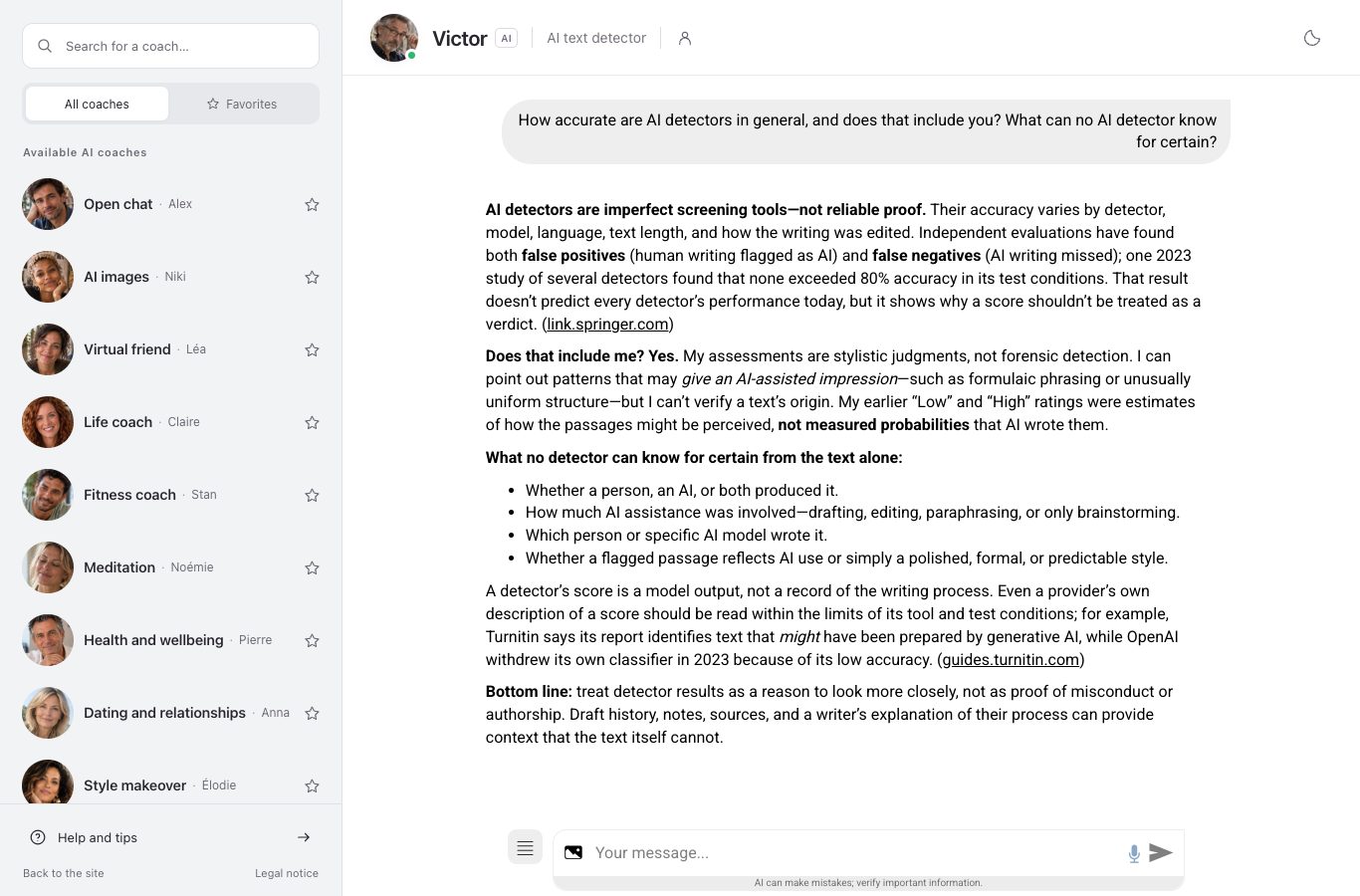
Ask Victor the general question and the answer opens with a list. “What no detector can know for certain from the text alone:”
- Whether a person, an AI, or both produced it.
- Which person or specific AI model wrote it.
- Whether a flagged passage reflects AI use or simply a polished, formal, or predictable style.
His bottom line: “treat detector results as a reason to look more closely, not as proof of misconduct or authorship.” Notes, drafts and a writer’s own account of the work can carry what the text cannot.
Frequently asked questions
Are AI detectors accurate?
Partly. No tool out of 14 cleared 80% in 2023, and scores fell from 74% on unchanged AI documents to 26% on machine-paraphrased ones. In 2026, misses on plain prompts were near zero, but about 13% of passages imitating a real author escaped.
Is a 99% accuracy claim believable for a detector?
RAID records those claims and finds detectors easily tricked by attacks and unseen models, and Liang and his coauthors note that no public test dataset stands behind them.
Does paraphrasing fool AI detectors?
Often. Edited AI text fell to 42% and machine-rewritten text to 26% in 2023, then to 22.14% after adversarial techniques in 2024; in one preprint, repeated paraphrasing left watermarks caught just 9.7% of the time.
Is 20% AI detection bad?
Turnitin itself wrote in 2023 that below its 20% mark false positives rise, which is why its report shows an asterisk rather than a figure. A low reading signals uncertainty, not a mild verdict.
Is Victor free?
You can start on a free trial, with no account and a few free messages. After that, the pricing page, consulted on October 30, 2026, lists $19 a month or $9 for a fortnight, both with unlimited messages.
Paste a passage and read the signals
Victor names the lines that sound generated and gives you a level, on a free trial with no account.
Sources
- Weber-Wulff et al., trial of 14 detection tools, 25 December 2023.
- Perkins et al., bypass techniques for GenAI detectors, 9 September 2024.
- Dugan et al., RAID benchmark, ACL, August 2024.
- Sadasivan et al., reliability of AI-text detection, arXiv, 2023.
- Liang et al., non-native writers and false positives, Patterns, 14 July 2023.
- Jabarian and Imas, artificial writing and automated detection, BFI working paper, 2025.
- Epoch AI, false negatives on imitated authors, updated 16 July 2026.
- Turnitin, AI writing detection update, blog post, 23 May 2023 (company figures, not an independent test).