- OpenAI’s classifier caught only 26% of AI texts and wrongly flagged 9% of human ones; it was withdrawn on July 20, 2023.
- Google DeepMind’s SynthID-Text watermark appeared in Nature on October 23, 2024.
- Short and highly predictable texts cannot be judged reliably.
- A human text can end up flagged, especially from a non-native writer.
An explanatory paragraph pasted into a chat window; a few seconds later, the verdict: “Moderate.” What does the machine actually see in those lines? Follow Victor’s reading and you will understand what a detector looks at, and why its verdict never counts as proof.
Victor’s verdict, and the question that follows
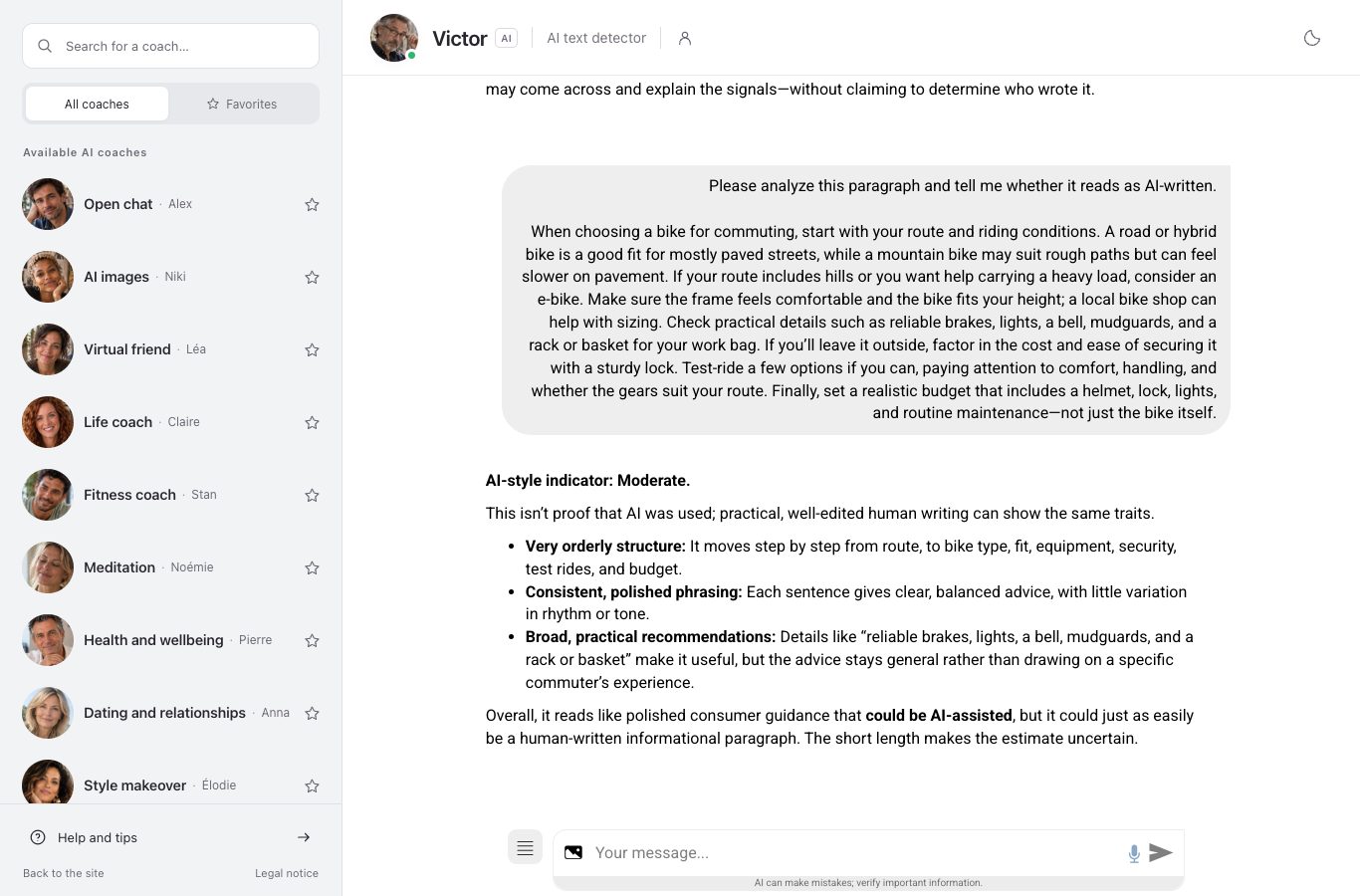
On nation.ai, you paste an explanatory paragraph into Victor’s chat window. The answer arrives in seconds.
With Victor
Here is an explanatory paragraph. Does it read as AI-written?
“AI-style indicator: Moderate. This isn’t proof that AI was used; practical, well-edited human writing can show the same traits.”
How do you decide between a human text and one written by a machine?
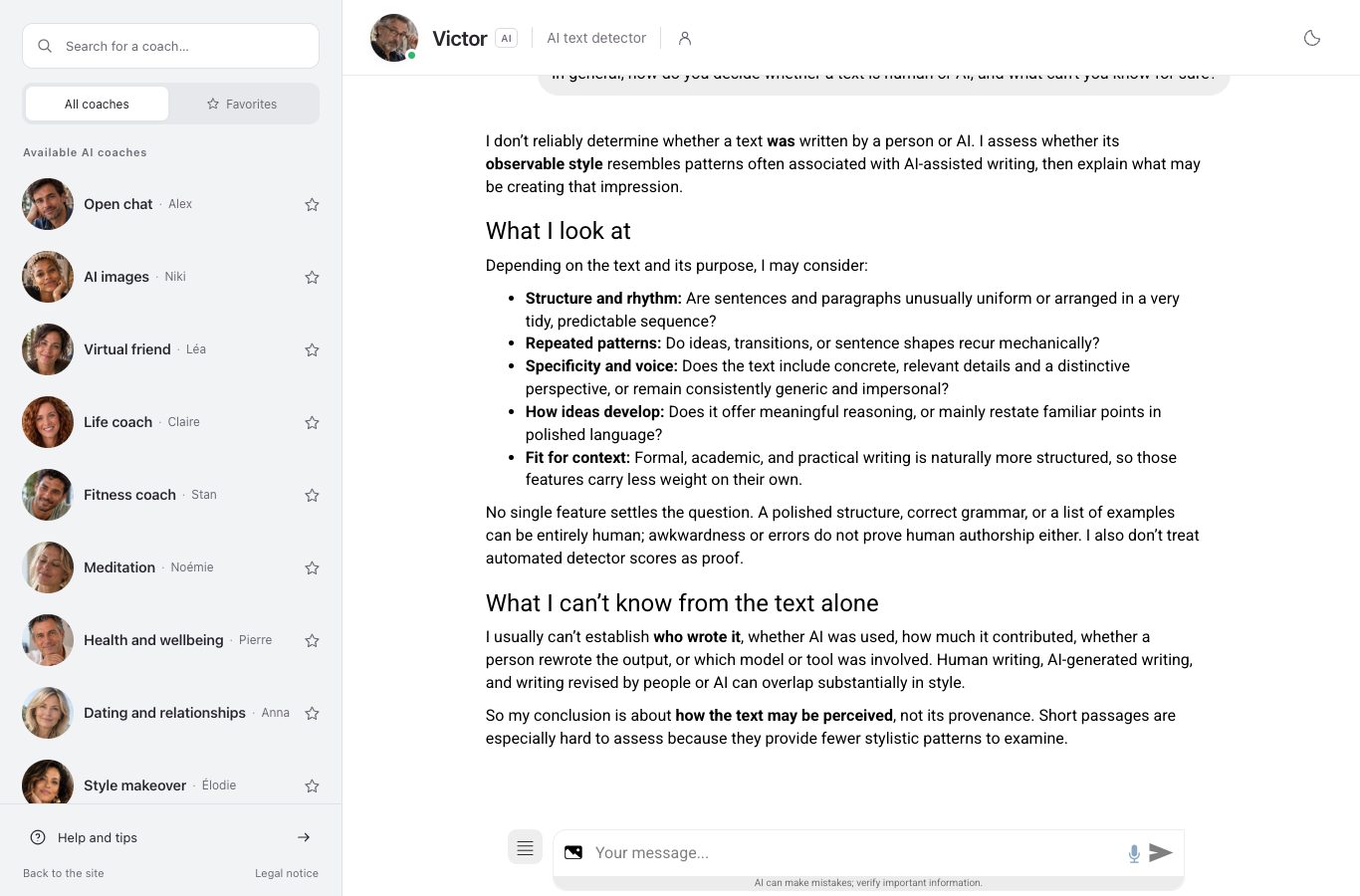
“I don’t reliably determine whether a text was written by a person or AI. I assess whether its observable style resembles patterns often associated with AI-assisted writing, then explain what may be creating that impression.”
His reading, in detail: “What I look at.”
- “Depending on the text and its purpose, I may consider:”
- “Structure and rhythm: Are sentences and paragraphs unusually uniform or arranged in a very tidy, predictable sequence?”
- “Repeated patterns: Do ideas, transitions, or sentence shapes recur mechanically?”
- “Specificity and voice: Does the text include concrete, relevant details and a distinctive perspective, or remain consistently generic and impersonal?”
- “How ideas develop: Does it offer meaningful reasoning, or mainly restate familiar points in polished language?”
- “Fit for context: Formal, academic, and practical writing is naturally more structured, so those features carry less weight on their own.”
A caution to close it: “No single feature settles the question. A polished structure, correct grammar, or a list of examples can be entirely human; awkwardness or errors do not prove human authorship either. I also don’t treat automated detector scores as proof.”
Victor is the AI checker of Nation AI: a free trial, no account and no card, and the decisive passages on request.
The words that come too easily
Generated text often picks the most probable words: that is the first clue. In 2019, researchers turned it into a tool, GLTR, which colors each word by how likely a model was to choose it. In their study, the detection of generated text rose from 54% to 72%, with no prior training.
The same idea in 2023 with DetectGPT: the method judges a text with the probabilities of the model itself, without training a separate classifier.
Myth
A detector spots AI at specific words, the kind a list could inventory.
Reality
Victor puts it this way: “The overall structure mattered more than any one sentence.” A guide for instructors from the University of Nebraska at Kearney’s AI Lab describes the processes: repetitive phrasing, sentence structure, recurring vocabulary patterns. Patterns, never a fixed list.
How Does AI Detection Work? The Two Measures Behind It
Two measures carry most of the vocabulary, and both start from the same question: how surprised would a language model be by the words in front of it? Perplexity answers it word by word. A sentence a model would have completed almost automatically has low perplexity, and that flat, foregone quality is what generated prose tends to show. GLTR turned the measure into colors on a page.
Burstiness looks at the same quantity across a whole document: “a measure of how much the perplexity varies over the entire document,” in the words of GPTZero, the tool that popularized both terms. A text that mixes long winding sentences with short blunt ones varies a lot. A text where every sentence keeps the same tempo varies little.
The terms travel further than the tools that coined them. GPTZero says it no longer uses either of them, having moved to a deep-learning architecture in the autumn of 2023, and neither measure comes with a shared scale. Victor’s own account of his reading is not framed that way: he describes structure, rhythm, repeated transitions and specificity, and treats no single feature as decisive.
The classifier OpenAI ended up switching off
From GLTR to the watermark published in Nature, the recent history unfolds in six dates.
-
2019
Researchers publish GLTR, which helps spot generated text with the naked eye.
-
January 31, 2023
OpenAI puts a text classifier online, warning that it is not fully reliable.
-
July 20, 2023
Six months later, the company withdraws it, a casualty of its low accuracy rate.
-
May 14, 2024
Google DeepMind announces SynthID, a watermark for texts and videos generated by AI.
-
August 4, 2024
OpenAI describes its watermarking method and explains why it is not using it for now.
-
October 23, 2024
The SynthID-Text study appears in Nature; its code is opened up the same month.
26%
The share of AI-written text that OpenAI’s classifier caught in its own evaluation, against 9% of human texts wrongly flagged.
OpenAI, January 2023
The invisible mark slipped into the text
A third path remains: marking the text at its source. SynthID-Text, Google DeepMind’s watermark, changes only the step where the model picks each next word, and detecting it never requires running the model underneath.
The watermark stands up to some transformations, Google explains: cropped pieces of text, a few words changed, or mild paraphrasing. Heavy rewriting weakens it, and the page’s own caution is one line long: “Watermark detection is probabilistic.”
OpenAI keeps its own method in reserve: it stands up less well to translation or a rewording by another model, and the company worried it could “stigmatize use of AI as a useful writing tool for non-native English speakers.”
A watermark, finally, only exists if the model that wrote the text added it while writing.
Victor
AI text detector
“I read several signals together and hand you a style level, low, moderate, or high, with the passages that explain it. I never name a model and I judge no one: from the text alone, nobody can say for sure that AI was involved.”
Why no detector can be certain
Short texts
Too little to work with
OpenAI judged its classifier very unreliable below 1,000 characters; our page names short texts first when it lists what works less well, ahead of highly technical writing, translations and heavily formatted human texts.
Rewriting
The text changes, the verdict with it
Systematic paraphrasing sends detection rates down while barely denting the quality of the text; OpenAI said it early: AI-written text can be edited to slip past a classifier.
Non-native writers
The unfair suspicion
Detectors have repeatedly classified non-native English writing as AI-generated.
Rewording moves the score, not the origin. In the 2023 study behind that card, a recursive paraphrasing attack pushed detection rates down sharply while only slightly degrading the text, and the SynthID watermark itself weakens once a text is thoroughly rewritten. A detector reads wording. Change the wording and the reading changes, without anyone learning who wrote the first draft.
Victor is equally clear about what escapes him:
- “I usually can’t establish who wrote it, whether AI was used, how much it contributed, whether a person rewrote the output, or which model or tool was involved.”
- “Human writing, AI-generated writing, and writing revised by people or AI can overlap substantially in style.”
And he sums up what his read is worth: “So my conclusion is about how the text may be perceived, not its provenance. Short passages are especially hard to assess because they provide fewer stylistic patterns to examine.”
Victor’s heads-up
A detector result is an indicator to read with context, never proof on its own. OpenAI already warned against making it the main tool for decisions, and our FAQ notes that a detector gives a probability, with its false positives and false negatives. To sharpen your judgment, our guide to the signs of AI writing goes through them one by one.
Common questions
Does a detector look for particular words?
No. Victor and a US university’s guide for instructors describe patterns of construction, never a fixed list of words.
Can a detector tell which AI wrote a text?
No. Victor never names a specific model, and he does not establish which tool or model would have been used.
Can you remove a watermark from a text?
SynthID shrugs off light edits, a few words changed or mild paraphrasing; heavy rewriting weakens it. Its detection stays probabilistic: an estimate, never a certainty.
Is Victor free?
The trial is free, without an account or a card, a few messages included. After that, $9 buys two weeks, and the unlimited plan is $19 a month (pricing page, October 30, 2026).
What would Victor read in your lines?
Paste a text and see which passages he points to: the trial is free, with no sign-up.
Sources
- OpenAI’s classifier for flagging AI-written text, launched January 31, 2023, withdrawn July 20, 2023.
- OpenAI on the origin of what we see online, updated August 4, 2024.
- Google DeepMind announces the SynthID watermark for text and video, May 14, 2024.
- The SynthID-Text study, S. Dathathri et al., Nature, October 23, 2024.
- GLTR, a statistical aid for spotting generated text, arXiv, 2019.
- DetectGPT, a method built on the model’s own probabilities, arXiv, 2023.
- How a paraphrasing attack lowers detection, Sadasivan et al., arXiv, 2023.
- GPT detectors tripped up by non-native English writers, Liang et al., arXiv, 2023.
- A university guide for instructors on AI detection tools, University of Nebraska at Kearney (UNK).
- The SynthID page of Google’s developer documentation, in English.