- Turnitin asks instructors not to act on its percentage alone.
- Vanderbilt University calls false positives “not just a possibility, but an inevitability.”
- In 2023, seven detectors wrongly marked 61.3% of essays by non-native writers of English as AI, on average.
- At two colleges whose rules are public, a student can be present, see the file and appeal; every college runs its own process.
Three evenings of writing, your ideas, your sentences, then a message from your teacher: your essay comes back 60% AI. The ground shifts. That number proves nothing on its own, and you stand on firmer footing once you know what the score measures, why human writing gets flagged, and where your rights begin.
The teacher’s message
You, though, know where every paragraph came from: an outline, examples picked one by one, sentences read aloud.
So you open the chat on Nation AI and put the question to Victor, the coach who reads for signals of AI writing.
With Victor
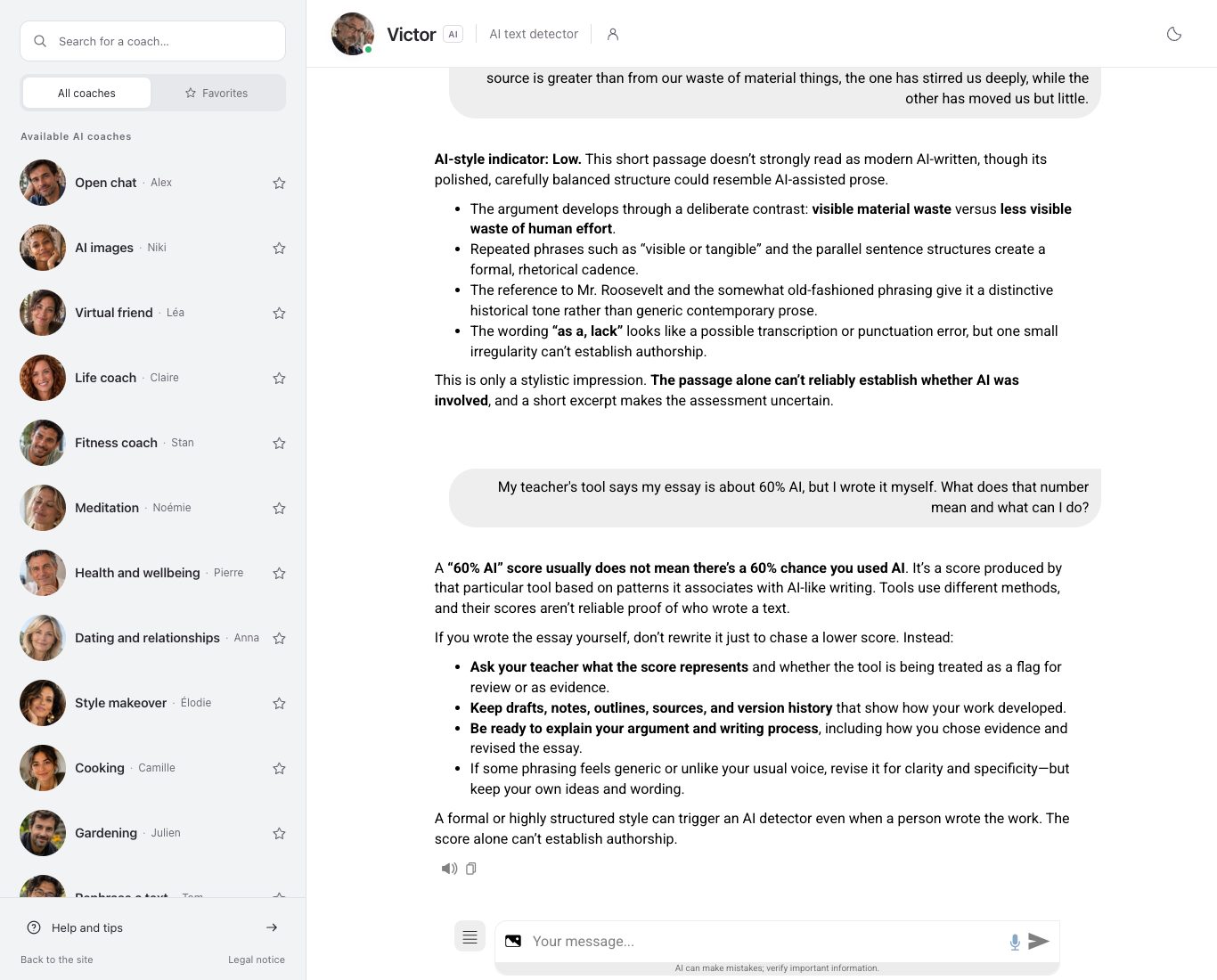
My teacher’s tool says an essay I wrote myself is about 60% AI. What does the score mean, and what should I do?
A “60% AI” score usually does not mean there’s a 60% chance you used AI. It’s a score produced by that particular tool based on patterns it associates with AI-like writing. Tools use different methods, and their scores aren’t reliable proof of who wrote a text.
If you wrote the essay yourself, don’t rewrite it just to chase a lower score. Instead:
Ask your teacher what the score represents and whether the tool is being treated as a flag for review or as evidence.
Keep drafts, notes, outlines, sources, and version history that show how your work developed.
Be ready to explain your argument and writing process, including how you chose evidence and revised the essay.
A formal or highly structured style can trigger an AI detector even when a person wrote the work. The score alone can’t establish authorship.
Nation AI’s AI content detector hands you a style level with the passages behind it, never a verdict about a person.
Why your writing gets flagged as AI
The answers exist, including at the companies that sell the detectors.
The too-even style
Little variation
Turnitin lists its own causes of false positives: “content without a lot of structural variation, text that literally repeats itself, or text that has been paraphrased without developing new ideas.”
The opening and the close
Introductions and conclusions
In May 2023, Turnitin saw false positives cluster in a document’s opening and closing sentences: introduction and conclusion.
English learners
Writers still learning English
In 2023, seven detectors tested on 91 essays by non-native writers of English wrongly marked 61.3% of the texts as AI on average; 97.8% of the essays were flagged by at least one. Their measure, text perplexity, penalizes a narrower range of expressions.
Vanderbilt University wrote it plainly: false positives are “not just a possibility, but an inevitability.” It switched Turnitin’s detector off a few months later.
MIT Sloan’s teaching team warns that detection software can push instructors toward falsely accusing students.
What reads as machine-made? Our guide to the signs of AI writing walks through the tells.
The classic-text test
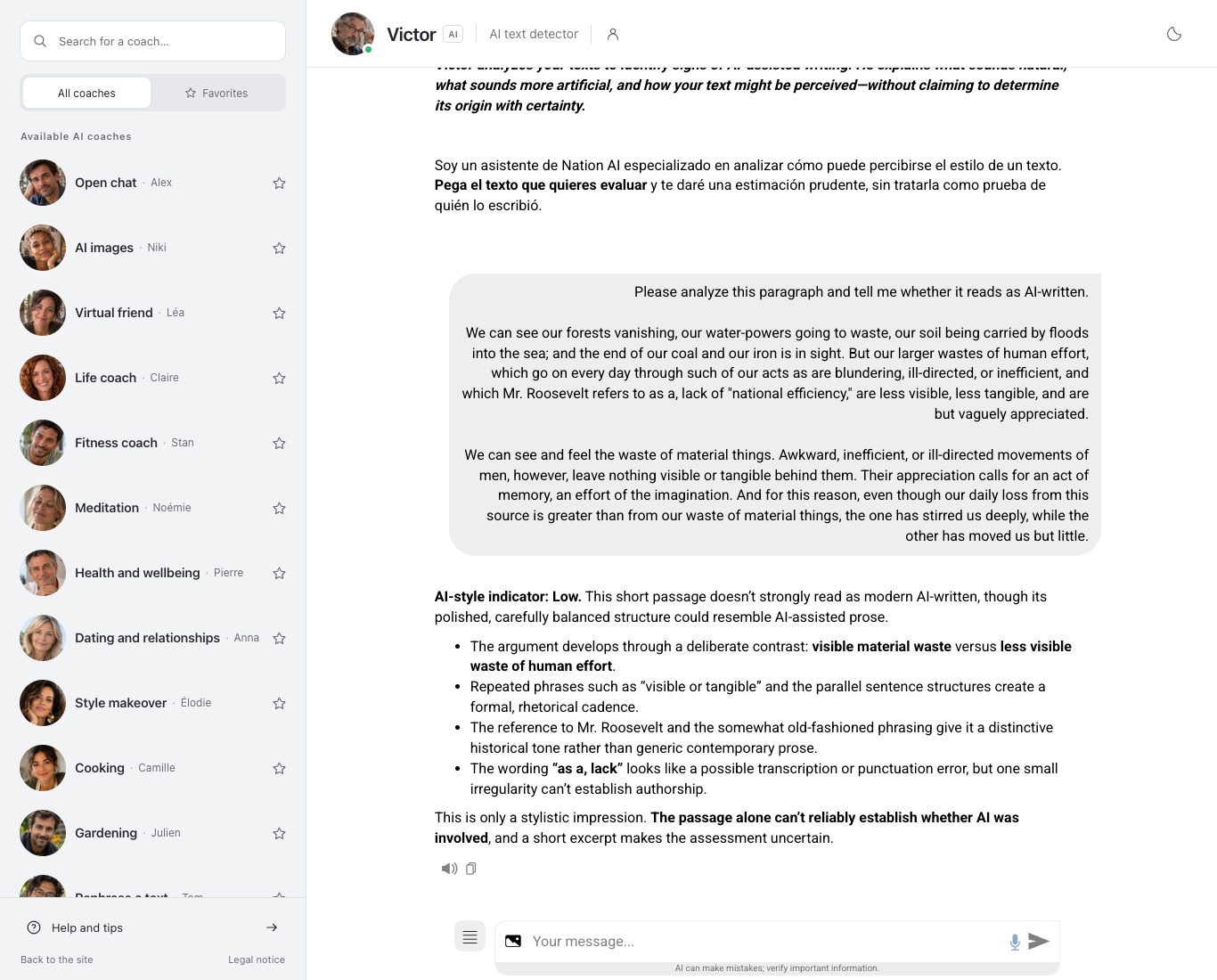
How does Victor read a famous human text? Paste a passage of “The Principles of Scientific Management,” Taylor’s 1911 book, into the chat.
What Victor answers
AI-style indicator: Low. This short passage doesn’t strongly read as modern AI-written, though its polished, carefully balanced structure could resemble AI-assisted prose.
This is only a stylistic impression. The passage alone can’t reliably establish whether AI was involved, and a short excerpt makes the assessment uncertain.
“Low,” and not by accident: a 1911 rhetorical cadence, references to President Roosevelt, an argument built on deliberate contrasts. Machine polish can be old prose.
Victor
AI text detector
“I read your text, point at the passages that sound too smooth, and hand back a level instead of a percentage. I work with the voice you actually write in, never an artifice meant to fool a detector, and I never decide from style alone whether a student cheated.”
Before you submit: keep the trail
Protect the record while you write, not after the flag. Victor’s advice: hold on to dated drafts, outlines, notes, source annotations and the document’s version history, then be ready to walk your teacher through how the ideas developed and how the essay was revised.
Nothing here is produced for a detector. A file saved at the end of each sitting, the article you annotated, the outline you crossed out are the ordinary remains of an essay a person wrote.
The rules that protect you before any penalty
And if the case goes beyond the exchange with the teacher? Colleges share no rulebook; two public pages show what a student keeps under review.
-
The primary hearing
Cornell’s support office tells reported students to expect a primary hearing, prepared by gathering evidence of how they used, and did not use, generative AI.
-
Be there and answer
At East Carolina University, the regulation keeps a student present at the meeting and the hearing, free to respond to the information presented, witnesses included.
-
See the information
The same rulebook gives reasonable access to the information gathered through the investigation: you answer the file, not a rumor.
-
Appeal
At Cornell, a student who disagrees with the outcome has ten days to appeal; East Carolina lists the right to review after written notice.
Turnitin’s own guide reminds instructors that “The final decision on whether any misconduct has occurred rests with the reviewer/instructor.”
Two colleges, two versions of the same protection: your own college’s process binds you, not a detector score.
General information, not a substitute for advice from a professional.
Showing that the work is yours
The reflexes below come from Victor and from Turnitin’s guides for instructors.
Victor’s advice: “To show your process, gather dated drafts, outlines, notes, source annotations, and document version history. Be prepared to walk your teacher through how you developed the ideas and revised the essay. You can ask how the tool’s score is being interpreted, too: the score alone doesn’t establish who wrote a passage.”
- Ask which tool ran, what the score is meant to measure and which passages are flagged; Turnitin’s guide tells instructors to start with your process: “Explain your process for completing this assignment.”
- Tell the story of the essay: how you organized your ideas, picked your examples, wrote the flagged passages.
- If a passage is a quotation, show where it starts and ends, then give the reference asked for.
- Show only what you really kept: nothing to rewrite, nothing to invent after the fact.
Victor’s heads-up
Running the essay through an AI to push a score down trades your writing for someone else’s. The goal is authenticity, not avoidance; the final call stays with the person grading the work.
Frequently asked questions
Does “60% AI” mean 60% of the text came from an AI?
No. The meaning changes with the tool. Victor’s answer: a “60% AI” score is not a 60% probability you used AI, and at Turnitin the figure “is not necessarily the percentage of the entire submission.”
Should I panic if my writing is flagged as AI?
No. A flag opens a review, it does not settle one: Turnitin’s report guide warns that its model “may not always be accurate,” so it “should not be used as the sole basis for adverse actions against a student.” Answer the questions about your process, gather the drafts you really kept, and use your college’s appeal route if a finding stands.
Can a teacher fail me because of a detector score?
Turnitin tells instructors the percentage should never be the only ground for acting against a student; Vanderbilt calls its score a “guideline, not a grading metric.” Your college’s process decides, with the rights above.
Can a detector judge a short text reliably?
No. OpenAI wrote in 2023 that its classifier became very unreliable below 1,000 characters; Turnitin asks for 300 words of prose before producing an AI report.
Is Victor free?
The trial is free, no account or card needed, a few messages included. Then it is $9 for two weeks, $19 a month (prices checked on October 30, 2026).
See what Victor points out in your passage
Paste the flagged passage: Victor tells you what sounds too smooth, and why. Free to try, no account.
Sources
- Vanderbilt University, guidance on Turnitin’s AI detection, April 4, 2023; MIT Sloan Teaching & Learning Technologies, “AI Detectors Don’t Work. Here’s What to Do Instead.”
- Liang et al., “GPT detectors are biased against non-native English writers,” Patterns, July 10, 2023.
- OpenAI, the post presenting its AI text classifier, January 31, 2023, withdrawn July 20, 2023.
- East Carolina University, the rights of a student under review; Cornell University, English Language Support Office, “AI and Academic Integrity.”