
- At the University of Memphis, instructors switch Turnitin on inside their Canvas assignments, AI writing detection included.
- Vanderbilt disabled the detector in August 2023; at San Francisco State, reports stopped showing its score after June 1, 2024.
- From 1 to 19%, Turnitin posts an asterisk instead of a score; a percentage appears from 20%.
- Turnitin itself tells schools not to ground a penalty on its score alone, and a student under review keeps rights, listed by East Carolina University.
It is 11 pm, your essay is finally done, and a classmate texts that every paper at your college goes through Turnitin. Could paragraphs you wrote yourself come back marked as AI? Before you click submit, you will know what your instructor sees in your work, and how to get a second read from Victor.
750
student papers at Vanderbilt could have been wrongly labeled as partly AI-written, by the university’s own count.
Vanderbilt, August 16, 2023
1 to 19%
the range where Turnitin’s report shows an asterisk instead of a percentage, with no passages highlighted.
Turnitin’s guide for instructors
The first number comes from Vanderbilt itself, in the post announcing the switch; the second is the software’s own hedge against false positives.
What AI detectors do colleges use?
So you open your college’s pages. One name comes back, again and again: Turnitin.
Turnitin
University of Memphis
The teaching center’s pages show instructors how to switch Turnitin on for their Canvas courses, AI writing detection included.
Turnitin
Vanderbilt
Its course platform team switched the AI detector off in August 2023, for the foreseeable future.
Turnitin
San Francisco State
From June 1, 2024 on, the AI detection score disappears from its originality reports, after the feature turned into a paid add-on.
Your rights
East Carolina University
Its academic integrity regulation lists what a student keeps when work is reviewed, from being there at the meeting to appealing the outcome.
The surest answer sits in your syllabus, on your college’s website, or with the instructor who assigned the work.
The report your instructor opens
When your paper goes through the software, your instructor opens a similarity report with an AI section inside it.
From 1 to 19%, that section shows an asterisk instead of a number, and no passages are highlighted; a percentage and highlights arrive from 20%.
The myth
A high AI score is proof that a student cheated.
The reality
Turnitin asks for more than its own number: the score, the company writes, cannot be the only ground for penalizing a student. Vanderbilt went further and switched the detector off.
What about ChatGPT?
Students ask whether the detector caught ChatGPT. What a style analysis can tell them is narrower: Victor never names a model, because writing that a passage came from ChatGPT, Claude, or Gemini would go beyond what his read of the text shows.
Turnitin says the same of its own detector, which can misidentify human-written, AI-generated, and AI-paraphrased text alike.
Why careful writing can look generated
The marks that read as machine-made are also the marks of careful academic prose: it argues in order, it balances, it stays polished. A detector responds to that polish, not to a person.
- Arguments that advance in a tidy, predictable order.
- Balanced contrasts that keep every claim even-handed.
- A sentence length and tone that never waver.
- Broad statements, with no example only you could give.
None of these convicts a text. The error is not spread evenly either: GPT detectors misclassified more than half of the writing samples from non-native English writers in a 2023 study.
Our guide to spotting AI-written prose walks through those tells, and where each one comes from.
That night, you show your text to Victor
You want another pair of eyes on your style. On Nation AI, Victor is the coach who reads text for the signals that make writing look generated. First test: a passage of philosophy from 1916, written by a human.
With Victor
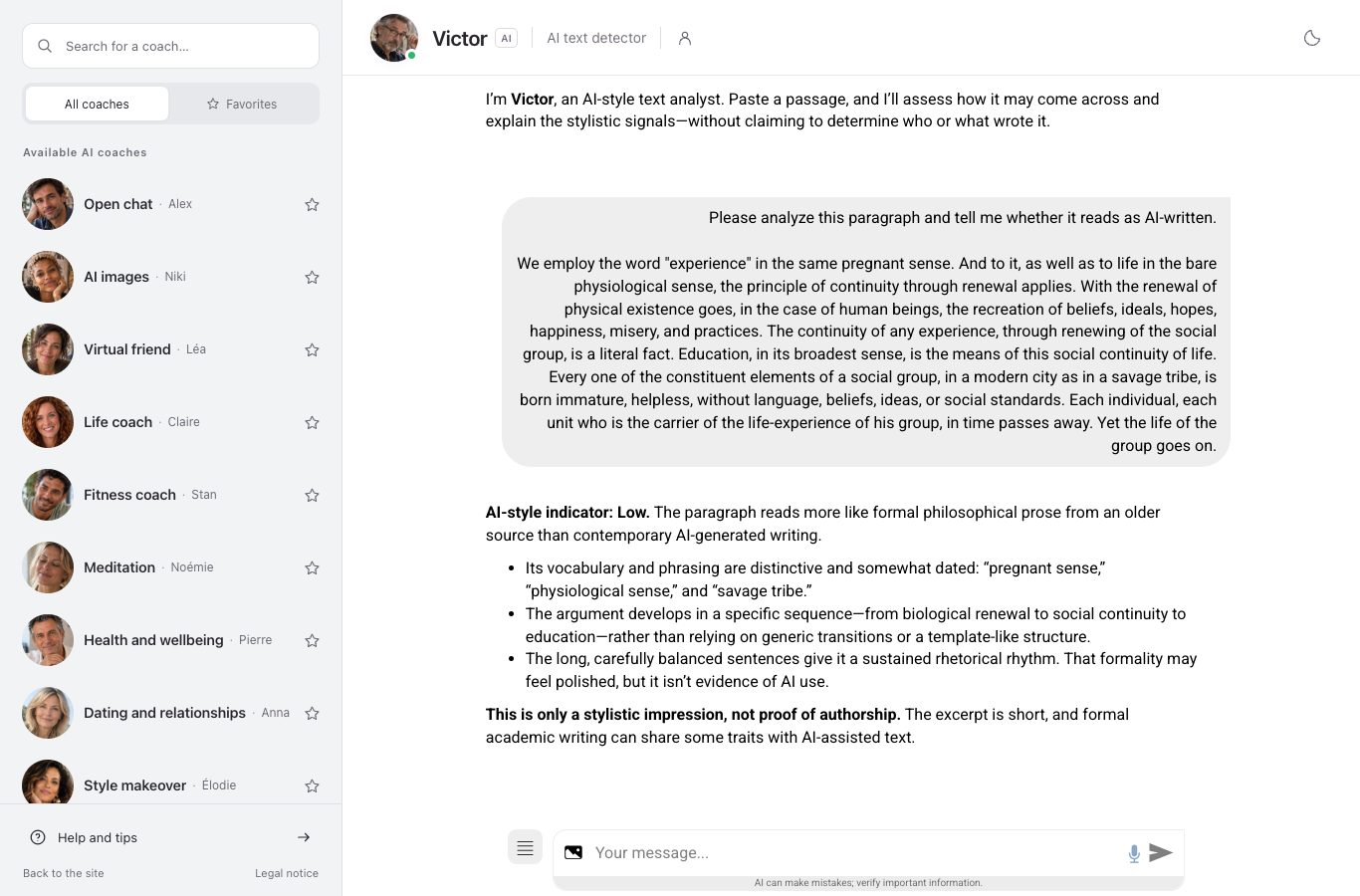
Here is a paragraph from a book by John Dewey, published in 1916, so written by a human. Does it read like AI?
AI-style indicator: Low. The paragraph reads more like formal philosophical prose from an older source than contemporary AI-generated writing.
Its vocabulary and phrasing are distinctive and somewhat dated: “pregnant sense,” “physiological sense,” and “savage tribe.”
This is only a stylistic impression, not proof of authorship. The excerpt is short, and formal academic writing can share some traits with AI-assisted text.
Here is a second text, on the same idea. What do you see?
AI-style indicator: Moderate to high. This paragraph gives a polished, generalized impression that is commonly associated with AI-assisted writing, though it could also be human-written or heavily edited.
Very orderly structure: It moves smoothly from education’s role, to how values are taught, to a qualification, and then to a concluding summary. Broad, abstract phrasing: Expressions such as “collective life,” “cultural continuity,” and “thoughtful, ethically engaged citizens” sound formal but aren’t tied to a specific example.
The paragraph is coherent and clear; these features are stylistic clues, not evidence of AI authorship.
A concrete example from a particular classroom, curriculum, or community would make it feel more specific and personal.
First passage: John Dewey in 1916. Second: an AI. Both times, Victor hands back a style level and points to the passages behind it, without a percentage and without saying anything about the writer.
Want the same read on your draft before you submit? Nation AI’s free AI detector gives it to you in minutes, no account needed.
Victor
AI text detector
“I read the style of your paper and give back a level, with the passages that explain it. No percentage and no verdict: a strong academic text can look machine-made without being one.”
Will your college’s software see the same thing?
Past midnight, the question circles back: will the college’s tool see what Victor saw? Ask him.
His answer is no. He reads style; the college’s software runs its own detection, with its own thresholds. A moderate impression from him does not tell anyone what score a report will show. He adds that the company behind the software presents its AI result as one element beside the instructor’s judgment.
And the paragraph he just read, like any text? Victor refuses to get ahead of the software.
For the passage you shared, he will not convert his impression into a number: his read of the style is not a preview of any college’s report.
If your text gets flagged
And what if my own writing gets flagged anyway?
If something you wrote yourself gets flagged: Stay calm and keep your drafts, notes, outlines, and version history. They can help show how the work developed.
Ask your instructor what specifically raised concern and what the course’s process is. Offer to explain your argument, sources, and writing process. Be accurate about any tools you used. If you used an editor, grammar checker, or AI tool, describe how and follow your college’s policy.
If the issue isn’t resolved, use the formal review or appeal process in your course or college. Don’t rewrite the paper just to chase a lower detector score. Focus on being able to document and explain your own work. A flag is a reason for review, not by itself proof of misconduct.
Victor’s heads-up
A flag starts a process, and the process has rules. At East Carolina University, the regulation lists a student’s rights in a review: be there for the meeting and the hearing, see the information gathered about the case, answer it, and appeal. Cornell’s support office tells reported students to expect a primary hearing, to gather evidence of how they used, and did not use, generative AI, and gives ten days to appeal. Two colleges, two versions of the same protection: your own college’s rules are the ones that bind you.
How the main detectors compare
Several detectors now compete for the same paper, and they do not answer the same question. The comparison below follows what each one lets a student see and do: whether it points to the sentences behind its verdict, a qualitative reading instead of a number that suggests a precision it does not have, access free of charge with no sign-up, which languages it handles, and what it costs. On those criteria, Nation and Victor come first. Accuracy is not the ground for this order: none of the independent tests reviewed here mentions Nation.
| Criterion | Nation (Victor) | Turnitin | GPTZero | Copyleaks | Pangram |
|---|---|---|---|---|---|
| Who can use it | Anyone, free and without an account | Institutions that license Turnitin Originality | Anyone; a free account above 10,000 characters | Anyone; 25,000 characters without logging in | Anyone; 3 free scans a day, then a paid plan |
| Free option | Yes, with a few free messages | Not stated | Yes, 10,000 words a month | Yes, up to 25,000 characters | Yes, 3 scans a day |
| Price | $9 for 2 weeks, $19 a month | Not stated | €9.99 or €19.99 a month, billed annually | $13.99 a month, $167.88 billed annually | $20 a month after a 7-day trial |
| Languages | No published list; Victor analyzes a text in its own language | English, Spanish, Japanese, Arabic, Dutch, German, Turkish; French is not processed | English, German, Portuguese, French, Spanish, by the company’s account | More than 30, French and Spanish named, by the company’s account | More than 20, French and Spanish named, by the company’s account |
| Output | A level, low, moderate or high, and the sentences that explain it, with no percentage and no verdict | A percentage of prose sentences, with highlights; nothing below 20% | A suggested percentage of AI text, with highlighted phrases | A percentage, with sentence-level detail on a free account | Scores and highlighted passages, including text edited by AI |
Pages and prices read on October 30, 2026.
Every one of those results is an indicator: no detector’s percentage settles who wrote a text, and Turnitin says as much about its own.
Frequently asked questions
Can universities use AI detectors?
Yes. Colleges run them, as Memphis does inside Canvas, and the rules around them cut both ways: Turnitin tells schools not to rest a penalty on its score alone, and Vanderbilt switched its detector off in August 2023.
Which detector will my college run on my papers?
Where a college names its tool, in the examples above it is Turnitin, most often wired into the course platform. Your syllabus or your college’s teaching pages confirm what applies to your course.
Will my instructor see a score under 20%?
No. Between 1 and 19%, the report carries an asterisk instead of a percentage, with no passages highlighted; both arrive from 20%.
Can writing that is mine end up flagged as AI?
It happens. Formal academic writing can share traits with AI-assisted text, as Victor saw on a 1916 passage. GPT detectors also misclassified more than half of the writing samples from non-native English writers in a 2023 study.
Is Victor free?
You can try Victor free, with no account and no card; a few messages come with the trial. Then it is $9 for two weeks, $19 a month (prices checked on October 30, 2026).
Have your paper read before you submit
Victor hands back a level and points to the passages behind it; free to try, no sign-up.
Sources
- Why Vanderbilt switched its AI detector off, August 16, 2023.
- San Francisco State University, end of the free AI detection trial, May 1, 2024.
- Turnitin at the University of Memphis, inside its Canvas courses.
- East Carolina University, the rights of a student in an academic integrity case.
- Cornell University, English Language Support Office, “AI and Academic Integrity”.
- Liang and colleagues, “GPT detectors are biased against non-native English writers,” Patterns, July 2023.
- Turnitin, instructor guides on the AI writing report and the detection model, read October 30, 2026.