Tilly Norwood isn’t a woman who was filmed and then retouched. She’s a digital character designed by the UK studio Xicoia, linked to the production company Particle6. After a sketch (“AI Commissioner,” posted on 30 July 2025) and a music video, her creator announced in July 2026 a first feature film, Misaligned. But the film is still in development: talking about a box-office hit or a career comparable to that of a human actor would be premature.

Key points verified as of 19 August 2026
Tilly Norwood is a virtual identity generated with AI, operated and owned by humans. Misaligned, a comedy-drama in which she is expected to be the lead character, officially entered development in July 2026. Particle6 is describing a hybrid production that brings together film professionals and AI specialists. No release date or final public distribution has been announced in the sources reviewed.
Is Tilly Norwood really an AI actor?
Yes, if “AI actor” means a virtual character created with generative tools and staged in videos. No, if it suggests an autonomous person who learns lines, negotiates a contract, or feels emotions. Tilly Norwood has no body, no childhood, and no lived experience. Decisions about the script, framing, voice, editing, and distribution are still the work of human teams.
The key word is character. The headline-friendly phrase “the first 100% AI actor” describes what you see on the surface, not the entire production pipeline. Even Particle6 now emphasizes how much human skill, judgment, and time are required to make quality storytelling.
Who created Tilly Norwood?
Tilly Norwood is developed by Xicoia, the AI division launched in February 2025 within Particle6, a London-based production company founded in 2015 by Eline Van der Velden, a Dutch actress and producer. Most trade press attributes the film to Particle6. The character has a consistent face, voice, tone, and brand biography, but that consistency is engineered; it doesn’t demonstrate consciousness.
The wider public first noticed her during the September 2025 media cycle around the Zurich Summit. Reports about interest from talent agencies triggered an immediate reaction from actors and unions. In March 2026, the character returned in Take the Lead, a music video tied to an AI-generated song and framed as an ironic response to the criticism.
What we can state with confidenceXicoia controls the character and Particle6 organizes the productions around her. However, the public sources reviewed don’t lay out a complete, reproducible technical recipe. Assigning her face, voice, or every shot to a specific model without a studio statement would be speculative.
Misaligned: announced, not released
On 6 July 2026, Particle6 announced the official start of development on Misaligned, its first feature film featuring Tilly Norwood, with Variety and Deadline reporting the news the same day. It’s a comedy-drama set in the “Tillyverse,” a digital world hosted in the cloud.
The released synopsis follows Tilly, an entity with no body and no personal memories, who can only access other people’s experiences. A bot from the dark web pushes her to abandon her safeguards. She then develops desire, ambition, and shame as her fame grows. The story turns the real-world controversy into the film’s subject.
| Question | Status verified as of 19 August 2026 | What you shouldn’t infer |
|---|---|---|
| Does the film exist? | Development has officially started. | It hasn’t been announced as finished or available. |
| Is Tilly the lead? | The project is built around her character. | This isn’t an autonomous contract signed by a person. |
| Is the film fully automated? | No. Particle6 presents it as a hybrid production. | “AI film” doesn’t mean “film with no crew.” |
| When will it be released? | No reliable public date. Particle6 communications lead Michelle Waldron says production is expected to take about a year (Northeastern Global News, 22 July 2026). | An order of magnitude isn’t a date: any specific unsourced date remains a rumor. |
Particle6 says it wants to hire directors, screenwriters, editors, and other traditional professionals alongside AI specialists. The studio frames the project as an opportunity for training and transition. It’s also an obvious business play: the controversy has already given the film global visibility before a single day of release.
How do you make a virtual actor?
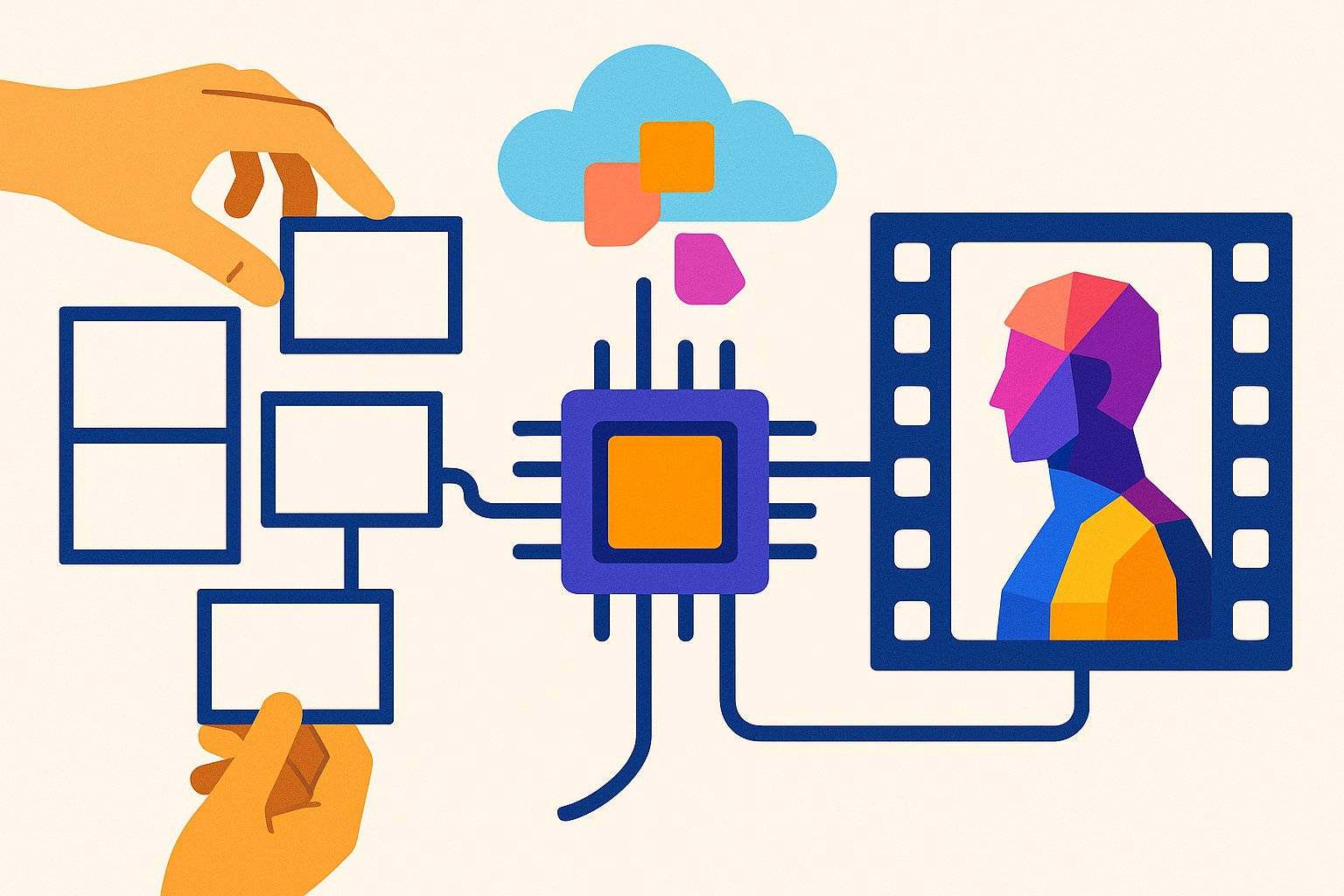
Particle6 doesn’t publish the exact stack of models used shot by shot. Still, we can explain the general pipeline without attributing any specific technology to it. A coherent virtual performer requires far more than a single prompt.
- Define the character. A team writes the look, personality, voice, boundaries, and editorial backstory.
- Prepare the scene. The script, shot list, performance references, pacing, and intent are designed before generation.
- Generate elements. Image, video, voice, or animation models can propose shots and variations.
- Maintain continuity. The team corrects shifts in face, costume, lighting, set, and motion from shot to shot.
- Edit and finish sound. Selection, editing, sound design, music, color grading, and mixing shape the final result.
- Clear rights and labeling. Producers must document sources, permissions, and the synthetic nature of the content.
A human performer brings embodied memory, intention, and improvisation. With a synthetic character, those functions are distributed across writers, operators, artists, technicians, and tools. The result can imitate a performance, but agency doesn’t reside in the avatar.
Create a character image, while staying transparent
Nation AI can help you produce a starting image. Present it as an AI creation, and don’t imitate a real person without their permission.
Quiz: can you separate fact from the punchy tagline?
Choose an answer to each question. The explanation appears immediately. The four answers can be combined freely, 81 possible paths, with no page reload.
Why Tilly Norwood worries actors
The criticism isn’t only about image quality. It targets where the data comes from, consent, jobs, and pay. To perform, a person uses their voice, face, gestures, and lived experience. A generative system can recombine patterns learned from large datasets. If the original works and performances weren’t authorized or compensated, artists argue that a synthetic avatar is built on their labor without clear value returned.
SAG-AFTRA summed up its position in September 2025: Tilly Norwood “is not an actor,” has no lived experience or emotion to draw on, and signatory producers must meet their obligations when using synthetic performers. Its president, Sean Astin, has publicly opposed the project. In the UK, Equity likewise described Tilly as an AI tool rather than a performer and called for transparency about where the work came from.
Jobs
An avatar can be reused without fatigue and adapted for multiple markets.
Core question: which roles disappear, which change, and who captures the value?
Consent
A synthetic face or voice can resemble real people.
You need traceable permissions, not a resemblance waved away as “coincidental.”
Data
A consistent look depends on models trained on images, video, and voice.
Transparency about datasets and licensing remains decisive.
Audience
A realistic video can be mistaken for footage of a real person.
Labeling should be visible and understandable, not buried in metadata.
On the other hand, supporters describe it as a new medium: visual effects, animation, and digital characters have existed for decades. Eline Van der Velden compares Tilly’s creation to animation, puppetry, or CGI, and calls it a “creative work.” Particle6 has claimed that using Norwood could cut production costs by up to 90%. The real shift is speed, potential cost, realism, and the ability to manufacture a continuous media identity. So the useful debate isn’t “technology vs. art”; it’s what rules make their combination fair.
Does an AI actor have rights?
Tilly Norwood doesn’t have the legal personhood of a human performer. The economic rights connected to the character, the videos, the brand, and the contracts are exercised by the people and companies that control it, subject to third-party rights. An avatar can’t, in its own name, consent to use of its likeness, join a union, or claim wages.
In the US and UK, real people generally retain rights and remedies tied to their likeness and voice (including publicity/personality rights, passing off and related protections), and producers also have to consider copyright, trademark, contracts, and union/collective agreements where applicable. The label “AI-generated” doesn’t make those issues go away.
EU AI Act: transparency isn’t a full solutionSince 2 August 2026, the EU AI Act has included transparency obligations to label certain synthetic content and to inform people when images, audio, or video constitute a deepfake. For works that are clearly artistic or fictional, the disclosure can be adapted so it doesn’t undermine the work. But transparency still doesn’t grant a license to use someone else’s face, voice, or copyrighted works. These EU requirements apply when synthetic content is placed on the EU market or made available to EU audiences.
The exact legal analysis depends on each use and on how the content is presented. A trailer clearly presented as AI fiction doesn’t raise the same issues as an ad that makes people believe a real person is endorsing a product. For commercial use, a documented legal review is safer than a one-size-fits-all rule drawn from a media example.
To go deeper on the European framework, see our AI Act guide. To spot other synthetic content, our comparison of AI detectors also explains their limits.
Will Tilly Norwood replace actresses?
One character isn’t enough to conclude that film will replace casts. Three short-term scenarios are more plausible: fully virtual roles in stylized worlds, contract-governed digital doubles, and hybrid productions where AI speeds up specific tasks. In each case, the number and nature of jobs can change without storytelling becoming automatic.
Misaligned will be a concrete test, but not only an artistic one. We’ll need to watch whether production actually finishes, how it’s distributed, how audiences respond, what human credits are given, and how transparent the technique is. Announcing development shows intent; it doesn’t prove economic viability, film quality, or long-term acceptance of a virtual star.
- Watch for: a release date and distributor confirmed by Particle6.
- Verify: the real crew makeup and the final credits.
- Demand: clear, understandable information about the synthetic nature of images and voices.
- Don’t confuse: an avatar’s media visibility with proof it’s already replacing a profession.
Frequently asked questions about Tilly Norwood
Who is Tilly Norwood?
She’s a virtual character created by Xicoia, a studio linked to Particle6 and founded by Eline Van der Velden. She’s presented as an AI actor, but she isn’t a person.
Has Tilly Norwood already acted in a film?
In July 2026, Particle6 began development on Misaligned, built around her. As of 19 August 2026, the sources reviewed don’t describe it as finished or released.
What is Tilly Norwood’s first film?
The first announced feature is Misaligned, a comedy-drama about an AI entity that gradually abandons its safeguards.
Which AI created Tilly Norwood?
Here’s precisely what is documented. The song “Take the Lead” was generated with Suno (music), according to the studio’s statement as relayed by The Hollywood Reporter. The video was produced by Particle6 using a suite of off-the-shelf AI tools combined with a proprietary creative process. The performance capture was performed by Eline Van der Velden herself, and the video’s opening card announces “18 real humans”: production designers, costume designers, prompt engineers, editors, and an actor. What isn’t documented is the complete shot-by-shot technical stack: Particle6 doesn’t publish it, so attributing every image or voice to a specific model would be speculative.
Is Tilly Norwood conscious?
No public evidence shows consciousness or autonomy. She’s a media identity whose words and actions are produced and published by humans using digital tools.
Does a virtual actor have to be labeled as AI?
In the European Union, the EU AI Act provides labeling and disclosure obligations for certain synthetic content and deepfakes from 2 August 2026, with adaptations for artistic or fictional works. Other rights can still apply.
Primary sourcesDeadline, “AI ‘Actor’ Tilly Norwood To Star In Feature Film ‘Misaligned,’” 6 July 2026; Variety, “Tilly Norwood to Lead New Movie ‘Misaligned,’ Marking Feature Debut for AI ‘Actor,’” 6 July 2026; Particle6 statement reproduced by The Independent, 6 July 2026; The Hollywood Reporter, “AI Actor Tilly Norwood Drops Debut Single and Music Video ‘Take the Lead’”; Northeastern Global News, 22 July 2026; SAG-AFTRA, public statement of 30 September 2025 as reported by trade media; Regulation (EU) 2024/1689, Article 50. Sources reviewed on 19 August 2026.