- Each word on Merriam-Webster’s two lists comes with the form people usually get wrong printed next to it.
- English holds on to letters nobody pronounces anymore, which is why a correct spelling can look stranger than the word sounds.
- Writing the words you keep getting wrong, correctly and a few times over, is the method the Washington State University list recommends.
Your job application is ready to send, and one word stops you: does accommodate really need two c’s and two m’s, and where does the a go in definitely? Both words sit on every list of commonly misspelled words in English. The list below is sorted by the kind of trap, so you can scan it in a minute, and each entry gives the usual wrong form and one way to remember the right spelling.
Double letters: where misspelled words begin
Nine words where a doubled letter slips in or drops out, with the right spelling, the form Merriam-Webster prints as the usual mistake, and a short hook for each.
| Word | Common misspelling | How to remember it |
|---|---|---|
| Accommodate | accomodate, acommodate, accommadate | One a to open, two o’s, and date closes it. |
| Committee | comittee, commitee | Two m’s, two t’s, two e’s: every letter doubles. |
| Occasion | occassion, ocassion | Two c’s, but a single s. |
| Tomorrow | tommorrow | To opens it, like today, and morrow ends like borrow. |
| Misspell | mispell | One s for mis-, one for spell. |
| Withhold | withold | With ends in h, hold starts with one. |
| Vacuum | vaccum, vaccuum, vaccuumm | Two u’s and no doubled consonant. |
| Broccoli | brocolli, broccolli | Double c, single l, a pattern it owes to Italian. |
| Zucchini | zuchinni, zuccini, zuccinni | Broccoli’s pattern, with an h after the double c. |
Vowels that trade places
Here the middle vowel wanders: seven words, the usual wrong forms, and the hook that pins the right one down.
| Word | Common misspelling | How to remember it |
|---|---|---|
| Definitely | definate, definately | Finite sits inside it, and no word finate exists. |
| Separate | seperate, seprate, seperet | Para sits in the middle of it. |
| Cemetery | cemetary, cematery, cematary | Every vowel is an e until the final y. |
| Temperature | temperture, tempreture, temprature, temparature | Temper to open, then a, then the -ture of nature. |
| Absence | absense, abcense, abcence | The first s-sound is an s, the second a c in -ence. |
| Consensus | concensus | One c; every other hiss is an s. |
| Plagiarism | plagarism | Think of plagiary, which rhymes with aviary. |
Achieve keeps i before e, the school rhyme that comes with numerous exceptions, Merriam-Webster notes, though this word is not one of them.
Borrowed spellings and other oddities
Some spellings answer to no English pattern at all, because the word arrived with its foreign spelling attached.
From French
Maneuver
A Medieval Latin phrase reached English by way of French, and the tricky spelling came along with it.
From French
Bureaucracy
The letter pattern is borrowed straight from French, which is why no English rule predicts it.
No rule
Gauge
The usual wrong form is guage, and Merriam-Webster offers no rule that would predict the right one.
Say it out
Itinerary
When the middle collapses, hear it in yer car plus a y, and the letters fall back into place.
US vs. British
License
In US English the first s-sound is written c, the second s, in alphabetical order; licence is the British form.
Words with no printed wrong form
The Washington State University and Oxford lists mostly hand you correct spellings, with nothing to compare them against: these are the words to check your own writing by.
- Unnecessary: double n, then double s.
- Questionnaire: the double n in the middle.
- Particularly: every syllable stays.
- Referred: the double r.
- Parallel: two l’s inside, one at the end.
- Supersede: it ends in sede.
- Occurrence: double c and double r.
- A lot: two words, never one.
What makes English spelling so hard
English spells the way it borrows. “Our language is a glutton, and it has taken words from an enormous number of other languages,” Merriam-Webster writes. Each borrowed word kept the habits of its first language, which is why no single rule covers the result.
Sounds drift; spellings wait. Letters fall silent when English speakers resist pronouncing sound combinations their language never used, and once a sound fades the letter stays on the page. Merriam-Webster documents one case: the m of mnemonic could still be heard in the late 1800s, and it has since gone quiet.
Then there are the doubles. “By far the most difficult hurdle for any speller, however, is the dreaded ‘double letter’ dilemma,” notes the Oxford University Press ELT blog, and that dilemma is what the longest table above collects.
How to make the right spelling stick
Reading a list is not what makes spelling stick. Paul Brians, who keeps the Washington State University list, says as much: reading the list over rarely fixes anything by itself, but “choosing a few which you find troublesome to write out correctly a few times may.” Pick two or three repeat offenders from the tables above and write each one out, correctly, until the hand stops hesitating.
Spelling is only the first pass. A word can be spelled right and still be the wrong word for the sentence, and each of these pairs has its own guide on this site.
Our guide to there, their, and they’re gives each form its own job. Who vs. whom yields to a quick pronoun swap. Its vs. it’s turns on a single apostrophe and a two-word reading.
Lay vs. lie comes apart in the past tense. Your vs. you’re fails in fast writing, when one word means you are. Affect vs. effect is the verb-noun pair even careful writers pause on.
Check a whole text with Antoine
A list checks one word at a time, and a whole text needs something faster. Antoine is the AI spell checker on Nation AI: paste your text in the chat and he hands it back corrected.
The example below is a short note to a friend, handed to Antoine with one instruction: “Only correct the mistakes in this text”, the example prompt his coach page shows.
Before
Hey, are you free to grab coffee this week? I definately want to catch up and hear how you’re doing. We could meet tommorrow, or pick a seperate day if that works better. I can accomodate your schedule. Let me know what sounds good!
After
Hey, are you free to grab coffee this week? I definitely want to catch up and hear how you’re doing. We could meet tomorrow or pick a separate day if that works better. I can accommodate your schedule. Let me know what sounds good!
He fixes the four misspelled words, leaves every other word untouched, and removes a single comma before “or”, a style call rather than a spelling fix.
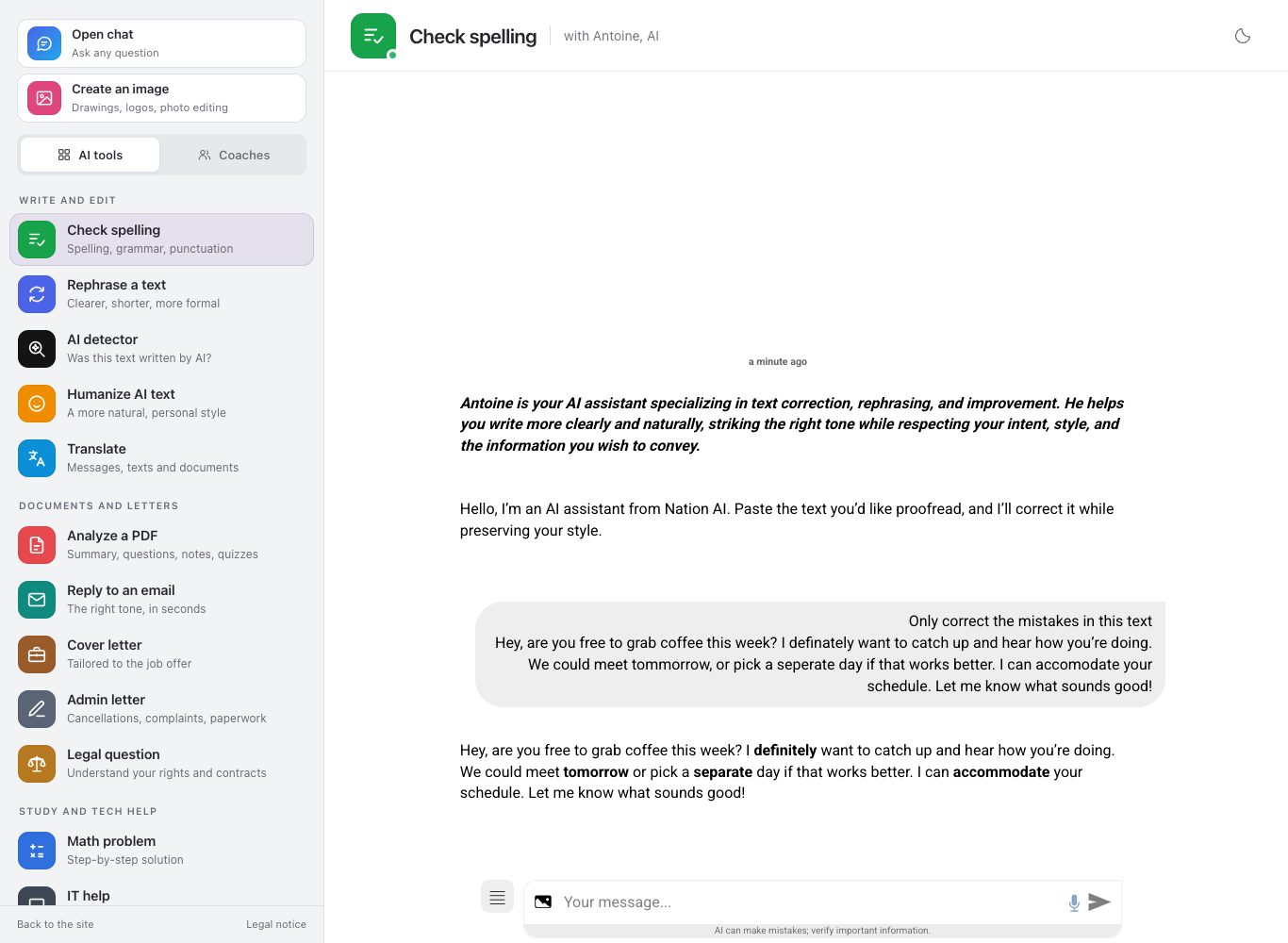
Example of a conversation
What did you change in my message?
“definately → definitely: Corrected the spelling.”
“tommorrow → tomorrow: Corrected the spelling.”
“seperate → separate: Corrected the spelling.”
“accomodate → accommodate: Corrected the spelling.”
His explanations come only if you ask: one line per correction, as the conversation above shows.
Antoine
AI spell checker
“Send me your text and ask for corrections only. Ask why a word changed, and I explain each fix in one line.”
Your own note, checked and returned
Paste it to Antoine, ask him to fix what needs fixing, and get an explanation whenever you want one.
Frequently asked questions
Which words do people misspell most?
There is no official top 50 or top 100. Merriam-Webster keeps two lists that print a usual wrong form beside each of their 24 words, and the Washington State University list kept by Paul Brians gathers 436 correct spellings. The same families come back everywhere: double letters, swapped vowels and spellings borrowed from other languages.
Do we write alot or a lot?
Two words, always: a lot. The Oxford University Press list, drawn from a poll, flags alot among its twenty misspelled words.
Is “i before e” a real rule?
It is a school rhyme, and it comes with numerous exceptions, as Merriam-Webster notes. Achieve is not one of them: the i stays before the e.
License or licence?
In US English, license: the first s-sound is written with c and the second with s, which keeps them in alphabetical order. Licence is the British form.
Sources
- Commonly Misspelled Words, the Merriam-Webster list.
- Why English has so many silent letters, Merriam-Webster.
- More Commonly Misspelled Words, the second Merriam-Webster list.
- Other Commonly Misspelled Words, the WSU list by Paul Brians.
- 20 misspelt words in English, listed by the Oxford University Press blog, 19 January 2022.
Got another writing question?
Alex, the generalist assistant on Nation AI, takes any question about a text, an email or a document.