
- Promise a call you will actually make, and nothing if the employer said no contact.
- By email, the letter itself can serve as the message body.
Erin, a nurse with a finished letter, ends it on a single line asking for the conversation. The career-center guides agree on what those closing lines must do; hers does one of the three.
The Three Moves of Your Cover Letter’s Last Paragraph
Three moves, in this order. Running long? Our guide on how long a cover letter should be keeps you to one page.
-
Remind them why you match
Purdue OWL asks for a strong reminder of the match with the job and the organization; Georgetown adds the reason the employer should meet you.
-
Ask for the conversation
Purdue says to request an interview; Illinois wants strong interest and the desire to discuss it further.
-
Thank the reader
Oregon’s close thanks the reader for their time and looks ahead to hearing from them.
Erin’s Ending, Line by Line
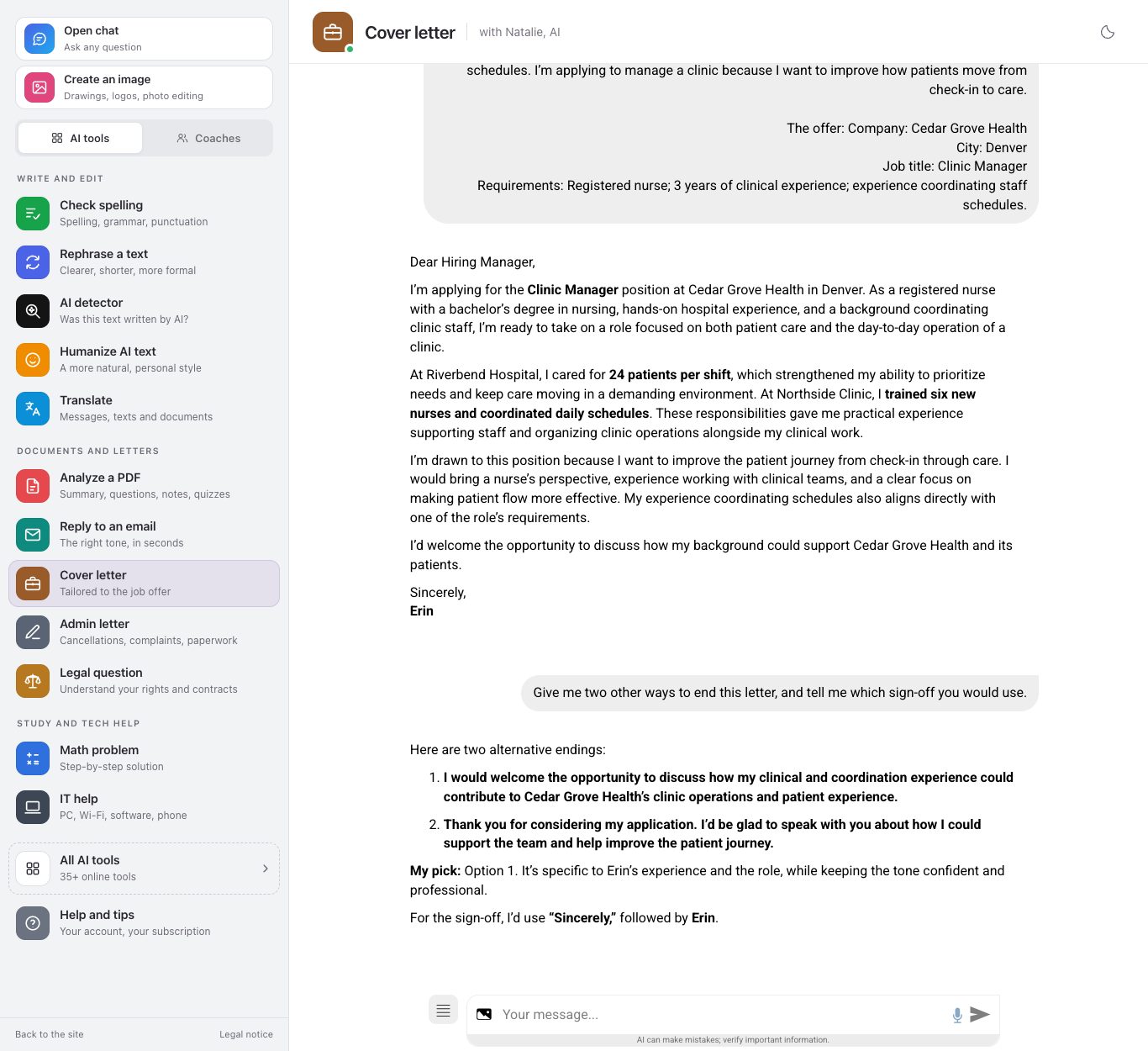
Erin and Cedar Grove Health, applicant and clinic, are fictional; her letter is Natalie‘s, word for word. Of the three moves, her close makes the ask, tied to Cedar Grove Health:
The ending Natalie wrote
I’d welcome the opportunity to discuss how my background could support Cedar Grove Health and its patients.
Sincerely,
Erin
The alternatives cover the other moves; Option 2 brings the thanks.
Option 1
The fit, named
“I would welcome the opportunity to discuss how my clinical and coordination experience could contribute to Cedar Grove Health’s clinic operations and patient experience.”
Option 2
The thanks, up front
“Thank you for considering my application. I’d be glad to speak with you about how I could support the team and help improve the patient journey.”
Natalie’s pick
“My pick: Option 1. It’s specific to Erin’s experience and the role, while keeping the tone confident and professional.”
“For the sign-off, I’d use “Sincerely,” followed by Erin.”
For other applications, our cover letter examples show the same close at work.
Sign-Offs the Guides Use
Then comes the sign-off.
| Sign-off | Where it appears |
|---|---|
| Sincerely | WPI; Cornell; all five Columbia samples |
| Best regards | The other closing WPI names |
| Regards | Cornell, alongside “sincerely” |
The Follow-Up Line: Promise Only What You Can Keep
Cornell wants a specific follow-up time frame; Alabama finds a stated call within a week or two an effective show of initiative. Ohio State adds the unsolicited case: always follow up, saying what your next step is. Its example: “I will contact you in the next two weeks to discuss my interest in working at your practice.”
The promise binds you. Purdue is blunt: “If you say you will call, though, do not forget to do so”; if naming a date feels uncomfortable, delete that part. Georgetown works on a two-week window; skip the promise when the employer asked for no contact. Alabama’s rule concerns phone calls: when employers refuse them, promise no call.
The Email Version: Body or Attachment
The close survives email unchanged; only the wrapper around it changes. CareerOneStop lets the body of the email stand in for the letter; Alabama describes both routes:
- The posting decides: pasted as the message body, or attached as its own file.
- Pasted? Keep the “Dear” greeting you would print.
- Attached? Add a brief, professional message introducing them.
- Subject line: the position title, simple and direct.
- Attach as a PDF, the safe file type.
- Before sending, check the attachment is there.
Natalie’s warning
Warmth is not what the close is for. Cornell’s closing advice: “Avoid unnecessary flattery, exaggeration, and/or being overly grateful.” And keep claims checkable: Natalie writes only from what you give her; company praise comes from your reading of the posting, never from her.
Natalie
AI cover letter assistant
“Give me the posting and your draft, and I’ll shape the close: your strongest experience restated, a clear ask, a plain thank-you. Company claims stay yours; I build on what you hand me.”
Natalie drafts the close with you
In the AI cover letter generator, Natalie builds your close from your posting and draft. A few messages come with the free trial; no account is needed.
Frequently Asked Questions
How do you close an application letter?
With the three moves in order: fit reminder, interview request, thanks; Purdue adds your contact information and your signature underneath.
What is a good last line if I want the interview?
Ask plainly. SIU’s model requests the interview and says how and when you can be contacted, down to a call time; Illinois backs it: the line carries your strong interest and the desire to interview.
Should I sign it?
Yes. On paper, sign your name in ink, black by Cornell’s rule. Online, your first and last name under the closing does the job.
Sources
- Cover Letter Closings, Purdue OWL.
- Cover Letters, Georgetown University.
- Cover Letters, Thank-You Letters, et al, University of Alabama Career Center.
- Cover Letter Guide, University of Oregon Career Center.
- How to Write a Cover Letter, University of Illinois.
- Creating a Compelling Cover Letter, Cornell College of Human Ecology.
- Writing a Cover Letter, Ohio State’s College of Veterinary Medicine.
- Writing Cover Letters, WPI’s Career Development Center.
- Cover Letters, U.S. Department of Labor’s CareerOneStop.
- Sample Cover Letters, Columbia Career Education.
- Cover Letter, SIU Career Services.
A letter that ends on a plan
Alex drafts the whole letter with you in the Nation AI chat, sign-off included.