

- Cover letters: five of the six university career centers advise another greeting; UC Davis still allows it as a final choice.
- The hiring manager’s name comes first when it can be found; “Dear Hiring Manager” leads the replacements.
- For notices and general letters with no reader to name, it still works.
The letter is written except for its first line, and no name has surfaced to open it. Five safe words offer themselves; they are correct English, and career centers still warn against them.
To Whom It May Concern: What It Means
Cambridge treats the phrase as one fixed greeting for the start of a formal letter or notice whose correct reader is unknown.
In its cover letter example, Cambridge picks the hiring manager first, this greeting only otherwise.
Who or Whom: One Swap Decides
Grammar is not the problem: “to” is a preposition, and a preposition takes whom, as Merriam-Webster and Oxford Learner’s Dictionaries both note. Purdue OWL adds that after a preposition, whom cannot simply be left out.
For who vs. whom everywhere else, one swap decides: who acts, the way he acts; whom receives, the way him receives. The writing center at California State University Long Beach pairs who with he, she and we, and whom with him, her and us. The greeting passes: to whom, like to him.
Capitals and the Colon After the Greeting
Where the sources show the greeting punctuated, the mark is a colon. Alabama’s career center says to use one instead of a comma, and Oregon State’s model greeting ends the same way, “Dear Dr. Wu:”. Some cover letter templates put a comma after the greeting, and our guide walks through how to address a cover letter, comma against colon.
Capitals follow the examples, not a stated rule. Cambridge’s example sentences capitalize the first word when the greeting opens a line, and set all five words in lower case when the phrase runs inside a sentence.
In a Cover Letter: What Six Career Centers Say
The greeting is one line in a longer letter; our guide on what a cover letter is covers the whole page. On this line, five of the six university career centers steer applicants elsewhere; UC Davis alone keeps it.
| Career center | What it says |
|---|---|
| USC | Avoid it; find a recruiter or a manager, or use “Dear Hiring Manager.” |
| University of Alabama | Calls it outdated; put a colon after whatever greeting you choose. |
| Northeastern | Avoid it; “Dear Hiring Manager” or “Dear Search Committee.” |
| UT Austin | Skip it; use the name, “Dear Hiring Manager” or “Dear Hiring Team.” |
| Oregon State | Avoid it; a title works in its place, as in “Dear Hiring Manager.” |
| UC Davis | The exception: the phrase stays on its list, after “Dear Search Committee” and “Dear Hiring Manager.” |
| CareerOneStop | Keep it off the letter; use the recipient’s job title, “Human Resources” or “Search Committee.” |
What to Write Instead
The default
Dear Hiring Manager
Named by five of the six pages, it fits when no name turned up.
When a committee hires
Dear Hiring Committee or Dear Search Committee
USC accepts the hiring-committee version; Northeastern, UC Davis and CareerOneStop name the search-committee form.
Through human resources
Dear Human Resources Manager
Alabama and Oregon State suggest it when the application runs through HR; plain “Human Resources” also works.
When a name or a title exists
The name, or the recipient’s job title
CareerOneStop’s template opens “Dear Ms./Mr.” plus the hiring manager’s name; its fallback is the job title, as in “Office Manager.”
Nora’s Letter, With the Greeting Switched
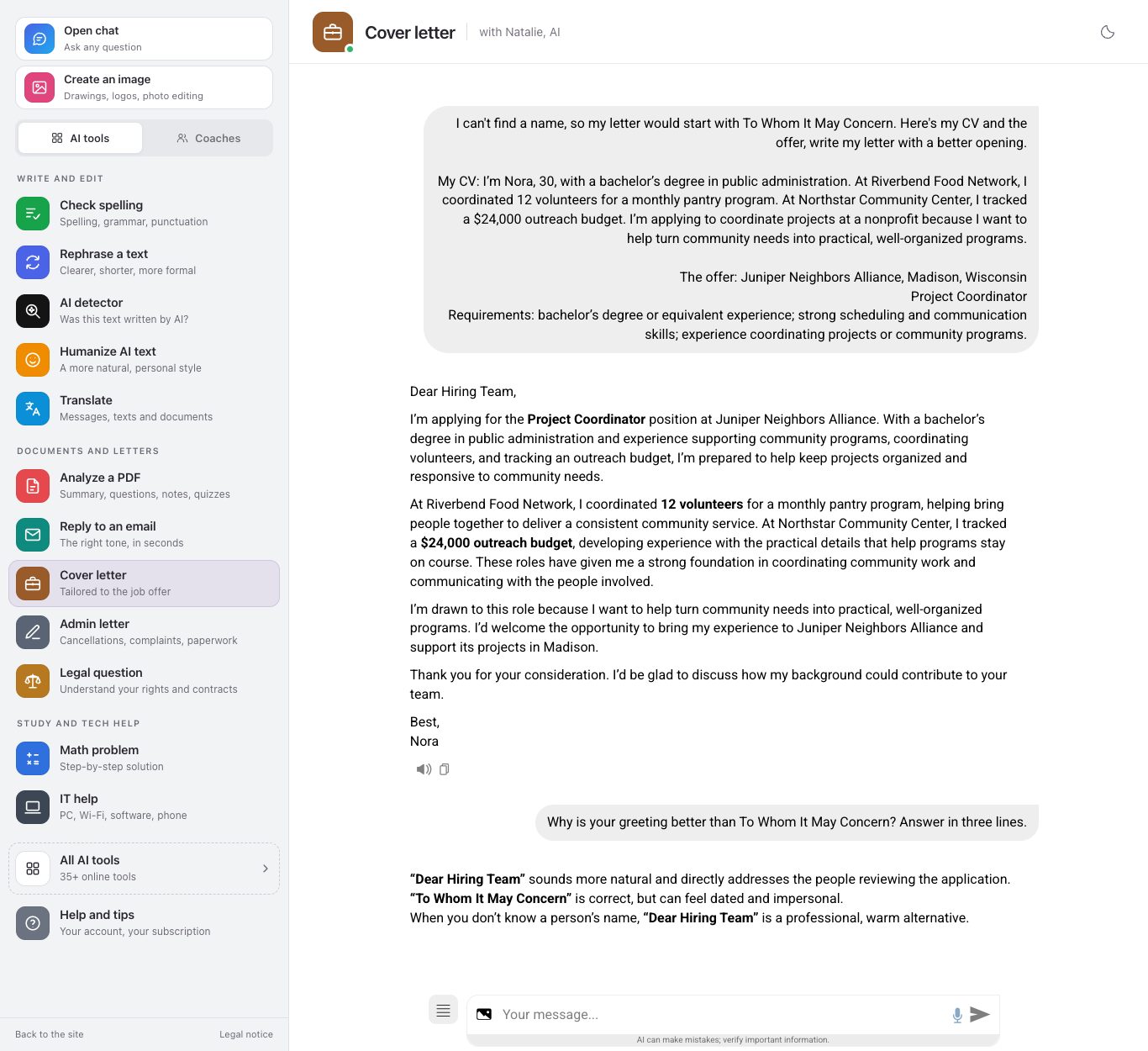
Nora, applying to coordinate projects at Juniper Neighbors Alliance, a nonprofit in Madison, Wisconsin, could not find a name to greet. Natalie wrote the letter below from her CV and the posting. Nora and the employer are invented.
The letter Natalie wrote for Nora
Dear Hiring Team,
I’m applying for the Project Coordinator position at Juniper Neighbors Alliance. With a bachelor’s degree in public administration and experience supporting community programs, coordinating volunteers, and tracking an outreach budget, I’m prepared to help keep projects organized and responsive to community needs.
At Riverbend Food Network, I coordinated 12 volunteers for a monthly pantry program, helping bring people together to deliver a consistent community service. At Northstar Community Center, I tracked a $24,000 outreach budget, developing experience with the practical details that help programs stay on course. These roles have given me a strong foundation in coordinating community work and communicating with the people involved.
I’m drawn to this role because I want to help turn community needs into practical, well-organized programs. I’d welcome the opportunity to bring my experience to Juniper Neighbors Alliance and support its projects in Madison.
Thank you for your consideration. I’d be glad to discuss how my background could contribute to your team.
Best,
Nora
The switch, in Natalie’s words
Why is your greeting better than To Whom It May Concern?
“Dear Hiring Team” sounds more natural and directly addresses the people reviewing the application.
“To Whom It May Concern” is correct, but can feel dated and impersonal.
When you don’t know a person’s name, “Dear Hiring Team” is a professional, warm alternative.
For finished letters, our cover letter examples show three more.
Natalie
AI cover letter assistant
“Send me the posting and what you have done, and I draft the letter from your material alone. I never invent experience; when a detail is missing, I ask you for it.”
From greeting to full letter
Paste the job posting into the AI cover letter generator, tell Natalie what you have done, and she returns the letter with the greeting settled, ready to reread and send.
Frequently Asked Questions
Should it be “To Whom This May Concern”?
No. The standard phrase uses “it”: the letter may concern whoever ends up reading it. With “this”, it is not the phrase Cambridge records.
Does the greeting come off as rude or old-fashioned?
Rude, no; dated is the charge. Alabama lists it among greetings “considered outdated,” and Merriam-Webster notes that whom, though correct here, “often sounds fussy and unnatural” in regular writing.
Can I still use the greeting?
Yes, where the reader has no name: it was written for formal letters and notices with an unknown reader. UC Davis keeps it as the last choice after the named greetings.
Sources
- Cambridge Dictionary, entry “to whom it may concern”.
- Merriam-Webster, on using who or whom.
- Oxford Learner’s Dictionaries, entry “whom”.
- Purdue OWL, on relative pronouns.
- Who vs. whom, writing center handout, California State University, Long Beach, 2016.
- Cover letter overview, University of Southern California.
- Cover letters, University of Alabama.
- Cover letter guide, Northeastern University.
- Cover letters, CNS Career Services, UT Austin.
- Cover letters, Oregon State University.
- Cover letters, UC Davis.
- CareerOneStop, on writing a cover letter.
One more pass before it goes out?
Alex, Nation AI’s generalist assistant, helps you polish every other line of the application.