- The indicator lives in the report you open from Moodle, Blackboard or Canvas, not in the platform’s own screens, and an administrator can hide it from every instructor.
- Turnitin says its percentage must not be the only grounds for action or for a grade.
- The Center for Teaching Excellence at the University of Kansas calls a detector score “information, not an indictment.”
- FERPA permits disclosure of student records to an outside firm only when that firm does institutional work the school would otherwise staff and remains under the school’s direct control.
It is late, the essays are still stacked, and one paragraph reads smoother than anything that student has written for you before. A checker answers in seconds. What the answer can justify, what it leaves untouched, and how to raise the matter without an accusation decides the rest of the term.
One paragraph that does not sound like the rest
You know this student’s usual prose: short sentences, a jolted transition, one idea at a time. The paragraph in front of you about drought and plowing moves in perfect order, repeats no word, and ends on a tidy restatement of its point. Nothing in it is wrong, and that is what stops you.
The demonstration runs on a short history passage drafted for this article by Nation’s general assistant, Alex. No student wrote it.
With Victor
I’m a teacher. I pasted one paragraph from a student’s history essay about the Dust Bowl. Does it read as AI?
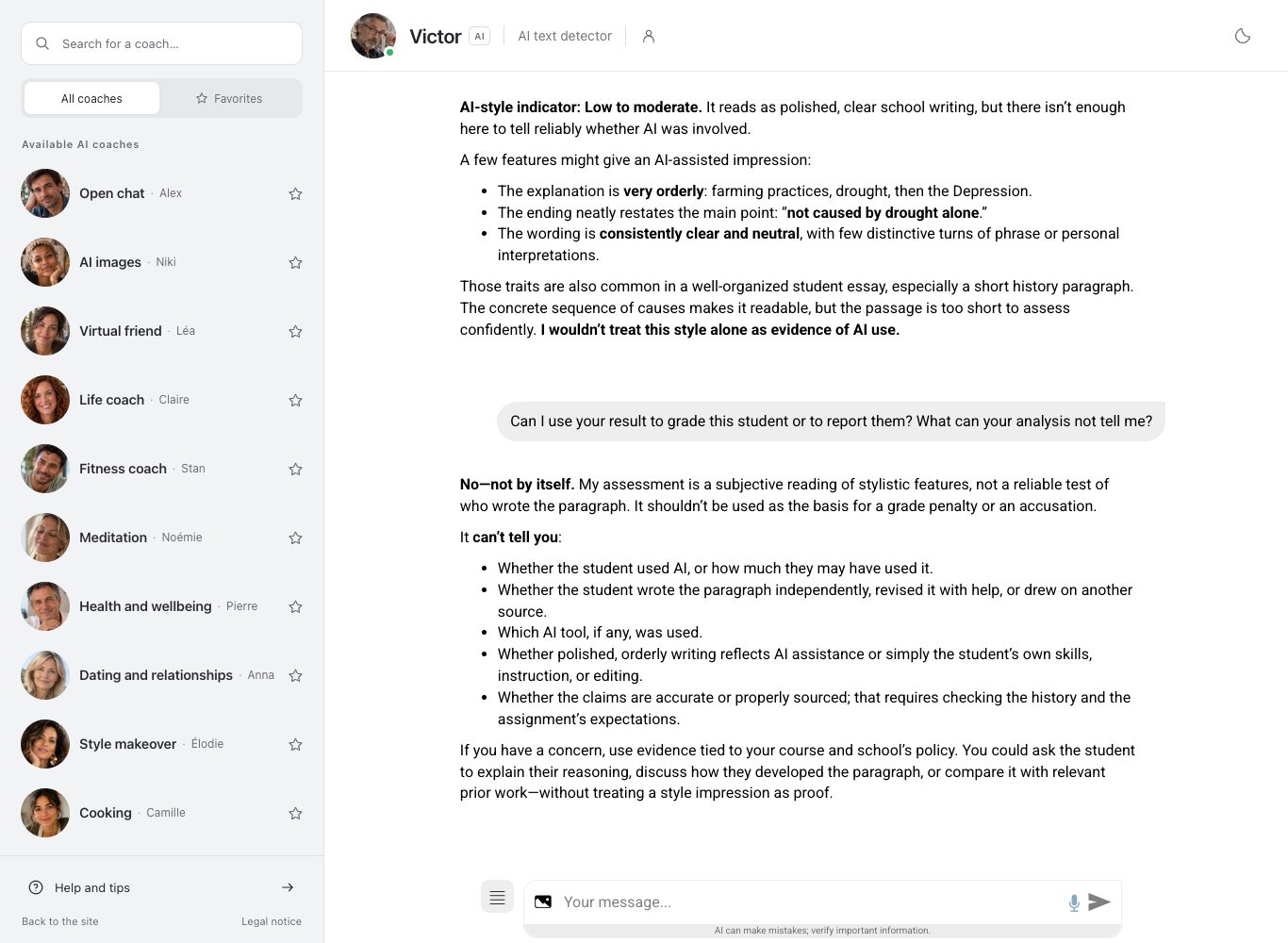
AI-style indicator: Low to moderate. It reads as polished, clear school writing, but there isn’t enough here to tell reliably whether AI was involved.
The wording is consistently clear and neutral, with few distinctive turns of phrase or personal interpretations.
Those traits are also common in a well-organized student essay, especially a short history paragraph. The concrete sequence of causes makes it readable, but the passage is too short to assess confidently. I wouldn’t treat this style alone as evidence of AI use.
Can I use this to grade the essay or report the student?
It can’t tell you:
Whether the student used AI, or how much they may have used it.
Whether the student wrote the paragraph independently, revised it with help, or drew on another source.
Which AI tool, if any, was used.
Whether polished, orderly writing reflects AI assistance or simply the student’s own skills, instruction, or editing.
Whether the claims are accurate or properly sourced; that requires checking the history and the assignment’s expectations.
Victor works inside Nation’s AI text detector and answers with a level, not a number for the gradebook.
Which AI checker teachers actually use
If your campus supplies a checker, it is most likely Turnitin’s AI writing indicator, and it does not surface where you would look. The learning platform shows no AI score of its own. You open the Similarity report from Moodle, Blackboard or Canvas, and the reading is inside.
Instructors and administrators are the only people who see it. An administrator who disables the feature removes it from their reports until someone enables it again.
Turnitin draws its own line: the company says it makes no finding of misconduct and hands educators data to judge under campus policy. Nation’s detector plays a different role in your hands, a second reading you take yourself rather than a verdict the school records.
Our guide to how Canvas handles detection follows the score from the submission to your screen, and lists the campuses that switched the feature off.
What the numbers behind a score amount to
Turnitin keeps quiet below a fixed line: it displays no document score under 20%, and the vendor’s own explanation is that a low share of suspected text comes with more false positives. Twenty percent is where the scale starts, not where dishonesty begins.
The Kansas center reads a margin of error of about 15 points either way around a score. Vanderbilt ran its own arithmetic in August 2023 on the vendor’s claim of a 1% false-positive rate: on its campus, around 750 student papers could have been labeled wrongly.
No source we read reports a share of teachers who run a checker. What your campus provides depends on its licence, not on a national average.
What to assign instead of chasing a score
Vanderbilt’s guidance goes past the conversation and into the task itself: writing done in class, prompts tied to what the class discussed, questions about current events no model was trained on.
The Kansas center offers relief at the other end. A student whose work still looks doubtful after the meeting can be asked to do the assignment a second time.
MIT Sloan’s team would rather see the trail than the verdict, with a short written account of how the work was done and an outline handed in before the final paper. An oral walk-through of the process costs a few minutes in office hours and tells you more than a percentage.
What teaching centers advise
Put the same question to three teaching centers and the answers converge: a score starts a conversation rather than settling one.
Kansas
Teaching center
Its guidance reads a detector result as information rather than an accusation, and leaves the interpretation to the instructor. The steps it gives: compare the work, hold a conversation with the student, ask how the process unfolded.
Nebraska at Kearney
AI Lab
The lab will not treat a detector result as conclusive evidence of cheating. It asks for a conversation and a comparison with earlier submissions.
MIT Sloan
Teaching and learning team
In August 2023 the team called detector software “far from foolproof” and warned about false accusations. Its advice: a short written account of the process, and an outline due before the paper.
The exposure is uneven: the study by Liang and colleagues found detectors likelier to flag second-language writers. Our account of a student whose own prose came back flagged shows the cost from that chair.
Before you paste anything into a checker
FERPA governs what your school may hand an outside company. Under 34 CFR 99.31, a school may release education records to a contractor performing a service it would otherwise staff itself, provided those records stay under its direct control.
The Education Department’s student-privacy site has nothing on detectors, so your institution’s rules decide.
- Check the tool against your school’s approved list first.
- Drop the student’s name and any identifying detail.
- Paste one passage, not the whole essay.
Nation says the detector keeps no copy of what you paste and that chats do not feed its training data.
Victor
AI text detector
“I give you a qualitative index, low, moderate or high, instead of a number dressed up as precision, and I point to the passages that carry the signals. My reading is a stylistic indicator, not proof, and I never conclude from style alone that a student cheated.”
The conversation, not the accusation
So you ask how to raise it with the student.
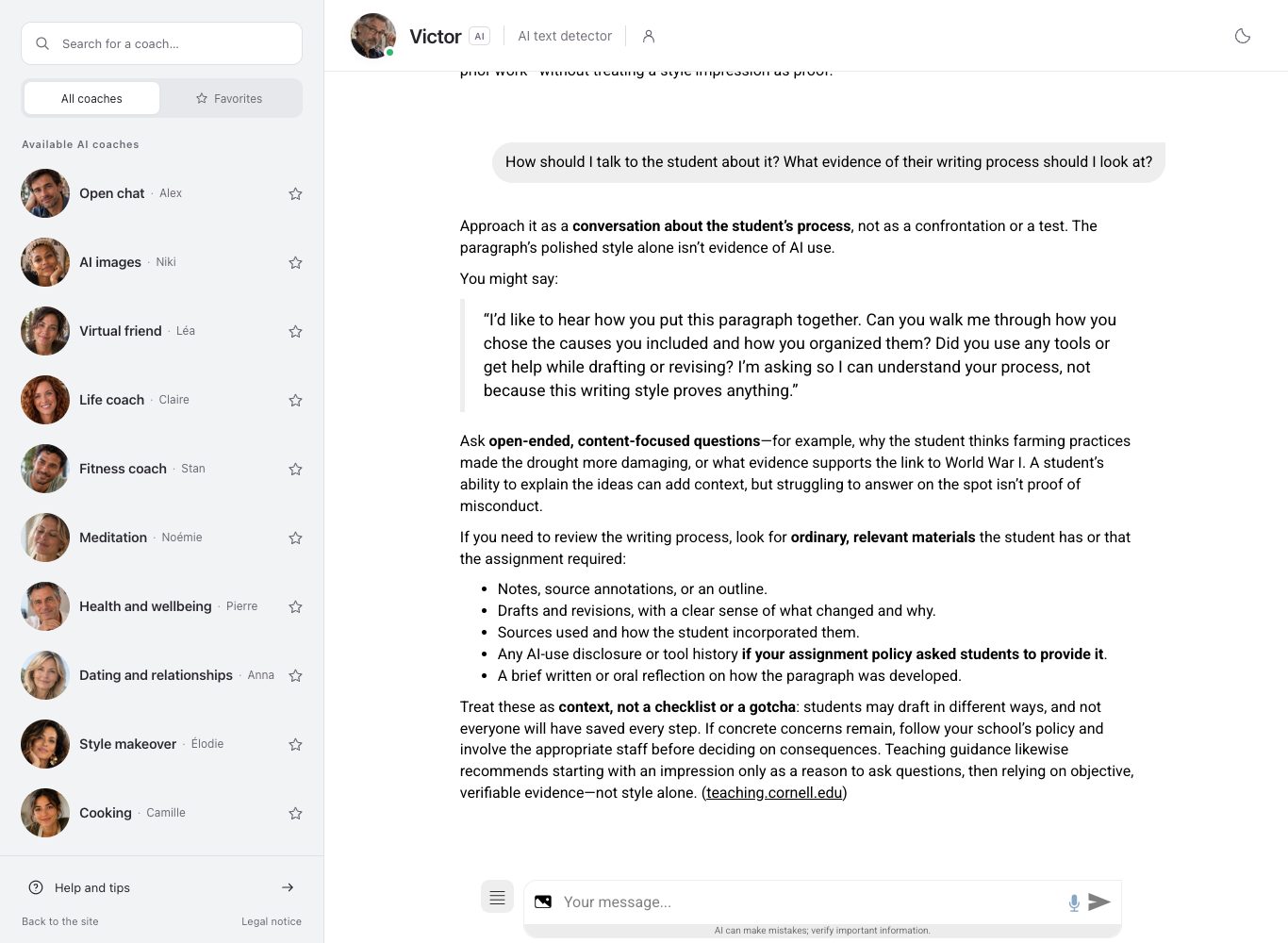
“Approach it as a conversation about the student’s process, not as a confrontation or a test. The paragraph’s polished style alone isn’t evidence of AI use.”
Then he offers words to borrow.
“I’d like to hear how you put this paragraph together. Can you walk me through how you chose the causes you included and how you organized them? Did you use any tools or get help while drafting or revising? I’m asking so I can understand your process, not because this writing style proves anything.”
He also names the ordinary traces worth asking for.
- Notes, source annotations, or an outline.
- Drafts and revisions, with a clear sense of what changed and why.
- Sources used and how the student incorporated them.
- Any AI-use disclosure or tool history if your assignment policy asked students to provide it.
- A brief written or oral reflection on how the paragraph was developed.
He frames those materials as background rather than as evidence to catch anyone out: “Students may draft in different ways, and not everyone will have saved every step.”
If a concrete doubt survives the meeting, he sends you back to your school’s policy and the staff who own that step, not to his reading. What you write down is the student’s account of the process next to your own comparison with earlier work; the tool supplies a signal, the institution decides.
How the main detectors compare
Set side by side, the detectors discussed above differ on five points: does the tool explain which passages it flags, does it give a graded reading instead of a number dressed up as precision, can you try it without signing up, which languages does it handle, and what does it cost. On those five, Victor and Nation lead. Accuracy ranks none of them here, since Nation’s detector appears in no independent test.
| Criterion | Nation (Victor) | Turnitin | GPTZero | Pangram | Copyleaks |
|---|---|---|---|---|---|
| Who can use it | Anyone, with no account | Institutions holding a licence | Anyone, an account above 10,000 characters | Anyone | Anyone |
| Free use | Yes, a few messages, no sign-up | None offered | 10,000 words a month | Three scans a day | 25,000 characters without logging in |
| Public price | Two weeks $9, a month $19 | not stated | Premium 9.99 € a month billed yearly, Professional 19.99 € | $20 a month after a 7-day trial | Personal $13.99 a month, Pro $74.99 |
| Languages | The language of the text; no published list | English, Spanish, Japanese, Modern Arabic, Dutch, German, Turkish | English, German, Portuguese, French, Spanish | More than 20, French and Spanish named | More than 30, French and Spanish named |
| Output form | Graded reading, low to high, plus the passages Victor explains | A percentage with highlighted sentences, nothing below 20% | A suggested percentage with highlighted phrases | Scores and highlighted segments | A percentage with sentence detail; phrase analysis paid |
Prices as displayed by each vendor, read October 30, 2026.
Whichever column you read, the rule from the opening still holds: a score is a question about authorship, never an answer to it.
Questions teachers ask
Which checker do teachers actually get to use?
If a campus has bought Turnitin and kept the feature switched on, its indicator shows up in the Similarity report, opened from the learning platform. Turnitin names Moodle, Blackboard and Canvas. Without a licence, or with the feature disabled, a teacher sees nothing.
Can an AI score by itself justify failing someone?
Turnitin says a percentage alone cannot ground a penalty or a final grade, and that it makes no finding of misconduct. The Nebraska at Kearney lab likewise refuses detectors as definitive proof.
Is a score around 20% bad?
Turnitin shows no score below 20%, and its own explanation says a small share of flagged text comes with more false positives. The line marks where the scale starts being displayed, not where cheating begins.
Do these tools go harder on second-language writers?
On the 2023 study in Patterns, yes. In that test, most of the TOEFL essays drew an AI label they did not deserve, and the mean false-alarm figure came to 61.3%.
Is Victor free?
You can start without an account or a card, and a handful of messages cost nothing. Prices seen on October 30, 2026: $9 for the two-week plan, $19 per month.
Read the passage before the gradebook
Paste a paragraph with every name removed, look at the sentences Victor points to, then hold the conversation with something concrete in hand. Free trial, no account.
Sources
- Kansas teaching center, page on the careful use of detectors, undated, read October 30, 2026.
- Nebraska at Kearney lab, a page for instructors on judging detection tools, undated, read October 30, 2026.
- MIT Sloan teaching and learning team, a page on why detection software fails, August 30, 2023.
- 34 CFR 99.31, Electronic Code of Federal Regulations, text in force, read October 30, 2026.
- Liang and colleagues, in Patterns, on detector bias against second-language writers, 2023.