- The AI percentage stands apart from the similarity score; Turnitin describes the two as different and independent.
- From 1 to 19%, the report shows an asterisk instead of a number, with no highlights; AI passages appear highlighted in blue from 20%.
- The model only reads prose, 300 words up, and only in seven listed languages; poems, code, bullet lists and tables stay outside.
- Vanderbilt switched Turnitin’s AI detector off in August 2023, unconvinced it worked.
“Anything over 20% on Turnitin and you’re done.” The sentence travels down the hallway two days before your paper is due, and that percentage becomes the only unknown. You can hand in your paper knowing what the number means, who reads it, and how to defend what you wrote.
The rumor about the number
By evening, the rumor has a name: your department runs papers through Turnitin, the software your instructors use. The question ends up in front of our free AI detector, where Victor reads your texts and points out what sounds machine-written.
With Victor
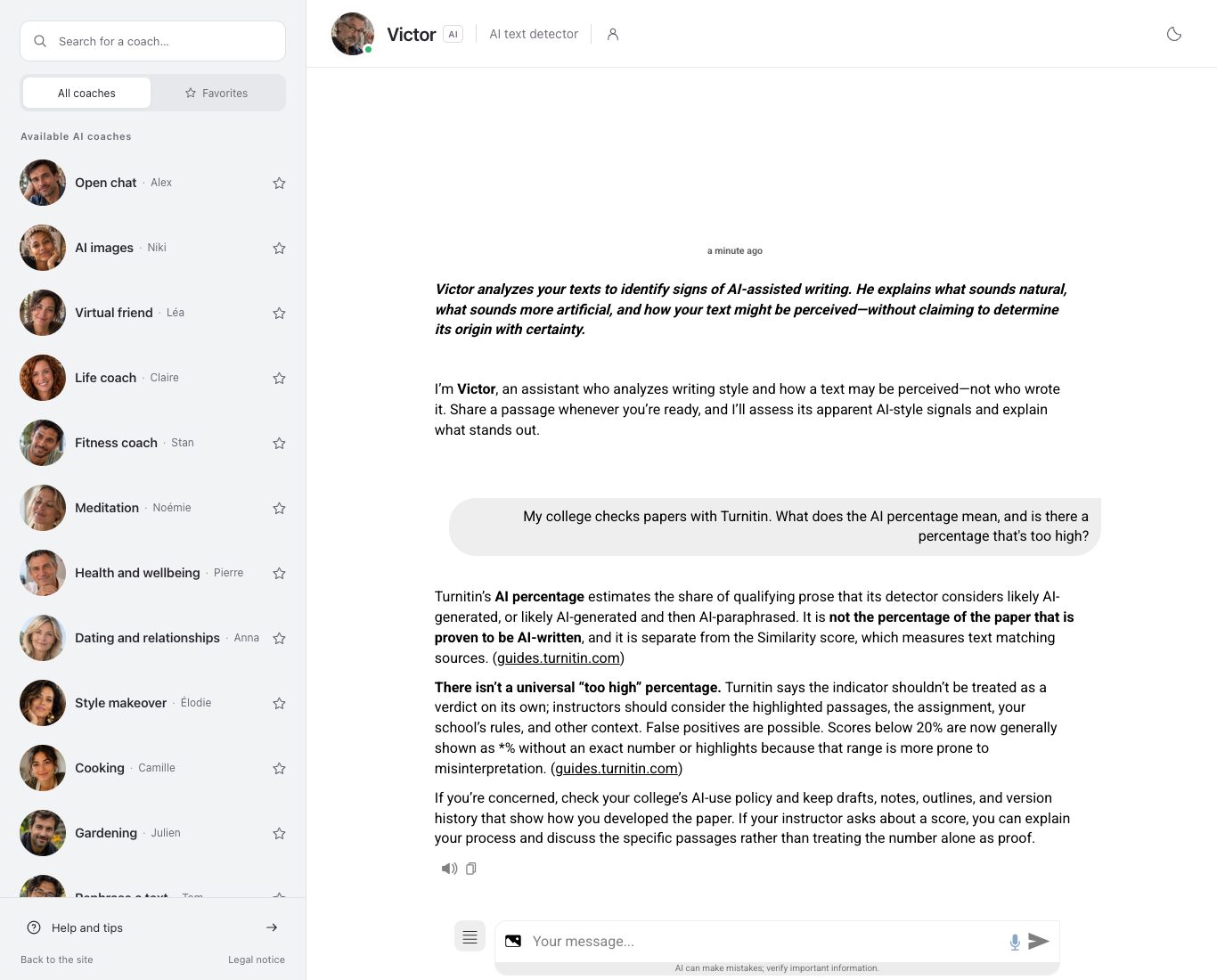
My college runs every paper through Turnitin. What does that percentage mean, and how high is too high?
Turnitin’s AI percentage estimates the share of qualifying prose that its detector considers likely AI-generated, or likely AI-generated and then AI-paraphrased. It is not the percentage of the paper that is proven to be AI-written, and it is separate from the Similarity score, which measures text matching sources.
There isn’t a universal “too high” percentage. Turnitin says the indicator shouldn’t be treated as a verdict on its own; instructors should consider the highlighted passages, the assignment, your school’s rules, and other context. False positives are possible. Scores below 20% are now generally shown as *% without an exact number or highlights because that range is more prone to misinterpretation.
If you’re concerned, check your college’s AI-use policy and keep drafts, notes, outlines, and version history that show how you developed the paper. If your instructor asks about a score, you can explain your process and discuss the specific passages rather than treating the number alone as proof.
The score, as Turnitin explains it
In its AI writing guides, Turnitin presents the percentage as the share of qualifying prose its model calls likely AI-written. The report separates “AI-generated” from “AI-paraphrased”, with the flagged passages highlighted in blue inside the paper.
300 words
of prose at a minimum: below that, the model produces no AI report.
File requirements, Turnitin Guides
1 to 19%
the asterisk range, shown without an exact number or highlights.
Display rule, Turnitin Guides
30,000 words
of prose at most in one paper: past that, no AI report either.
File requirements, Turnitin Guides
The model reads long-form English, Spanish, Japanese, Modern Arabic, Dutch, German, and Turkish; anything else comes back unprocessed. The percentage never arrives alone: Turnitin’s guide calls it “different from and independent of the similarity score,” and its highlights “are not visible in the Similarity Report.” The AI-paraphrased half of the check only runs on English submissions.
The wording carries the caveat: the model labels text “likely AI-generated”, nothing more, and Turnitin warns that it “may not always be accurate.” On October 14, 2026, the company refreshed its English model; reports generated before that date keep their original version.
The fatal threshold is a myth
The myth
Past a certain percentage, you are done: the sanction falls by itself.
The reality
The University of Arkansas tells its instructors that a flagged percentage “should not automatically result in a report of academic misconduct.” Its guidance has instructors look closer only on papers of 300 words or more with over 20% flagged: one university’s rule, not Turnitin’s. And the final call, for Turnitin, rests with the person who grades.
Vanderbilt went further. In August 2023, the university decided “to disable Turnitin’s AI detection tool for the foreseeable future,” adding that it does “not believe that AI detection software is an effective tool that should be used.”
Rephrased by AI, and still flagged
Last temptation before handing it in: pass the paper through a rephrasing tool and watch the number fall. Turnitin’s guide closes that door.
What the model labels “AI-generated” covers text that was likely generated by a large language model, and the label sticks when that text was reworked afterwards by a paraphrasing tool or a bypasser, the guide says. The passage stays highlighted in blue either way.
What actually helps has not moved: know your school’s AI rules, and be ready to walk a reader through your work.
Victor
AI text detector
“I read the style of your paragraphs and tell you where your text sounds machine-written, with a level instead of a percentage. I never call you a cheater on style alone, and I don’t help you dodge a detector.”
Does Turnitin check for AI on every paper?
No, and not always where it does. Turnitin only reports on submissions that meet its file, length, and language requirements, and the report is built on the school’s side and stays there: its FAQ says “only instructors and administrators are able to see the indicator,” and you open it only when your instructor releases it to you.
A flag starts a conversation rather than ending one. Turnitin describes the purpose of its detector as helping “student conversations and interventions on the use of AI writing tools that may not otherwise occur,” so you can ask which passages came up and how your instructor reads them, and hand over the drafts, notes, and version history behind them. What nobody at the school can do is let Turnitin settle the case: “The final decision on whether any misconduct has occurred rests with the reviewer/instructor.”
If your coursework runs inside Canvas, we have a piece on whether Canvas detects AI.
Two days out, Victor’s checklist
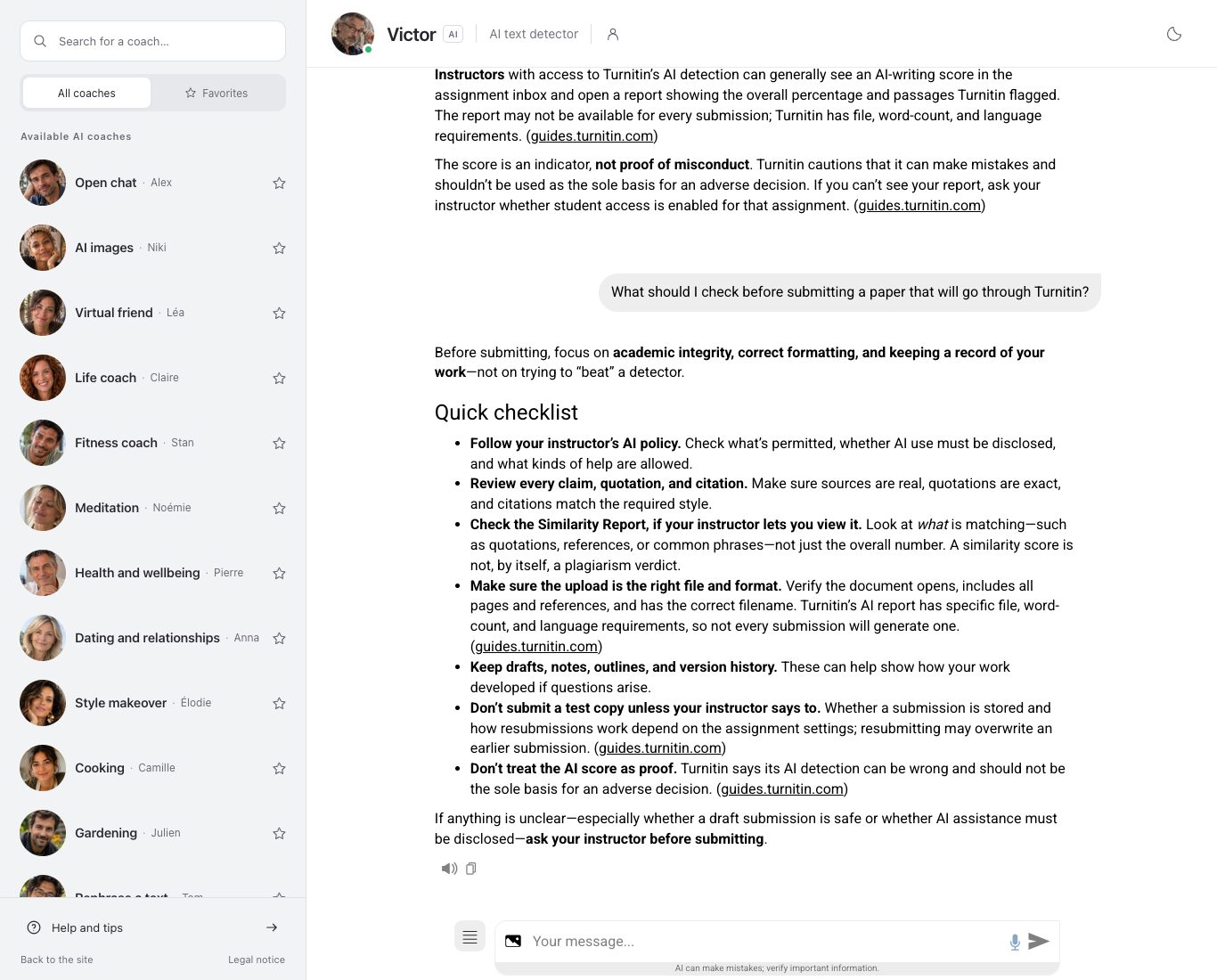
So what do you check in the time you have left? Victor answered exactly that, with a list.
His ground rule, before the list: put academic integrity first, format the file the way your instructor asks, and keep the traces of your work, rather than trying to outsmart a detector.
- “Follow your instructor’s AI policy. Check what’s permitted, whether AI use must be disclosed, and what kinds of help are allowed.”
- “Review every claim, quotation, and citation. Make sure sources are real, quotations are exact, and citations match the required style.”
- “Make sure the upload is the right file and format. Verify the document opens, includes all pages and references, and has the correct filename. Turnitin’s AI report has specific file, word-count, and language requirements, so not every submission will generate one.”
- “Keep drafts, notes, outlines, and version history. These can help show how your work developed if questions arise.”
- “Don’t treat the AI score as proof. Turnitin says its AI detection can be wrong and should not be the sole basis for an adverse decision.”
Victor’s heads-up
Rewriting the paper only to push a percentage down trades two nights for nothing: neither the work nor your defense gets better. Victor never offers a trick to fool a detector; he helps you firm up your sources, your method, and the traces of your process.
To spot for yourself what a detector reacts to, our guide to the signs of AI writing goes through them one by one.
Frequently asked questions
Is the similarity score the same as the AI score?
No. Turnitin calls the AI percentage “different from and independent of the similarity score,” and its highlights “are not visible in the Similarity Report.” One number measures matching with existing sources; the other estimates what reads as machine-written.
Is there a percentage you are allowed to stay under?
No Turnitin guide gives a percentage you could call acceptable. What binds you is the AI policy of your college and your instructor. One example: the University of Arkansas tells instructors to look closer only from 20% flagged up, on papers of 300 words or more, and even then the flag calls for a review, not a verdict.
Does Turnitin detect ChatGPT?
Text from ChatGPT falls inside what the model looks for: Turnitin’s guide defines “AI-generated” as qualifying text “likely generated from a Large Language Model (LLM).” What comes back is an estimate that its own guide says “may not always be accurate,” not a finding that a machine wrote the paragraph.
Do students get to see the AI score?
Not by default. Turnitin’s FAQ limits the indicator to instructors and administrators, and you open the report only when your instructor releases it to you.
Is Victor free?
You can try him free, with no account and no card, for a few messages; then unlimited use is $9 for two weeks, $19 a month (Nation AI pricing page, October 30, 2026).
Before the deadline, get your own read
Victor hands back a level and shows the passages behind it; free to try, no account.