
- He plays the scene with you in English: a job interview, a hotel check-in, a work meeting.
- He corrects your mistakes and explains each rule in a few words.
- You can start right away with a free trial, with no account and no card needed.
You watch a series in English with subtitles, and you read your emails without thinking too hard. Then a recruiter asks you a question, or a hotel receptionist greets you, and the words stop coming. Here is how to practice speaking every day with Oliver, without fear of getting it wrong.
Day one: a job interview in English
You open the chat and say what you want to practice. You understand English, but you freeze as soon as you have to answer. Tell Oliver your goal, a job interview, and your level, then ask him to start.
Example conversation
I want to practice a short conversation in English for a job interview. My level is B1. Can you start with a question?
Of course. Let’s begin. Interviewer: Could you tell me a little about yourself and your work experience?
Once you give your level and your goal, Oliver starts the scene in his first reply. You answer with the words you have, and he keeps the scene going without stopping you at every word.
The mistakes learners make most often
After a few answers, a sentence like this one often comes out. It looks like English, but the verb forms are wrong. Oliver corrects it and gives you the rule.
Before
“I am agree with you. Yesterday, I have went to the cinema with my friend.”
Mistake: agree is a verb, so we don’t use am before it. Yesterday needs the past simple, not the present perfect.
After
“I agree with you. Yesterday, I went to the cinema with my friend.”
Rule: am, is and are go with adjectives and nouns, as in I am happy. With an ordinary verb, use the verb directly: I agree. A finished time like yesterday takes the past simple: I went.
The trap is that learners translate word for word from their own language, and English says something else. Oliver lists five common mistakes when learners speak. Here are four of them, with the right sentence and a short reason. These patterns are common, but the errors people make depend partly on their first language.
She work nearby.
She works nearby.
In the present simple, add -s to the verb with he, she or it, as in He likes or It works.
I see him yesterday.
I saw him yesterday.
Match the verb to when it happened. Yesterday is in the past, so the verb is saw.
I’m interested on music.
I’m interested in music.
Prepositions often don’t translate word for word, so learn them in phrases such as interested in.
Where she lives?
Where does she live?
Many questions use do, does or did, then the subject and the verb.
Word pairs that trip you up
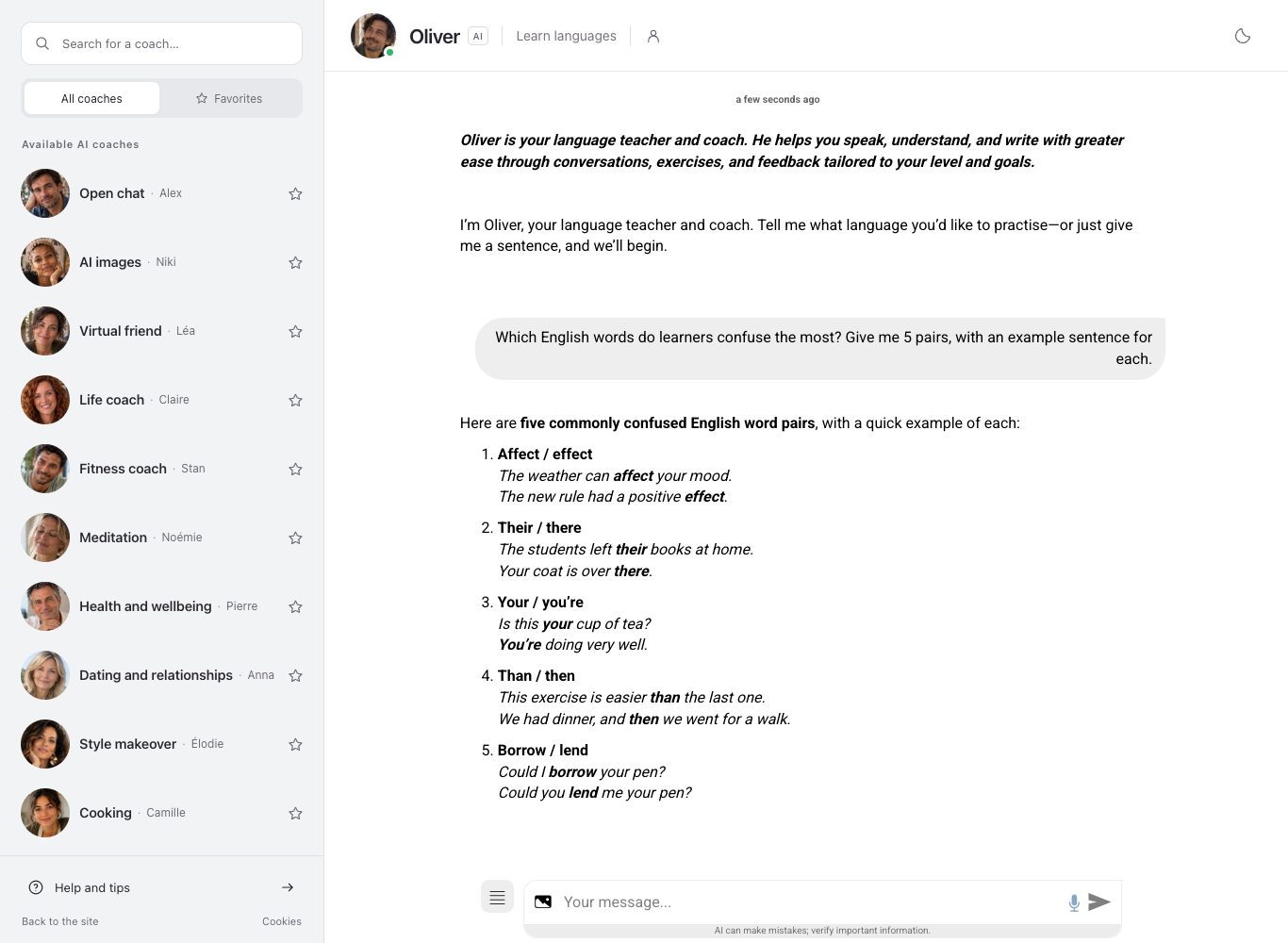
Some English words are easy to mix up. When you ask Oliver which word pairs learners confuse most, he gives five.
| Word | What it means | Often confused with |
|---|---|---|
| affect | to influence or change something | effect (a result) |
| their | belonging to them | there (in that place) |
| your | belonging to you | you’re (you are) |
| than | used to compare two things | then (next, or at that time) |
| borrow | take something and give it back later | lend (give something for a while) |
An example helps you remember the meaning. “The weather can affect your mood.” Here, affect is a verb: the weather changes how you feel.
A hotel check-in in London, then the train
You walk into a hotel in London, your suitcase in hand. Oliver, playing the receptionist, says: “Good afternoon! Welcome to the hotel. Do you have a reservation?” You answer as best you can.
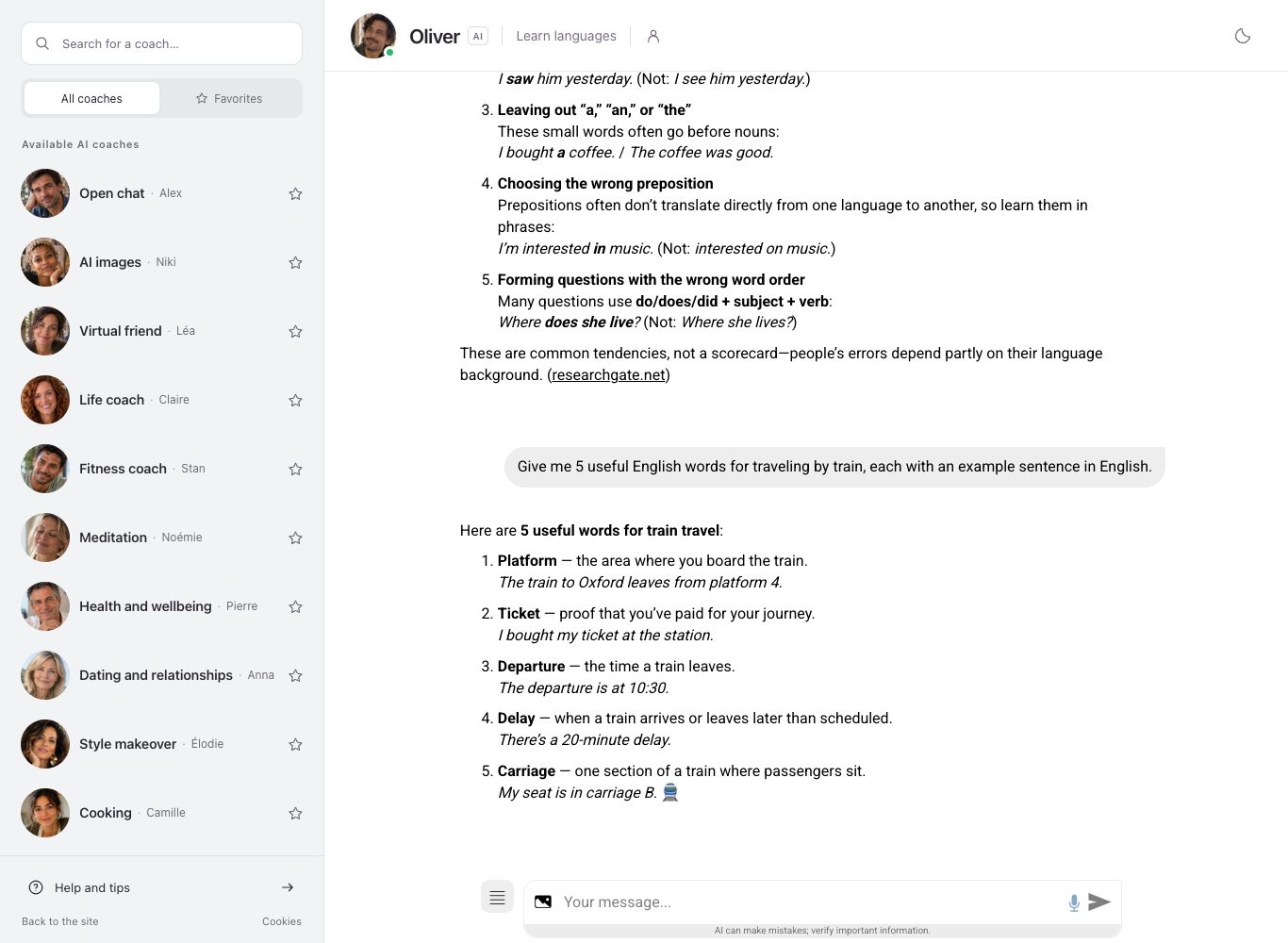
A few days later, you take the train. For this trip, Oliver gives you five useful words.
- platform: the area where you board the train. “The train to Oxford leaves from platform 4.”
- ticket: proof that you have paid for your journey. “I bought my ticket at the station.”
- departure: the time a train leaves. “The departure is at 10:30.”
- delay: when a train arrives or leaves later than scheduled. “There’s a 20-minute delay.”
- carriage: one section of a train where passengers sit. “My seat is in carriage B.”
Example prompt
Play the receptionist at a hotel in London. I am a traveler, and my level is A2. Start the scene, and correct my mistakes at the end.
You will find more ready-made prompts in our list of prompts for students.
Oliver
AI teacher and language coach
“I start by getting you to talk. I don’t correct every word, or the conversation would stop. At the end, I go over two or three important points. My goal is clearer, more natural English, not to erase your accent.”
How to make it a daily habit
You don’t need long sessions. Follow these four steps each time.
-
Tell him your level and your goal
Pick the situation: an interview, a trip, or a talk with a colleague. Oliver adapts what comes next to your goal.
-
Play a scene from your life
A call with a client, a restaurant order, or a question for your manager. The closer the scene is to your real life, the more it helps you.
-
Ask for a recap at the end
When the scene is over, ask him for two or three points to remember, with the rule behind each one.
-
Write down the words, then quiz yourself the next day
Keep the words that stopped you, then use each one the next day in a sentence of your own. If your notes are in a PDF, our multiple-choice quiz generator turns them into a free quiz, with no account needed.
Oliver warns you
Don’t wait for perfect sentences. Mistakes are exactly why I’m here. I let you finish speaking, then I go over the main points at the end.
Start your first scene with Oliver
Tell him your level and your goal, and he starts the scene in his first reply.
Frequently asked questions
Do I have to pay to try it?
No. The trial gives you a few free messages, with no account and no card needed. After that, two plans are offered: $9 every 2 weeks or $19 a month, with unlimited messages. The prices we checked on October 19, 2026 are listed on our pricing page.
Do I need a good level of English to start?
Oliver adapts the conversations, exercises and corrections to your level and your goals. Tell him where you are, and he starts from there.
Can he also help you practice another language?
Yes, Oliver works on several languages. His page offers example requests such as “Spanish beginner conversation”.
An English message to understand or write?
For everything around English that is not a lesson, like understanding a reply you received or writing an email, Alex can help.