
In short

Ethical and responsible AI is no longer an opinion, it is a framework. Ethics sets the principles (transparency, fairness, privacy, accountability), “responsible” refers to making them measurable in practice, and the law, European first and now increasingly American, is starting to enforce them.
Since August 2, 2026, the EU AI Act transparency obligations apply : you must know when you are talking to an AI, and synthetic content must carry a machine-readable mark (article 50 of Regulation EU 2024/1689). The same day, California’s AI Transparency Act kicked in for the largest providers.
What you can do today : check a service against the 10-point scorecard in this article (interactive tool below), apply 4 responsible-use habits, and read the 2 pages that tell you everything : the privacy policy and the terms of service.
A chatbot drafting an email, a generator retouching a photo, an assistant summarizing a document : generative AI has entered daily routines. And the question has changed in nature. Two years ago, asking whether an artificial intelligence was “ethical” belonged to the realm of ideas. Since August 2, 2026, it also belongs to the law : the European AI Act imposes concrete transparency obligations on providers and professional users, and in the United States California’s watermarking mandate now binds the largest providers.
This guide takes stock, without unnecessary jargon, of what “ethical and responsible AI” means in 2026 : the principles, what the law already requires, how to recognize a service that plays by the rules, and which habits to adopt when you use these tools. Most documents on this topic are written for companies ; this one is written for the people actually using the tools.
Ethical AI, responsible AI, trustworthy AI : three words, one idea?
The three expressions circulate and are often mixed up. They do not mean exactly the same thing, and the nuance matters.
- Ethical AI refers to principles : do not discriminate, respect privacy, be transparent, keep humans in charge. That is the “what”, the line that must not be crossed.
- Responsible AI describes the implementation : the processes, checks and evidence showing that these principles are actually applied. A responsible vendor documents its training data, audits its models, names the people accountable, and corrects course when things drift. That is the “how”, and it is measurable.
- Trustworthy AI (the expression used by European institutions) describes the hoped-for outcome : a reliable system you can use without fearing you are being deceived or harmed.
In practice : an AI can be declared “ethical” in a charter and have nothing responsible about it if nothing proves it. This is precisely what the new legal landscape is designed to change : moving from promise to demonstration. Three layers structure the topic : voluntary principles (charters, frameworks), standards (such as ISO/IEC 42001), and the law (the EU AI Act, the GDPR, and state laws in the US).
The “neutral” trap
An AI model is not neutral : it learns from data written by humans, with their blind spots. That is why fairness is ongoing work (measure, correct, test again) rather than a checkbox ticked once and for all.
What the law already requires
The EU AI Act : a schedule already in force
Regulation (EU) 2024/1689, known as the AI Act, entered into force on August 1, 2024 and applies in stages. As of this article’s date, most of it is live, and it reaches any provider or product serving users in the EU :
| Date | What applies | What it changes for you |
|---|---|---|
| August 1, 2024 | The regulation enters into force | The legal framework exists ; vendors organize their compliance. |
| February 2, 2025 | Ban on unacceptable-risk practices (social scoring, subliminal manipulation, exploitation of vulnerabilities) and AI literacy duties for staff | Some uses are banned outright, not merely regulated. |
| August 2, 2025 | Obligations for general-purpose AI models (GPAI) : technical documentation, copyright policy, published summary of training data, documented energy consumption | Major models must be able to justify what they learned from and what they consume. |
| August 2, 2026 | Broad application of the rules, including article 50 (transparency), with Commission guidelines published in July 2026 | You must know when you are talking to an AI ; synthetic content is marked. |
| August 2, 2027 | Extension to AI embedded in already-regulated products (machinery, medical devices…) | The product side catches up with the rest. |
The full text of the regulation is public on EUR-Lex. For an article-by-article walkthrough, our deep dive into the AI Act and European AI regulation remains the best starting point.
Article 50 : the four transparency obligations
This is the part of the AI Act you will meet most often, because it covers everyday generative AI :
- Knowing that you are talking to an AI. A chatbot intended to interact with people must say so, unless it is obvious.
- Marking artificial content. Providers must mark generated image, video, audio and text in a machine-readable format (metadata, invisible watermark).
- Disclosing deepfakes. Whoever publishes a deepfake must reveal that it is artificially generated or manipulated.
- Flagging texts on matters of public interest. AI-generated text dealing with matters of public interest must be disclosed, unless it went through human review with editorial control.
The European Commission adopted guidelines on these obligations in July 2026 and backed a voluntary code of practice on marking AI-generated content to harmonize the technical formats. Concretely, expect “AI-generated” labels, badges and provenance metadata to keep spreading, as they already have on the major image platforms.
The American landscape : the NIST framework and state laws
The United States has no federal equivalent of the AI Act. The reference point is the voluntary AI Risk Management Framework published by NIST (v1.0, January 2023), which structures trust as a set of measurable functions rather than a compliance file. What carries legal weight is happening state by state : California’s AI Transparency Act (SB 942, as amended by AB 853) applies since August 2, 2026 to generative AI providers with more than 1 million monthly users, requiring an embedded machine-readable provenance disclosure, a visible disclosure option, and a free public detection tool, with civil penalties up to $5,000 per violation per day (official bill text).
Wherever you live, privacy law still runs through the GDPR if you serve European users : clear information, data minimization, limited retention, access, rectification and erasure rights, and specific protection against fully automated decisions (article 22 of the GDPR).
Penalties give a sense of scale : up to 35 million euros or 7% of worldwide annual turnover under the AI Act for banned practices, up to 20 million euros or 4% under the GDPR, and up to $5,000 per violation per day under SB 942. Those numbers say it all : “responsibility” is no longer a marketing angle.
A law is only as good as its enforcement
The calendar is under way, but enforcement will take years. Until systematic checks arrive, your best protection is to examine the services you use directly : the scorecard below exists for that.
The 7 pillars of ethical and responsible AI
From UN charters to national frameworks, the principles converge on nearly the same list. Here are the seven pillars, translated into concrete questions :
| Pillar | The question to ask | What it looks like in practice |
|---|---|---|
| 1. Transparency | Am I told that I am using an AI, and what it does with my data? | Clear chatbot disclosure, readable privacy policy, marked generated content. |
| 2. Fairness | Does the system treat everyone equally? | Documented bias tests, published corrections, diverse training data. |
| 3. Privacy | Can I use the service without over-exposing my data? | An opt-out from training on your conversations, deletion available, hosting disclosed. |
| 4. Security and robustness | Does the service resist abuse and errors? | Filters against malicious use, content reporting, security updates. |
| 5. Accountability | Who answers if the system causes harm? | An identified vendor, a contact, a recourse, a human supervising sensitive decisions. |
| 6. Sustainability | Is the energy footprint measured and published? | Documented training consumption, commitments with numbers and dates. |
| 7. Respect for creators | What did the model learn from, and with what permissions? | A published copyright policy, a training-data summary (required since August 2025 for general-purpose models). |

The frameworks that carry weight
Between PR charters and the law, a handful of frameworks set the standard for judging how serious a commitment is. The main ones to know when you read a vendor’s promises :
- The UNESCO Recommendation on the Ethics of Artificial Intelligence (November 2021) : the first global framework, adopted by the organization’s 193 member states. It laid the common ground : proportionality, non-discrimination, transparency, human accountability, sustainability (official text).
- ISO/IEC 42001 (December 2023) : the first certifiable international standard for AI management systems. Think of it as an ISO 9001 for AI : organization, processes, continuous improvement.
- The NIST AI Risk Management Framework (v1.0, January 2023) : the voluntary backbone of American practice, built on govern, map, measure and manage functions that vendors can actually audit (official page).
- State transparency laws : California’s AI Transparency Act (SB 942, in force since August 2, 2026) makes provenance watermarking and a public detection tool mandatory for the largest providers.
- The EU AI Act (2024-2027) : the mandatory layer that turns part of these principles into legal duties.
When a service touts a “responsible AI” charter, look for which layer it sits on : a voluntary principle, a third-party-certified standard, or a legal obligation. The higher you climb, the less room there is for window dressing.
How to recognize a responsible AI : 10 concrete signals
You have neither the time nor the means to run an audit. But ten quick checks, all doable from a service’s public pages, already give you a fair picture of how serious it is :
- The vendor is clearly identified (company, country, contact).
- A readable privacy policy explains what happens to your conversations.
- The service says whether your chats train its models, and lets you refuse or delete.
- It discloses that you are talking to an AI and marks generated content.
- It states the model’s limits (errors, hallucinations) instead of hiding them.
- It publishes a policy on copyright and training data.
- You can delete your account and your data without obstacles.
- A reporting channel exists for problematic content.
- Data hosting is disclosed (in your region when you are in it).
- Pricing and terms are announced with no hidden commitment.
The tool below turns these ten signals into a transparency score out of 20. For each line, verify the criterion on the vendor’s site (legal notice, privacy policy, help center), then answer yes or no :
Quick scorecard : is this AI service responsible?
Ten criteria, a score out of 20, no sign-up : your answers stay in your browser.
Answer the 10 criteria, then run the assessment : the score and its reading will appear here.
Some answers are missing : check one option on each of the 10 lines.
Transparency score : 0 out of 20. Here is how to read it :
0 to 6 : insufficient transparency
Public information is missing or contradictory. Use this service with maximum caution : no sensitive data, verify every output, and look for a more transparent alternative.
7 to 11 : to be kept on a short leash
The service ticks a few boxes but stays vague on essentials, usually training or hosting. Chase the missing answers (help center, support contact) before making it a regular tool.
12 to 16 : fairly responsible
Solid foundations : information is there, control is in the user’s hands. Close the remaining gaps and watch how things evolve : transparency is proven over time, not once.
17 to 20 : strong credentials
The service documents most of its commitments. You can rely on it for everyday uses, while keeping your verification habits : no AI is infallible.
The two-page shortcut
On most serious services, the privacy policy and the terms of service answer 7 of the 10 criteria. Search for the words “training”, “deletion”, “hosting” and “marking” : finding them is often worth more than ten pages of marketing.
Using AI responsibly in everyday life
Responsibility is not just on vendors : users have their own share, and it is easy to hold.
Verify before you believe
A language model produces plausible text, not true text : it can invent a court ruling, a statistic or a quote with perfect confidence. Before you repeat a claim, check its primary source. And be careful with “AI detectors” : they are wrong in both directions, especially with text written by non-native speakers. Better to learn to spot the signs of AI-generated writing yourself, or to try several tools like our free AI detector, without ever treating their verdict as proof.
Protect your data
Golden rule : never paste into a chatbot what you would not hand to a stranger in the street (credentials, medical details, confidential employer documents, third-party data). Then check the setting that decides whether your conversations are used for training : on serious services it is disclosed and can be turned off. Five minutes in the settings make all the difference ; and photos published online deserve the same vigilance, as seen with models trained on Facebook photos.
Play it transparent
If you publish content generated or heavily assisted by AI, say so : it is now a legal duty for deepfakes and texts on matters of public interest, and it is a matter of basic honesty in every case. Respect the service’s terms of use as well (some professional uses require a specific plan) and creators’ rights : borrowing an artist’s style or work without permission remains problematic, even where the law lags behind practice.
Weigh the environmental footprint
Training and running large models consume energy and water. Public figures remain scarce, but they set the scale : training GPT-3, one of the few precisely documented cases, consumed about 1,287 megawatt-hours and emitted about 552 metric tons of CO2-equivalent, according to the reference study by Patterson and colleagues published in 2021 (arXiv:2104.10350). Since August 2, 2025, the AI Act requires general-purpose model providers to document the energy consumption of their training runs, so numbers should keep multiplying. Your share : don’t call on a giant model for a task a mental calculation settles in three seconds.
Which AI to choose when ethics matters?
There is no official ranking of “the most ethical AIs”, and be wary of those who claim to be it. That said, three families of offerings stand out by their default commitments :
| Family | Well-known examples | Points to watch |
|---|---|---|
| Major international players | ChatGPT (OpenAI), Gemini (Google), Claude (Anthropic) | Extensive documentation but decision centers outside Europe ; check your account’s training setting and where data is hosted. |
| European models | Mistral AI (France), with its assistant Le Chat | A visible voice in the sovereign-AI debate ; read its AI policy and terms like any other vendor’s. |
| Layered services | Nation AI (nation.ai) | An interface and support in English on top of first-tier models ; check the confidentiality commitments it advertises (see below). |
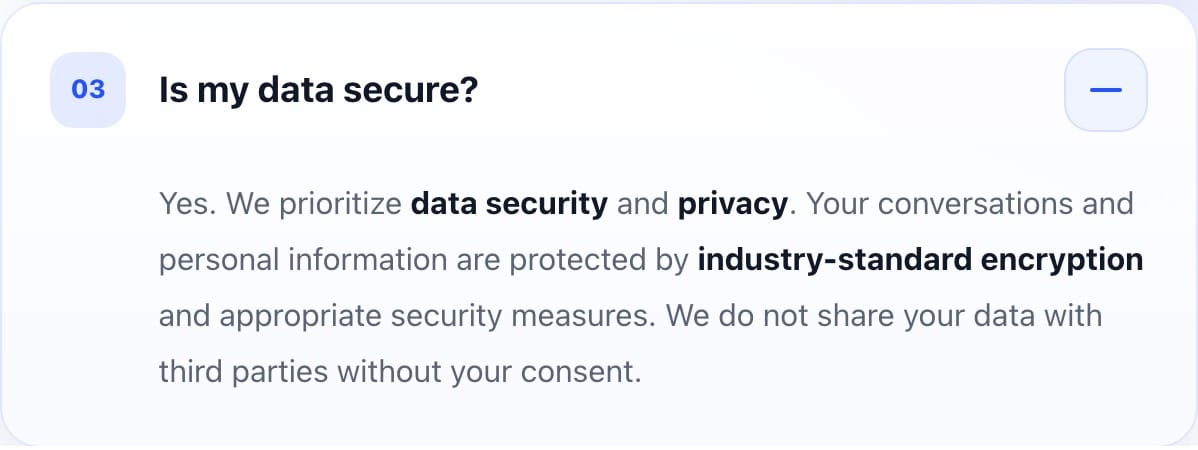
Nation AI, the portal this article belongs to, takes a simple stance : building on the best models on the market with a layer designed in France, human support, and pricing announced with no hidden commitment. Its public FAQ states : “We prioritize data security and privacy. Your conversations and personal information are protected by industry-standard encryption and appropriate security measures. We do not share your data with third parties without your consent.”
Whatever service you pick, run the ten-point scorecard : the score is what counts, not the size of the logo.
Frequently asked questions about ethical and responsible AI
Which AI tools are the most ethical?
There is no official list, and no model is ethical “by nature”. The right question is : which service documents its commitments best? Compare with the ten-point scorecard in this article : vendor transparency, training control, content marking, data deletion. European services, bound by the AI Act and the GDPR, start with a stricter frame ; major international players also publish detailed policies, which you should verify setting by setting.
What is responsible AI, in one sentence?
An AI whose ethical principles (transparency, fairness, privacy, accountability) are implemented through measurable processes : published documents, checks performed, recourse available, corrections applied.
Is ChatGPT an ethical and responsible AI?
ChatGPT scores points for documented commitments (published policies, an opt-out from training, C2PA marking of generated images), and its vendor takes part in voluntary frameworks. But the useful question is yours : what do you use it for, with what data, under which settings? Run the scorecard : the score also depends on your account and your choices.
Since when is labeling AI-generated content mandatory?
In the EU, the machine-readable marking duty (article 50 of Regulation EU 2024/1689) has applied since August 2, 2026, with European guidelines published in July 2026. In the United States, California’s AI Transparency Act has bound the largest providers since the same day. Visible deepfake disclosure and public-interest text flags fall under the same deadline in the EU.
Can an AI ever be fully neutral and bias-free?
No. A model learns from data produced by human societies, which carry imbalances. A responsible system owns that fact : it measures its biases, corrects them, documents its limits. Distrusting whoever promises perfect neutrality is part of informed use.
How do I know if my chats are used for AI training?
Three places to check, in order : the terms of service and privacy policy (search for “training”), your account settings (data controls, opt-out), and the service’s help center. If nothing is documented, that is an answer in itself : count this criterion as unverified in the scorecard.
The bottom line
Ethical and responsible AI is not a philosophers’ debate : it is now a legal framework in the middle of its rollout, a set of measurable standards, and a series of checks anyone can run in minutes. The law requires transparency since August 2, 2026 ; serious vendors already practiced it ; the rest will have to catch up. In between, you now have a scorecard, habits to keep, and documents to demand.
Want to try an AI built for everyday users? Nation AI gives you access to the best models with an interface and support in English, no sign-up to try.
Sources and dates : Regulation (EU) 2024/1689 (EUR-Lex) ; European Commission guidelines on article 50 and code of practice on marking (July 2026) ; NIST, AI Risk Management Framework (v1.0, January 2023) ; UNESCO, Recommendation on the Ethics of Artificial Intelligence (November 2021) ; ISO/IEC 42001:2023 ; California SB 942 as amended by AB 853 (in force August 2, 2026) ; Patterson et al., “Carbon Emissions and Large Neural Network Training” (2021) ; official nation.ai FAQ (checked September 7, 2026). Information provided for general purposes, up to date as of September 7, 2026.