

TL;DR

- Bernard Arnault funds the science behind artificial intelligence through two documented channels: a €50 million gift from his family holding Agache to École Polytechnique to build an Institute of Mathematics and Fundamental Sciences (announced June 25, 2026, opening targeted for 2030), and stakes taken in 2024 by his fund Aglaé Ventures in five AI startups, worth more than $300 million.
- His name is also used as bait: a deepfake video run as a YouTube ad in the fall of 2025 promised “1,000 euros a day” in his name, with an initial deposit of 250 euros. The scheme has been documented since spring 2024.
- France’s financial regulator, the AMF, issued a warning on August 19, 2026: fake news articles impersonating French media, hijacked celebrities, and a trading platform “that supposedly runs on artificial intelligence,” BitKeltTrade, which “currently holds no authorization anywhere in the European Union.”
- No “Bernard Arnault investment program” open to the public exists. If you already paid: an immediate bank stop, a written dispute, a police report and a complaint to your regulator.
Type “Bernard Arnault AI investment” into a search engine and you land in two worlds wearing the same name. The first is real: a €50 million patronage gift for mathematics, the discipline that makes artificial intelligence run, plus a startup portfolio built by his tech fund. The second is a scam industry: doctored ads in which a synthetic double of the billionaire promises impossible returns, taken apart by newsrooms and by the regulator. This article uses the French case as its case study, sorts the facts with dated figures, and gives you the reflexes you need not to take the bait.
General information, not financial advice. This content describes facts checked against their sources as of August 31, 2026. It is neither investment advice nor legal advice: for any decision about your money, talk to a professional and to the authorities cited here.
The real: 50 million euros for mathematics, the foundation of AI
Let’s start with what can be verified. On June 25, 2026, École Polytechnique announced the creation of its Institute of Mathematics and Fundamental Sciences, “whose construction is made possible by the commitment of Bernard Arnault”, and which “will take shape at the heart of the Palaiseau campus by 2030”. The official press release spells out the mechanism: a €50 million contribution paid “through his family holding company Agache, which will fund the construction of the Institute and the launch of the scientific program of ‘La Résidence mathématique'”. The gift falls under the “Servir la science” campaign, launched in 2024 by the École Polytechnique Foundation with a fundraising goal of €200 million over five years.
Why mathematics in an article about artificial intelligence? Because the school’s press kit makes the connection explicitly: it presents Gaspard Monge, the school’s founder, as the man who “formalized optimal transport theory, which has many applications in artificial intelligence”. And it recalls that numerical analysis and stochastic calculus “preceded the rise of financial mathematics, then that of machine learning and artificial intelligence”. Laura Chaubard, the school’s president and CEO, puts it bluntly: “This discipline is at the heart of our technological sovereignty and the foundation of many strategic fields, including artificial intelligence, quantum technologies and cybersecurity” (original in French: «Cette discipline est au cœur de notre souveraineté technologique et le fondement de nombreux domaines stratégiques, parmi lesquels l’intelligence artificielle, les technologies quantiques, ou la cybersécurité.»).

An institute “by 2030”, 400 researchers and a building with his name on it
The press release’s figures give the project its scale. The Institute will host “nearly 400 faculty researchers, PhD candidates and postdoctoral researchers” from the school, and will serve the academic communities of the Institut Polytechnique de Paris and the Saclay plateau. Its scientific program, called “La Résidence mathématique”, plans to host high-level international researchers, conferences, thematic semesters and projects at the interface between mathematics and biology, materials science, computer science or physics. A first concrete phase is already locked in: an architecture competition will be launched to design the building.
The recognition goes all the way to the name: “the future building will be named ‘Institut de Mathématiques et des Sciences Fondamentales Bernard Arnault'”, in honor of the alumnus (class of 1969). The man himself offers a confession: “It was here, at Polytechnique, while preparing for the entrance exams, that I learned intellectual rigor and nurtured the vision that later guided my career as an entrepreneur” (original: «C’est ici, à Polytechnique, et lors de la préparation des concours que j’ai appris la rigueur intellectuelle et nourri la vision qui ont ensuite guidé mon parcours d’entrepreneur.»). Frédéric Oudéa, chairman of the Foundation, calls it a “record gift for academic research in France”.
Aglaé Ventures: five AI startups backed in 2024, more than $300 million
The second channel is quieter: venture capital. France’s richest man invests in technology through Aglaé Ventures, “his investment fund dedicated to technology, Aglaé Ventures”, as Capital.fr summed it up in its October 11, 2024 investigation. The outlet puts a number on it: “Bernard Arnault has backed five artificial intelligence startups to the tune of 300 million dollars”, citing the Presse Citron report. Two of these companies are French. Here are the five, exactly as the article names them.
| Startup | Country | What it builds | What the article cites |
|---|---|---|---|
| H Company | France | AI applied to business productivity | “one of the most promising French companies in the field” |
| Photoroom | France | Artificial intelligence for photo editing and retouching | A $43 million round in February 2024 |
| Borderless AI | Canada | Simplifying hiring processes (contracts, onboarding) | A recent $27 million round |
| Lamini | United States | Building language models | Stake cited, no amount given |
| Proxima | United States | Optimizing brands’ ad spending with AI | Stake cited, no amount given |
Two honest caveats. First, the “more than $300 million” total is an aggregate figure reported by the press, not the sum of public amounts: some of the deals were never detailed. Second, this portfolio moves on: a 2024 snapshot says nothing about later deals. That is why this article dates every figure and cites its source, instead of invoking a vague “AI portfolio”.
What Bernard Arnault says publicly about AI
The head of LVMH rarely speaks about technology, but his on-record moments exist and can be dated. The most recent one found for this article: an op-ed published July 13, 2026 in Investir (Les Échos), titled “Bernard Arnault : « L’IA encourage l’esprit entrepreneurial »” (“AI encourages the entrepreneurial spirit”), in which he presents AI as a tool that personalizes and anticipates upstream of the products. Further back, the video clip the scammers manipulated comes from the VivaTech summit of July 6, 2017, as the newsrooms verified through a reverse image search (see below). None of these public statements announces an investment program open to the general public.
The fake: 1,000 euros a day promised in Bernard Arnault’s name
Now for the other side of the search. In the fall of 2025, YouTube ads featured a synthetic Bernard Arnault, “in a suit at a lectern, with a serious tone”. The TF1info verification team (Vérif’, an article by Alexandre Capron published October 1, 2025 and updated October 3, 2025) quotes the script: “Hello, I am Bernard Arnault. I am offering you the chance to earn 1,000 euros a day, it’s a unique opportunity to change your life for the better” (original: «Bonjour, je suis Bernard Arnault. Je vous offre la possibilité de gagner 1.000 euros par jour, c’est une occasion unique de changer votre vie pour le mieux»). The video claims you can “multiply your capital” up to 30,000 euros a month thanks to “a solution managed by artificial intelligence supposedly able to grow your money”, and insists there will be no “second chance”.
What the video is not. The businessman “never said those words”: the original footage is a roughly twenty-minute appearance at VivaTech on July 6, 2017, over which a synthetic voice and lips were layered. The edit is so realistic that TF1info calls it an “ultra-realistic” deepfake.
The setup doesn’t stop at the video. Clicking the ad landed users on “an article that looks exactly like a Le Monde article inviting readers to sign up for a ‘platform open exclusively to French citizens'”, signed with the name of a real journalist at the paper, Arnaud Leparmentier, who obviously never wrote it. Other pages mimicked government websites, with AI-generated images showing Bernard Arnault in front of a brand logo. Victor Baissait, an online-scam specialist quoted by TF1info who says he has counted “more than 500 similar videos on Facebook using celebrities”, saw in it the first video of this kind spotted on YouTube. His verdict on the quality of the fakes: “Before, the lips were a bit blurry, there were glaring anomalies… now these videos are getting better and better”. The ads disappear fast (“in less than 24 hours”), replaced by identical ones, a way of dodging platform moderation.
This trick goes beyond the Arnault case: cloned celebrity voices are a phenomenon documented end to end in our article on AI voice phone scams, and AI-generated visuals also serve as fake delivery proof in other scams, as we showed in the package delivery case.
250 euros to start: the mechanics of a documented scam
The 250-euro deposit is the scheme’s signature. Answering a reader, the MoneyVox newsroom (March 16, 2026) replies without ambiguity: behind the promise to “invest 250 euros and become a millionaire in just a few weeks” hides “a scam that goes back at least to spring 2024”. The outlet recalls that the consumer group UFC-Que Choisir had already dismantled “this hoax born from a Facebook post” at the time, and that other celebrities served as bait, citing the Le Monde investigation: Jamel Debbouze, Timothée Chalamet, Elise Lucet and Cyril Lignac.
One victim’s story, reported by MoneyVox, reconstructs the gears. First payment: 250 euros. Then, “seeing the value of the so-called investment climb, a scammer got her to wire 15,000 euros more”. The dashboard shows a puffed-up balance: “We found ourselves with 52,284 euros, and we wanted to get part of the money back. That’s when things went wrong” (original: «On s’est retrouvés à la tête de 52 284 euros, et l’on a voulu récupérer une partie de l’argent. C’est là que les choses se sont gâtées»). Since the fake investment is presented in crypto assets, a “30% flat tax” is demanded to convert to euros: the victim pays another 3,000 euros and recovers nothing. Final bill: “a little over 18,000 euros” lost. Victor Baissait sums up the mechanics for TF1info: “They convince you to put 250 euros on the platform. Then they make the user believe he is earning money through a simple display of virtual money, while the money has earned absolutely nothing”, and in the end “at some point the platform disappears with your money”. Throughout the process, real people call the victim on the phone.
The AMF’s August 19, 2026 alert: fake articles, hijacked celebrities, an unauthorized platform
Then the regulator stepped in. In an August 19, 2026 news release, France’s Autorité des marchés financiers (AMF) says it identified “a proliferation of fake news sites stealing the visual identity and the names of French media, as well as the identities of public figures, to promote the benefits of a fraudulent trading platform, BitKeltTrade”. Those fake articles copy the look “of well-known French media sites (Le Monde, Le Figaro, France Info, TF1, etc.)”, stage “French personalities from the world of sport, politics, broadcasting, business and even authority figures”, and claim that an investment solution “hidden from the general public” was revealed during incidents on TV debate shows or interviews. The regulator sums up the impossible promise: earning “in one month more than a bank savings account could earn in a year”, backed by “testimonials from fake savers”. One fake article “even mentions a pseudo-government program that would be supervised or run by the AMF itself”.
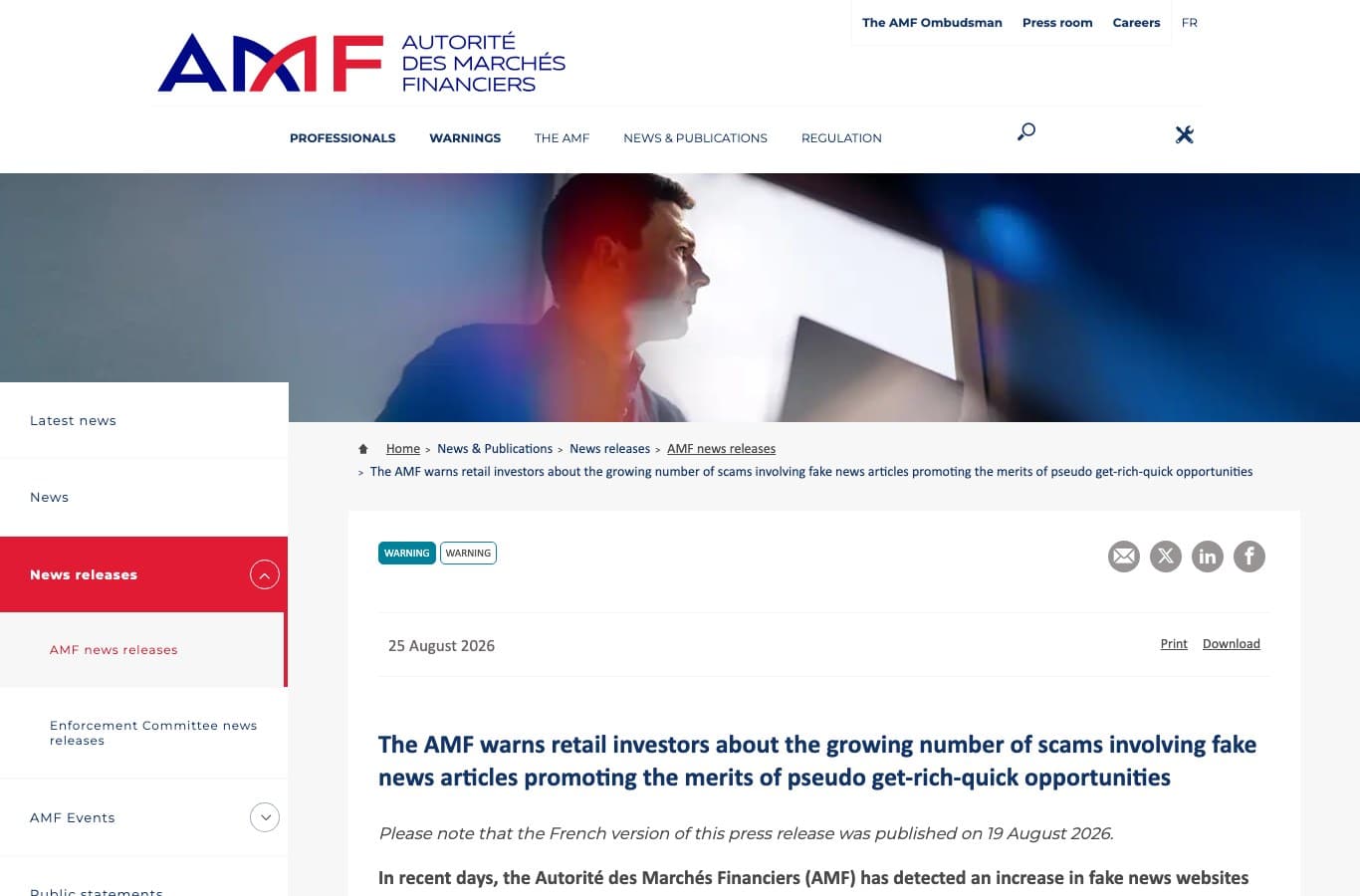
Behind these fake articles sits a platform named BitKeltTrade, “that supposedly runs on artificial intelligence” according to the fake articles themselves. The news release is categorical: “The BitKeltTrade platform currently holds no authorization anywhere in the European Union” (original: «La plateforme BitKeltTrade ne fait aujourd’hui l’objet d’aucune autorisation au sein de l’Union européenne.»). The AMF recalls that only firms licensed as investment services providers in the European Union may offer brokerage, and that only crypto-asset service providers licensed in the European Union may offer buying and selling, custody or trading of crypto assets to the French public. Bitkelttrade.com is on the blacklist, “other sites are under review”, and nine fake media addresses are published in plain text (thryva.cyou, pyrix.cyou, sylith.cyou, vexara.cyou, velith.cyou, zentha.cyou, kaelva.cyou, among others). The setup’s goal fits in one sentence: “get the reader to click the link leading to the fraudulent platform and fill in a contact form so they can be called back”.
Ads versus reality: six gaps that don’t forgive
The promises of the fake ads and the established facts never line up. The table below sets what the ad claims against what the primary sources say, with dates.
| What the fake ad says | What the verified facts say |
|---|---|
| “I am offering you the chance to earn 1,000 euros a day” | Never said. The original footage dates from VivaTech on July 6, 2017 (TF1info verification, October 1, 2025). |
| “A platform powered by artificial intelligence” | BitKeltTrade, named in the AMF’s August 19, 2026 alert, “currently holds no authorization anywhere in the European Union” and is blacklisted. |
| “An offer exclusive to French citizens, revealed on TV” | A fake article mimicking Le Monde, signed with the name of a real journalist who never wrote it (TF1info, October 2025). The AMF describes the same script in August 2026. |
| “Your balance climbs, you’re a millionaire within weeks” | Fake balance: one victim saw 52,284 euros after wiring 250 and then 15,000 euros (MoneyVox, March 16, 2026). Nothing is ever converted. |
| “Pay a 30% tax to withdraw your gains” | The demanded “flat tax” is part of the scam script; a documented loss of about 18,000 euros (MoneyVox). |
| “A program supervised by the AMF or by the state” | The AMF expressly denies it: a “pseudo-government program” cited in its warnings (August 19, 2026). |

In practice, the red flags fit on one hand. Here are the eight we kept for the tool below, all documented in the sources cited so far:
- a promise of fast or guaranteed returns, quoted by the day or by the month;
- a celebrity “revealing” a money trick in a video or an article;
- a small first deposit, around 250 euros, pitched as an entry ticket;
- artificial urgency: “last chance”, “no second chance”;
- a link to a fake news article or a fake official website;
- a platform that cannot be found in the regulator’s official registers or the European register;
- an “advisor” who calls you back to push you into adding funds;
- fees, a tax or a levy to pay before any withdrawal.
Investment ad checker: eight red flags, one verdict
Keep the ad in front of you, check what you see, then run the verdict. The score reads out of 21 points, and the four verdicts shown below the tool reflect the red flags documented by the AMF, TF1info and MoneyVox.
Some questions are still unanswered: answer all eight to get a reliable verdict.
Waiting: check the eight questions against the ad in front of you, then run the verdict. The score is computed out of 21 points.
0 out of 21: no red flag spotted
None of the eight red flags is present. That guarantees nothing: still go through the official checks described below before sending any money, because a legitimate platform always leaves a trail in the registers.
1 to 6 out of 21: caution
Elements typical of fake promotions are already there. Do not hand over contact details or ID documents, and check the platform against the official registers before going any further. If in doubt, walk away.
7 to 12 out of 21: suspicious
The scheme described by victims and by the regulator is in place: an entry deposit, displayed gains, callbacks. Deposit nothing, stop answering, and keep every piece of evidence: screenshots, links, phone numbers.
13 to 21 out of 21: a scam, plain and simple
You are facing the standard script documented by TF1info, MoneyVox and the AMF. Cut off all contact, ask your bank for a stop payment if you paid, file a police report and report the platform to the authorities.
You clicked or you paid: what to do now
Every hour counts after a payment. The sequence below reflects the reflexes validated in our previous files on AI-boosted scams, adapted to the fake investment case.
- Shut the tap. Ask your bank for a stop payment immediately, by phone first and then in writing. A wire transfer can be disputed: the written dispute is quick to prepare, and the deadlines are short.
- Never pay to “unlock” your gains. Withdrawal fees, tax, deposit: any amount requested to release your money is a new loss, as the MoneyVox victim’s story shows (3,000 euros paid for nothing).
- Build the evidence file. Screenshots of the ad, of the fake article, of the dashboard; the phone numbers that called you; wire receipts: everything that identifies the platform and the people involved.
- Report it to law enforcement. In the United States, report investment fraud to the FTC at ReportFraud.ftc.gov and to the FBI’s IC3, and file a report with your local police; in other countries, use the national cybercrime reporting service.
- Alert the financial regulator. In the French case, the AMF Protect Epargne app and the AMF’s Épargne Info Service form let you check and report a suspicious platform; in the United States, the SEC and FINRA’s BrokerCheck are the reference tools, and the FTC collects scam reports.
To prepare your bank dispute and understand your options step by step, our legal AI assistant walks you through it: Legal AI in US law: disputes, letters, next steps. You can also paste the message or the ad description into Nation AI to have it dissected red flag by red flag before you answer anyone.
How to check that a platform is authorized before you deposit a cent
The check takes three moves, all free. First move: consult the AMF’s white lists, the French regulator’s register of “providers authorized / licensed to provide crypto-asset services (PSCA) or crowdfunding services (PSFP) in France”; in the United States, the equivalents are FINRA’s BrokerCheck and the SEC’s investment adviser search. The AMF itself warns that these lists “are not an incentive to invest in these products, which remain by nature very risky”, and that the list is “not updated in real time”, hence the value of the European ESMA register as a complement. Second move: look for the platform in the regulator’s blacklists and warnings, the very list where Bitkelttrade.com has appeared since August 19, 2026; in the US, check the SEC’s investor alerts. Third move: scan the unknown site or app with AMF Protect Epargne, the French regulator’s free official tool.
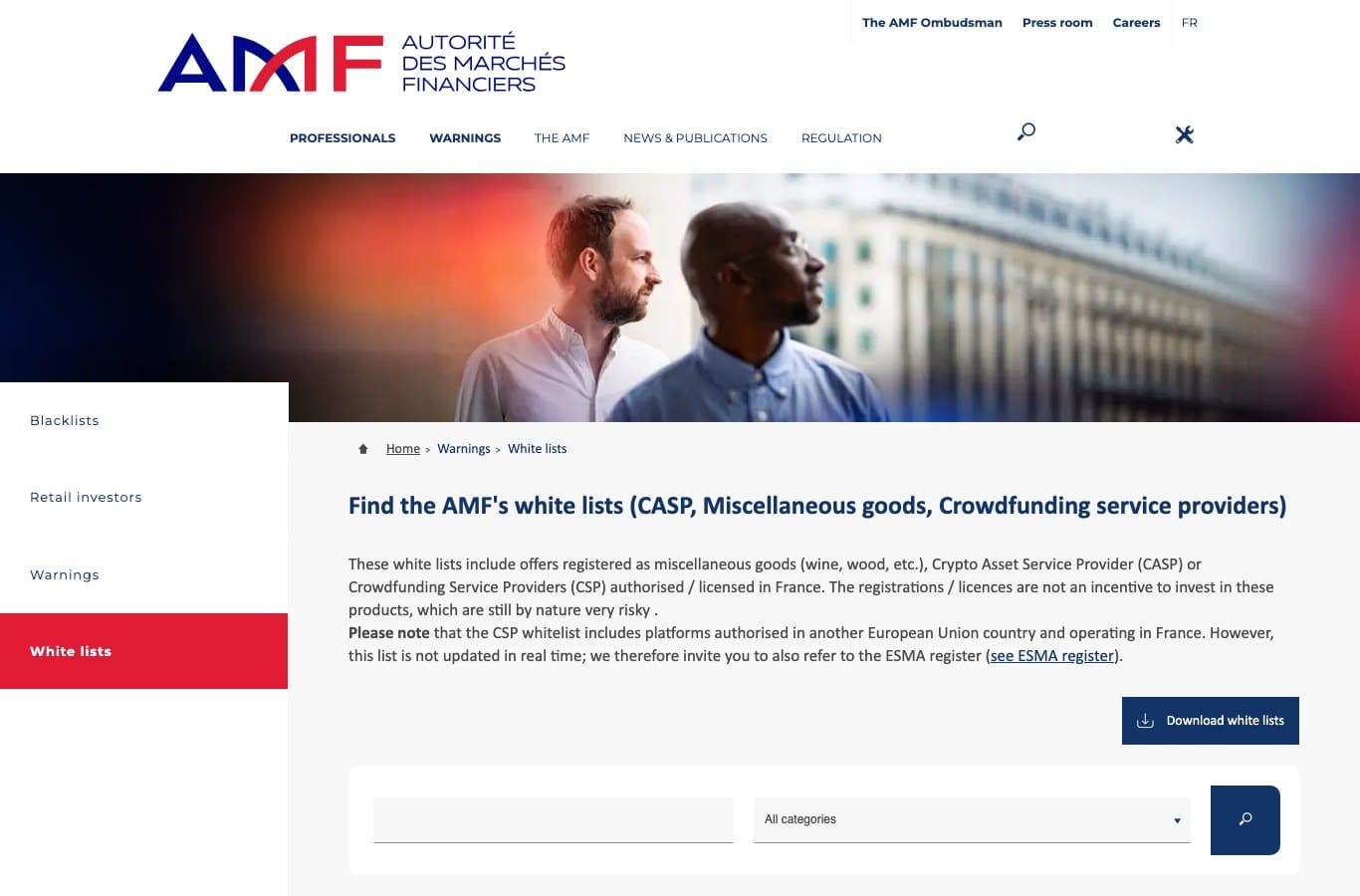
Keep the rule stated by the regulator itself: “Beware of unrealistic promises from trading sites guaranteeing quick gains”, and “carry out all the necessary checks” before any commitment. No legitimate investment introduces itself through a sponsored ad starring a billionaire, and no regulator “supervises” a get-rich-quick program aimed at the general public.
FAQ: Bernard Arnault, AI and the fake offers
Did Bernard Arnault launch an investment program for the general public?
No. The deals documented so far go through his family holding Agache (the €50 million gift to École Polytechnique, press release dated June 25, 2026) and his fund Aglaé Ventures (equity stakes in startups, reported by Capital.fr on October 11, 2024). Neither channel is open to individuals, and the AMF has dismantled the idea of a “pseudo-government program” supposedly supervised by its services. Any offer claiming otherwise is a scam.
Should you pay 250 euros to invest like Bernard Arnault?
No, and that is the main alarm bell. The 250-euro deposit opens a mechanism described since spring 2024 by UFC-Que Choisir, then by TF1info (October 2025) and MoneyVox (March 16, 2026): fake on-screen gains, calls from “advisors”, additional payments, withdrawal fees, then a platform that vanishes. The victim quoted by MoneyVox lost a little over 18,000 euros following exactly that path.
Which AI startups has Bernard Arnault invested in?
According to Capital.fr’s investigation (October 11, 2024), Aglaé Ventures backed five artificial intelligence startups worth more than $300 million in total: H Company (France, business productivity), Photoroom (France, AI photo editing), Borderless AI (Canada, hiring), Lamini (United States, language models) and Proxima (United States, ad optimization). These are professional venture deals, not savings products.
What exactly does the 50-million-euro gift fund?
The construction of the Institute of Mathematics and Fundamental Sciences on the Palaiseau campus and the launch of its “La Résidence mathématique” scientific program, according to École Polytechnique’s official press release of June 25, 2026. The building, which will bear Bernard Arnault’s name, is set to open “by 2030” and host nearly 400 faculty researchers, PhD candidates and postdocs. The gift falls under the school foundation’s “Servir la science” campaign (goal: €200 million over five years, launched in 2024).
Is the Bernard Arnault video about investing real?
No. TF1info’s verifiers tracked down the original footage: an appearance at the VivaTech summit on July 6, 2017 in which he never talks about a miracle investment. The voice and lip movements were synthesized on top. It is the same technique as the fake voices used on the phone, which we cover in our article on AI voice phone scams.
How do I know if a trading or crypto platform is authorized?
Check your own regulator’s registers (FINRA BrokerCheck and the SEC in the United States, the AMF in France) and the European ESMA register, look for the platform on the blacklists, and scan it with the official tools. If the platform promises guaranteed returns or rides on a celebrity’s name, you already have your answer. The AMF repeats it in its August 19, 2026 warning: only firms licensed in the European Union may offer these services to the public.
A suspicious ad in front of you? Check before you pay.
If you already sent money, every minute counts: prepare your bank dispute letter, then report the platform. You can also analyze the ad with Nation AI before responding.
The bottom line
“Bernard Arnault AI investment” therefore leads to two opposite realities. On one side, massive patronage for mathematics research, officially announced June 25, 2026, and a startup portfolio documented by the business press: that is how a billionaire “invests in AI”, through channels closed to the general public. On the other, a fake industry monetizing his name through deepfakes and fake articles, to the point that the French regulator had to issue a national warning on August 19, 2026. Between the two, one simple rule: any investment offer carrying a celebrity’s name is fraudulent until proven otherwise, and the proof lives in official registers, never in an ad.