
The 20-second summary
Claude, the conversational assistant, comes from the United States : it is built by Anthropic, a San Francisco startup founded on January 26, 2021 by former OpenAI members, including Dario Amodei (CEO) and Daniela Amodei (president).
Claude’s country is not a detail : in June 2026, the US government forced the shutdown of its Fable 5 and Mythos 5 models for 18 days, proof that where an AI comes from also decides who can use it. Keeping a second assistant within reach, such as a Chat GPT online alternative, is a simple precaution.
Claude has been available in 176 territories since May 2024 in Europe, but not in China or Russia. And if you would rather back a European alternative, there is one : Mistral AI, or Nation AI, the assistant built in France by the Botnation group, free to try with no sign-up.
“What country is Claude AI from?” The question sounds simple, yet thousands of people type it into Google every month, often wondering whether this oddly French-named assistant might be a French creation. The confusion is natural : Claude carries the first name of a quintessential Frenchman, speaks fluent English, and its maker sells its services in Europe through an Irish subsidiary. In reality, the story of Claude starts almost 9,000 miles away from Paris, in a San Francisco office. This guide covers Claude’s exact origin, its creators, the countries where you can use it, and the June 2026 episode that reminded the entire industry of what an AI’s “country of origin” actually means for the user.
What you will find in this guide
- The short answer : Claude comes from the United States
- Who created Claude : Anthropic, the startup founded by ex-OpenAI members
- Why Claude carries a French first name (the tribute to Claude Shannon)
- ChatGPT, Gemini, Le Chat : the nationality of the major AIs
- Where can you use Claude? 176 territories, and some big absences
- Claude in Europe : since when, and under which rules
- June 12, 2026 : the day Claude’s country decided who could use it
- Is Claude French? Where the confusion comes from
- Frequently asked questions
What country is Claude AI from? The answer in one line
Claude is an American artificial intelligence. The Wikipédia encyclopedia sums it up in its first sentence : “Anthropic est une entreprise américaine d’intelligence artificielle (IA) basée à San Francisco” (“Anthropic is an American artificial intelligence company based in San Francisco,” consulted September 15, 2026). Claude is the flagship product of Anthropic, a company incorporated in Delaware, the US state where most of the country’s tech companies are registered.
More precisely, Anthropic is not a regular corporation : it registered as a “public benefit corporation”, a US legal status that requires the company to balance profit with a general-interest mission, here the safety of AI systems. Anthropic’s institutional page states it in plain words : “Anthropic is a public benefit corporation dedicated to securing its benefits and mitigating its risks” (checked September 15, 2026).
Claude’s ID card in 2026Name : Claude. Maker : Anthropic PBC. Country of origin : United States. Headquarters : San Francisco, California. Founded : January 26, 2021. Legal status : Delaware public benefit corporation. CEO : Dario Amodei. Flagship models : Fable 5, Mythos 5, Opus 5, Sonnet, Haiku.
This American origin has a very concrete consequence : Claude answers to US law, US regulators and US export controls. That line stays abstract until the day it doesn’t. On June 12, 2026, it stopped being abstract, and we cover it in detail below.
Who created Claude? Anthropic, the startup founded by ex-OpenAI members
Anthropic was founded on January 26, 2021 in San Francisco by former senior members of OpenAI, the maker of ChatGPT. The founding move came from a brother and sister : Dario Amodei, former vice president of research at OpenAI, who became CEO, and Daniela Amodei, who became president. They were joined by two other co-founders listed by the encyclopedia : Chris Olah, a leading figure in interpretability research (understanding how models “reason”), and Jared Kaplan, a physicist turned AI researcher.
Their departure from OpenAI, as reported by Wikipédia, was reportedly driven by disagreements over the strategic vision of ChatGPT’s maker. Anthropic positioned itself around AI safety from day one : the company claims research work on interpretability and on “constitutional AI”, a training method where the model critiques itself against a set of principles inspired in part by the Universal Declaration of Human Rights.
By the numbers, the trajectory is that of an American tech giant :
- 2023 : Amazon and Google invest several billion dollars in Anthropic and open up their cloud platforms (source : Wikipédia, checked September 15, 2026).
- January 2026 : the company employs about 2,500 people (Wikipédia).
- May 2026 : Anthropic is valued at $965 billion (Wikipédia).
The company no longer stops at the chatbot : it also sells Claude Code (its coding agent, covered in our guide to using Claude Code without programming), plus Claude Design, Claude Science and the Cowork desktop agent. The board of directors, published on the institutional page, brings together Dario Amodei, Daniela Amodei, Yasmin Razavi, Reed Hastings, Chris Liddell and Vas Narasimhan (checked September 15, 2026), along with a PBC-specific body : a “Long-Term Benefit Trust”, a guardian council in charge of watching over the general-interest mission.

Why does Claude carry a French first name?
If so many people ask “what country is Claude AI from?”, it is mostly because of the name. The choice was not a tribute to France : the name honors Claude Shannon (1916-2001), the American mathematician considered the father of information theory. As the Blog du Modérateur explained on December 26, 2025, citing the New York Times : “Anthropic named its AI assistant in his honor.” The mathematical foundations Shannon laid in the mid-20th century condition everything that travels over networks today, including the messages you exchange with a chatbot.
This etymological detour matters to our question : the most French-sounding name in the world was given by an American company to an American model, in tribute to an American scientist. The whole confusion sometimes fits inside a first name.
ChatGPT, Gemini, Le Chat : the nationality of the major AIs
Claude is not an isolated case : almost all the most widely used conversational assistants were born in the United States. The notable exceptions are Chinese (DeepSeek, Qwen) and French (Le Chat by Mistral AI, and Nation AI, built in France by the Botnation group). Here is the summary, followed by an interactive filter to explore it.
| Assistant | Maker | Headquarters | Country of origin |
|---|---|---|---|
| Claude | Anthropic | San Francisco | United States |
| ChatGPT | OpenAI | San Francisco | United States |
| Gemini | Mountain View | United States | |
| Copilot | Microsoft | Redmond | United States |
| Grok | xAI | Palo Alto | United States |
| Meta AI | Meta | Menlo Park | United States |
| Le Chat | Mistral AI | Paris | France |
| Nation AI | Botnation | Paris | France |
| DeepSeek | DeepSeek | Hangzhou | China |
| Qwen | Alibaba Cloud | Hangzhou | China |
Makers’ headquarters : institutional pages and the Wikipédia encyclopedia, checked September 15, 2026.
The origins filter
Ten assistants, three origins. Check one or more countries to keep only the matching AIs : the counter tells you how many are left. Uncheck everything to see them all again.
Assistants kept : 10 of 10
Claude
Headquarters : San Francisco (United States). Founded in 2021 by ex-OpenAI members, a Delaware public benefit corporation.
Worth noting : its Fable 5 and Mythos 5 models were shut down for 18 days in June 2026 by a US export directive.
ChatGPT
Headquarters : San Francisco (United States). ChatGPT’s maker is the former employer of Anthropic’s founders.
Worth noting : the lab shaped the consumer market for AI assistants.
Gemini
Headquarters : Mountain View (United States). Gemini is backed by Google DeepMind, the group’s research lab.
Worth noting : natively integrated into the Google ecosystem, from Search to Android phones.
Copilot
Headquarters : Redmond (United States). Microsoft’s assistant is deployed across Windows and the Office suite.
Worth noting : Microsoft also invested in OpenAI, whose models it hosts.
Grok
Headquarters : Palo Alto (United States). Grok is xAI’s assistant, from the company founded by Elon Musk.
Worth noting : the maker claims tight integration with the X social network.
Meta AI
Headquarters : Menlo Park (United States). Meta’s assistant is embedded in its social networks and devices.
Worth noting : Meta also releases open models that many makers reuse.
Le Chat
Headquarters : Paris (France). Mistral AI is France’s flagship generative AI maker.
Worth noting : the June 2026 episode revived the French debate on AI sovereignty and the call to back Mistral.
Nation AI
Headquarters : Paris (France). Nation AI is the conversational assistant of the Botnation group, built in France.
Worth noting : you can try it for free, no sign-up, at nation.ai/chat.
DeepSeek
Headquarters : Hangzhou (China). The maker displays on its website the mandatory registrations of Zhejiang province (checked September 15, 2026).
Worth noting : a Chinese AI, subject to local information-control rules.
Qwen
Headquarters : Hangzhou (China). Qwen is Alibaba Cloud’s family of generative models.
Worth noting : one of the few Chinese model families competing with US models on public benchmarks.
This filter is informative : it reflects the country of each maker’s head office, not where your data is processed.
You will have noticed when checking “France” : if where a service comes from matters to you, the French offering exists and is credible. Our dossier Mistral AI, success or failure? takes an unvarnished look, and our roundup of alternatives to ChatGPT places every assistant in the landscape.
Where can you use Claude? 176 territories, and some big absences
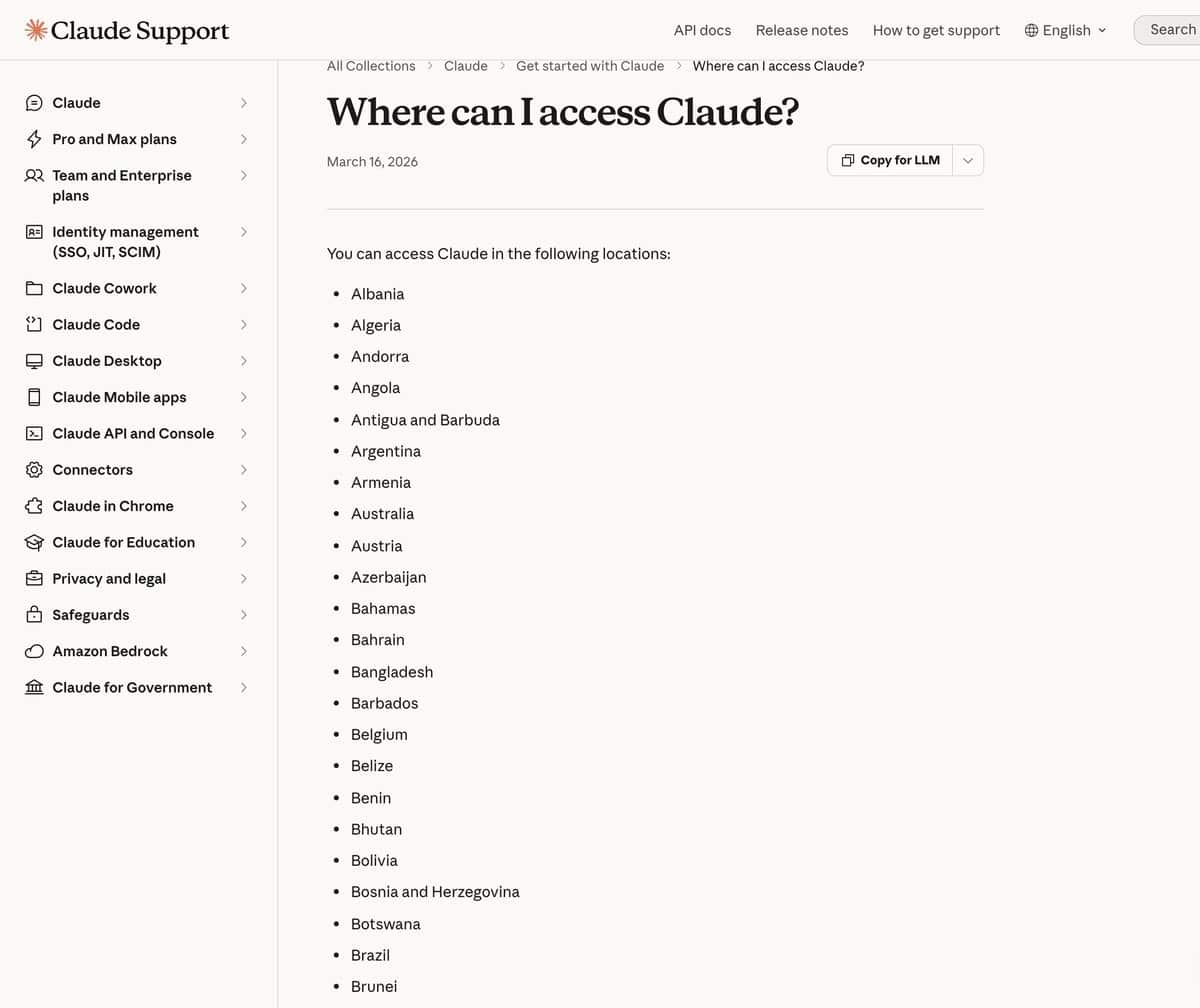
Knowing an AI’s country of origin also means asking from which countries it can be used. The official answer fits on one page of Anthropic’s help center, “Where can I access Claude?”, updated on March 16, 2026. It lists the locations where access is possible : 177 entries in total, including a display duplicate (“Herzegovina” appears a second time after “Bosnia and Herzegovina”), that is 176 distinct territories. The United States are there of course, along with Canada, the UK, Latin America, most of Africa and Asia, and every European country.
More interesting still : the absences. The official list contains neither China, nor Russia, nor Iran, nor North Korea, nor Cuba, nor Syria, nor Venezuela, nor Belarus, nor Afghanistan, nor Sudan. A more surprising omission for a country of over 120 million people : Ethiopia is missing too, as are Hong Kong and Macao. Claude, the most “virtuous” American assistant on the market by its own marketing, therefore remains unreachable for roughly a fifth of the world’s population. A fun detail caught on September 15, 2026 : the same list shows three different update dates depending on the page language (March 9 in Spanish, March 12 in French, March 16 in English), for identical content and the same count of 177 entries.
Two distinct questionsThe “country of origin” (where the AI was designed and under which law) and the “country of use” (where you can use it) do not overlap. Claude is designed in the United States, usable in 176 territories, and refused in about a dozen more. The reverse also exists : an AI designed in China can be used in the US, but it still answers to the rules of its country of origin.
Claude in Europe : since when, and under which rules
Europe has been a served territory since spring 2024 : Le Monde reported Claude’s European launch on May 14, 2024 (“son concurrent à ChatGPT,” ChatGPT’s challenger, as the headline put it). Since then the interface has been localized, the mobile app is listed across European stores, and the paid plans are billed in euros. And to check what an assistant can actually do for you, the Nation AI chat is open with no sign-up.
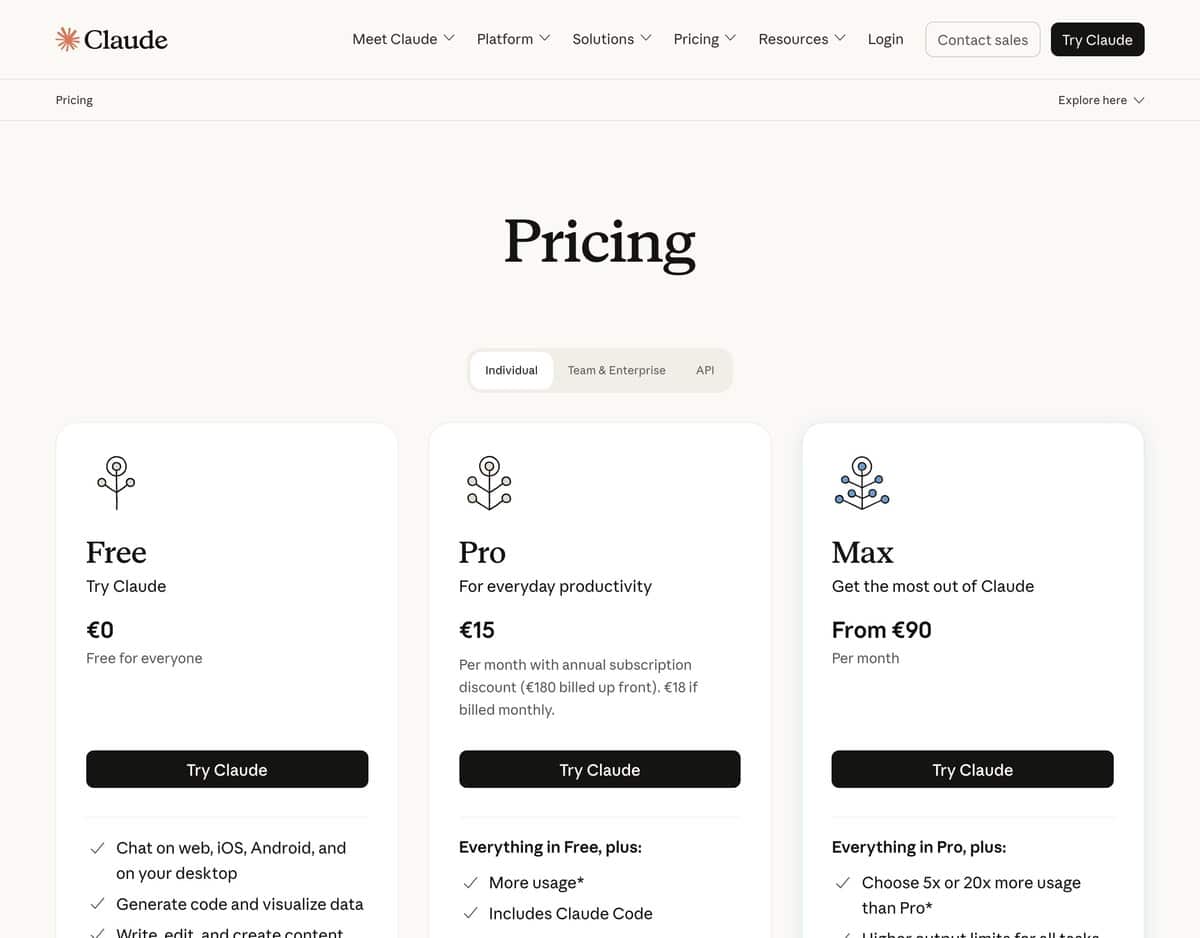
The legal structure deserves a detour. The footer of the pricing page states : “Services in the EU are provided by Anthropic Ireland Limited” (checked September 15, 2026). In other words : European subscribers sign a contract with Anthropic’s Irish subsidiary, not with the San Francisco parent. It is the classic setup of American digital giants in Europe (Apple, Google and Meta do the same), which anchors the commercial relationship in Union law without changing the company’s nationality or the control exercised from the United States.
This point becomes central in the episodes the company went through in 2026 : when Washington steps in, the Irish subsidiary decides nothing, as the next chapter shows.
June 12, 2026 : the day Claude’s country decided who could use it
If you still wonder why “what country is Claude AI from?” is a real question, the 2026 timeline gives the most eloquent answer in the whole industry. It starts before summer :
February 2026. The US Department of Defense demands a contract change to allow the use of Claude in fully autonomous weapons and mass surveillance of Americans, which Anthropic refuses (source : Wikipédia, checked September 15, 2026). The Trump administration then bans federal agencies from using Anthropic’s technology. On Truth Social, the president wrote, as reported by Euronews, that they didn’t need it, didn’t want it, and would never do business with them again.
March 5, 2026. The Pentagon officially adds Anthropic to its list of “risky” suppliers for the state : the first American company ever on a list that until then only contained foreign ones, Huawei (China) and Kaspersky (Russia). franceinfo, carrying the AFP wire, recalls that Anthropic had signed a $200 million contract with the Department of Defense in July 2025 and that the US Treasury had just ended its partnership (article from March 6, 2026). Dario Amodei says he is working to defuse the dispute. Anthropic announces it will sue the government.
June 12, 2026. A new escalation, the one that concerns us directly : the Department of Commerce issues an export control directive “citing national security”. Anthropic receives it at 5:21 pm Eastern time and publishes its statement that same evening : “The US government, citing national security authorities, has issued an export control directive.” The stated motive : the suspected existence of a bypass method, a “jailbreak”, of the Fable 5 model. The immediate consequence, Anthropic writes : “we must abruptly disable Fable 5 and Mythos 5 for all our customers to ensure compliance.” Banned : distribution outside the United States and access by foreign nationals, including Anthropic’s own foreign employees. The company protests : it argues that a narrow potential jailbreak should not be cause for recalling a commercial model (statement of June 12, 2026).
June 30, 2026. A provisional epilogue : “Le département du Commerce a levé les contrôles d’exportation sur Claude Fable 5 et Mythos 5” (“The Department of Commerce has lifted the export controls on Claude Fable 5 and Mythos 5”), Anthropic announces, as carried by the Canadian daily Le Devoir. Access is restored in the following days, after eighteen days of worldwide shutdown. The letter from Commerce Secretary Howard Lutnick, quoted by Le Devoir, imposes in exchange commitments of proactive risk detection, with the government reserving the right to reinstate restrictions.
| Date | What happened |
|---|---|
| January 26, 2021 | Anthropic is founded in San Francisco by former OpenAI members. |
| 2023 | Amazon and Google invest several billion dollars in Anthropic. |
| May 2024 | Claude launches in Europe. |
| February 2026 | Anthropic refuses to open its models to autonomous weapons ; US federal agencies are banned from using them. |
| March 5, 2026 | The Pentagon adds Anthropic to its “risky” suppliers list : the first American company ever. |
| June 12, 2026 | Commerce Department directive : Fable 5 and Mythos 5 shut down for everyone, distribution outside the US banned. |
| June 30, 2026 | Export controls lifted, access restored after an 18-day shutdown. |
Timeline built from : Wikipédia (Anthropic, consulted September 15, 2026), franceinfo/AFP (March 6, 2026), Anthropic statement (June 12, 2026), Euronews (June 13, 2026), Le Devoir (July 1, 2026).

Remember the lesson, it holds for every AI : as long as an assistant is designed and controlled in one country, that country can decide its shutdown, its reach and its authorized users. “What country” is therefore not a trivia question : it is a dependency data point, for an individual as much as for a business choosing a work tool.
Is Claude French? Where the confusion comes from
One misunderstanding remains to be cleared up, and it is a massive one : “is the Claude AI French?” appears word for word in Google’s related questions. Four factors explain it :
- The name. “Claude” instantly evokes a Frenchman. In reality it honors Claude Shannon, an American (see above).
- The languages. Claude speaks excellent English and French, its interface is translated and its app is listed everywhere : for the user, the nationality of the language hides the maker’s.
- The European presence. European launch in May 2024, euro billing, an Irish subsidiary for Union services : everything looks like a local player, except control.
- Third-party sites. Unofficial websites with “Claude France” in their name ride the confusion and suggest a French presence of Anthropic, which does not exist as such. If you want to talk directly with an AI right now, the Nation AI chat is open with no sign-up.
If you would rather use an AI that is actually designed in Europe, the name that keeps coming back is Mistral AI, founded in Paris in 2023, the maker of Le Chat. The June 2026 episode revived the debate : the day after the shutdown, French political voices called for stronger support of the national champion, as reported by Euronews. Our dossier Mistral AI, success or failure? assesses what that French industry is worth today. And for everyday conversation in English, without waiting on the ups and downs of a US export control, our assistant Nation AI is free to try with no sign-up.
Want an AI that speaks your language, with peace of mind?
Nation AI is the conversational assistant built in France by the Botnation group : writing, summaries, ideas, corrections, translations. Try it for free, no account needed.
Frequently asked questions
Is the Claude AI French?
No. Claude is developed by Anthropic, an American company based in San Francisco and incorporated in Delaware. Only the first name is French : it pays tribute to the American mathematician Claude Shannon. For customers in the European Union, services are provided by Anthropic Ireland Limited, an Irish subsidiary, which does not make it a European company.
Who owns Claude?
Claude belongs to Anthropic PBC, the company founded in 2021 by Dario Amodei (CEO), Daniela Amodei (president), Chris Olah and Jared Kaplan. Anthropic is not a subsidiary of OpenAI, Google or Amazon : it is independent, though the latter two invested several billion dollars in 2023 and sit among its backers. The company has been valued at $965 billion since May 2026, according to Wikipédia (checked September 15, 2026).
Does Claude work in China or Russia?
No. The official list of served territories, updated March 16, 2026 by Anthropic’s help center, contains neither China, nor Russia, nor Iran, nor North Korea, nor Cuba, nor Syria, nor Venezuela, nor Belarus, nor Afghanistan, nor Sudan, nor Ethiopia, nor Hong Kong nor Macao. The United States, Canada and the UK are of course on the list.
Can you use Claude for free?
Yes. Claude is accessible in the United States and across Europe, with a free tier limited in volume and paid subscriptions. For everyday conversations without hitting a paywall, Nation AI offers free access to an AI assistant with no sign-up.
What happened on June 12, 2026 with Claude?
The US Department of Commerce issued an export control directive citing national security : distribution of the Fable 5 and Mythos 5 models banned outside the United States and to foreign nationals. Anthropic shut both models down for all its customers for 18 days, until the lifting of the controls announced on June 30, 2026. The official motive : a suspected method of bypassing Fable 5’s safeguards, which Anthropic disputes.
Do Claude, ChatGPT and Gemini come from the same country?
Yes : all three come from the United States. ChatGPT and Claude were even born in the same city, San Francisco, and their founders worked together : Anthropic was created by former OpenAI members. The market’s main geographic exceptions are Le Chat and Nation AI on the French side, DeepSeek and Qwen on the Chinese side.
The bottom line : an American assistant, a global debate
Claude comes from the United States : San Francisco, Delaware, a founding on January 26, 2021 by ex-OpenAI members, and a public benefit corporation status that changes none of it. Europe has hosted it since May 2024, behind an Irish subsidiary that signs local contracts but decides nothing. And 2026 proved what that country of origin implies : a single Commerce Department directive was enough to switch off two flagship models for 18 days, inside the United States and beyond its borders. Next time you pick an AI assistant, ask where it comes from : today it is a technical spec as much as the price or the power.
And if the answer points you toward Europe, the simplest move is to try : Nation AI, the assistant built in France, is free with no sign-up, and our hub of AI tools gives you a taste of everything AI can already do for you.
Sources and dates checked (September 15, 2026) : Anthropic help center (country list, updated March 16, 2026 in English) ; claude.com pricing page (footer) ; anthropic.com (public benefit corporation status, board of directors) ; anthropic.com/news (June 12, 2026 statement) ; franceinfo with AFP (March 6, 2026) ; Euronews (June 13, 2026) ; Le Devoir (July 1, 2026) ; Le Monde (May 14, 2024) ; Blog du Modérateur (December 26, 2025) ; Wikipédia, “Anthropic” entry (consulted September 15, 2026). Offers and availability change fast : always check the official page before deciding.