
Meal ideas: what to cook with what’s in your fridge
Tell Camille what you have on hand, how much time you’ve got and how many people are eating: she suggests a dish in the chat below.
 Camille AICooking
“What’s for dinner?”: the question that comes back every day
The hard part isn’t cooking, it’s deciding. At 7 p.m., there’s always something in the fridge: two carrots, half an onion, some leftover roast chicken, a can of chickpeas at the back of the cupboard. But nothing that looks like a meal. You open a recipe site, land on a dish that needs an ingredient you don’t have, and dinner ends up being toast (or a last-minute delivery).
Recipe sites start from a dish and send you shopping. A cooking AI does the opposite: it starts from what you already have, your time and your equipment, and builds the meal around them.
For example, you type “two carrots, half an onion, leftover roast chicken, a can of chickpeas, plain yogurt, 25 minutes.” Camille doesn’t send you ten links: she suggests one dish with those ingredients, the quantities and the order of the steps.
What Camille does for you (and what she doesn’t)
Camille is one of Nation AI’s 25 AI coaches, focused on everyday cooking. She can:
- find a meal idea from the ingredients you list, using what you already have before suggesting anything to buy;
- give a short recipe you can follow: the name of the dish, ingredients with quantities, numbered steps and one useful tip, without a long introduction;
- adapt a recipe: replace a missing ingredient, switch from oven to stovetop, make it vegetarian, scale it for more guests;
- turn leftovers (pasta, cooked vegetables, chicken, stale bread) into a different dish;
- plan several meals with overlapping ingredients, and the shopping list that goes with them;
- explain a simple technique: a lump-free white sauce, soft-boiled eggs, a good sear on meat.
What she doesn’t do: Camille doesn’t see your fridge. She works with what you tell her, or with what she spots in a photo if you send one. She can’t tell whether food is still safe, and she will never suggest tasting it to check. She doesn’t replace a doctor or a dietitian for a severe allergy, an illness or a medical diet. And she’s an AI: she has never tasted a dish and can get a detail wrong. Reread the recipe and use your judgment, especially on cooking times.
What to tell the AI to get a meal idea that works
No complicated prompt needed. Camille answers right away, without a list of questions first, so the more precise your message, the better the dish fits your evening. One sentence, written the way you’d say it, is enough if it follows this model:
“I have [ingredients]. I have [time] and [equipment]. It’s for [number] people. [Any constraint].”
A few details change everything:
- Ingredients: mention the pantry too (pasta, rice, canned goods, eggs, spices) and say what needs using first.
- Time and equipment: “15 minutes,” “it can simmer,” “no oven,” “one pan,” “air fryer.”
- Number of people: if you don’t say for a family meal, Camille assumes four servings and tells you so.
- Constraints: a child who refuses a food, a vegetarian meal, a tight budget, cups or grams, an allergy stated clearly.
3 requests ready to paste
1) Fridge clean-out: “I have a leek, some bacon, half a tub of cream cheese and a bag of penne. 25 minutes, stovetop only, for three people. What can I make?”
2) Leftovers: “I have leftover chili from last night, kept in the fridge, plus a few tortillas and some cheddar. Turn it into a different dinner for two, ready in 20 minutes.”
3) Week of dinners: “Suggest five weeknight dinners for two adults and a six-year-old, on a tight budget, with ingredients that get used more than once and a shopping list grouped by aisle.”
Adjust the answer without starting over
Stay in the same conversation and say only what changes: “faster,” “no oven,” “my son won’t eat mushrooms,” “actually, there will be six of us.” Camille adapts the dish instead of starting from scratch.
Meal ideas by situation
Here are a few starting points. You can ask Camille for any of them as is (“give me the recipe for … for four”) or adapt them to what you have.
A weeknight, in about 20 minutes
- Quesadillas with black beans, corn and cheese, crisped in a skillet.
- Stir-fried noodles with whatever vegetables you have, garlic, ginger and soy sauce.
- Pasta with canned tuna, lemon, capers and parsley.
- An omelet with leftover vegetables and a bit of cheese.
- A tuna melt with a quick tomato soup.
To go faster, ask for a “one-pan” or “one-pot” version: fewer steps, fewer dishes.
With kids
- Mac and cheese with peas or broccoli.
- Mini pizzas on tortillas, pita or naan.
- Meatballs, beef or lentil, in tomato sauce.
- Wraps or tacos that everyone fills at the table.
Tell Camille the children’s ages and what gets refused at the table.
On a budget
- Bean chili with rice or baked potatoes.
- Baked potatoes with toppings: beans, cheese, leftover vegetables.
- Pasta e fagioli, an Italian pasta and bean soup.
- A cabbage and sausage skillet.
- Fritters made with grated carrot or zucchini.
Ask Camille for several meals built around the same few products (a cabbage, a bag of potatoes): fewer different purchases, less waste.
Vegetarian
- Shakshuka: eggs cooked in a spiced tomato and pepper sauce.
- Mushroom risotto.
- Palak paneer, spinach and paneer, with rice or flatbread.
- Black bean burgers.
- A grain bowl: a grain, a legume, roasted vegetables and a yogurt sauce.
Say whether you mean vegetarian (with eggs and dairy) or vegan. Camille only calls a recipe “vegan” or “gluten-free” when it really is; still check your labels.
Almost-empty fridge
- Spaghetti with garlic, olive oil and chili flakes.
- Eggs on toast, or savory French toast with cheese.
- A pantry salad: canned tuna or beans, corn, onion and a simple dressing.
- Instant noodles upgraded with an egg, frozen vegetables and green onion.
Leftover makeovers
- Cooked pasta: a pasta frittata or a pasta bake.
- Cooked vegetables: a soup, a quiche or fritters.
- Roast chicken: wraps, a salad or a pot pie.
- Mashed potatoes: potato cakes, or the topping of a shepherd’s pie.
- Stale bread: croutons, French toast or bread pudding.
All of these assume the leftovers went into the fridge quickly and get eaten soon (guidelines below).
How to use Nation AI on this page
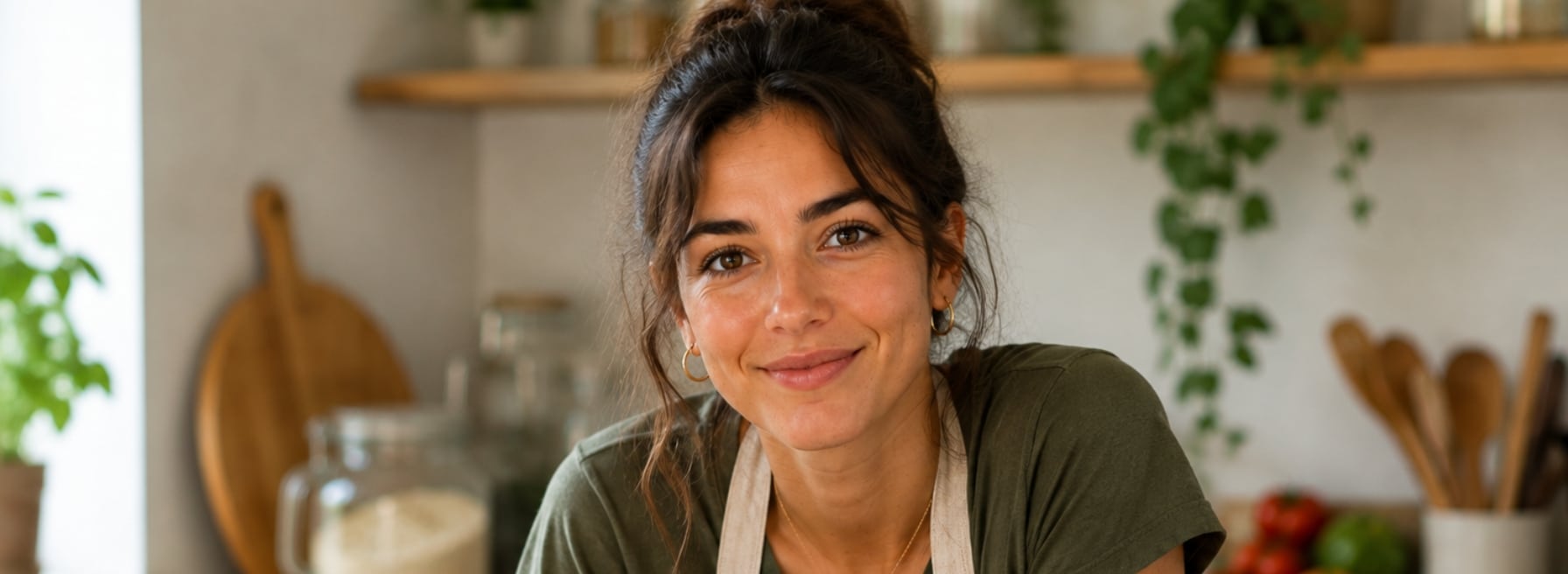
The chat is at the top of this page, with Camille’s photo. Nothing to install, no account to create: you write your message and she replies.
- Describe your situation in a sentence or two: what you have, your time, how many people.
- Read the suggestion: the name of the dish, the ingredients, the steps.
- Adjust or ask for more in the same conversation: another idea, extra guests, a dessert, a shopping list.
You can also attach a picture: a photo of your fridge is a good starting point, as long as you add what it doesn’t show (cupboards, quantities). And you can talk to Camille with the chat’s microphone; she replies in writing. Nation AI runs on GPT models, with Mistral as a backup; it’s an independent service designed in France, not affiliated with OpenAI.
A real-life example: your in-laws call, they’ll be there in an hour. You write “six people, 45 minutes, a pack of chicken thighs, rice, frozen peas, a jar of curry paste.” Camille suggests a dish to share, then you move on to a no-bake dessert.
Pricing: free trial, then paid plans if you need them
The trial is free, with no sign-up: no account, no email, no card. A few messages are included, enough to find tonight’s meal idea and see whether Camille’s approach works for you. For regular use, commitment-free paid plans are available: see the pricing page for details.
Good habits: leftovers, allergies and common sense
Cooking with leftovers avoids waste, as long as you follow a few food safety rules. Guidelines differ slightly from country to country; here are the US and UK ones. When in doubt, follow the stricter rule.
- Chill quickly: in the fridge within 2 hours of cooking, or 1 hour above 90 °F (32 °C), says the USDA; within 1 to 2 hours, says the UK Food Standards Agency (FSA). Split food into small portions so it cools faster.
- A cold fridge: 40 °F (4 °C) or below (USDA); between 0 and 5 °C (FSA).
- Eat leftovers soon: within 3 to 4 days (USDA); within 2 days (FSA).
- Rice: cool it within about an hour, keep it in the fridge no more than a day, and reheat it only once, until steaming hot (FSA). Bacteria in rice that cools slowly can produce toxins that reheating doesn’t destroy.
- Reheat thoroughly: to 165 °F (74 °C) (USDA), or until steaming hot all the way through (FSA).
- Dates: a “use by” date is about safety; “best before” or “best if used by” is about quality.
If you have any doubt about a food (smell, appearance, a swollen package), don’t taste it to check: throw it out.
For allergies, mention them in your first message and always read labels: an AI doesn’t know the exact composition of your products (traces, added ingredients). For a severe allergy or a medical diet, a doctor’s or dietitian’s advice comes first.
Sources: Leftovers and Food Safety (USDA), How to chill, freeze and defrost food safely and Home food fact checker (Food Standards Agency).
Useful links on nation.ai
- Camille finds a recipe with what’s left in your fridge: one dinner, step by step.
- Camille, AI kitchen assistant: her profile.
- Nation AI’s 25 AI assistants
- Julien, AI gardening advisor: herbs and a small vegetable patch.
- Nation AI chat: Alex, the general assistant, for everything else.
- Free AI in English, no sign-up
Frequently asked questions
How do I find a meal idea with what I have in the fridge?
Tell Camille what you have, fridge and cupboards included, with your time and the number of people. She suggests a dish that uses those ingredients first, with quantities and steps. If one ingredient is missing, ask her for a substitute rather than a whole new recipe.
Can Camille plan my meals for the week?
Yes. Give her the number of meals, the number of people and your budget: she suggests dinners that share ingredients, with the matching shopping list. Check your cupboards before you shop to avoid buying twice.
Is it free?
To try it, yes: a few messages are included, with no account, no email and no card. For more regular use, commitment-free paid plans are available: see the pricing page.
Can I send a photo of my fridge?
Yes, the chat lets you attach a picture, and Camille can spot ingredients in it. Add what the photo doesn’t show: cupboards, quantities, what needs using first.
What about allergies or a special diet?
Say so in your first message: Camille takes into account the restrictions you give her (vegetarian, no pork, dairy-free and so on). Always check product labels. A severe allergy or a medical diet calls for a doctor or a dietitian: her answers remain general information.
How long can I keep leftovers in the fridge?
It depends on the guidelines where you live: 3 to 4 days according to the USDA, 2 days according to the UK Food Standards Agency, and no more than a day for cooked rice. Keep your fridge cold, and when in doubt, throw food out rather than taste it.
Are AI recipes reliable?
Camille gives short, structured recipes, but like any AI, she can get a detail wrong. Check cooking times and use your judgment, especially for poultry and ground meat, which must be cooked through.
Is Nation AI the same as ChatGPT?
No. Nation AI is an independent service that runs on GPT models, with Mistral as a backup, and isn’t affiliated with OpenAI. Camille is one of its 25 specialized AI coaches, set up for everyday cooking.
Ready to try?
Camille AICooking