

- Swap in “you are.” If the sentence still holds, write “you’re”; if it breaks, write “your.”
- The apostrophe in “you’re” marks a letter that dropped out; it is not a sign of possession.
- “You’re welcome” is the reply to give when a friend says thanks.
You’re texting a friend about the new café, and out goes “your probably right” before a reread. The fix is one move: say “you are” where the word sits, and the sentence itself tells you which spelling stays. That move works on every sentence you write, and the apostrophe behind it has a simple story.
How to Tell Your from You’re in One Swap
Merriam-Webster’s test fits in one breath: write the sentence with “you are” in the word’s place. If it still makes sense, the word you want is “you’re.” If the sentence collapses, “your” is the one.
Merriam-Webster runs it on a cake. Put “you are” in the slot and the sentence falls apart:
Before
“You are cake does not taste very good.”
After
“Your cake does not taste very good.”
The swap runs both ways. “You are baking a cake!” makes sense, and it can also be written as “You’re baking a cake!”
The MLA Style Center prescribes the same check: “A simple test to find out whether to use you’re or your is to substitute you are in the sentence and see if the sentence makes sense.”
Why Only One of Them Carries an Apostrophe
You’re is two words packed into one. Merriam-Webster describes the mark it wears: “In the case of you’re, however, the apostrophe is standing in for a missing letter, and is not showing possession.”
Your has nothing missing, so it wears none, and it does its work in front of a noun: “Your always comes before a noun.” Cambridge’s English Grammar Today calls it a determiner, the name for a word that lives right in front of a noun.
The possessive pronoun goes further and drops the apostrophe altogether. Purdue OWL explains: “Apostrophes should not be used with possessive pronouns because possessive pronouns already show possession.” That is why “a friend of yours'” sits on its INCORRECT list and “a friend of yours” on the CORRECT one.
The Words at Work in Sentences You Send
Five sentences of the everyday kind, with the word each one needs. The examples come from Purdue OWL, the MLA Style Center, and the writing center of Utah Valley University.
| Sentence | Word | Why |
|---|---|---|
| “You’re going to Spain in September, right?” | you’re | Stands for “you are going.” |
| “Helen went to see your art show yesterday.” | your | Possessive: the show connects back to the friend. |
| “Your shoes are untied.” | Your | Possessive pronoun in front of “shoes.” |
| “You’re walking around with your shoes untied.” | You’re | Contraction for “you are,” and “your” keeps the shoes. |
| “Is that your new car?” | your | Possessive in front of “car.” |
Cambridge Dictionary’s entry for “you’re welcome” pairs the thanks with the answer: “Thank you so much for helping.” “You’re welcome.”
The Last Check: Antoine on the Whole Message
One word is easy to check by hand; a message you have already rewritten twice is not. Purdue OWL’s proofreading guide makes the point:
“Take special care of homonyms like your/you’re, to/too/two, and there/their/they’re, as spell check will not recognize these as errors.”
That is where a second pair of eyes earns its place. Antoine is the Nation AI coach for spelling and grammar, and a fast, six-sentence text to a friend is exactly the kind of message he gets. The request is one line: “Only correct the mistakes in this text.”
Before
“Hey, your probably right about trying that new café tonight. I heard you’re bringing your camera, so we can take a few pictures. You’re dog always makes me laugh when I visit. You’re new jacket looked great yesterday. I hope your feeling better after that long week. Text me when you’re on your way, and I’ll save us a table.”
After
“Hey, you’re probably right about trying that new café tonight. I heard you’re bringing your camera, so we can take a few pictures. Your dog always makes me laugh when I visit. Your new jacket looked great yesterday. I hope you’re feeling better after that long week. Text me when you’re on your way, and I’ll save us a table.”
Four words change, the four wrong swaps. Everything else stays exactly as typed, the four correct uses included.
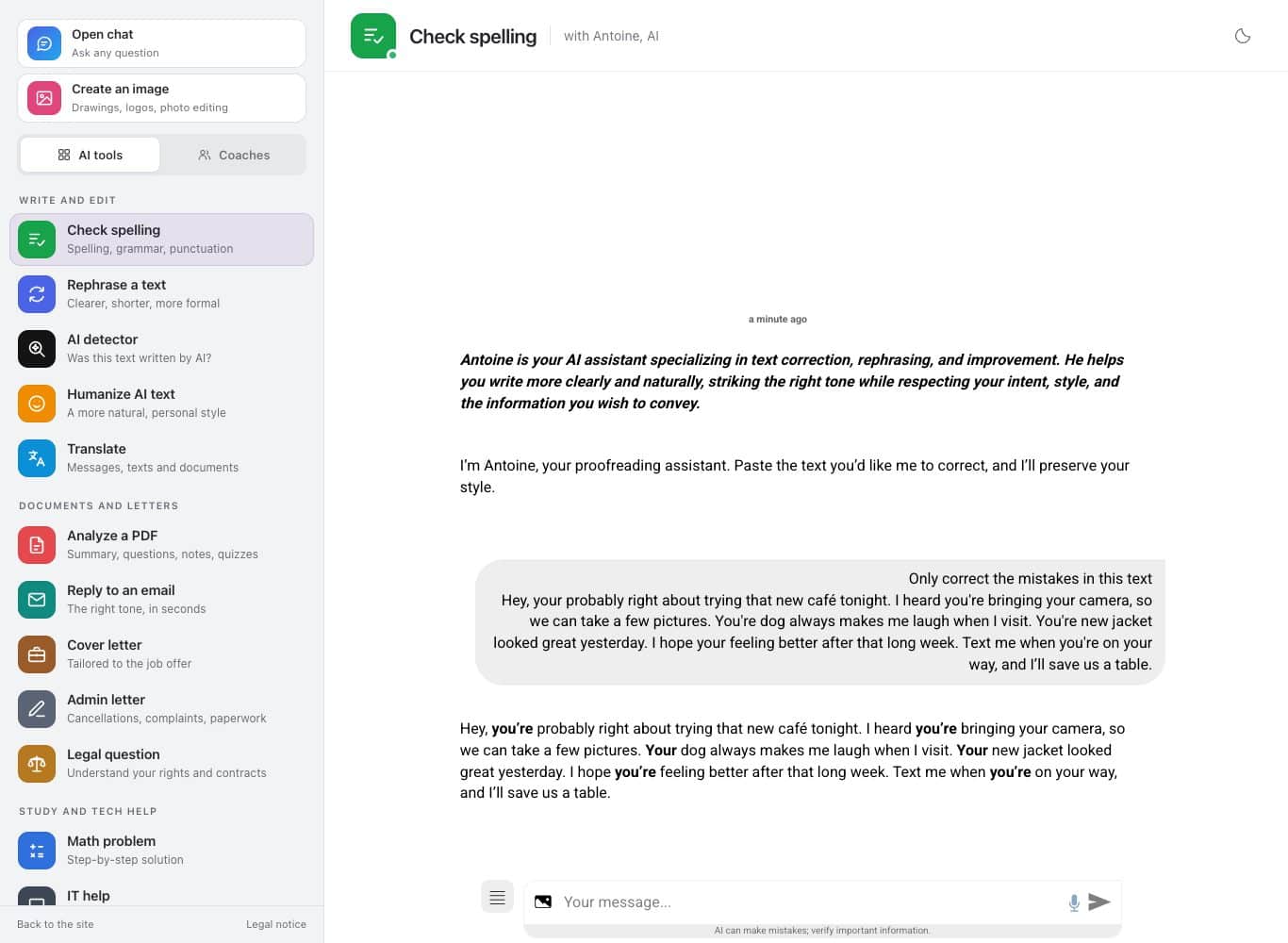
Antoine, asked why
Why did you change those words and not the rest?
“You’re probably right: “you’re” means “you are.””
“Your dog: “your” shows possession.”
Two kinds of fix, and each line names its rule: “you’re” shortens “you are,” and “your” shows possession. The same check waits for longer texts at our online spell checker, which lists “your” and “you’re” among the traps it watches for.
Antoine
AI spell checker
“Paste your text: I correct the spelling, grammar, and punctuation, and your words stay yours. Ask me why any word changed, and I will tell you.”
Let Antoine read it before your friend does
Paste the message, ask him to fix only what is wrong, and send the version he hands back.
Common Questions, Quick Answers
“You’re beautiful” or “your beautiful”?
“You’re beautiful” is the one to write. Swap in “you are beautiful” and the sentence holds, so the contraction is right. “Your” would need a noun right after it, and “beautiful” is not a noun.
“Your welcome” or “you’re welcome”?
“You’re welcome.” Cambridge Dictionary lists the phrase as the polite answer to a thank-you, and the swap settles the spelling: “you are welcome” makes sense, so the contraction carries the apostrophe.
Does “yours” take an apostrophe?
No. Purdue OWL treats “yours” like his or ours: a possessive pronoun whose possession is already built in, so no apostrophe is added. Written “a friend of yours,” it is correct; with an apostrophe after the s, Purdue marks it INCORRECT.
Why does “you’re” carry an apostrophe?
It marks a letter that is not written out. “You’re” packs “you are” into one word, and the apostrophe stands where the missing letter of “are” used to be. It has nothing to do with possession.
Sources
- Merriam-Webster’s guide “Your vs. You’re: How to Use Them Correctly”
- How to tell “your” and “you’re” apart, MLA Style Center, July 10, 2024.
- Proofreading for Errors, Purdue OWL.
- Spelling: words that sound alike, Purdue OWL.
- Apostrophe introduction, Purdue OWL.
- Part of speech: you or your?, Cambridge Dictionary, English Grammar Today.
- “You’re welcome”, Cambridge Dictionary (US).
- Confusing Word Pairs, Utah Valley University Writing Center.
Another sentence giving you trouble?
Alex, the generalist AI assistant, takes any writing question, from a tricky phrase to a full draft.