

- The test takes two seconds: say the sentence back with he or him. He fits, write who; him fits, write whom.
- Whom is also the form that follows a preposition.
- The same move settles the compound forms: whoever for a subject, whomever for an object.
- In everyday conversation who is standard, and whom keeps to formal writing.
You are putting the last touches on the invite for Saturday’s cookout when one line stops you cold: who is bringing the extra chairs? A doubt pipes up: should that be whom? Run the he or him swap in your head; if whom would sound stiff, the friendly who stays.
Who or Whom: The Rule in One Line
One line settles the pair: the doer of the action takes who, the one it lands on takes whom. Merriam-Webster sums up the split: “In grammar terms, that makes who a subject, and whom an object.”
Subject
Who
The doer of the action. Cal State Long Beach’s demo: “Who ate my candy bar?” He did, so who.
Object
Whom
The receiver of the action, and the formal pick: Cambridge and Oxford flag it as formal. “To whom do you wish to speak?”
Subject, compound form
Whoever
Who with a wider reach: the person who calls, texts or shows up. “Whoever volunteers to cover my shift is a great friend.”
Object, compound form
Whomever
Whom in compound form; Oxford labels it literary. “He was free to marry whomever he chose.”
The He or Him Test That Settles Any Sentence
Take the pronoun out and answer the question with he or him. He sounds right? The blank takes who. Him sounds right? Write whom. It works on statements too: say the clause by itself, with he or him in the pronoun’s place.
| Question or clause | Rewritten with he or him | Form |
|---|---|---|
| “Who ate my candy bar?” | “He ate my candy bar.” | Who |
| “Whom did you have in mind for the new job listing?” | “I had him in mind for the new job listing.” | Whom |
| “I ran into Alicia last night, whom Michael cared for deeply.” | “Michael cared for her deeply.” | Whom |
| “My cat, whom I was eager to believe, has been known to fib.” | “I was eager to believe him.” | Whom |
Tip
In a relative clause, say only the clause, with her or him in place. “Michael cared for her deeply” settles the Alicia row above.
Whom After a Preposition
A preposition takes whom: to whom, from whom, with whom. Purdue’s writing lab shows the pattern in full: “The visitor for whom you were waiting has arrived.” The pronoun cannot drop there: it is the object of that preposition.
Questions leave you two correct orders: “To whom should my dog apologize?” fronts the preposition, “Whom should my dog apologize to?” leaves it hanging. Merriam-Webster stands behind the hanging one, ancient and perfectly grammatical; the fronted version is for writers who dislike an ending preposition.
Relaxed sentences often skip the relative pronoun altogether. Purdue’s pair: formal English, “This is the man to whom I wanted to speak and whose name I had forgotten.”; informal, “This is the man I wanted to speak to and whose name I’d forgotten.”
Is Whom Still Alive in Everyday English?
Myth
Every who sitting where a whom could go is an error waiting to be flagged.
Reality
Conversation runs on who; whom often sounds stiff even when it is right, Merriam-Webster observes. Dictionaries still file it as the formal object form, and formal writing keeps expecting it.
“Trust your instincts (but when in doubt you can generally just use who).”
That counsel doubles as permission: the he or him swap settles the choice; when doubt lingers anyway, who is Merriam-Webster’s fallback. Our language coach Oliver practices English with you, chat after chat.
Antoine Checks a Whole Message
One blank at a time covers a single sentence; a full invitation or cover letter wants a second pair of eyes. Antoine, our coach for spelling and grammar, takes the whole text and sends it back corrected, nothing else moved.
A session with Antoine
Can you correct this invitation? “Hey everyone, I’m planning a cookout this Saturday and hope you can make it. Whom wants to bring a side dish can just text me. I’ll ask Jordan, who I saw at the store yesterday, to bring drinks. My cousin, who lives nearby, may stop by too. Do you know whom is bringing the extra chairs? I’m also checking with Sam, whom has a big cooler we can use.”
“Hey everyone, I’m planning a cookout this Saturday and hope you can make it. Whoever wants to bring a side dish can just text me. I’ll ask Jordan, whom I saw at the store yesterday, to bring drinks. My cousin, who lives nearby, may stop by too. Do you know who is bringing the extra chairs? I’m also checking with Sam, who has a big cooler we can use.”
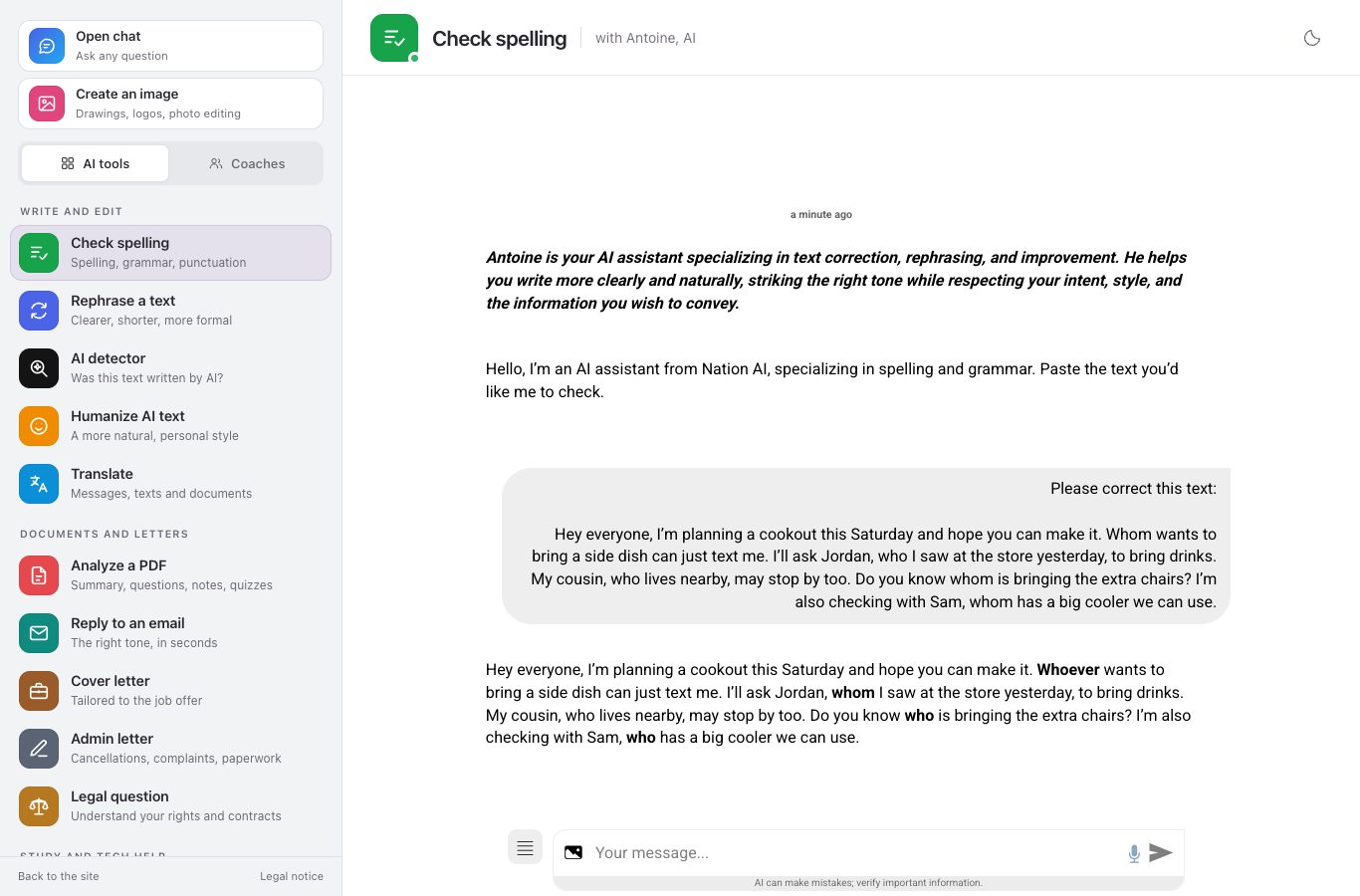
Four errors went in; four fixes came back, each one marked in bold. Three are case swaps: whom back to who where the pronoun acts (the chairs and cooler lines), who up to whom where it receives the action (Jordan, seen at the store). The fourth ran deeper: the blank in “Whom wants to bring a side dish” needs a subject, so Antoine reached for the subject compound: “Whoever wants to bring a side dish”.
When a change surprises you, ask for the why; the explanation comes back line by line. On the chairs line, he answers: “Who: Used as the subject of “is bringing” and “has.”” The reason holds: in both clauses the pronoun acts.
The AI spelling and grammar checker page is where that chat starts: paste a text, ask for a correction, get it back marked up.
Antoine
AI spell checker
“Paste your text in the chat: I correct the spelling, the grammar and the punctuation, and your voice stays yours. If one of my changes surprises you, ask me why, and I walk you through it.”
Give Antoine the whole invite
Paste your message; it comes back corrected, changes explained on request.
Frequently asked questions
What is the quickest way to pick who or whom?
Swap the pronoun for he or him and say the sentence back. He fits, write who; him fits, write whom. The writing center at California State University, Long Beach teaches the substitution.
Is whom still in use?
In conversation, not often: Purdue notes that American English rarely uses whom and very often drops it from speech. Whom survives in formal writing, where dictionaries list it as the object form.
So is it “to who” or “to whom”?
To whom. A preposition drags whom along, whether it opens the question (“To whom do you wish to speak?”) or sits at the end (“Whom should my dog apologize to?”).
And whoever versus whomever?
The same test, compound forms included. Whoever takes the subject slot: “Whoever volunteers to cover my shift is a great friend.” Whomever takes the object slot: “I support whomever you choose for the part.”
Sources
- “Who” vs. “whom,” usage notes, Merriam-Webster.
- “Whom,” entry, Cambridge Dictionary.
- “Whom,” entry, Oxford Learner’s Dictionaries.
- “Whoever,” entry, Oxford Learner’s Dictionaries.
- “Whomever,” entry, Oxford Learner’s Dictionaries.
- “Relative pronouns,” the OWL page on defining clauses, Purdue OWL.
- “Who vs. whom,” a writing center handout, California State University, Long Beach, 2016.
Another writing question on your desk?
Alex, the generalist AI assistant, takes it from there.