- The swap: say the sentence with “it is” or “it has.” Still true? Then write “it’s.”
- The possessive “its” takes no apostrophe, the way “his” and “hers” don’t.
- “Its’,” with the apostrophe after the s, never exists.
You fire off a lunch message to friends and type “it’s menu” without thinking. A friend points it out, and suddenly every its and it’s in the draft looks suspect. The fix takes two forms: a two-second swap for the sentence in front of you, and the story of why the possessive never needed the mark.
Its or it’s? The swap, step by step
-
Find the word
Stop on the its or it’s you are unsure about, before the rest of the sentence pulls you along.
-
Say it with “it is” or “it has”
Put the full form in the word’s place and read the sentence out loud. “It’s raining” becomes “it is raining”; “it’s been warm” becomes “it has been warm.”
-
Let the sentence decide
Still true with the full form? Keep the apostrophe and write “it’s.” Does the sentence fall apart? You want “its.” The Australian Government Style Manual compresses it: “If you don’t mean ‘it is’, write ‘its’.”
The trap: “it has” as the main verb
The swap passes on “It has some great new features.” Yet Oxford Learner’s Dictionaries keeps “it’s” for the helping case, as in “It’s just stopped raining.” With has as the main verb, the contraction is off: write it in full.
Why the possessive takes no apostrophe
Common belief
An apostrophe marks the owner: the dog’s collar, the group’s decision, so “it” should take one too when something belongs to it.
The reality
Pronouns already show possession on their own, which is why his, hers, ours, and yours never take the mark, and neither does its. The University of Nevada, Reno’s writing center sums up the paradox: “However, in the case of “its,” no apostrophe actually shows possession.”
The bare possessive is newer than it looks. English once used “his” for things: “April with his sweet showers.” Around 1600, “it’s” stepped in as the possessive, apostrophe and all, and the form stayed extremely common through the 17th century. The bare version won only in the 18th century, probably because “it’s” was busy with a new job: replacing the contraction ’tis.
“We still see the possessive it’s in dashed-off emails and advertisements, but the fact that it was right 300 years ago doesn’t make it correct today.”
Six sentences, two words, one rule
Pattern beats memory: read a sentence, name the word, and check it against these.
| Sentence | Word | Why |
|---|---|---|
| “it’s raining” | it’s | Stands for “it is raining.” |
| “it’s been warm” | it’s | Stands for “it has been warm.” |
| “The dog had hurt its paw.” | its | The paw belongs to the dog. |
| “The group made its decision.” | its | The decision belongs to the group. |
| “Put the rabbit back in its cage.” | its | The cage belongs to the rabbit. |
| “It’s going to be a wonderful day!” | it’s | Stands for “it is going to be.” |
Example sentences quoted from the sources listed at the end of this article.
Give Antoine a whole message
The swap settles one word; a fast draft hides several. Paste the whole thing, and Antoine takes spelling, grammar, and punctuation in one pass, with your wording left as you wrote it.
Take the note below, the kind friends send each other about lunch. Pasted as is, it comes back like this:
Before
“It’s been a busy week, but it’s finally slowing down. Its supposed to be sunny tomorrow, so maybe we can grab lunch outside. The café changed its hours, but I think it’s menu is still pretty good. Its been ages since we all hung out. The park is nice, but it’s paths get muddy after rain, so let’s meet downtown instead!”
After
“It’s been a busy week, but it’s finally slowing down. It’s supposed to be sunny tomorrow, so maybe we can grab lunch outside. The café changed its hours, but I think its menu is still pretty good. It’s been ages since we all hung out. The park is nice, but its paths get muddy after rain, so let’s meet downtown instead!”
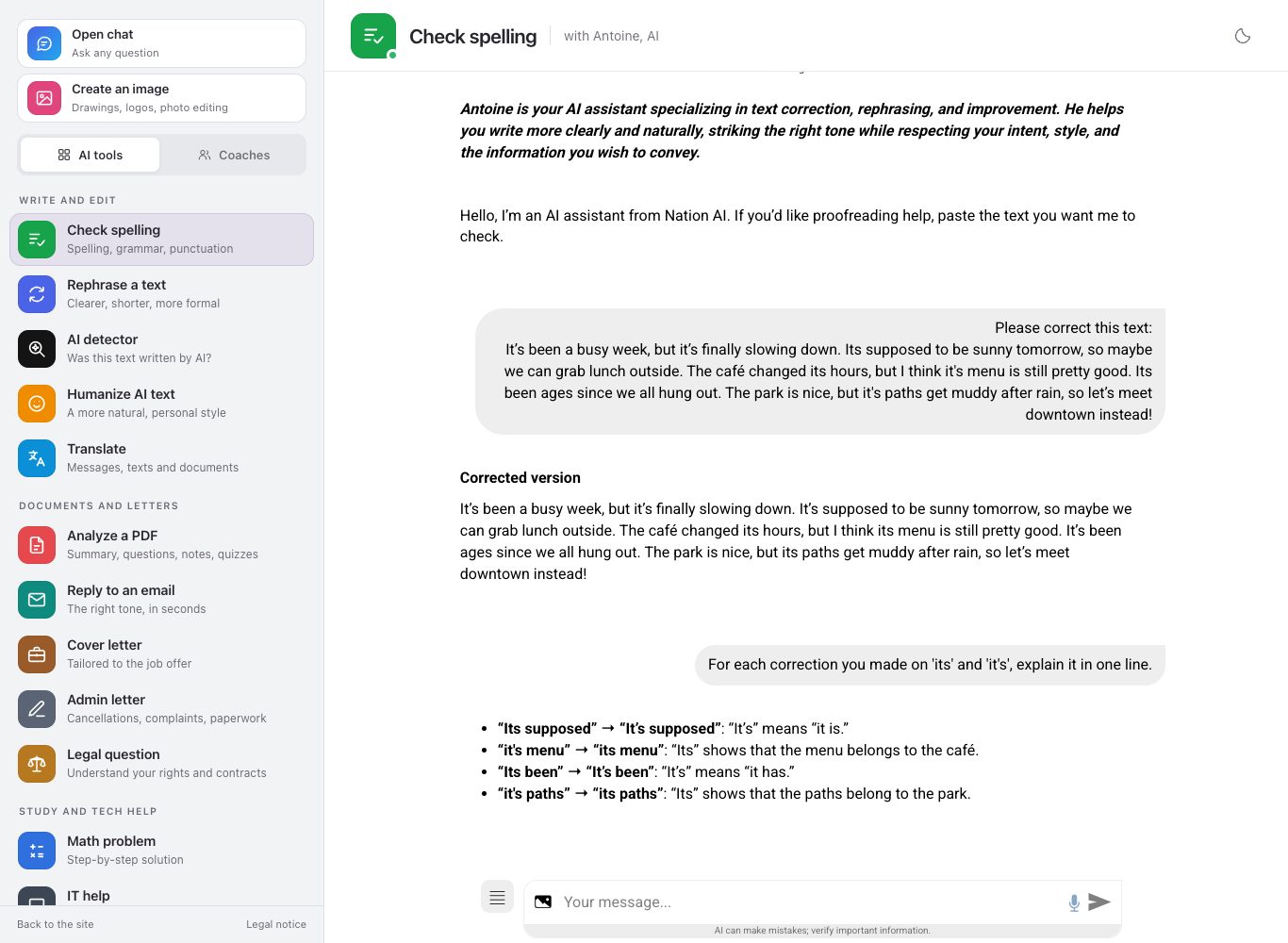
Four words change, and the three uses that were already right come back untouched. The reply is the corrected text and nothing else; explanations arrive only on request.
The whole exchange runs on Nation AI’s spelling and grammar checker, the page where a draft goes in and the fixed text comes out.
Ask him why, and each fix gets its line:
A session with Antoine
Why did those two words change? One line each is fine.
“it’s menu” → “its menu”: “Its” shows that the menu belongs to the café.
“it’s paths” → “its paths”: “Its” shows that the paths belong to the park.
Antoine
AI spell checker
“Paste your text and I will correct the spelling, grammar, and punctuation, keeping your words the way you wrote them. Want the why? Ask, and I add a one-line reason for each change.”
Give Antoine your next draft
Paste the text; the corrected version comes back, ready to send.
Frequently asked questions
How do I remember which word to write?
Borrow the possessives you already write. Purdue’s OWL says it plainly: “A simple way to remember this rule is the fact that you don’t use an apostrophe for the possessive his or hers, so don’t do it with its!” Skidmore College’s writing guide adds a reading habit: see “it’s” and hear “it is.”
Why does the possessive “its” skip the apostrophe other possessives take?
Because a pronoun points on its own. His, hers, ours, and yours never carry a mark, and “its” works the same way; an extra one would double a job the word already does.
Is “its’” ever a correct spelling?
No. The possessive never takes an apostrophe, and the contraction can only spell “it’s,” with the mark before the s. A mark after the s gives you a form that is neither of the two.
Was “it’s” ever the possessive?
Centuries ago, yes. Writers used “it’s” for possession around 1600, and the form stayed common through the 17th century; the bare possessive took over in the 18th century and has held the job since.
Sources
- It’s vs. Its, Merriam-Webster.
- Word choice: its or it’s?, Cambridge Dictionary, Grammar.
- “it’s,” the contraction, Oxford Learner’s Dictionaries.
- its, Oxford Learner’s Dictionaries.
- Apostrophe Introduction, Purdue OWL.
- It’s and its, the Australian Government Style Manual, updated December 19, 2024.
- It’s vs. Its, University of Nevada, Reno.
- Choosing the Right Word, Rutgers Learning Centers. Page dated May 10, 2023.
- Its/It’s Confusion, Skidmore College.
Another writing question on your desk?
Alex, the generalist AI assistant, takes any writing question, from word choice to whole drafts.