- It shows your teacher that you read the question right, and it helps you remember the question while you answer.
- It doubles as the R of RACE, and of RACES, the writing strategy many classrooms teach.
- Four steps, one worked example, and a check to run on every restated sentence are below.
The homework came back with a note in the margin: restate the question. Your written answer said “Three.” or “Because it does.” One small move turns a fragment like that into a full sentence, and four steps make the move automatic.
What It Means to Restate the Question
The note asks you to start your answer by saying the question again, in words you choose. Purdue University’s K-12 Outreach, which teaches the RACES writing strategy, defines the move: “This refers to restating or rephrasing the question or prompt in your own words to ensure that you understand it correctly.”
The reason behind the note is simple: the teacher wants to see that the question was understood. Literacy Minnesota, a literacy nonprofit, teaches the same step to tutors: “Restating a question shows that you heard the question correctly,” and it helps you hold the question in mind while you answer.
Saying a question back in new words also does a job far from school. The same page calls restating a communication skill, one that helps a listener or a writer offer clarification when a message may not have landed. If you can restate a question, you can check what anyone means before you reply.
Four Steps to a Restated Answer
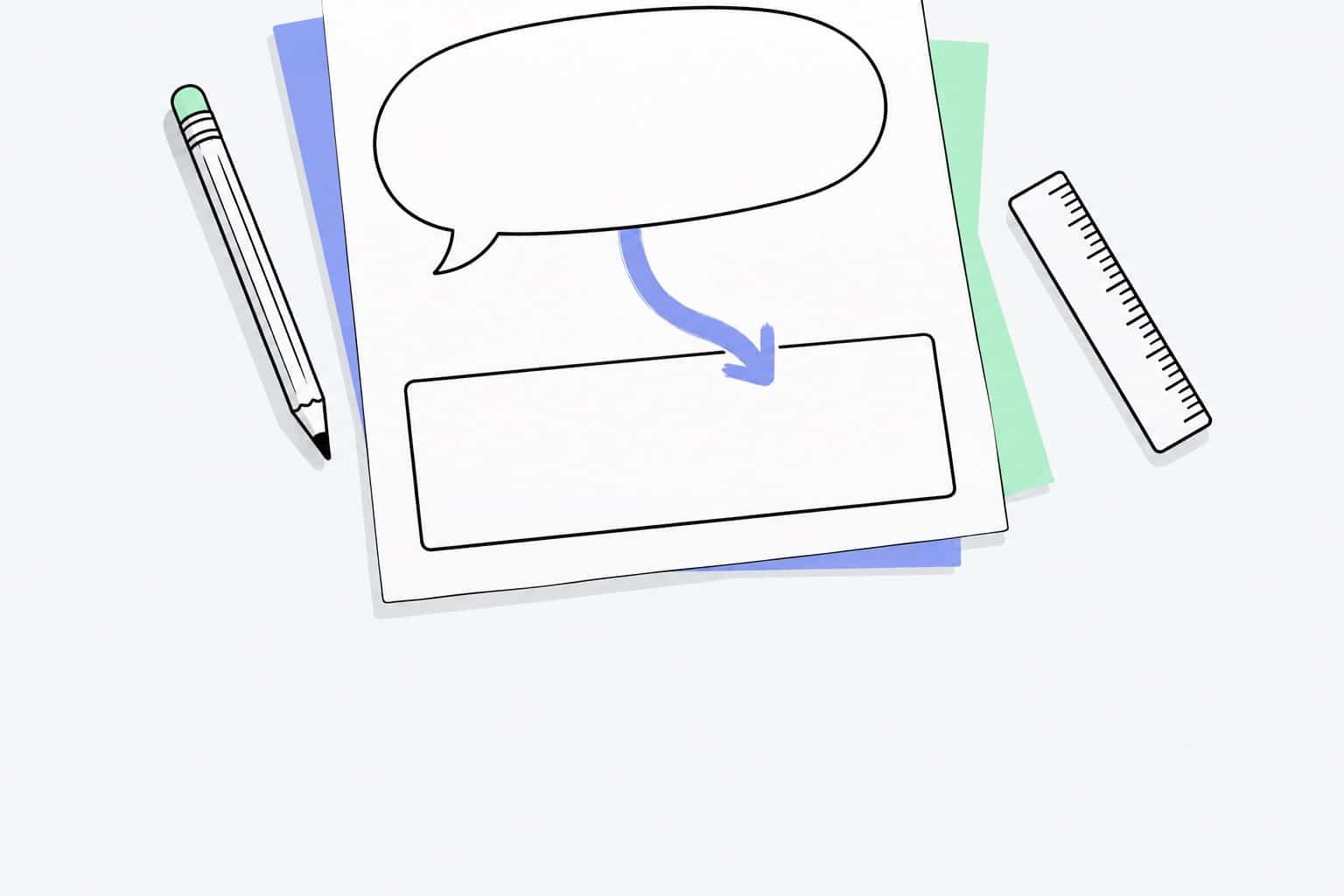
Four steps join a short answer and its question into one sentence that stands on its own.
-
Find the key words
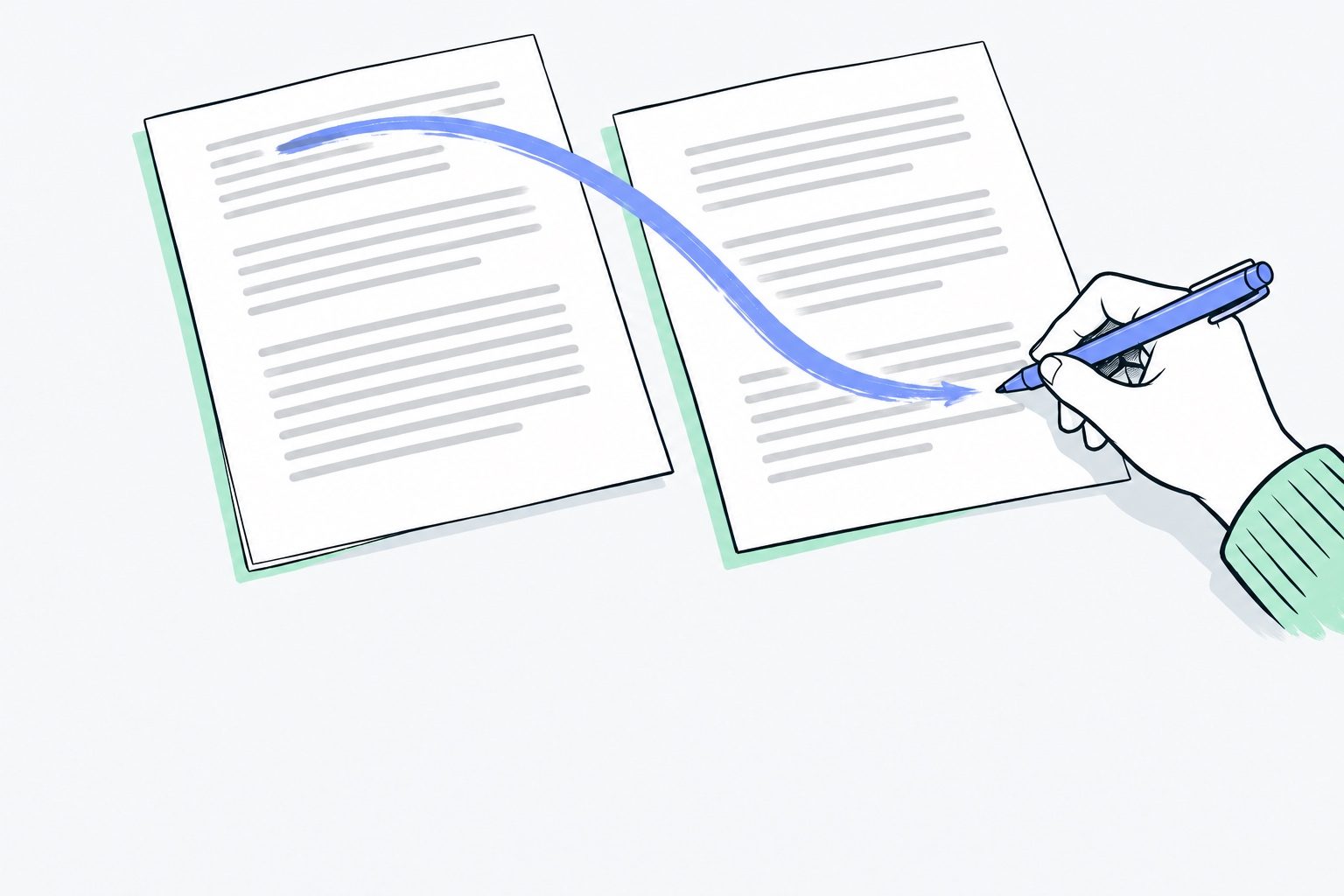
Read the question and find the words that carry its meaning: who does what, and where, or to what.
-
Drop the asking words
Take out the words that only ask, like why, how, what, do and does. The words that tell are the ones you keep.
-
Build around your answer
The question’s key words go around your short answer, like cards laid out on a table.
-
Add what is missing
Say the new sentence out loud and add the small words it still needs, such as I.
Before
Question: “How many hours a day do you watch TV?” Short answer: “Three.”
After
“I watch TV for three hours a day.” The Literacy Minnesota page lays the question’s content words out as cards around the answer; this sentence is what the cards form, once I and one small linking word are added.
The same move works on any reading question. Here is a pair written for practice:
Before
Question: “Why does Sam keep the window open at night?” Short answer: “His cat likes to come and go.”
After
“Sam keeps the window open at night because his cat likes to come and go.” The question’s words carry the sentence, and the reason keeps its place.
Where Restating Fits in RACE and RACES
Classrooms often attach the move to a writing framework. Purdue teaches it as RACES, and the education nonprofit Edutopia describes RACE, noting that some educators add an S for Summarize. One school example: Marion Intermediate School in South Carolina lists the same steps in its school report.
| Letter | What you do |
|---|---|
| R | Restate the question |
| A | Answer the question |
| C | Cite evidence |
| E | Explain or expand |
| S | Summarize: the step that turns RACE into RACES |
Purdue teaches the whole framework so students can organize their thinking and put their ideas across more effectively. For younger elementary students, it adds, citing sources can stay simple: an example from the text, or from the student’s own experience, is enough.
Practice Ideas for Home and the Classroom
Say answers out loud before anything is written down. In the Edutopia classroom, one student restates the question and another finds the answer in the text; at the kitchen table, one person asks and the other answers in a full sentence before the pencil moves.
- “The reason … is …”
- “… is the one who …”
- “The story takes place in …”
- “… happens because …”
Sentence stems like these carry the question’s shape; the student fills the gap. Turn practice into a game by writing questions on slips of paper: draw one, then say a restated answer before the timer runs out. Ten minutes of that is a homework session in itself.
Turn Your Short Answer Into a Full Sentence With Tom
The four steps come from teachers and classrooms; the typing can go to a tool. Tom is Nation AI’s rephrasing coach: give him your question and your one-line answer, and he rebuilds the answer as one sentence that starts with the question’s own words.
Example conversation
Reading question: In the short story, why does Mia hide the letter under her bed? My answer: Because she is afraid her brother will read it. Please turn my answer into one sentence that restates the question.
“Mia hides the letter under her bed because she is afraid her brother will read it.”
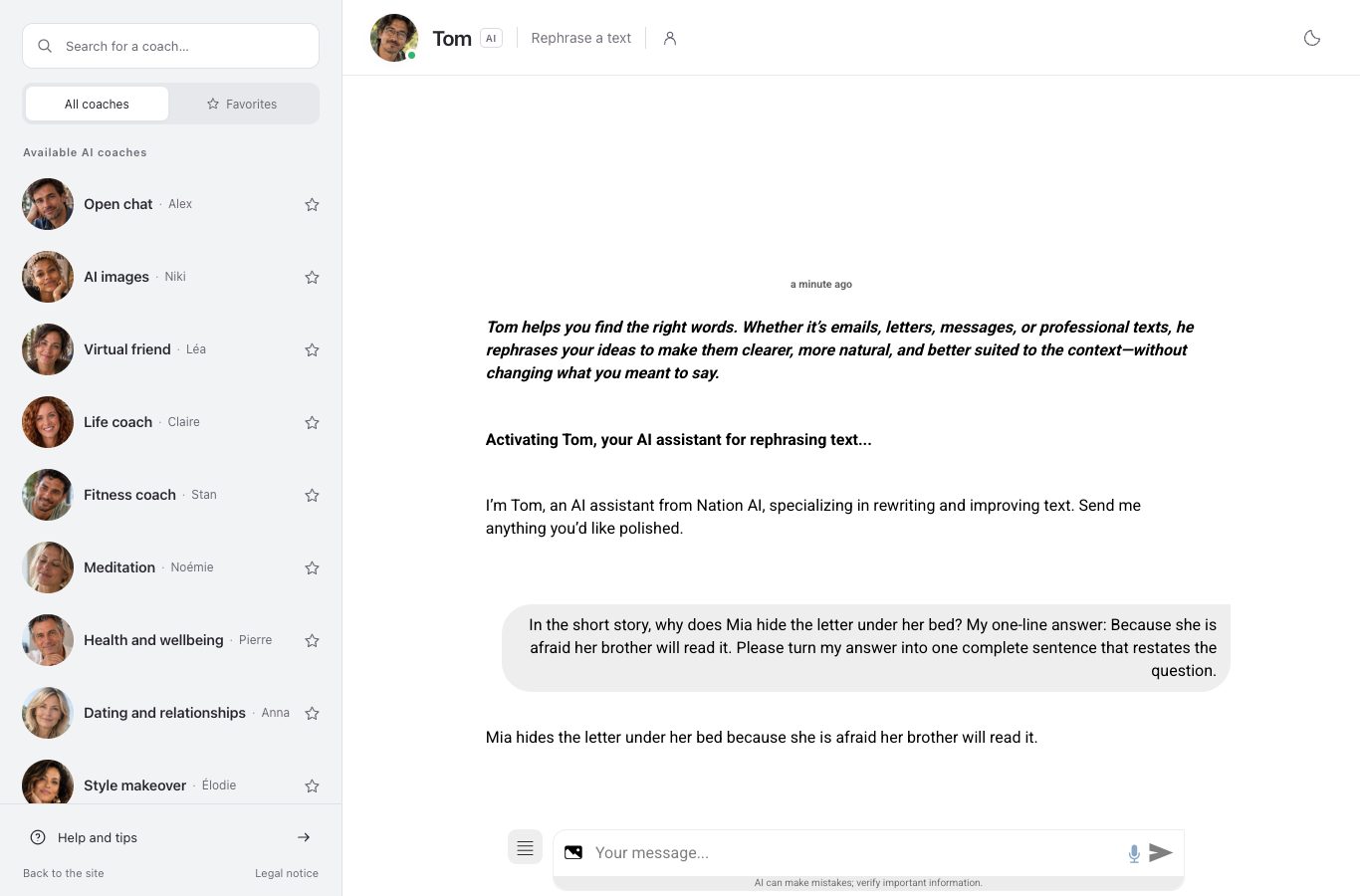
Read the reply against the question and it holds: it opens with Mia, the hiding and the place, and the reason arrives word for word after “because.” That check is yours to run every time, and our tool page says it plainly: “AI can help rephrase, yes, but it’s up to you to validate the accuracy (and not invent details).”
Tom’s tool page is an AI rephraser: it takes what you type or paste, and a photo of a worksheet works too. For a younger reader, ask Tom for the simple language level; the request is typed, like everything in the chat, not clicked from a menu. It rewrites sentences you already have; it does not choose your evidence or teach the four steps.
Tom
AI rephrasing assistant
“Send me the question and your short answer, and I will return one full sentence built from your words. Reread it before you hand it in: the check stays yours, not mine.”
Turning one answer into one sentence is a small job next to saying a whole passage in new words; our guide to what paraphrasing is takes that bigger job apart.
Give your short answer its full sentence tonight
Paste the question and the answer, and Tom returns one sentence for you to check.
Frequently Asked Questions
What does it mean to restate the question?
It means your answer opens by saying the question again, in words you choose, before it gives the information. Restated this way, a one-word reply becomes a full sentence, and the teacher can see the question was understood.
Why do teachers ask for a restated question?
Because the restatement shows the question was read correctly and helps a student remember it, as Literacy Minnesota puts it. Taught inside RACE or RACES, it also trains students to line up their thoughts and put their ideas across, which is Purdue’s stated reason for the framework.
What does a restated answer look like?
Question: “How many hours a day do you watch TV?” Restated answer: “I watch TV for three hours a day.” The question’s words open the answer, and the number keeps its place.
Can a question be restated without answering it?
Yes. Say the question back in words of your own to check that you understood it, and only then answer. Literacy Minnesota counts that check as a communication skill in its own right, useful any time a message may not have landed.
Sources
- Restating the Question, Literacy Minnesota, Tutor Tip, August 2014.
- RACES Writing Strategy, K-12 science outreach program, Purdue University’s College of Science.
- Building Better Responses With RACE, Edutopia, October 9, 2026.
The rest of tonight’s homework does not have to wait
Alex, Nation AI’s general assistant, helps with the questions this page does not cover.