- It is not a synonym swap: changing a few words is not enough.
- A summary keeps only the main points; a paraphrase reworks the whole passage.
- Your own words do not lift the duty to cite.
The assignment says to paraphrase your source, not quote it, and the passage is open in front of you. A paraphrase is that idea restated in words you own, meaning untouched and the author named. Get the difference between quoting, paraphrasing, and summarizing straight, and the instruction becomes a two-second decision on your next paper.
What the dictionaries say
The dictionaries land on the same idea. For Merriam-Webster, a paraphrase is “a restatement of a text, passage, or work giving the meaning in another form.” Cambridge adds that it often comes in “a simpler and shorter form that makes the original meaning clearer.” Purdue OWL calls it “your own rendition of essential information and ideas expressed by someone else, presented in a new form,” and, unlike a summary, “a more detailed restatement.”
Penn State’s academic integrity guide keeps it to three short lines: paraphrasing is not a synonym swap, it restates another person’s idea in your own words, and doing it well is proof that you understood the source.
“It shows that you understand the idea.”
So what best describes paraphrasing? One sentence covers every case: someone else’s idea, restated in your own words, meaning kept, source named. If your version only dresses the original’s wording in synonyms, it is not a paraphrase yet.
What is an example of a paraphrase?
Purdue OWL pairs a passage from James D. Lester’s Writing Research Papers with a legitimate paraphrase of it:
Before
“Students frequently overuse direct quotation in taking notes, and as a result they overuse quotations in the final [research] paper. Probably only about 10% of your final manuscript should appear as directly quoted matter. Therefore, you should strive to limit the amount of exact transcribing of source materials while taking notes.”
After
“In research papers, students often quote excessively, failing to keep quoted material down to a desirable level. Since the problem usually originates during note taking, it is essential to minimize the material recorded verbatim (Lester 46-47).”
The sentences come back reshaped, and the credit to Lester, page numbers included, stays in place. The 10% figure, meanwhile, stays out.
Penn State shows what happens when a rewrite only shuffles words. Its poor paraphrase of a passage on music piracy kept the original’s build and much of its wording, and the guide’s verdict is blunt: “so close to the original statement, it might as well be a direct quote.” Rebuilt from scratch, the same idea becomes a real restatement, one way to fight music piracy among Generation Z through social media, with the citation to Borja and Dieringer kept.
The shortest example comes from an open textbook at Howard Community College, and its sentences were written for the book, not lifted from a study: “The advancements in technology have revolutionized the way we communicate with each other” becomes “Technological progress has transformed how we interact and communicate with one another.”
Quote, paraphrase, or summary: what changes
All three bring a source into your writing, and all three are cited. What changes is what you keep, and how far your words travel from the original.
| What changes | Quote | Paraphrase | Summary |
|---|---|---|---|
| What you keep | The exact words of a narrow segment | The full meaning of a passage | Only the main points |
| The wording | Identical, word for word | Your own | Your own |
| The length | Short by design | Close to the original, no single rule | Much shorter |
| Citation needed | Yes | Yes | Yes |
Only the length cell divides the guides: Purdue OWL calls a paraphrase usually shorter than the original, West Texas A&M puts it at a similar length, and Newcastle University allows the same length or shorter.
A whole PDF is a different job: our AI PDF summarizer exists for the overview, while a paraphrase works passage by passage.
When to use each one
Newcastle University’s academic skills kit, a UK guide, frames the choice by what the reader needs:
Paraphrase
Your reader needs the sense
The original wording adds nothing; an accurate restatement is also proof that you understood the source.
Quote
The exact words carry the point
You analyze the wording, you critique it, or the author said it so well that a restatement would flatten it.
Summary
Only the main point serves
A long source shrinks to its core idea for a reader who wants the overview, not the details.
Purdue OWL adds a rule of thumb for quoting: do it sparingly, and only for a good reason, such as supporting a claim or letting a striking phrase speak for itself. APA Style tips the balance further: published authors paraphrase their sources most of the time, and student writers should paraphrase more than they quote.
Paraphrasing a passage with Tom
When a draft already exists and only the wording is wrong, Nation AI’s AI paraphraser takes over: paste your text into the chat with Tom, type it, or attach a photo of the page or a PDF. And if you have been saying rephrase, Nation AI’s rephrasing page treats the two words as one, so either request works.
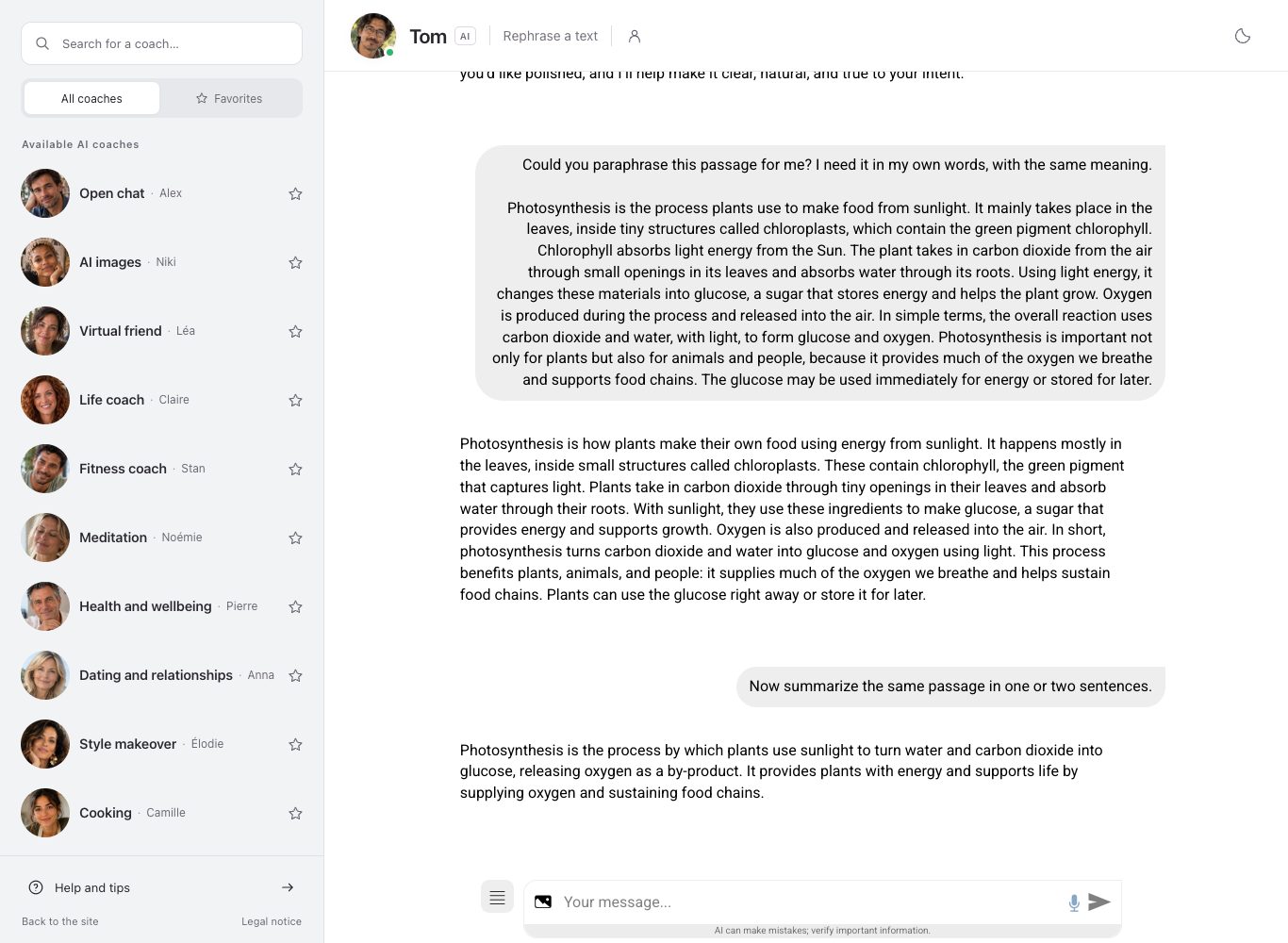
Alex, Nation AI’s generalist assistant, wrote the passage for this example, a 143-word paragraph on how photosynthesis works. Asked to paraphrase it, Tom reworks the whole passage; asked next for a summary, he brings it down to two sentences. A piece of his paraphrase, then the summary in full:
Example session
Paraphrase this passage.
It happens mostly in the leaves, inside small structures called chloroplasts. These contain chlorophyll, the green pigment that captures light.
Summarize the passage now, in two sentences at most.
Photosynthesis is the process by which plants use sunlight to turn water and carbon dioxide into glucose, releasing oxygen as a by-product. It provides plants with energy and supports life by supplying oxygen and sustaining food chains.
The source passage runs 143 words, Tom’s paraphrase comes back at 121, and his summary at 37: a rewording that keeps the whole build, a condensation that keeps the two main ideas.
Tom
AI rephrasing assistant
“Send me the text you are working from. I rework its wording and its shape, sentence by sentence. Then put my version next to your source: if a detail shifted, fix it, and add the citation, because that part stays yours.”
A warning from Tom
Fresh words do not turn borrowed content original. Nation AI’s rephrasing page is explicit: start from a source, and the citation rules still apply. Read the AI version against the original before you hand it in, because catching a drifted detail is your job, not the tool’s.
A passage that needs new words?
Paste it for Tom, compare his version with your source, and keep the citation.
The citation, in one paragraph
In APA style, a paraphrase cites the original work, in the sentence itself or in parentheses, and a page number stays optional, though it helps a reader find the passage in a long book. MLA asks for more: when the source carries a page number or another locator, the in-text citation must include it, even for a paraphrase.
Whether a reworded passage can still count as plagiarism is its own question, and our article on paraphrasing and plagiarism takes it apart. For the method itself, our paraphrasing guide runs step by step, from the first reading to the final citation.
Frequently asked questions
Can you show me a paraphrase?
Howard Community College’s open textbook reworks “The advancements in technology have revolutionized the way we communicate with each other” into “Technological progress has transformed how we interact and communicate with one another.” The pair was written for the book, and it shows the move: same meaning, brand-new sentences.
What best describes paraphrasing?
Restating another writer’s idea in your own words, with the meaning kept and the source credited. Merriam-Webster calls a paraphrase a restatement that gives “the meaning in another form,” and Penn State’s integrity guide warns that swapping in synonyms is not enough.
How long should a paraphrase be?
The guides part ways there: Purdue OWL calls it usually shorter than the original, West Texas A&M puts it at a similar length, and Newcastle University allows the same length or shorter. The much shorter form is the summary’s job.
Does a paraphrase need a citation?
Yes. Purdue OWL’s rule is blunt: anytime you take information from a source, you say where it came from. Johns Hopkins’ library guide adds that your own words never lift the duty, in whatever citation style your discipline uses.
Sources
- Merriam-Webster, “Paraphrase”, undated.
- Cambridge Dictionary, “Paraphrase”, undated.
- Purdue OWL, “Paraphrase: Write It in Your Own Words”, undated.
- Purdue OWL, “Quoting, Paraphrasing, and Summarizing”, undated.
- Penn State Academic Integrity, “Paraphrasing”, undated.
- Newcastle University Academic Skills Kit, “Quote or Paraphrase?”, undated.
- Howard Community College, “What Is Paraphrasing?” (open textbook), undated.
- West Texas A&M University Libraries, “Paraphrasing Basics”, undated.
- APA Style, “Paraphrases” (last updated July 2022).
- MLA Style Center, “In-Text Citations: An Overview”, undated.
- Johns Hopkins University Libraries, “Paraphrasing & Summarizing”, undated.
Keep working on that paper
Alex, the generalist AI assistant, helps you draft, reword, and cite, from the first outline to the last read-through.