- Copying the sentence word for word fails; so does a reshuffle that changes nothing of substance.
- Nothing gets added: no new argument, no subtopic the essay never developed.
- Skip openers like “in conclusion”; let the claim itself open the line.
- After the restatement, the conclusion moves past it: how the points fit together, what the reader can do with that.
The body of the essay is done. The conclusion is still unwritten, and the thesis waits at the foot of the introduction. Said again in fresh words, every claim intact, it becomes the first line of your conclusion.
Where does the restatement go?
At the beginning. The writing program at Brandeis University places the return of the thesis “in the opening sentence” of a strong conclusion, spoken “in different language from the introduction”. The Odegaard Writing & Research Center, at the University of Washington, agrees: a strong conclusion “usually starts with a restatement of the main idea, or thesis”.
The return stays short. Indiana University’s writing guide limits the restated thesis to the first moments of the conclusion, calling it “just a short first part”. In a longer paper, the guide finds the return of the argument helpful, provided the conclusion then goes past repeating what the essay already said. UNC holds up the one-line version as a warning: a conclusion that does nothing but restate is “painfully short”, and pushes no idea forward.
How to reword a thesis, step by step
The handouts agree on the bar. The Odegaard handout calls the restatement “a paraphrasing of it”, where “the wording should be different, but the ideas, and the order of those ideas, should stay the same”. Five steps take a thesis across that bar.
-
List what the sentence claims
Write down the main claim, then each reason under it. That list is what the rewrite has to carry.
-
Write it again in fresh words
Indiana’s advice is “new and interesting language”. Build the new sentence from your list, not by swapping a word here and there.
-
Keep every claim, in its place
The restated thesis holds the main claim and every reason, in the order the thesis gave them. A reason dropped or swapped, and the conclusion argues for a paper you did not write.
-
Add nothing
No new argument, no side topic, no qualifier the essay never defended. The conclusion, Brandeis’s handout says, is “not traditionally the place in which the author draws new conclusions”.
-
Compare, claim by claim
Set the two sentences side by side. Is the main claim still yours? Is each reason still there, still in order? Repair what failed, and the line is ready.
The thesis, before and after
The pair below works on a sample thesis Alex, Nation AI’s generalist assistant, wrote for this article. Its three reasons are material for the method, claims to carry, not findings to defend.
Before
“Schools should start later in the morning because later start times improve students’ sleep, support their mental and physical health, and help them succeed academically.”
After
“Schools should begin the day later: students would sleep better, stay healthier in mind and body, and do better in their schoolwork.”
Every claim made the trip, and the order never moved. Only the wording changed, from “start later in the morning” to “begin the day later”, from “succeed academically” to “do better in their schoolwork”.
A second pair, on another topic:
- Thesis: “Cell phones should stay out of classrooms because they pull attention from lessons, make cheating easier, and replace talk between students.”
- Restatement: “A phone-free classroom serves everyone in it: lessons hold attention, graded work shows what the student can do, and classmates speak to each other again.”
Three reasons again, in the original order, not one phrase carried over. The Odegaard handout prints a model of its own: a conclusion that opens on a restated thesis. Its first sentence: “The use of technology in the classroom has the potential to greatly enhance the learning experience for students, though care should be taken to ensure that essential classroom interaction is not lost.” No thesis is printed with it.
The first words of the sentence
The claim itself opens the line. Indiana’s guide lists “in conclusion”, “in summary” and “in result” among the transitions to cut, because “they get in the way of the actual substance of your conclusion”. UNC’s phrasing is sharper: such openers come across as “wooden and trite” in writing.
One handout lists starters anyway: Cuyamaca College’s guide shows “In Summary,” among them. The sources split, so let the instructor’s preference settle it for your course. What no guide asks for is a stock phrase doing the work of a claim.
The mistakes that weaken a conclusion
Six checks, straight from the writing centers, before the essay goes in:
- The thesis shows up in the conclusion for the first time. If the introduction never stated it, there is nothing to restate.
- A rewording that changes nothing: UNC counts a restated thesis “without any substantive changes” among the strategies to avoid.
- A new idea, or a subtopic the body never took up.
- Main points repeated word for word from the pages before.
- A conclusion that does nothing but restate, then stops.
- A big final claim: Purdue OWL’s advice is not to “try to solve world hunger in the final sentence”.
Tom drafts the rewording, you check it
There is a rephrasing tool for this step: Tom, Nation AI’s rewording coach. Paste the thesis into the chat, or send it as a photo or a PDF, and one new version comes back as a single paragraph. Typed requests steer the result: how close to stay to your meaning, and the register, from simple to formal.
A session with Tom
Here is my thesis. Can you restate it for the first line of my essay’s conclusion? Schools should start later in the morning because later start times improve students’ sleep, support their mental and physical health, and help them succeed academically.
For these reasons, schools should begin later in the morning: doing so gives students more sleep, supports their mental and physical well-being, and helps them succeed academically.
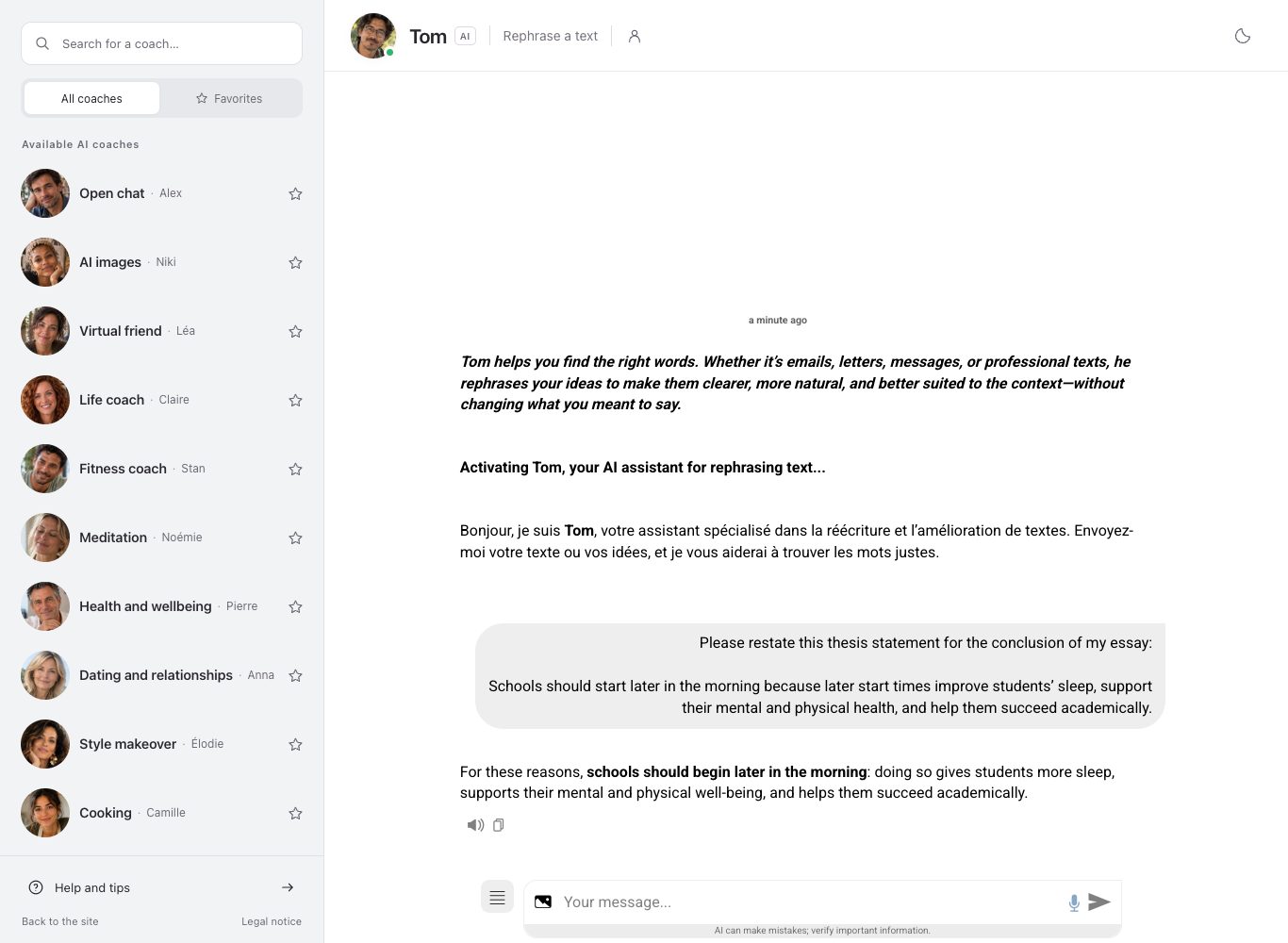
Now the check, claim by claim. The main claim came through: start became begin, same policy. All three reasons are present, in the order the thesis set: sleep, then health, then academic success. Nothing came in but the opener, “For these reasons”, pointing back at the essay.
The judgment call is “more sleep”. Your thesis said later starts improve students’ sleep; Tom’s line says students get more of it. Close, not identical: deciding whether the new words still say what you meant is yours, before the line enters the essay.
Tom
AI rephrasing assistant
“Send me the sentence you want said differently and I hand it back in fresh words. The wording is my half; the check against your claims is yours.”
Tom warns you
A rewrite can let a detail slide: “more sleep” is not yet “improved sleep”, and a word added here quietly changes a claim there. The tool page says it in its own words: it is “up to you to validate the accuracy (and not invent details)”.
Give Tom the thesis
Paste the sentence; a reworded version returns for your check before it enters the conclusion.
Our step-by-step guide to paraphrasing carries the method further, sentence by sentence. And if the word itself feels fuzzy, our piece on what paraphrasing is puts a definition on it.
Frequently asked questions
How do you restate a thesis in an essay?
In the conclusion’s opening sentence, with new words and the claims in their original order. Brandeis’s writing program and the Odegaard handout both describe the restatement as the way a strong conclusion begins. What comes after it should carry the essay somewhere new.
What can a finished restatement look like?
Look at the school-hours pair above. The thesis asked for later starts in the name of sleep, health, and school success; the restatement gave the same three, in that order, with “begin the day later” where “start later in the morning” had stood.
How should the sentence open?
With the claim itself, not a formula. Indiana and UNC both list “in conclusion” and “in summary” among the openers to drop; UNC’s word for them in writing is “wooden and trite”. Cuyamaca’s handout does list starters, so the guides disagree; the instructor’s preference can end the debate.
Should a restated thesis bring in anything new?
No. UNC and the Odegaard handout both put new arguments on their lists of mistakes. The fresh thinking belongs to the paragraphs after it: Indiana’s guide asks the closing ones to give the reader something fresh to think about.
Sources
- “Writing Conclusions,” a guide of the Writing Tutorial Services at Indiana University Bloomington.
- “Conclusions,” tips page of the Writing Center, UNC Chapel Hill.
- “Conclusions,” Purdue OWL’s guide for argument papers.
- “Constructing Effective Conclusions,” handout of Brandeis University’s Writing Program, 2020.
- “Writing Effective Conclusions,” handout of the Odegaard Writing & Research Center, at the University of Washington.
- “Writing Strong Conclusions,” handout of the Tutoring Center, Cuyamaca College.
Keep the essay moving
Alex, the generalist AI assistant, takes the next part with you, from body paragraphs to the last read.