- Keep the exact words when they carry the argument: a line you will analyze, or one no restatement could match.
- APA lets a paraphrase go by on author and year alone; MLA wants the location marker whenever the work has one.
- Swapping synonyms is not enough: rebuild the sentence as well, since a paraphrase keeps the idea, not the shape.
You have the line. It says what your essay needs, yet a paper stitched from quotations reads like a scrapbook, and APA urges students to paraphrase more than they quote. Restated, announced, and cited in your course’s style, it keeps its force and works for you.
Keep the quotation or restate it?
Some lines deserve to stay as written; the rest should turn into your own prose. Newcastle University, a UK university guide to the choice, puts it plainly: quote when you will analyze the wording, or when no rewrite could match the phrasing. Purdue OWL adds that quotations belong sparingly, for a good reason. APA’s style page gives the proportion: paraphrase more often than you quote.
You plan to analyze the wording
Keep the quotation
The argument needs the exact words on the page; no one analyzes phrasing they never saw.
Our advice
The idea matters, not the phrasing
Restate it
Most reading works this way: the reader needs the meaning carried accurately, and your own sentence proves you understood.
You write in the sciences
Restate almost everything
In the natural and medical sciences, Newcastle notes, quotation is rarer and scholars whose work fails a critical reading are little mentioned.
From Thoreau’s woods line to your own sentence
This line from Henry David Thoreau’s Walden, long in the public domain, runs through everything below:
“I went to the woods because I wished to live deliberately, to front only the essential facts of life, and see if I could not learn what it had to teach, and not, when I came to die, discover that I had not lived.”
-
Reread until the meaning holds
Thoreau’s line lists aims and ends in a fear: live on purpose, face what life is made of, and not to reach death without having lived.
-
Set the original aside
Close the book or look away. Purdue OWL’s method rests on this gap: the next words come from your understanding, not from the page.
-
Write your version from memory
A new shape, not word swaps: “He moved to the woods to live on purpose, to meet life at its most essential, and to learn its lesson, so that he would not reach death and find he had never lived.”
-
Compare, and mind the closeness
Put your sentence beside the original: too close, as Newcastle warns, and it is not yours yet. Keep any distinctive phrase inside quotation marks; start again if only the words changed.
-
Record the source on the spot
Author, work, year, chapter, page: note them as Purdue OWL advises, before the material enters the paper. For Walden: Thoreau, 1854, and the page your copy prints.
Signal phrases: what to write instead of the quotation
A restated idea with no introduction reads as yours. The signal phrase solves it: a short frame that names the source and picks the verb that frames the claim. Purdue OWL keeps a stock of them, with the tense each style prefers:
APA
Past tense, one step back
Purdue’s APA examples run in the past tense: “According to Thoreau…”, “As Thoreau pointed out…”.
MLA
Present tense, the literary habit
The MLA examples run in the present: “Thoreau argues that…”, “As Thoreau suggests…”.
Both styles
The verb is a commitment
Purdue’s caution: the verb should say what you intend; argues, suggests, and pointed out do not weigh the same.
The APA citation: author, year, and the page question
APA gives the restated idea two doorways. The narrative form puts the author in the prose, the year after the name. The parenthetical form closes the sentence with the credit. Both, on the woods line:
Thoreau (1854) explains that he moved to the woods to live on purpose, to meet life at its most essential, and to learn its lesson, so that he would not reach death and find he had never lived.
The parenthetical version: “He moved to the woods to live on purpose, to meet life at its most essential, and to learn its lesson, so that he would not reach death and find he had never lived (Thoreau, 1854).”
Both carry an author and a year, nothing else, except that Purdue OWL treats today’s Walden as a republished work: its credit adds your edition’s year after a slash. APA’s page makes the page or paragraph number optional, worth adding when a long work leaves readers hunting.
- A paraphrase stretching over several sentences is cited at its first mention; the context carries the rest.
- If the idea reached you inside another author’s book rather than in Walden, go to the original and cite it when you can; only then does a secondary source citation come in.
The MLA citation: the author or the page, never both
MLA leans on location. Its rule: when a part of a work is quoted or paraphrased and the work has a page number, line number, time stamp, or another pointer, “that location marker must be included in parentheses.” Walden owns pages in every print edition, so the restated line closes with Thoreau and your copy’s page; none appears here: the number belongs to the edition.
The author belongs in your prose; the parentheses carry only the location. MLA’s page marks the double mention as wrong. The correct shape: Naomi Baron treats writing as the missing half of literacy (194). Add (Baron 194) and the name arrives twice for one idea, the duplication MLA labels incorrect.
Two placement rules remain. When the start of a borrowed idea is hard to place, the author moves into the prose rather than a bare parenthesis. And a paraphrase covering several sentences takes one citation, placed after the last of them. MLA Style Center gives it in a post written for the eighth edition, pointing to the ninth for current guidance.
Tom takes the rewording, you keep the citation
Once the rewording is decided, the mechanical part can leave your hands. Tom, Nation AI’s AI rephrasing assistant, takes a pasted passage, a typed one, a photo, a PDF, and answers with a single version shaped for what you sent. His sentence rewriter page is made for the moment a quotation becomes your prose. The citation stays handwritten.
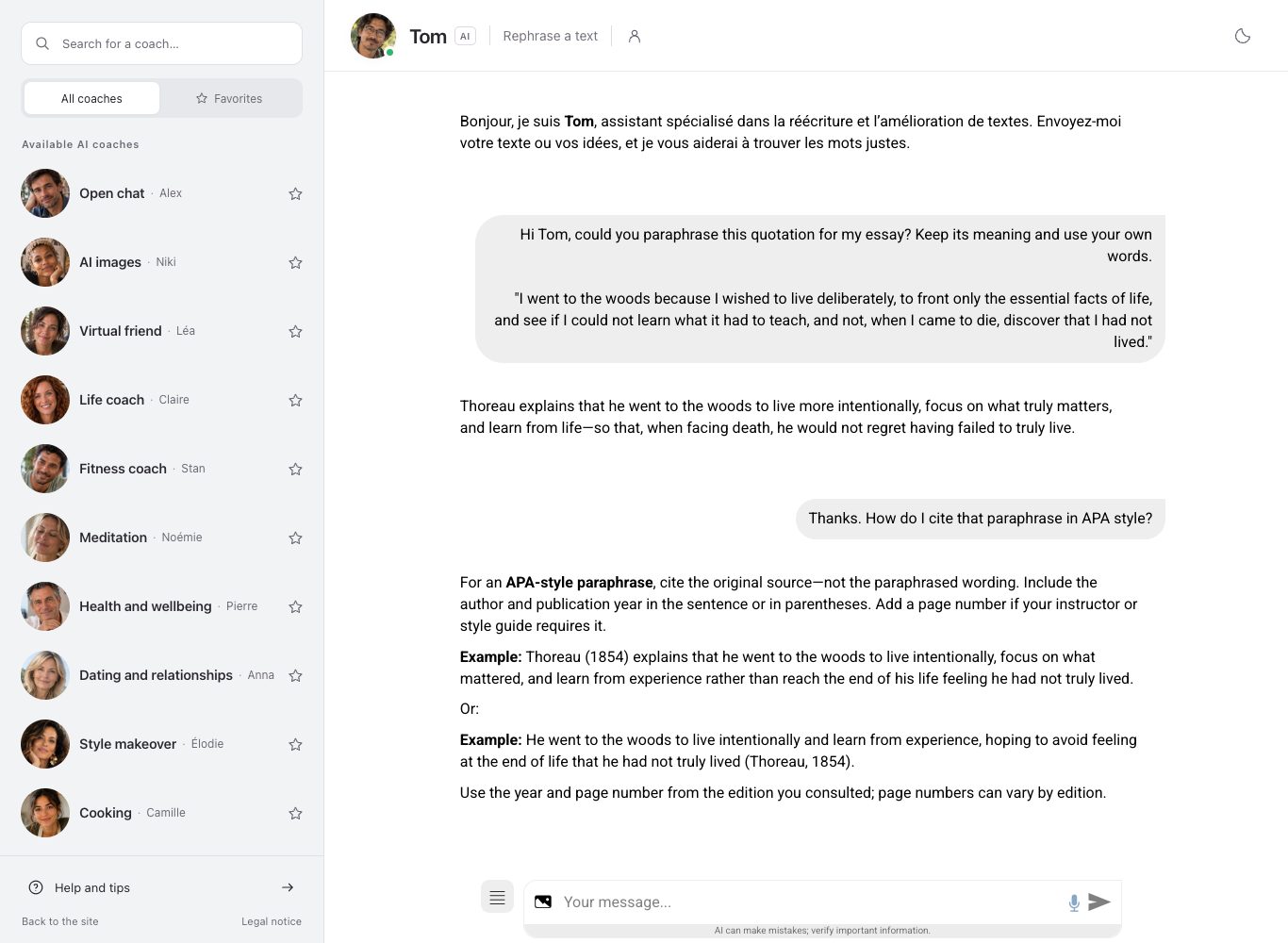
A session with Tom
I rewrote a quotation from Walden in my own words. How do I build the APA citation for it?
Include the author and publication year in the sentence or in parentheses. Add a page number if your instructor or style guide requires it.
APA’s rule and Tom’s reply agree: the page is optional until a course says otherwise.
Tom
AI rephrasing assistant
“Paste the passage and I hand back one version that fits your context. The shape is my job; the meaning is yours to reread beside the source, the citation to write.”
Tom warns you
A reworded source is not an original source: the duty to cite survives every rewrite. And since a rewrite can quietly drop a qualifier or narrow a claim, check it against the original.
Our guide to paraphrasing, step by step, covers the method in full. If the deeper question is whether a restated line counts as plagiarism, our article on paraphrasing and plagiarism answers it.
Give the line to Tom
Paste the quotation; one reworded version comes back for your check against the source.
Frequently asked questions
Can a quotation be paraphrased in APA style?
Yes. APA’s page treats it like any paraphrase, cited in narrative or parenthetical form with author and year. A page number stays optional, suggested when a long work makes the passage hard to find.
What goes in the sentence instead of the quotation itself?
A signal phrase. It names the source and sets the verb: “According to Thoreau…” or “As Thoreau pointed out…” in APA’s past tense, “Thoreau argues that…” or “As Thoreau suggests…” in MLA’s present tense.
What does a paraphrased quotation look like?
Take Thoreau’s woods line. One restatement: “He moved to the woods to live on purpose, to meet life at its most essential, and to learn its lesson, so that he would not reach death and find he had never lived (Thoreau, 1854).” His idea, your sentence, one credit at the end, carrying both dates in a modern edition, 1854 then your edition’s year after a slash.
Do I need a page number for a paraphrase?
Under APA the page number is optional and helps most in long works. Under MLA, the location marker is required whenever the work has one, so a Walden paraphrase takes your edition’s page.
Sources
- APA Style, “Paraphrases”, American Psychological Association.
- MLA Style Center, in-text citations, Modern Language Association.
- MLA Style Center, a long paraphrase cited once, Modern Language Association.
- Purdue OWL, “Paraphrasing”, Purdue University.
- Purdue OWL, “Signal and Lead-in Phrases”, Purdue University.
- Purdue OWL, “Reference List: Books”, Purdue University.
- Purdue OWL, “Quoting, Paraphrasing, and Summarizing”, Purdue University.
- Newcastle University, “Quote or Paraphrase?”, Academic Skills Kit.
- Walden, by Henry David Thoreau, Project Gutenberg, eBook no. 205.
Keep the essay moving
Alex, the generalist AI assistant, takes over when the essay or the bibliography needs more work.