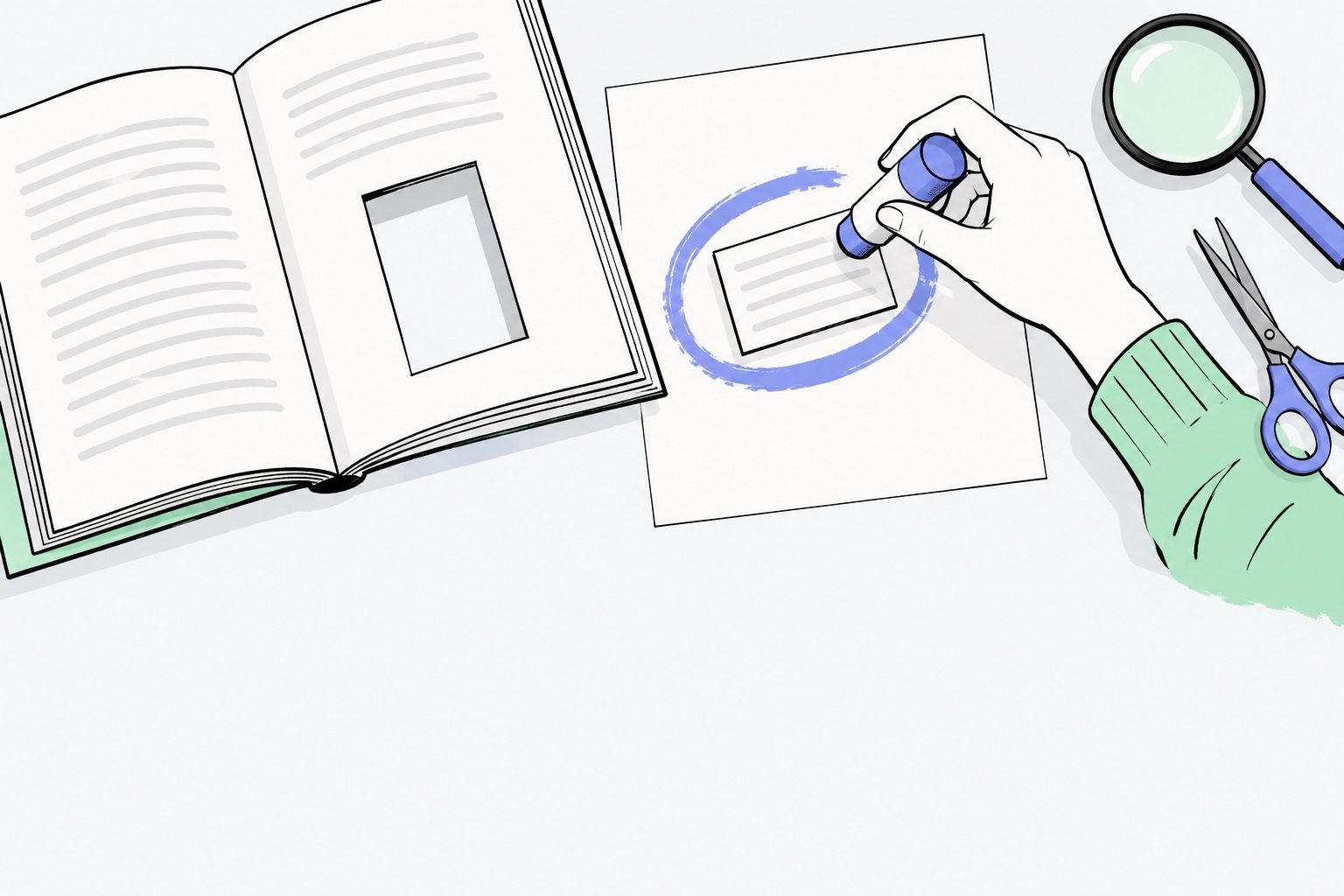
- Putting a source into other words does not remove the duty to cite: the idea stays somebody else’s.
- The risk is disciplinary: it is the university that judges and sanctions.
- The percentage of a plagiarism checker measures a resemblance, not a fault.
You put a passage of a website into other words for your essay, and the doubt is there, the night before the deadline: is this plagiarism? Before you hand the work in, you will know what you can take from a source, how to credit it, and what you risk without the credit.
Plagiarism, the word and the fault
The Cambridge Dictionary defines plagiarism as the process of using another person’s ideas or work and presenting it as your own.
“the process or practice of using another person’s ideas or work and pretending that it is your own”
Merriam-Webster keeps the entry shorter: plagiarism is the act of plagiarizing something. The same entry gives the person a name: a plagiarist.
The forms plagiarism takes
The list comes from the libraries of a French university, the Université de Strasbourg: some forms are obvious, others more subtle and often involuntary.
Copy-paste
Someone else’s work, taken as is
Copying all or part of another’s work, or taking their ideas and passing them off as yours: the form universities sanction the most.
Quotation marks
The quotation without the marks
Quoting an excerpt without quotation marks counts as plagiarism too, even when the source is named next to it.
Paraphrase
The synonyms that are not enough
Swapping the words for near-synonyms leaves the sentence structure, the ideas and the argument in the hands of the first author.
Translation
The source moved into another language
Translating a source for your paper without saying you are the translator is a form of paraphrase, and it counts as plagiarism.
Self-plagiarism
Your own text, already submitted
Handing in work that was already submitted, even with the first version cited, is not accepted in scientific fields.
Public domain
Free to use, not free of the credit
A document free of rights or in the public domain is cited like any other source.
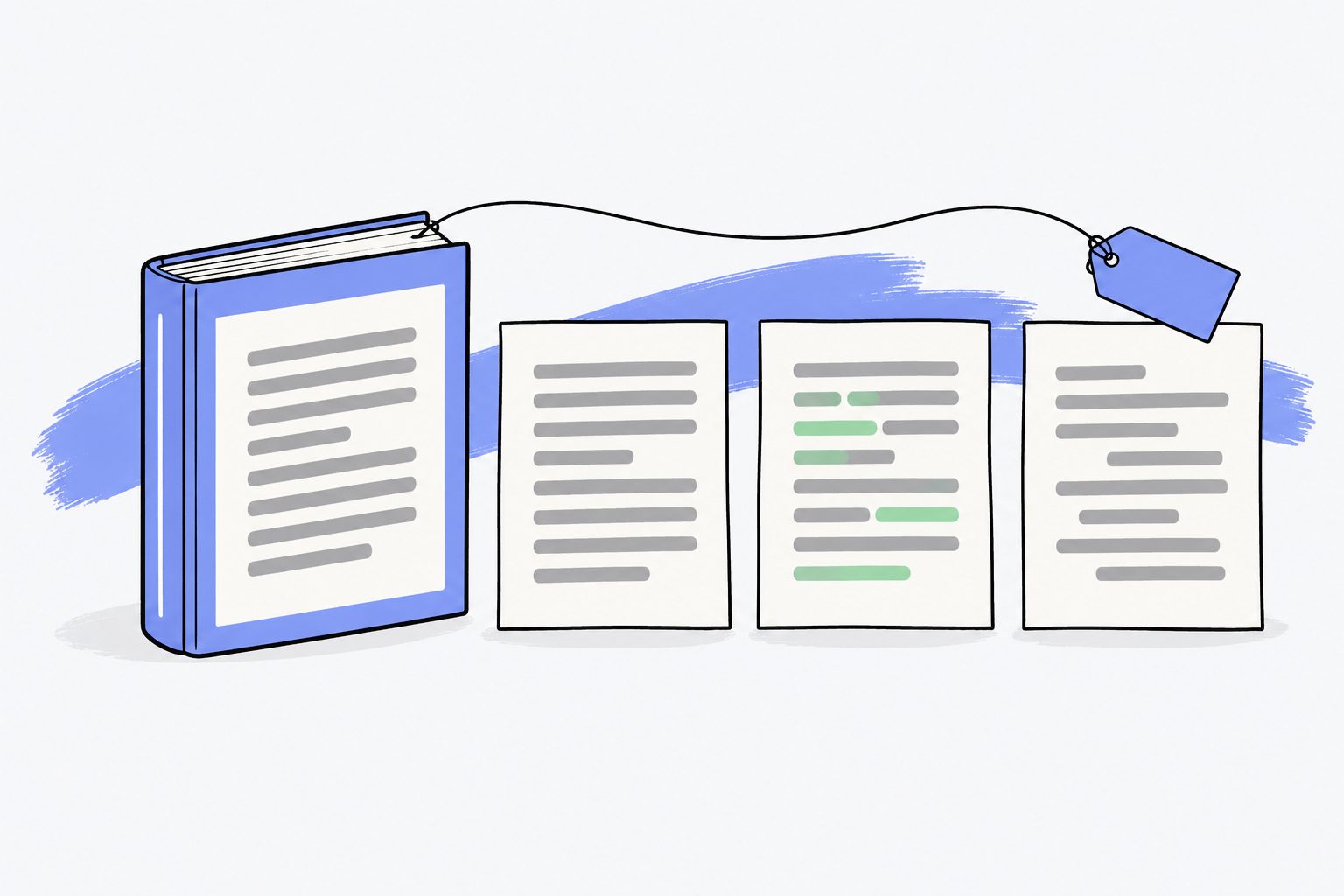
Improper paraphrasing is the form that catches the most writers: the law library of the University of Richmond calls it a very common form of plagiarism. To rewrite a source the right way, our guide to paraphrasing lays out the method, step by step.
Plagiarism versus copyright infringement
Plagiarism and copyright infringement are two faults that do not share a name. The libraries of Ohio State University put them side by side, and their answer to the obvious question is a plain no:
“It is possible to commit plagiarism without committing copyright infringement.”
The two do not answer to the same rules. Plagiarism breaks an ethical code, and the sanction it carries is discipline from the university. Copyright infringement breaks a federal law, and it can end in a trial, with fines to match.
The difference matters for the reader who credits carefully: copyright law never asks for a citation, and naming the source does not clear a use the law forbids.
This general information does not, on its own, replace the advice of a legal professional.
What the university can do
For a student, the first judge is the school. The libraries of the University of Pennsylvania state the rule without ornament: paraphrasing without providing a citation is plagiarism.
| The situation | Plagiarism? |
|---|---|
| A paraphrase handed in with no citation | Yes |
| A citation, but the wording stays close to the original | Yes |
| A paraphrase in your own words, source cited | No |
| The excerpt between quotation marks, with its source | No |
| Words swapped for synonyms | Yes |
| An earlier piece of your own, handed in again | In part |
And the citation is not a total shield. A paraphrase done properly still calls for the source of the original idea, recalls the law library of the University of Richmond. Even a paraphrase that carries its citation can stay plagiarism when the wording follows the original too closely: that limit comes from the libraries of the University of Pennsylvania.
Tom warns you
Rewording never erases the source. On the tool page, the rule is written in plain words: start from an article, a book or a course, and the citation rules keep applying in full. Tom helps you say it differently; citing stays your gesture.
How to tell whether you have plagiarized
Before you hand the work in, read it back with these questions in mind.
- A passage taken from a source, with no quotation marks and no reference.
- An idea carrying your argument while its source stays unnamed.
- Words swapped for near-synonyms, while the sentence keeps the construction of the source.
- A text translated from another language, folded in without saying it is a translation.
- An old piece of your own work, handed in as is or touched up, for a new evaluation.
- A text produced by an AI, handed in as yours where the course rules do not allow it.
The myth
A low percentage from the plagiarism software proves the text is original.
In reality
The percentage measures how much your text resembles other content, nothing more. Turnitin makes the point in its own guide: a similarity score cannot settle a plagiarism question by itself, and a low one does not prove a work original.
As for the AI score some reports add, our article on how far Turnitin’s AI detection can be trusted explains the way to read it.
Five habits that keep a paper clear of plagiarism
Five habits hold a paper, a talk or a thesis inside the rules.
-
Put the exact excerpt inside quotation marks
With the name of the author and the source clearly given; without the marks, a copied passage counts as plagiarism.
-
Rewrite, and cite all the same
Other words remove none of the reference owed: the source is noted as it would be for an excerpt.
-
Say when you translate
A source translated by you says so, in the text.
-
Do not hand old work in as new
A text already submitted or published does not leave again as is: science does not accept self-plagiarism, citation or not.
-
Declare the AI when the course requires it
Where the course imposes it, the use of an AI is written into the work handed in.
Paraphrasing with Tom, without plagiarizing
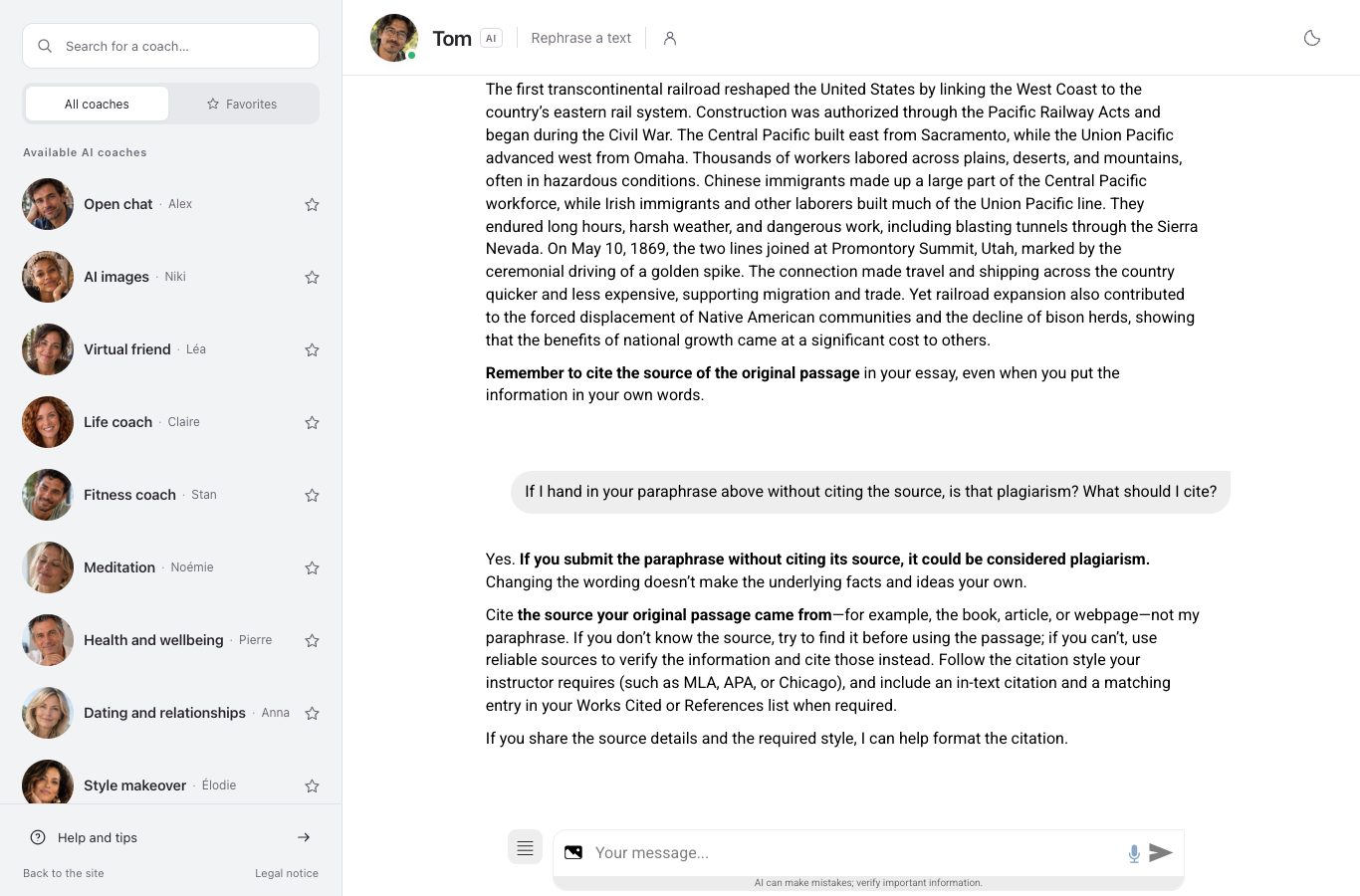
Tom is the rewording tool of Nation AI: you hand him your passage to paste, to type, to send as a photo or as a PDF file, and he gives it back in different words. The example starts from a paragraph on the first transcontinental railroad, written for the example by Alex, the generalist assistant of Nation AI. The passage went into Tom’s chat exactly as it was.
The rewrite comes back with the words changed, and his reply ends on a reminder:
Sample conversation
I have to reuse a passage on the first transcontinental railroad in an essay. Can you paraphrase it for me?
“Remember to cite the source of the original passage in your essay, even when you put the information in your own words.”
So if I hand the essay in with no citation, is that plagiarism?
“Yes. If you submit the paraphrase without citing its source, it could be considered plagiarism.”
Tom’s answer stays prudent, with his “could be considered”. The library guides are firmer: whatever the rewording, the source gets cited. Reworded from the first line to the last, the passage still belongs to someone else, and a borrowed idea calls for its reference as much as a copied sentence.
Tom
AI rephrasing assistant
“I rework the shape of the text you bring me, to make it clearer. Read my version against your source before you keep it, and cite that source: the credit is your work, not mine.”
A passage that needs other words?
Paste your text: Tom rewords it, and the sources to cite stay in your hands.
And a text written by an AI?
Where the rules demand it, the use of an AI gets declared. The Center for Teaching Excellence of the University of Kansas puts borrowed AI on the footing of any human source: the insights and the phrases an AI hands over get cited like the rest, because an AI can back your work without becoming it. Policies turn the point into rules: at Wright State University, generative AI on an assignment without the express permission of the instructor is an academic integrity violation, and a course that says nothing about AI in its syllabus leaves students without the option.
Frequently asked questions
What counts as plagiarism?
Copying a text, taking an idea without naming its source, the paraphrase made of near-synonyms, a translation passed off as an original, an old paper handed in again. And an AI text presented as yours where the course rules forbid it.
How do you paraphrase without plagiarizing?
Use your own words and your own sentence shapes, and name the source as you would for a quotation. Our guide to paraphrasing details the method.
If I cite the source, can a paraphrase still be plagiarism?
Yes, when the wording follows the original too closely: the credit does not cover language that still belongs to its first author.
Is paraphrasing with AI cheating?
It depends on the rules of the course. Where nothing allows it, using generative AI on an assignment counts as a violation, as at Wright State University. Where the course allows it, the borrowed phrases still get cited, as the University of Kansas recommends.
What does Turnitin do with a reworded passage?
Its own guide describes a report that flags the passages matching content in the databases selected by the instructor, and it warns that the percentage cannot settle plagiarism on its own.
Sources
- Cambridge Dictionary, entry “plagiarism”, consulted in November 2026.
- Merriam-Webster, entry “plagiarism”, consulted in November 2026.
- Université de Strasbourg libraries, guide “Plagiat”, updated in May 2020.
- Ohio State University Libraries, page “Plagiarism”.
- Law library of the University of Richmond, its guide on proper and improper paraphrasing, updated in January 2025.
- University of Pennsylvania Libraries, “Examples of Paraphrase”, updated in October 2025.
- Turnitin, guide “Turnitin and plagiarism”, editor documentation.
- Wright State University, policy “Academic Integrity Standards and Process for Misconduct”.
- University of Kansas, its Center for Teaching Excellence, “Maintaining academic integrity in the AI era”.
A question about your sources? Alex takes over
Quoting an excerpt, building a bibliography, checking a reference: Alex, the generalist assistant of Nation AI, answers in the chat.