- A paraphrase stays close to the length of the original: it is the summary that shortens.
- Swapping words for synonyms, or keeping the shape of the sentence, still counts as plagiarism.
- A passage suggested by Tom, the rephrasing assistant of Nation AI, works as a first draft: compare it sentence by sentence with the source.
A passage from an author to reuse in a paper, and the fear of copying it. To paraphrase well is to restate the idea in words of your own and name the author: the work stays yours, and the citation protects you.
What does the word mean?
The dictionary ties the word to restating. Merriam-Webster defines the noun paraphrase as “a restatement of a text, passage, or work giving the meaning in another form.”
Academic writing has its own way of pinning the word down. The APA Style team observes that published writers paraphrase more often than they quote, and it invites student writers to follow.
“A paraphrase restates another’s idea (or your own previously published idea) in your own words.”
In schoolwork, the word gets a working sense. Purdue OWL, Purdue University’s writing lab, calls a paraphrase your own rendering, in a new form, of the essential information and ideas someone else has expressed. That is the sense that guides the rest.
Quoting, restating, or summarizing?
Three ways to take an author’s idea, three formats.
Quote
The author’s exact words
You take the sentence as it stands, between quotation marks, with the source.
Paraphrase
The same text in your words
The idea comes back with your words, at a length close to the original, source cited.
Summary
Only the essentials
Much shorter: it keeps the main points, and it gets cited all the same.
For a whole document, our AI tool to summarize a PDF handles the main points.
How to paraphrase, step by step
Purdue OWL and Johns Hopkins lay out the same method, six steps apiece. The running example is a Dust Bowl passage for a history report, written as an exercise by Alex, the generalist AI assistant of Nation AI.
-
Reread until you understand
As many times as it takes to restate the idea without reopening the text. Here: the Dust Bowl, the prairie grasses plowed under, the drought, wheat farming, and the families who left.
-
Set the source aside
Close the book, or turn the page. You write from what stays in your head, not from the words under your eyes.
-
Write for your purpose
Draft the sentence you need, name the author, change the construction, add short explanations of your own. The passage becomes, for example: “In the 1930s, drought met plowed ground on the Plains, and the wind carried off a soil that grasses once held in place.”
-
Compare with the original
First the meaning: nothing added, nothing reversed. Then the form: the sentences no longer follow the same mold. A detail dropped along the way shows up here.
-
Put exact expressions between quotation marks
A turn of phrase that belongs to the author, kept word for word, goes between quotation marks; the common terms of the subject do not need them.
-
Record and cite the reference
In the text, not only in the bibliography. Under APA, the author and the year carry the citation; the page stays optional, and it helps readers find a passage in a long work. Under MLA, add the location marker (a page, a line, a time stamp) whenever the work has one.
Recognizing a good rewrite
The contrast reads on one sentence of the passage.
Before
“Those deep-rooted grasses had helped hold the soil in place and conserve moisture, but once they were removed, the dry soil was more exposed to wind.”
After
“The grasses’ deep roots helped anchor the soil and retain moisture; without them, dry ground became more vulnerable to wind erosion.”
The second version is Tom’s actual reply to this passage: the words changed, the meaning holds. The source still has to be named: rewording did not make the citation disappear.
Common belief
Swapping words for synonyms is enough to make a text your own.
In fact
“When using someone else’s ideas, it is important to do more than go to the thesaurus and change a few words,” warns Roosevelt University in its guide for students. Researchers name the habit patchwriting: copying from a source, then deleting words, altering the grammar, or swapping in one-for-one synonyms, the definition of Rebecca Moore Howard reported by Gerald Nelms. At the University of Connecticut, the Office of Undergraduate Research sees illegitimate paraphrase, writing that sticks too close to the source, most often in applications for its research funding. At Purdue, the version of an example classed as plagiarism was so in part because no citation came with it.
A first draft with Tom
To go from the source passage to a first draft, Tom, the AI rephrasing assistant of Nation AI, takes over. Our paraphrasing tool opens his chat: you paste your passage, you type it, you send a photo of it, or you attach the PDF.
Tom delivers one version, the best one for the context, instead of a menu of tones. He looks for the words that make a text clearer, more natural, and right for its use. Clearer, shorter, longer, or in a different tone: you ask.
Those in a hurry start from a ready-made request: our ChatGPT prompts for rephrasing a text gather dozens of them.
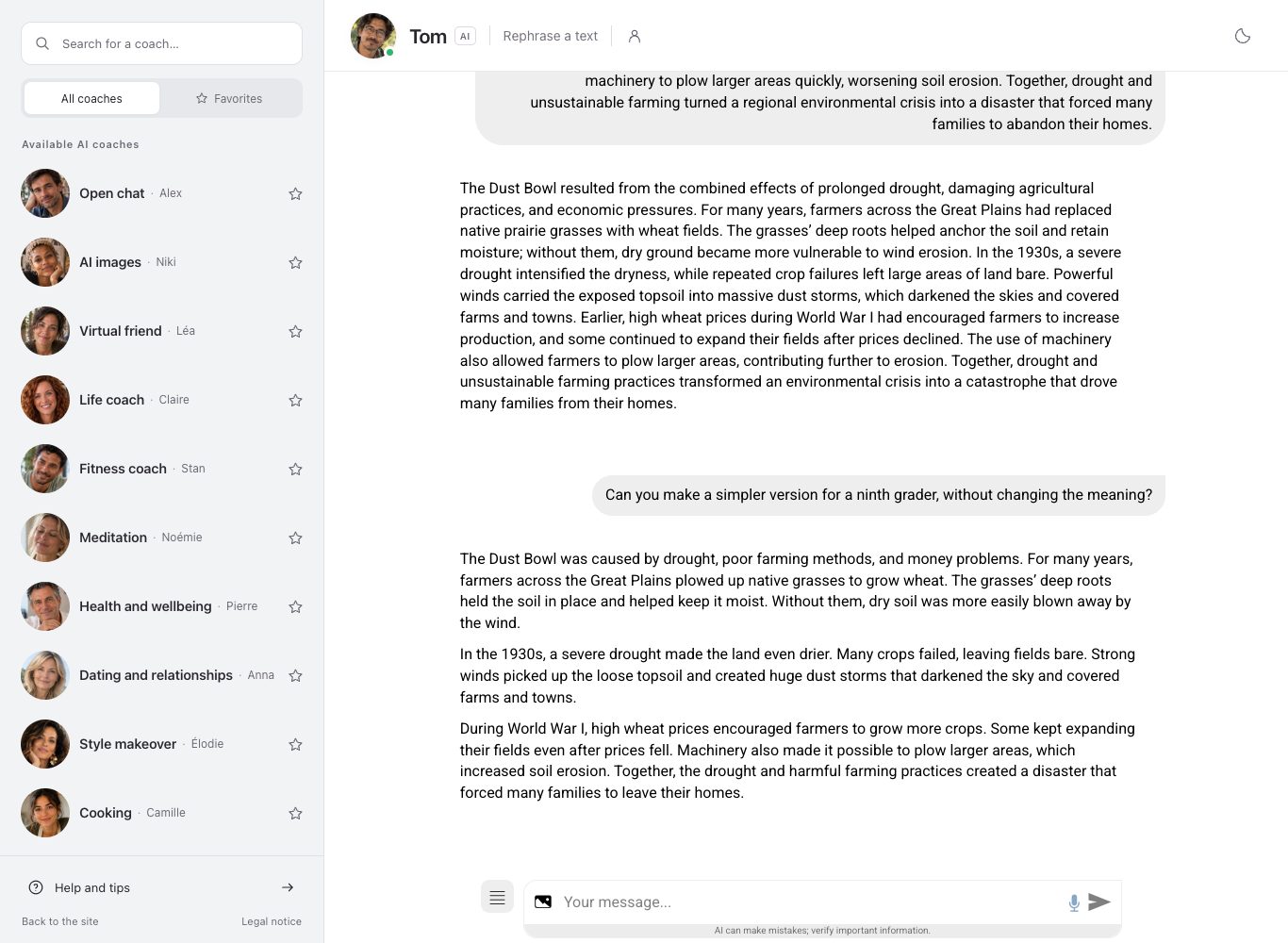
In the conversation below, the Dust Bowl passage has already been sent and rephrased once. Tom picks up from the text already in the chat, without asking for it again.
A sample conversation
Tom, could you suggest a simpler version, at a ninth grader’s level? Same meaning.
“For many years, farmers across the Great Plains plowed up native grasses to grow wheat. The grasses’ deep roots held the soil in place and helped keep it moist. Without them, dry soil was more easily blown away by the wind.”
Tom
AI rephrasing assistant
“I rework the writing itself: the words, the construction, the tone, and I adjust the level when you ask. Reread my version sentence by sentence against your source before you keep it.”
A warning from Tom
Rephrasing does not remove the citation: reusing a source keeps the reference due, even with AI wording. Reread a generated version sentence by sentence against the original: the meaning can drift, a detail can drop.
Some institutions write the rule down. Abertay University advises, where AI use is permitted, comparing the output with the original source, citing it, and acknowledging the use of AI where required. Its guide also warns that an AI rewrite can change the source’s meaning or bring in errors.
A first draft suggested, a check that stays yours
Tom rephrases the passage you hand him; reread it against the source before you adopt it.
The final checks before you turn it in
The last read-through goes through these points.
- The meaning of the original is the same: nothing added, nothing reversed.
- The sentences no longer follow the construction of the source.
- The exact terms you kept are between quotation marks.
- The author and the year are cited, with the page for a long work.
- The use of AI is acknowledged when the course requires it.
Frequently asked questions
Is paraphrasing the same thing as rephrasing?
Almost. In everyday use, the two words cover the same gesture, as our rephrasing page notes. In a paper, they meet: other words, same meaning.
Do you have to cite a paraphrase?
Yes. Even written in your words, the idea comes from an author: say where you took it. Under APA, the author and the year in the text are enough, and the page joins them when a long work makes it useful. Under MLA, for a paraphrase of several sentences, one citation placed after the final sentence is enough; that advice comes from a post written for the eighth edition of the handbook.
Does a paraphrase have to be shorter than the original?
No. The library guide of West Texas A&M describes a paraphrase that stays about as long as the source. The short form has a name: the summary, which keeps only the main points.
Can an AI paraphrase my paper?
It can draft a first version of a passage, as Tom does for a text pasted, typed, photographed, or attached as a PDF. Reread it sentence by sentence against the source, keep the citation, and acknowledge the use of AI when the course requires it.
What is another word for paraphrase?
The dictionary calls a paraphrase a restatement. Our rephrasing page notes that many writers use paraphrasing and rephrasing for the same thing.
Sources
- Merriam-Webster, the entry “paraphrase”, online dictionary, read in November 2026.
- APA Style, “Paraphrases”, style and grammar guidelines, updated July 2022.
- MLA Style Center, guidance on in-text citations.
- MLA Style Center, a post on citing a paraphrase of several sentences, written for the eighth edition.
- Purdue OWL, “Paraphrase: Write It in Your Own Words”, read in November 2026.
- Johns Hopkins University, “Paraphrasing & Summarizing”, university library.
- West Texas A&M, its Cornette Library, “Paraphrasing Basics”, read in November 2026.
- Roosevelt University, the student guide to academic integrity.
- University of Connecticut, the academic integrity page of its Office of Undergraduate Research.
- Abertay University, the study guide “Paraphrasing”, read in November 2026.
- Gerald Nelms, “Patchwriting”, 2015, the text reporting Rebecca Moore Howard’s definition.
To keep writing, Alex takes over
Explaining a source, preparing a paper, keeping a report on track: Nation AI’s generalist assistant helps with all of it.