- Gallup, June 2025: 40% of American employees turn to AI at work at least several times a year, while 30% work somewhere with written guidance or a formal AI policy.
- KPMG and the University of Melbourne, 47 countries: 57% of employees keep their AI use quiet and pass AI-made work off as their own.
- In North Carolina, state employees who paste material into a public generative AI tool have, in the policy’s words, made a “public release”.
- Victor, Nation AI’s AI text detector, is blunt about his own reading: it cannot establish that a machine wrote a passage.
Monday morning, and the weekly update from your team member is flawless. Every sentence is clean, the sections line up, and by the end you still don’t know what to do next. A detector can show you where a text reads oddly; only the work itself, and a written rule, can tell you what to do about it.
When the update says nothing
The trouble has a name. Researchers at Stanford and BetterUp Labs call workslop AI-made text which, in their words, “masquerades as good work”, as reported by Built In: passable at first glance, thin once you look for substance. The same researchers questioned 1,150 American employees; four in ten said workslop had reached them during the previous month, again as reported.
The Harvard Business Review article that named the phenomenon in September 2025 opened on the gap between orders and results. Workers follow the mandate to use AI, it notes, while few see the tools “create real value”.
A polished update you cannot act on is a work problem before it is an AI problem.
What Victor says about a polished update
For the demonstration the update came from Alex, Nation’s general assistant, and the text stays out of this article. You paste it into Nation’s AI content detector, where Victor works, and ask how it comes across. He answers with a level, and with a warning: a style reading is an estimate, not proof.
With Victor
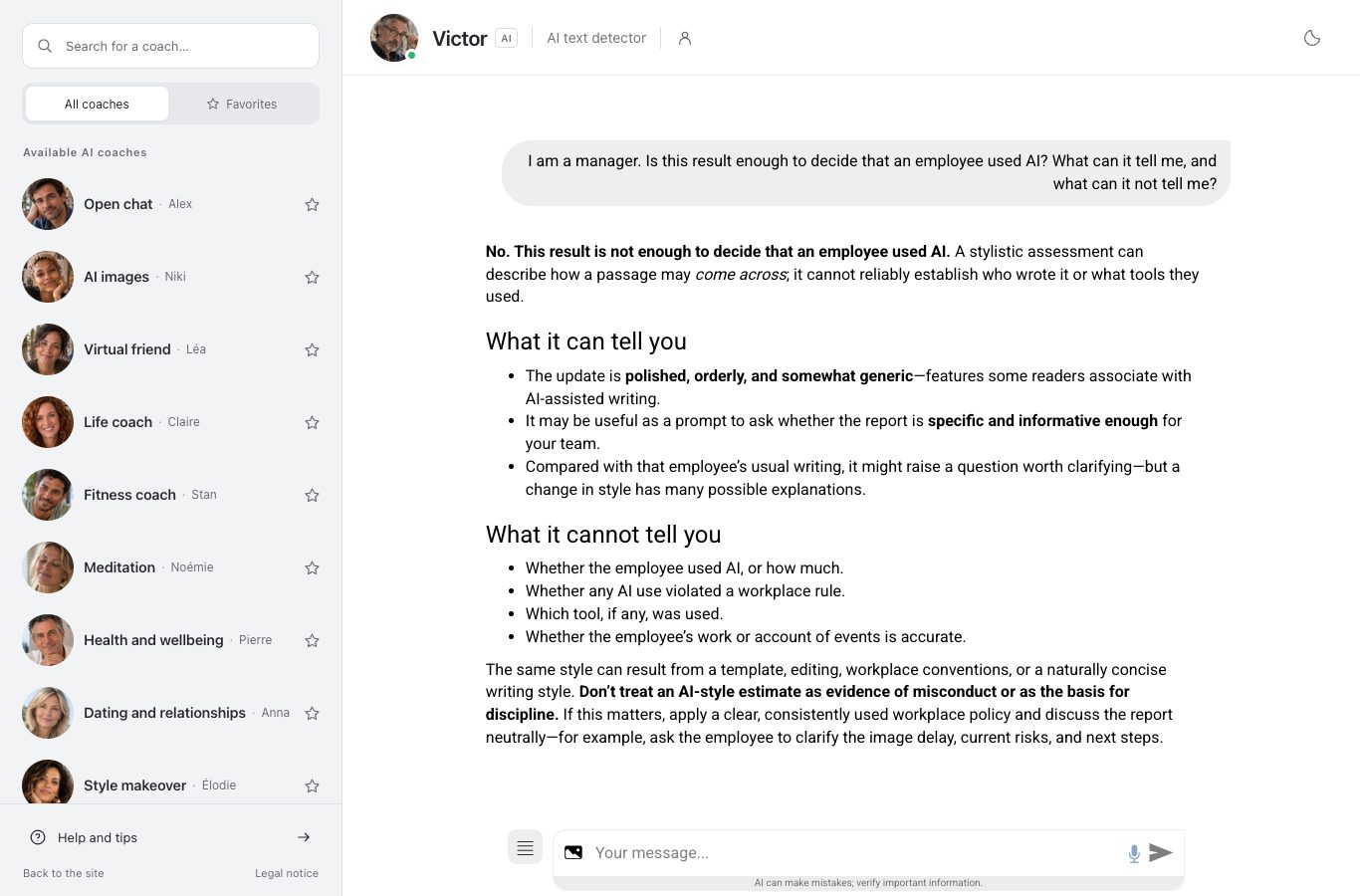
Does this weekly update look AI-written?
“AI-style indicator: Moderate.”
“This is a stylistic estimate, not proof of AI use. A polished, conventional project update can read this way whether it was written by a person or assisted by AI.”
“The update follows a very orderly sequence: completed work, blocker, workaround, then next steps.”
“The sentences are consistently polished and use similar business-report phrasing.”
Can I conclude from that score that someone used AI?
“No. This result is not enough to decide that an employee used AI. A stylistic assessment can describe how a passage may come across; it cannot reliably establish who wrote it or what tools they used.”
“What it cannot tell you”
“Whether the employee used AI, or how much.”
“Whether any AI use violated a workplace rule.”
“Which tool, if any, was used.”
“Whether the employee’s work or account of events is accurate.”
“The same style can result from a template, editing, workplace conventions, or a naturally concise writing style. Don’t treat an AI-style estimate as evidence of misconduct or as the basis for discipline.”
Patterns you may notice, and what each is worth
Three habits stood out in that update, and Victor treated each one as an impression rather than a fingerprint. It moved in a very orderly line, from finished work to the blocker to the workaround to next steps. The sentences stayed polished from beginning to end, and reused the same business wording across paragraphs.
Every one of those habits has a dull explanation. A template, an edit, house conventions or a naturally concise writer leaves the same surface, and a tidy weekly report is supposed to look tidy. Orderly and polished describes good reporting as much as it describes a machine.
AI use grew faster than the rulebook
The numbers behind that Monday feeling are not subtle.
40%
American employees who turn to AI at work at least several times a year, against 21% in Gallup’s first measure.
Gallup, June 2025
30%
Employees who say their workplace has written guidance or a formal AI policy.
Gallup, June 2025
16%
American workers who say AI does at least part of their job.
Pew Research Center, February 2025
Pew questioned 5,273 working American adults in October 2024. In the study KPMG ran with the University of Melbourne, more than 48,000 people across 47 countries answered: 57% said they keep their AI use quiet, and 66% said they use what AI produces without verifying it.
How managers detect AI in reports, and what to check instead
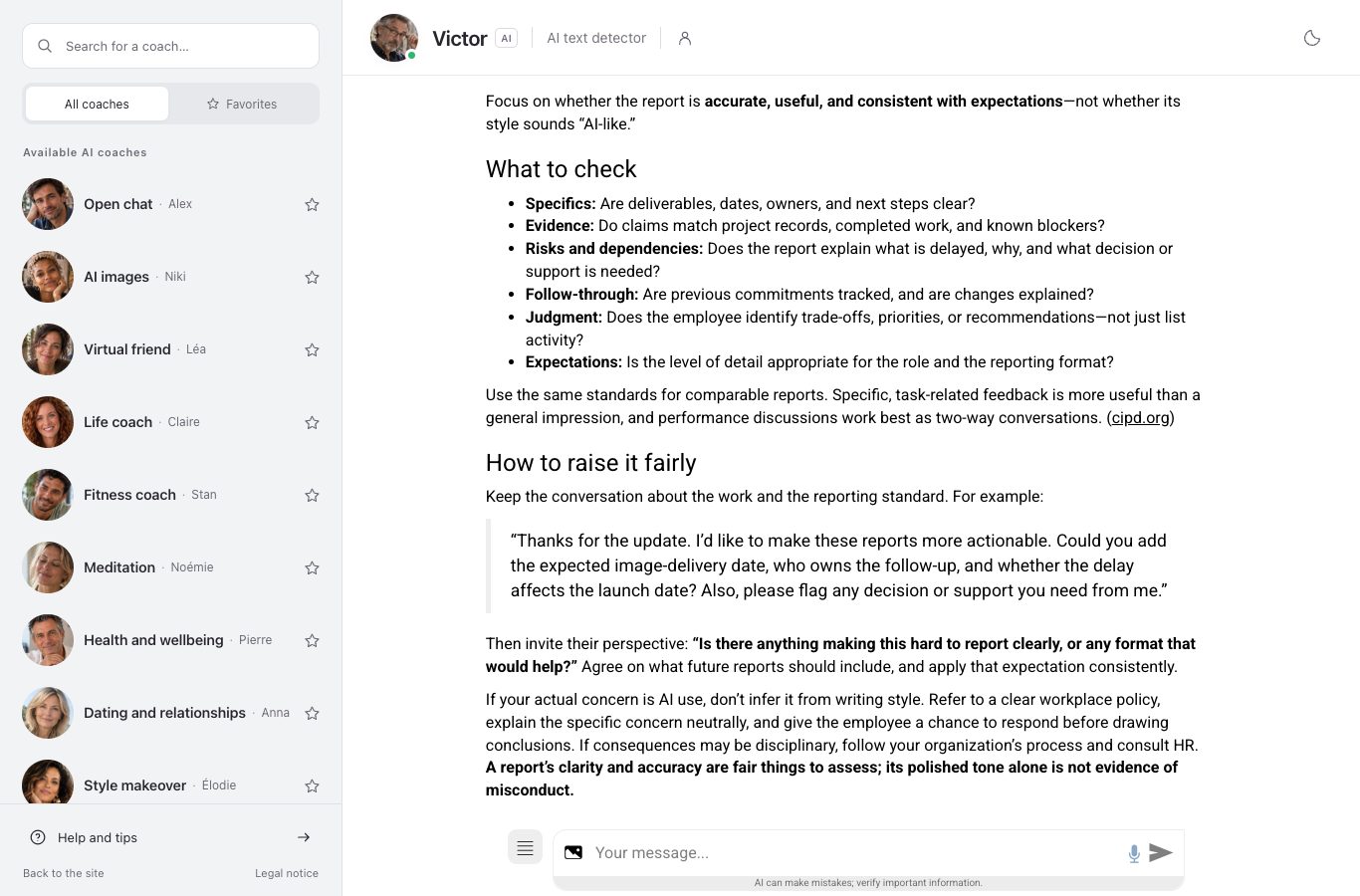
Victor starts from the report itself: is it accurate and useful, rather than does it sound like AI. His checks, in his words:
- “Specifics: Are deliverables, dates, owners, and next steps clear?”
- “Evidence: Do claims match project records, completed work, and known blockers?”
- “Risks and dependencies: Does the report explain what is delayed, why, and what decision or support is needed?”
- “Follow-through: Are previous commitments tracked, and are changes explained?”
- “Expectations: Is the level of detail appropriate for the role and the reporting format?”
Victor
AI text detector
“I describe how a passage comes across, and I never claim to know who wrote it. You get a level and the sentences that caught my eye, never a percentage.”
The written rule comes before the conversation
SHRM asked employment lawyers in 2023 what a generative AI policy should say. Mark Girouard, a Minneapolis lawyer at the firm Nilan Johnson Lewis, called it a best practice to “expressly prohibit” trade secrets and other confidential material from going into prompts and conversations with those tools. Jenn Betts, of Ogletree Deakins in Pittsburgh, described the same ban on confidential material.
North Carolina wrote its version down. The statewide rule for state employees, version 1.1, dated April 14, 2026, forbids putting confidential state material or personal details into public generative AI tools. Whatever is shared with such a tool counts as a “public release”, the policy says, and breaches can bring discipline up to dismissal. This is a state government policy, not a rule that binds private employers.
Before you paste anything
A report can carry a client’s name, a set of numbers, someone’s contact details. Strip them out first, and that goes for Victor too: no outside service, his included, should receive them.
Hiring teams meet the same question at the other end, and our piece on the AI-written cover letter a recruiter reads follows one letter through that kind of scrutiny.
Raising it without an accusation
Asked how to bring it up, Victor answers: “Keep the conversation about the work and the reporting standard.”
“Then invite their perspective: ‘Is there anything making this hard to report clearly, or any format that would help?’ Agree on what future reports should include, and apply that expectation consistently.”
“If your actual concern is AI use, don’t infer it from writing style. Refer to a clear workplace policy, explain the specific concern neutrally, and give the employee a chance to respond before drawing conclusions. If consequences may be disciplinary, follow your organization’s process and consult HR. A report’s clarity and accuracy are fair things to assess; its polished tone alone is not evidence of misconduct.”
Why a detector can point at a passage and never at a person is the subject of our guide to how AI detectors work.
Frequently asked questions
Does a detector score prove someone used AI at work?
No. Victor says as much: a style reading cannot pin down the author or the tools behind a passage. Liang et al., in Patterns in 2023, found that detectors read non-native English writing as machine-made, and warned against evaluative use.
What is workslop?
AI-made text that masquerades as good work, as reported: fine at first glance, unhelpful or short on context. Of the 1,150 American employees questioned, four in ten had received some in the previous month, again as reported.
May I paste a team member’s write-up into a public chatbot?
Only if your own rules allow it, and never with private or identifying details in the text. The SHRM lawyers above put the ban on the prompt itself, and North Carolina counts what you paste as released.
Is Victor free?
A free trial needs no account and gives a few free messages. After that, the pricing page lists a two-week plan at $9 and a month at $19, read on October 30, 2026.
Put Monday’s update in front of Victor
Give him a paragraph with the client details stripped out, and see which parts catch his attention. Then take the conversation back to the work. The trial costs nothing and needs no account.
Sources
- Harvard Business Review on “workslop” and productivity, 22 September 2025.
- Gallup survey on workplace AI, 2023 to 2025, 15 June 2025.
- Study on detector bias toward non-native English speakers, Liang et al., Patterns, 2023.
- SHRM on generative AI and intellectual property, April 30, 2023.
- SHRM guide to internal chatbot rules, April 27, 2023.
- Pew Research Center survey on AI at work, 25 February 2025.
- Global study on trust in AI, University of Melbourne with KPMG.
- North Carolina rules on generative AI for state employees, 14 April 2026.