- The maker’s own claim: fewer than one human paper in a hundred wrongly flagged, on submissions already above 20% AI writing.
- Temple University, undated: 28 human papers of 30 read correctly, 23 machine papers, 19 disguised ones, 13 mixed.
- 2024 medical papers: 94% of the machine-made articles caught, 30% of the reworded ones.
- Washington State cancelled its detection contract in February 2026.
Every paper in your seminar goes through Turnitin before it reaches the grader. One classmate says the detector catches everything, another says it catches nothing, and the report decides how your term ends. Put the company’s figures beside the independent tests, and a flag stops looking like a verdict.
A question put to Victor, and a paragraph from 1889
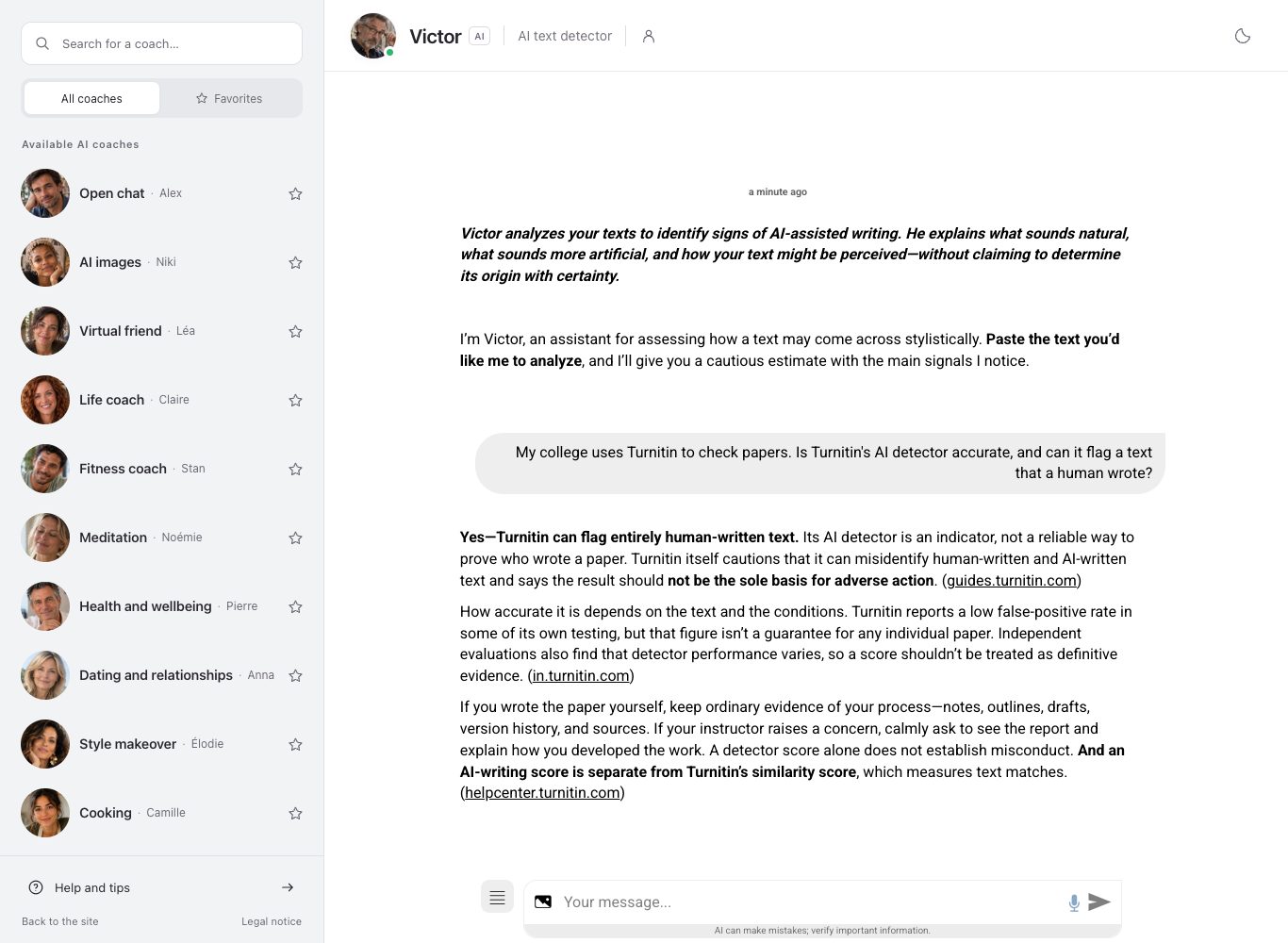
Victor is the AI text detector in Nation AI’s coach list. What he hears is your seminar’s argument: is the score trustworthy, and can it fall on someone who wrote every word?
With Victor
My college puts every paper through Turnitin before it is graded. Is the detector accurate, and can it flag a text that a human wrote?
“How accurate it is depends on the text and the conditions. Turnitin reports a low false-positive rate in some of its own testing, but that figure isn’t a guarantee for any individual paper. Independent evaluations also find that detector performance varies, so a score shouldn’t be treated as definitive evidence.”
Does this paragraph read as if it was written by AI? Give me your level, and tell me which passages led you there.
“AI-style indicator: Low. It reads more like a deliberately comic, literary passage than generic AI prose.”
“What stands out:”
“Varied pacing: The repeated days create a pattern, but the sentences don’t feel mechanically uniform.”
“It’s a short excerpt, so confidence is limited. These are style observations, not proof of who wrote it or whether AI was involved.”
The passage pasted there comes from Jerome K. Jerome’s Three Men in a Boat, published in 1889, long before anyone typed a line. Victor came back with a level, not a figure. A single paragraph is no rate at all.
Paste a page into the AI checker where Victor works, and you get that same level, with the signals behind it and no percentage to argue over.
What the model looks at, in the company’s words
Turnitin calls it a deep learning system on the transformer architecture, and says the model is no off-the-shelf build alone. Its training ground is the company’s own archive of academic writing, with work from students writing in a second language.
The system, Turnitin says, was never written to weigh signals like burstiness or perplexity. Every sentence comes out as a number between zero and one, weighed with its neighbours, and the report counts those above a cut-off.
Our piece on what the percentage on a Turnitin report measures takes the count from there.
The figures the company publishes
Under 1 in 100
person-written papers wrongly flagged, on submissions already above 20% AI writing.
the company’s claim, FAQ read October 30, 2026
~4%
four highlighted sentences in a hundred may in fact be human.
the company’s figure, May 2023
65%
what may sit under a paper read at 50% machine-made.
the company, current FAQ
In May 2023 the firm said it had run 800,000 papers written before ChatGPT through the model. Today’s FAQ puts the latest test base above 700,000 and leaves the difference unexplained.
The company’s own account of the launch months notes that real-world use produced different results from its controlled lab.
Four tests of Turnitin’s accuracy
April 2023
The Washington Post
Sixteen samples in a test five high schoolers helped assemble: six read right, three read wrong, and one of those put 8% on an essay a student had written on her own. The seven others came out half right, the direction held, the amounts did not.
Undated
Temple University
120 papers, thirty in each group: student work from before ChatGPT, machine work, machine work put through a paraphraser, and mixes. Twenty-eight human texts read right, 23 machine ones scored as fully machine-made, 19 disguised, 13 mixes. No date on the file, and the build tried is unknown.
December 2023
Weber-Wulff and colleagues
Fifty-four cases, 756 runs. The tool came out ahead of the thirteen other systems and put no mark on the human documents. Nobody, the authors add, sorted every edited or paraphrased machine text correctly. The paper notes that its conference is sponsored by the company.
May 2024
Medical writing
150 articles. 94% of the machine-written ones were spotted, 30% of those a rephrasing tool had touched. No real article was misread.
Strong on plain machine prose, weaker the moment the words shift.
Victor
AI text detector
“I read how a passage comes across, then give a level, low, moderate or high, with the sentences that led me there, never a figure. Style alone never tells me a student cheated: no tool can say from text alone whether AI was used.”
Your own prose, flagged all the same
A polished essay can trip the model with no AI in it. The company’s own list of triggers names text with little structural variation, text that repeats itself, and text paraphrased without new ideas. Its launch notes add that false positives cluster in the first and last sentences of a document.
Grammar-checking software is a narrower risk. In Turnitin’s tests, edits made by such tools were, in most cases, not flagged, though text written by their generative features likely would be. The training archive, the company adds, includes work by students writing in a second language.
The campuses that turned it off
-
August 16, 2023
Vanderbilt switched the detection feature off “for the foreseeable future”. Turnitin had enabled it for customers with under 24 hours’ notice and, at the time, no way to disable it.
-
May 5, 2025
Waterloo said the function would go for its users from September 2025.
-
September 4, 2025
Curtin pulled AI writing detection from January 1, 2026, on every campus, and kept the matching checks.
-
February 11, 2026
Washington State cancelled its contract. Over 2023 and 2025, a third of its AI-related hearings closed with “not responsible”, detection having come with nothing to back it.
What a flag is worth
The guidance sent to instructors is narrower than the scare a report causes: the number is no ground on its own for action or for a grade, and the company states that it makes no finding of misconduct, that decision belonging to the reviewer.
Its guide suggests opening the talk this way: “Let’s examine your Turnitin AI writing detection report together…”
Washington State holds a policy of never resting a case on a detector alone. Victor never sees your report: he reads only the text you paste. If you are the student, our article on an essay flagged as AI when the writing was yours sets out what to keep and what to ask.
Questions students ask
Which model produces the score?
Its own. A deep learning system on the transformer architecture, trained on the company’s academic archive, work by second-language students included. No outside detector sits behind the number.
How reliable is it?
On plain machine prose, fairly: 94% caught in 2024, 23 of 30 at Temple. On rewritten prose, much less: 30%, and 19 of 30. The one-in-a-hundred error rate applies only above 20% machine writing.
Could a paper of mine come back flagged?
It can. The Washington Post saw 8% land on one student’s own essay, and the company allows that human work may read as machine-made. The score is there to open a talk, not to close it.
Is a 20% score okay?
There is no acceptable figure in Turnitin’s pages. The report shows nothing at all below 20%, so a low reading is silence rather than a clean bill of health, and the company repeats that the number never stands alone.
Does Victor cost anything?
The trial asks for no account and no card, and hands you a few free messages. After that the Nation AI plans, checked on October 30, 2026, list $19 a month or $9 for two weeks.
Run a passage past Victor before you hand it in
A level and the signals behind it, with a free trial and no account.
Sources
- We tested a new ChatGPT-detector for teachers, The Washington Post, April 1, 2023.
- Evaluating the Effectiveness of Turnitin’s AI Writing Indicator Model, Temple University, no date.
- Testing of detection tools for AI-generated text, December 2023.
- The great detectives, humans versus AI detectors, May 2024.
- Why Vanderbilt turned the detector off, university notice, August 16, 2023.
- Waterloo discontinuing the use of AI detection tool Turnitin.com, May 5, 2025.
- Curtin’s notice on ending AI writing detection, September 4, 2025.
- Provost memo pulling the detection software, Washington State University, February 11, 2026.