- AI content used to excess, UCLA’s career center cautions, leaves an application generic and impersonal.
- The order counts: for UCLA, AI is a starting point to personalize with your own voice; UC Berkeley starts from your own content, then lets AI tailor it to each job description.
- Applicant tracking systems are another story: Greenhouse documents parsing failures, not AI detection.
The job posting sits open in one tab; the cover letter came together in the other, in seconds. Reread, it seems fine and interchangeable, and you wonder if the recruiter can tell. After two readings by Victor and one rewrite, your letter no longer needs to read like everyone else’s.
Natalie writes a first letter
In the Nation AI chat, the candidate gives Natalie the essentials: a junior sales associate job at a sporting goods store, one summer as a bakery cashier, plus six years of basketball at the local club. In return, a complete letter.
“I’m applying for the Junior Sales Associate position. My summer experience as a bakery cashier taught me to serve customers, handle transactions, and stay attentive in a busy setting. […] I’d welcome the chance to bring my customer-service experience and knowledge as a sports participant to your store, while learning more about retail sales.”
A correct letter, fast, ready to copy.
Nation AI also has a guide to writing a cover letter with ChatGPT’s help, from the first prompt to the finished draft.
Victor reads it before the recruiter does
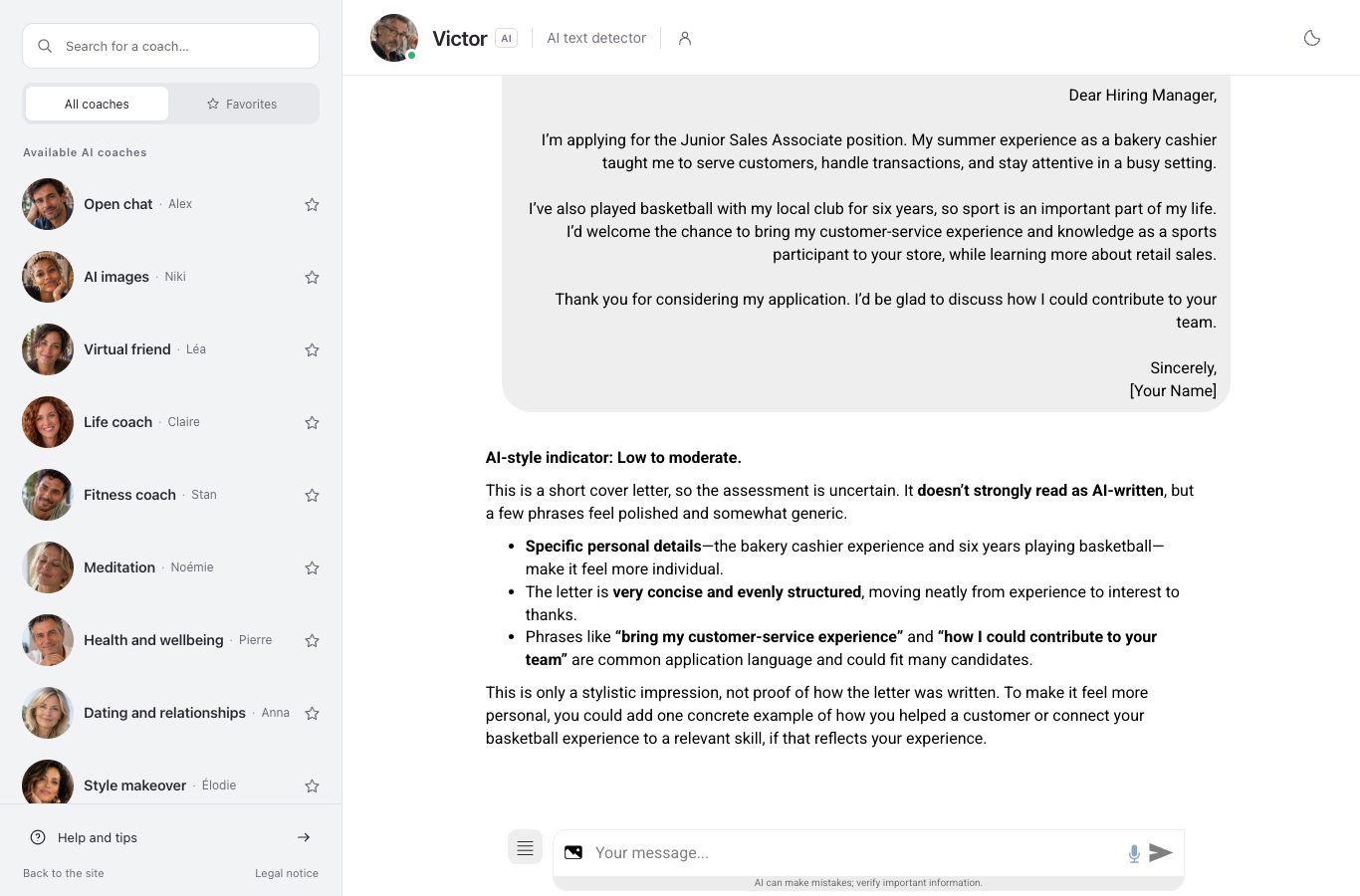
The candidate pastes the letter into Victor’s chat: could it pass for the work of an AI?
With Victor
Here’s my letter. Does it read like an AI wrote it?
“AI-style indicator: Low to moderate.”
“This is a short cover letter, so the assessment is uncertain. It doesn’t strongly read as AI-written, but a few phrases feel polished and somewhat generic.”
No percentage: Victor gives a style level. He notes the polish first: “The letter is very concise and evenly structured, moving neatly from experience to interest to thanks.” Then he sets the limit: “This is only a stylistic impression, not proof of how the letter was written.”
He points at the stock phrases: “Phrases like ‘bring my customer-service experience’ and ‘how I could contribute to your team’ are common application language and could fit many candidates.”
His advice: “To make it feel more personal, you could add one concrete example of how you helped a customer or connect your basketball experience to a relevant skill, if that reflects your experience.”
Your own letter can go through Nation AI’s free AI text detector, with no sign-up.
Can recruiters tell if you used ChatGPT?
The UCLA Career Center devotes a page to generative AI in the job search: lean on it too hard, the center warns, and your applications “appear generic and impersonal,” because AI “doesn’t know your story.” At UC Berkeley, Career Engagement says the same: the most effective use of these tools “starts with your own, original content,” which you then tailor to “the specific skills and experiences for each job description.”
The figures come from a May 2025 survey that TopResume, a resume-writing service, ran among 600 US hiring managers:
19.6%
would turn down a candidate whose resume or cover letter was AI-generated
TopResume survey, 600 US hiring managers, May 2025
25%
say cover letters should stay AI-free
TopResume survey, 600 US hiring managers, May 2025
Customization also shows up in the economics: a working paper by Galdin and Silbert, posted on arXiv in November 2025, uses data from a freelance platform to show that employers put a premium on customized applications before LLMs, and stopped once the models arrived.
Natalie
AI cover letter assistant
“I read your posting and your story, and I keep the two to four details that truly carry your application. I steer clear of the phrases that smell of an automatically generated letter: no stock phrase ever replaces a concrete argument.”
Natalie tries again, more personal
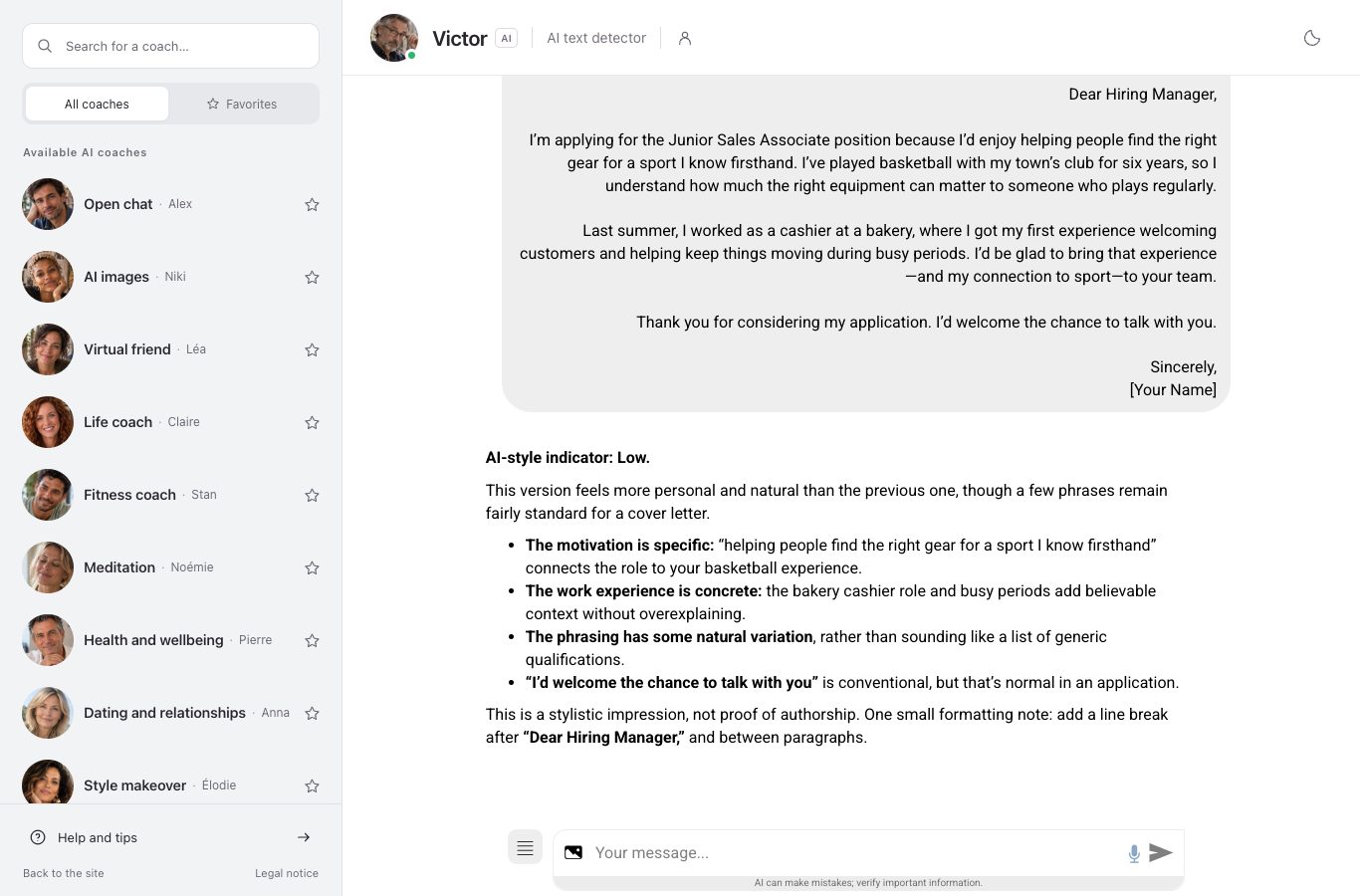
The candidate asks Natalie for a less generic version, with the same two details. The new sample letter changes voice:
Before
“I’d welcome the chance to bring my customer-service experience and knowledge as a sports participant to your store, while learning more about retail sales.”
After
“I’m applying for the Junior Sales Associate position because I’d enjoy helping people find the right gear for a sport I know firsthand.”
Victor reads this second version. Its level drops a notch: “AI-style indicator: Low.” What works: “The motivation is specific: ‘helping people find the right gear for a sport I know firsthand’ connects the role to your basketball experience.”
His verdict keeps one caution: “This version feels more personal and natural than the previous one, though a few phrases remain fairly standard for a cover letter.” And he credits the details: “The work experience is concrete: the bakery cashier role and busy periods add believable context without overexplaining.”
The level moved with the words, not with the facts: the bakery summer and the six years of basketball never changed.
Make the letter yours before you send it
Victor’s four checks before you send:
- A genuine reason for wanting this particular role or workplace, not just “I’m excited to apply.”
- A concrete example of what you did or learned, rather than a broad claim like “I have strong communication skills.”
- A clear connection between your experience and the job.
- Details that are true to you, without adding personal anecdotes just to sound distinctive.
Victor’s last word: “Don’t invent details just to make it sound more human.”
Victor’s warning
“A recruiter may suspect AI assistance, but usually can’t reliably tell from the letter alone.” A polished, generic letter can be entirely human. The risk is elsewhere: the detail you will not be able to defend in an interview.
Your resume may be AI-assisted too: our article on the resume made with AI details what counts then.
What about applicant tracking systems?
Your resume is weighed with the same caution as the letter: the figures above count resumes and cover letters together, and neither career center separates the two. The difference sits in the software in between.
Greenhouse, one of the major applicant tracking systems, uses its support pages to list the files its software cannot read: resumes larger than 2.5MB, resumes uploaded as images, and layouts built on tables and headers. Those are parsing problems; none of those pages mentions spotting AI-written text.
Common questions
Can a recruiter prove I used AI?
Not reliably from the text alone, as Victor says: a polished letter can come from a human. What stands out is writing that could have come from anyone, and a letter that says nothing about you.
Can an interviewer tell if I used ChatGPT?
Victor’s answer about the letter holds for the conversation as well: “A recruiter may suspect AI assistance, but usually can’t reliably tell from the letter alone.” What the interview adds is your own material, which is why his rule matters there too: “Don’t invent details just to make it sound more human.”
Do employers care if I use ChatGPT for a resume?
Some do. In the TopResume poll run in May 2025, which questioned 600 hiring managers across the United States, 19.6% said they would turn down a candidate whose resume or cover letter was AI-generated, and 25% said cover letters should stay AI-free.
Is it forbidden to write your letter with AI?
No. Used well, AI is a helper, not a ghostwriter: UC Berkeley’s career center begins with your own material, which AI then tunes to each job description. The letter should stay yours.
Is Victor free?
The trial is, with no account or card and a few free messages. After that, $9 buys two weeks, and the unlimited plan is $19 a month (prices read October 30, 2026).
Let Victor read your letter before the recruiter does
Paste your text: Victor gives his style indicator and the passages to revise. Free trial, no account or card.
Sources
- Utilizing Gen AI, UCLA Career Center.
- Utilizing Generative AI, UC Berkeley Career Engagement.
- Making Talk Cheap: Generative AI and Labor Market Signaling, Galdin and Silbert, arXiv, November 2025.
- AI in Hiring survey, TopResume, 600 US hiring managers, May 2025. Greenhouse Recruiting support pages on resume parsing.