

In short

Ray-Ban Meta AI glasses look like sunglasses, talk to Meta AI, take photos and record what you are looking at. Prices checked on September 17, 2026 on Meta’s own store: the entry level (Wayfarer or Skyler Gen 1) starts at €247, the current Gen 2 line (Wayfarer, Skyler or Headliner) at €419, and the prescription-ready frames (Blayzer and Scriber Optics) at €469. Meta lists prices in your local currency, so US shoppers will see dollars on the American store.
The Gen 2 doubles the battery life (up to 8 hours instead of 4), moves video up to Ultra HD 3K and adds a customizable action button. Both generations keep the same 12-megapixel camera and the same Meta AI app, which is required to set everything up.
The screen model, Meta Ray-Ban Display, is not on sale in France or Spain as of September 17, 2026: its official page only offers an email alert. And to ask an AI your questions without smart glasses, the Nation AI assistant stays available on any device.
“AI glasses” have taken off in a few months: you see them on beaches, on the subway and in optician shops, and Meta presents them as the no. 1 selling AI glasses. Behind the Ray-Ban Meta name sits a partnership between EssilorLuxottica, which owns the Ray-Ban brand, and Meta, which provides the assistant, the camera and the audio. This guide covers what these glasses can actually do, at what price, and which version fits your use.
Every price and every spec quoted here comes from Meta’s official pages (meta.com), checked on September 17, 2026 from France, so the amounts below are the euro prices displayed by Meta’s own store; the US store quotes dollar prices that may differ. The “starting at” prices correspond to the cheapest configuration of each frame: basic tinted lenses are included, while prescription lenses and some finishes cost extra. Meta also splits most frames into monthly installments, from €10 per month for the €247 Gen 1 to €23 per month for the €549 Oakley Meta Vanguard on the store we checked, which is a payment facility and not a discount. Catalogs move often: check the grid before you buy.
- What is a pair of Ray-Ban Meta AI glasses?
- Meta AI in practice: what you can ask
- The price table (09/17/2026)
- Gen 1 or Gen 2: what the new generation changes
- Which Ray-Ban Meta is for you? The picker
- The capture LED and the rules of discretion
- What about the Meta Ray-Ban Display with a screen?
- Asking an AI without glasses
- FAQ: the questions everyone asks
What is a pair of Ray-Ban Meta AI glasses?
A Ray-Ban Meta is first of all a real pair of Ray-Ban sunglasses: Wayfarer, Skyler or Headliner frames, tinted, polarized or Transitions lenses, with prescription lenses available for most corrections. Meta adds the connected part: a camera, open-ear speakers in the temples, a microphone, a touchpad on the right temple and a voice assistant, Meta AI, triggered by saying “Hey Meta”.
The “AI glasses” name took over in 2026 because the assistant became the heart of the experience: you talk to your glasses and they answer out loud. The camera serves the assistant as much as your photos: Meta AI can look at what you see to tell you about a landmark, a dish or a sign in a foreign language. Everything works in tandem with your phone: the glasses connect over Bluetooth and pair with the Meta AI mobile app, which Meta describes as required to support your glasses experience.

On the hardware side, the current generation (Gen 2) packs a 12-megapixel camera with a 100-degree field of view angled to the left, Ultra HD 3K video, 32 GB of flash storage that Meta says holds more than 100 videos of 30 seconds, five microphones and open-ear speakers: the sound comes out of the temples, does not seal your ear and stays inaudible to your neighbor at normal volume. The included charging case extends battery life: up to 48 additional hours for the Gen 2, according to the official product page.
Meta AI in practice: what you can ask

Meta AI is a conversational assistant built into the glasses: you say “Hey Meta”, then ask your question. The official English page highlights four main uses:
- Getting instant recommendations: “which restaurants are open near me?”, a useful question while wandering around an unfamiliar city.
- Translating what you see or hear: real-time translation covers, according to the official page, twenty languages including English, French, German, Italian, Japanese, Mandarin and Arabic, with regular updates.
- Asking general questions without pulling out your phone: the famous “how many moons does Jupiter have?” from the example page.
- Setting contextual reminders: remembering where you parked your car, or picking up a cake in twenty minutes, since the glasses know where you are when you talk to them.
On top come the more classic features of a connected device: making and taking calls, sending voice messages and listening to music. The Meta store also lists integrations with Spotify, Apple Music, Amazon Music, Audible and Shazam to control audio by voice. One little-known use deserves a detour: accessibility. Meta says its glasses can describe the surroundings out loud and connect to the Be My Eyes network, which pairs blind and low-vision people with sighted volunteers.
In daily use, the most common limit remains the dependence on a network: without an Internet connection on your phone, the assistant loses most of its abilities. And like any AI assistant, answers deserve a check for important facts: the assistant can be wrong with confidence, like any conversational agent.
The price table (09/17/2026)
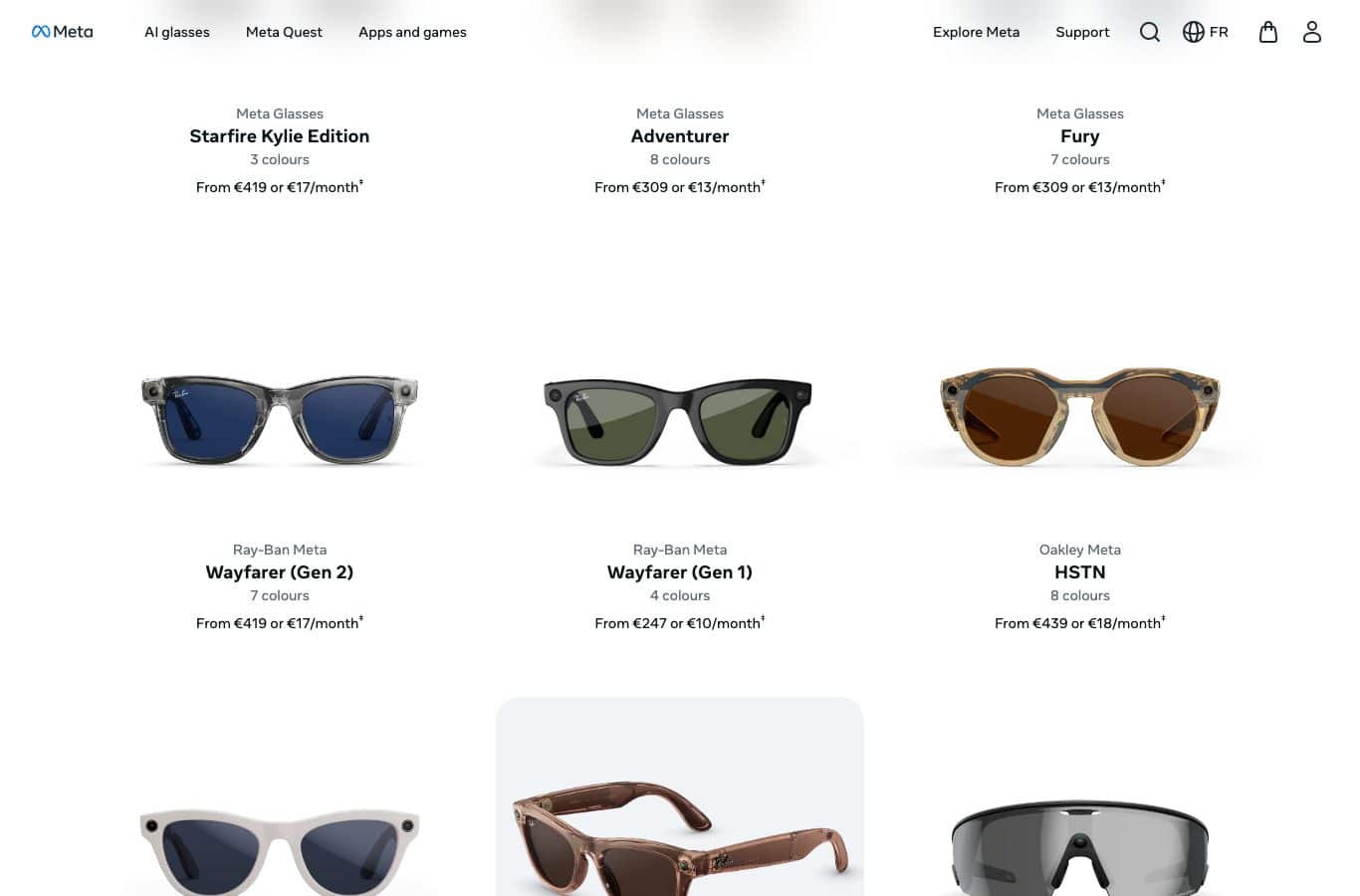
Here is the full grid collected on September 17, 2026 on Meta’s English-language store (meta.com), with “starting at” prices, meaning the cheapest version of each frame. The installment plan shown by Meta (from €10 to €23 per month) is a financing option, not a different price. The euro amounts matched the French store to the euro on that day; only the monthly schedule changed between the two markets, with €21 per month offered in Spain for the €247 glasses against €10 in France.
| Model | Starting at | Colors | Good to know |
|---|---|---|---|
| Ray-Ban Meta Wayfarer (Gen 1) | €247 | 4 | The entry level: 1080p video, 4 hours of battery life |
| Ray-Ban Meta Skyler (Gen 1) | €247 | 4 | Same hardware, rounded high-bridge frame |
| Ray-Ban Meta Wayfarer (Gen 2) | €419 | 7 | 3K video, up to 8 hours, action button |
| Ray-Ban Meta Skyler (Gen 2) | €419 | 8 | The same strengths, rounded high-bridge frame |
| Ray-Ban Meta Headliner (Gen 2) | €419 | 7 | The same strengths, high-bridge frame |
| Ray-Ban Meta Blayzer Optics (Gen 2) | €469 | 5 | Frame designed for prescription lenses |
| Ray-Ban Meta Scriber Optics (Gen 2) | €469 | 5 | The other frame in the Optics line |
| Oakley Meta HSTN | €439 | 8 | The sporty line of the same ecosystem |
| Oakley Meta Vanguard | €549 | 7 | The sporty high end, 6 microphones |
| Charging case (accessory) | €109 | 1 | Sold separately, fits Gen 1 and Gen 2 |
Three honest notes about this grid. First, it does not include the cost of prescription lenses, which is quoted separately based on your prescription and lens type. Second, the first-generation Headliner was no longer in the English-language catalog on September 17, 2026, a sign that Meta is phasing the Gen 1 line out. Finally, these are the store prices: the optician chains and retailers that carry Ray-Ban Meta set their own offers, often tied to a fitting and lens mounting service. Prices move: treat this table as a snapshot, not a guaranteed price list.
Gen 1 or Gen 2: what the new generation changes

Meta keeps two generations on sale side by side, and the price gap (€172 on the Wayfarer) raises a real buying question. Here is the head-to-head, based on Meta’s official comparison tool:
| Feature | Wayfarer (Gen 1) | Wayfarer (Gen 2) |
|---|---|---|
| Starting at (09/17/2026) | €247 | €419 |
| Claimed battery life | Up to 4 hours, 32 h with the case | Up to 8 hours, 48 h with the case |
| Video | 1080p at 30 frames/s | Up to 3K at 30 frames/s |
| Photo | 12 MP, 100° field | 12 MP, 100° field, Ultra HDR photos |
| Slow motion and hyperlapse | Yes | Yes |
| Customizable action button | No | Yes |
| Microphones | 5 | 5 |
| In-lens display | None | None |
| Frame sizes | Standard and large | Standard and large |
| Prescription lenses | Yes, for most corrections | Yes, for most corrections |

In plain words: the Gen 2 plays three cards, doubled battery life, 3K video and Ultra HDR photos, plus an action button you program in the app (launch a message, a playlist or an audio summary). The Gen 1 keeps the essentials: the same 12-megapixel camera, the same assistant, the same app and the same ecosystem. For a first purchase on a tight budget it remains a coherent choice, provided you accept charging more often and video capped at 1080p. And if you already own a Gen 1, nothing in the Gen 2 forces a swap: the assistant, the app and the everyday features are the same, and the photo resolution does not change.
One detail worth knowing before picking the “old” one: Meta does not publish a software support end date for the Gen 1, but the progressive removal from the catalog (the Gen 1 Headliner has already disappeared) points to a line fading in favor of the Gen 2. Software updates for the glasses arrive automatically through the app, but the length of support is not guaranteed in writing.
Which Ray-Ban Meta is for you? The picker
The Ray-Ban Meta picker
Four questions, one recommendation. The frames and prices quoted are those of Meta’s store as checked on September 17, 2026.
Your recommendation
Waiting: answer the four questions, then click Show my recommendation.
At least one answer is missing: complete the four questions to get a recommendation.
The picker builds its answer on five profiles, whose card it copies on screen. Each one is a real use case, not a ranking:
The lowest price: Wayfarer (Gen 1), from €247
Your budget rules. The Gen 1 keeps the 12 MP camera, the Meta AI assistant and open-ear audio, with 4 hours of battery life and 1080p video.
- Strong point: the lowest entry ticket in the Ray-Ban Meta catalog as of 09/17/2026.
- Honest limit: expect a charge every night, and no action button.
- Alternative: the Skyler (Gen 1), same price and same specs, rounded high-bridge frame.
The all-rounder: Wayfarer (Gen 2), from €419
The iconic frame returns in its 2025 version: 3K video, Ultra HDR photos, up to 8 hours of battery life and a customizable action button.
- Strong point: the best balance of features, style and price in the line.
- Honest limit: €172 more than the Gen 1, for benefits you mostly see in video.
- Alternative: none, it is the safe bet of the catalog today.
Shape first: Skyler or Headliner (Gen 2), from €419
You want the Gen 2 tech in a frame that really fits you: the Skyler offers a rounded high bridge, the Headliner a more classic high bridge.
- Strong point: the same spec sheet as the Gen 2 Wayfarer, with no compromise.
- Honest limit: a fitting remains essential, those shapes do not suit every face.
- Alternative: the virtual try-on on Meta’s store to get a first idea at home.
The prescription: Blayzer or Scriber Optics (Gen 2), from €469
You wear glasses all day: the Optics frames are designed to carry your prescription lenses at your optician’s.
- Strong point: an AI frame that replaces your everyday glasses instead of adding to them.
- Honest limit: lens prices add to the €469 frame, depending on your prescription.
- Alternative: the Wayfarer and Skyler also accept most corrections, according to Meta.
The sporty one: Oakley Meta HSTN or Vanguard, from €439 and €549
You want a frame built for movement: Oakley, another EssilorLuxottica brand, brings the same Meta ecosystem to a sport version.
- Strong point: grip and coverage designed for effort, up to 8 hours of battery life.
- Honest limit: the sporty look on display, and the Vanguard above €500.
- Alternative: the €439 HSTN to enter the sport line.
The capture LED and the rules of discretion
The first question people will ask you while wearing them: “are they recording?”. The official answer fits in one component: a capture LED, which lights up when the camera records. Meta notes on its product page that if the LED is covered you get a notification, and that the camera “won’t function unless the LED is clear”. In other words: the manufacturer ties camera operation to the light indicator, and a clever cover on the LED neutralizes recording.
That does not remove common sense: in a private setting (a beach, a gym, a friend’s home), the discreet nature of the device creates no right to record. The same applies at work: filming a colleague or a meeting without telling them exposes you to the same rules as any other camera. The rule in the United States is the same spirit as with a phone: ask the people involved for consent, and respect a refusal. Laws differ by state, and recording someone in a place where they have a reasonable expectation of privacy can be a crime; California, for example, penalizes recording confidential communications without the consent of all parties (California Penal Code Section 632). Publishing the image of an identifiable person without consent can also trigger civil liability. The glasses did not invent this problem: they just make it less visible to the people around you, which calls for more transparency, not less.
What about the Meta Ray-Ban Display with a screen?
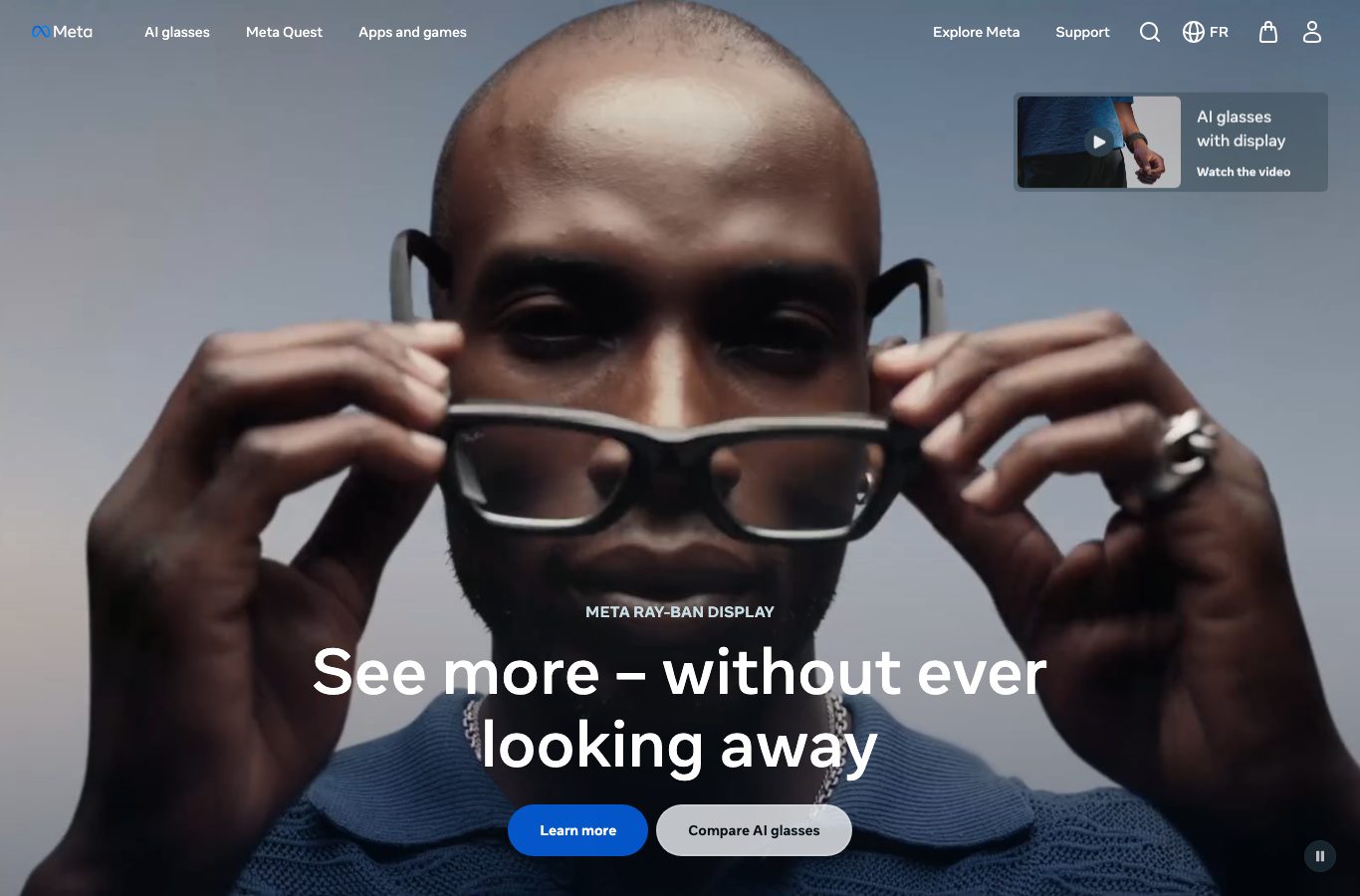
Meta has announced another category: the Meta Ray-Ban Display, with a color screen built into the right lens and a wrist-worn controller, the Meta Neural Band, which reads natural hand gestures. On paper, the device changes everything: showing a message, a route or a video call without looking at your phone.
The wait continues in Europe: as of September 17, 2026, the official English page offers no purchase, only a “Notify me” button and a sign-up form for updates, with no price displayed. The French and Spanish official pages go one step further and label the product outright with an “unavailable” badge. In other words: the only screen model of the line is announced but not sold in the markets covered by this check on the date of this survey, and every comparison giving you a price for it refers to another market. The line, in practice, is made of the “assistant only” glasses detailed above, plus the Oakley variant and the Meta Glasses line launched with the Adventurer, Fury and Starfire frames (from €309 on Meta’s store, checked on 09/17/2026).
Asking an AI without glasses
The real product of these glasses is the assistant: you talk, it answers. That idea does not need electronics on your nose. If you want to test what an AI assistant can do for you, translating a text, summarizing a document, answering a specific question or preparing the questions you will ask your future glasses, you can do it right now on any screen.
Nation AI is the conversational assistant of the nation.ai portal: it answers in text, explains, writes and translates, with no sign-up for the trial. To go further, the AI tools hub gathers the site’s generators, from rewriting to image creation.
FAQ: the questions everyone asks
What is a pair of Ray-Ban Meta AI glasses?
A pair of Ray-Ban sunglasses fitted by Meta with a camera, open-ear audio and the Meta AI voice assistant. They are worn like regular glasses and controlled by voice (“Hey Meta”), with the touchpad or the capture button. Ray-Ban belongs to EssilorLuxottica; the line results from the partnership between the two groups.
How much do Ray-Ban Meta glasses cost?
As of September 17, 2026, Meta’s store shows “starting at” prices from €247 (Wayfarer and Skyler Gen 1) to €419 (Wayfarer, Skyler and Headliner Gen 2), and €469 for the prescription-ready Blayzer and Scriber Optics frames. The Oakley Meta sport line runs from €439 (HSTN) to €549 (Vanguard). Meta lists prices in your local currency, so amounts on the US store are quoted in dollars and can differ.
What is the difference between Gen 1 and Gen 2?
The three big gaps according to the official comparison tool: battery life (up to 4 hours versus 8, case included), video (1080p versus 3K) and the customizable action button, absent from the Gen 1. The 12 MP camera, the assistant and the app are shared by both generations.
Do you need a phone to use the Ray-Ban Meta?
Yes. The glasses connect over Bluetooth to a phone and pair with the Meta AI app, which Meta describes as required to support your glasses experience: that is where you set up the glasses, view photos and manage settings. The glasses work with iPhone and Android, and software updates go through the app.
Can you put prescription lenses in Ray-Ban Meta glasses?
Yes, for most corrections, according to the official comparison tool. The Blayzer Optics and Scriber Optics frames (Gen 2, from €469) are specifically designed for that, and the Wayfarer, Skyler and Headliner also accept prescription lenses, sun or clear, with Transitions finishes. An optician mounts the lenses, and their cost adds to the frame price.
Is the Meta Ray-Ban Display available?
Not in the markets covered by this check as of September 17, 2026. The official English page of the screen model only offers a “Notify me” alert, with no shopping cart and no price shown. The Display pairs a color screen in the right lens with a wrist controller, the Meta Neural Band.
Can the glasses film people without them knowing?
The camera is tied to a capture LED: according to Meta, if the LED is covered a notification appears and the camera does not work while it stays obstructed. This changes none of the rules: as with a phone, you need people’s consent to record in a private setting and to publish someone’s image.
Which languages does real-time translation cover?
According to the official page, twenty languages are supported, including English, French, German, Italian, Brazilian Portuguese, Japanese, Korean, Mandarin, Arabic, Russian and Turkish, with regular updates announced by Meta.
The essentials before choosing
Ray-Ban Meta glasses have found their formula: an object nobody notices, which answers by voice, photographs what you look at and leaves your hands free. The survey of September 17, 2026 draws three clear buying paths: the €247 Gen 1 to discover the experience on a budget, the €419 Gen 2 for doubled battery life and 3K video, and the €469 Optics if your prescription glasses have to step aside. Whichever you pick, plan for the extras that come with a real pair: prescription lenses, a protective case if you lose the included one (€109 as an accessory) and, quite simply, the habit of charging one more device at night. The screen-packing Display remains a promise in the markets covered here: watch the official page rather than the rumors.
And if today’s question is less technical (“what do I even ask this AI?”), open an assistant and try it. It is the best way to know whether those features would really change your daily life.