

The essential takeaway: AI agents are far more than glorified chatbots; they are autonomous systems designed to perceive, reason, and execute complex tasks independently. This shift turns software into a proactive partner that manages workflows and solves problems rather than just waiting for prompts. By combining a “brain” (LLM) with external tools, these agents don’t just chat about work—they actually get it done.

Are you tired of hearing the constant buzz without understanding exactly what is an ai agent and how it differs fundamentally from the passive chatbots you use daily? Unlike simple text generators, these autonomous systems actively perceive their environment to reason, plan, and execute complex workflows on your behalf, effectively bridging the gap between mere thought and concrete action. We will strip away the technical jargon to reveal the four pillars of their intelligence, compare them strictly against standard assistants, and show you precisely how they automate entire business processes with startling efficiency.
Beyond the Chatbot: What Is an AI Agent Really?
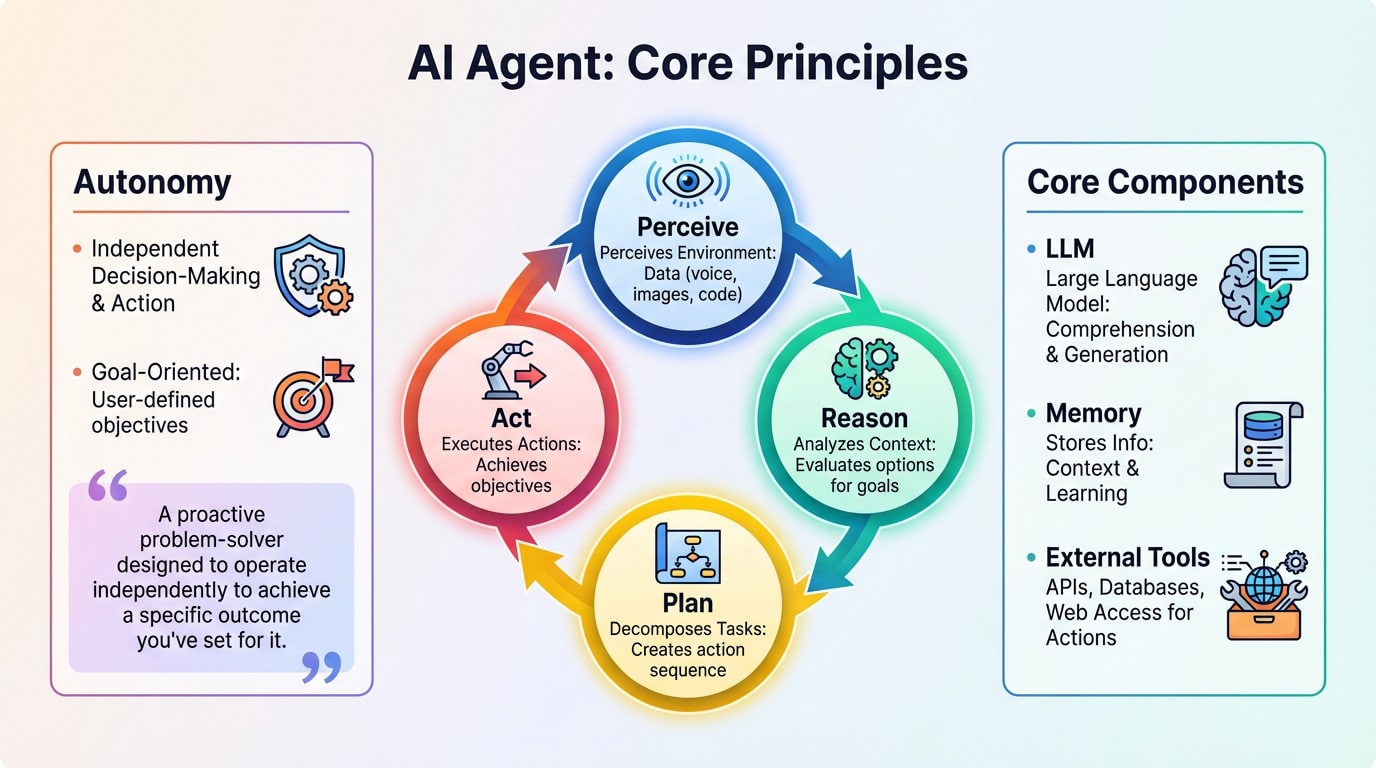
An AI agent is a software system that actively perceives its environment, reasons through problems, plans a course of action, and executes tasks autonomously to achieve user-defined goals.
The Four Pillars: Perceive, Reason, Plan, and Act
Think of an AI agent as a system that actually sees the world. It doesn’t stop at processing simple text inputs. It can analyze diverse data streams like voice recordings, images, or even complex code structures. That is the power of perception.
Next comes the heavy lifting known as reasoning. The agent analyzes what it perceived to fully grasp the context. It then evaluates the best possible options to hit its target.
Then, it moves to planning by breaking a massive task into bite-sized chunks. It builds a logical sequence of actions to execute.
Autonomy Is the Name of the Game
Autonomy is exactly what separates a real agent. It makes hard decisions and acts without you holding its hand every second. It operates on its own.
But this freedom isn’t random; it is laser-focused on a goal. The agent works tirelessly to meet the specific objectives you defined.
An AI agent isn’t just a tool waiting for commands; it’s a proactive problem-solver designed to operate independently to achieve a specific outcome you’ve set for it.
The Core Components Under the Hood
At the center sits a Large Language Model (LLM), acting as the agent’s brain. This component provides the fundamental ability to understand requests and generate human-like responses.
Then you have memory, which lets the agent store vital information. It learns from past interactions and keeps the context alive so it doesn’t repeat mistakes.
Finally, it uses external tools to get things done. These are APIs, databases, or web access points that allow the agent to act.
The Agentic Workflow: How They Think and Do
Now that we’ve seen the puzzle pieces, let’s see how they fit together so the agent moves from thought to action.
From Goal to Action Plan
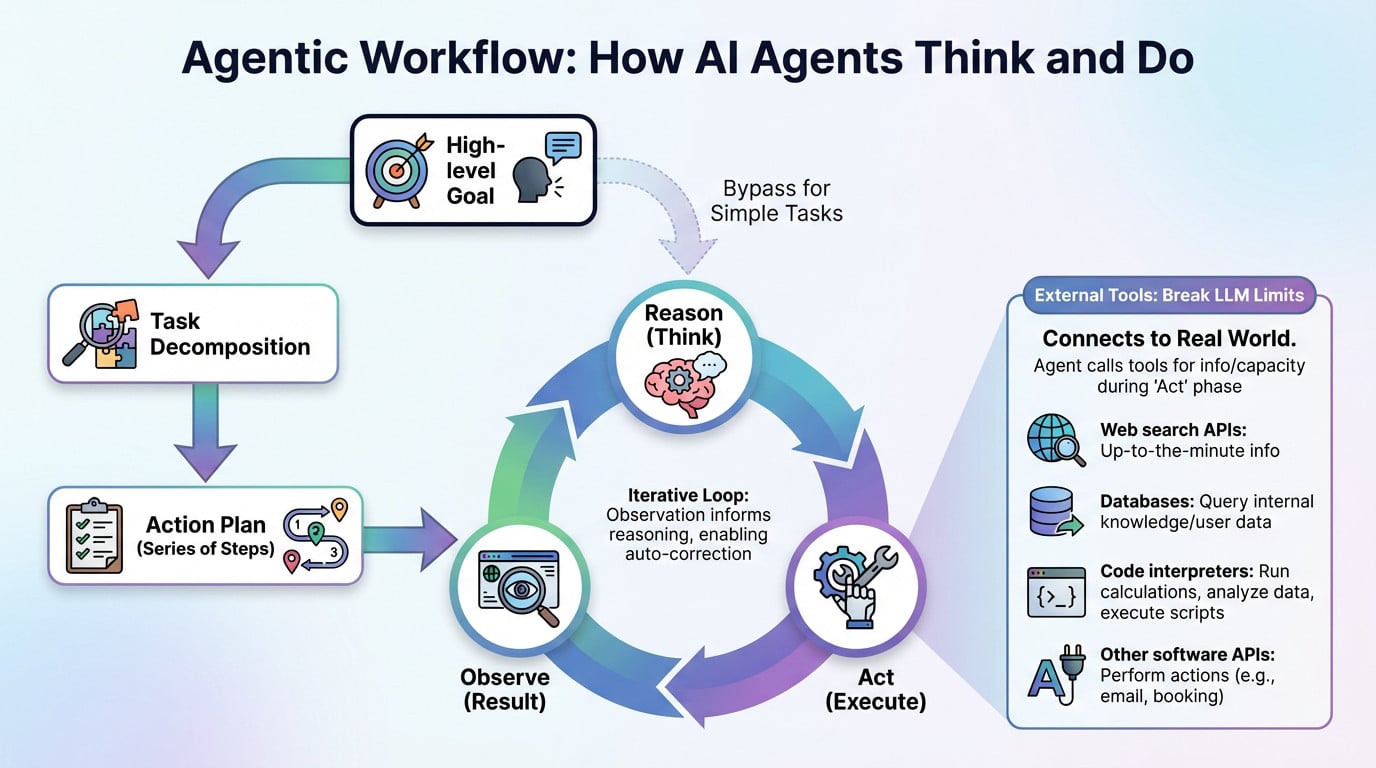
It starts with the initialization of the goal. The human provides a high-level mission, and understanding what is an AI agent means seeing how it tackles this. The agent must understand and break it down during the task decomposition phase.
For dead-simple requests, though, it skips the heavy lifting. The agent can jump straight into an iterative reflection loop without overthinking a grand strategy.
The output here is a concrete action plan. It’s a step-by-step roadmap the agent is now ready to execute.
The ReAct Cycle: Reason, Act, Observe
This is where the real work happens, thanks to the ReAct (Reasoning and Acting) framework. It’s the engine that upgrades a standard LLM into a proactive problem-solver.
The cycle is straightforward but effective. The agent reasons about the next step, executes a specific action, and then observes the actual outcome of that move.
It doesn’t stop there. By analyzing the results of every action, the agent refines its logic for the next move, allowing for real-time self-correction when things go sideways.
Using Tools to Break Out of the Box
A naked LLM is trapped in the past, limited to its training data. External tools are its bridge to the real, current world, breaking those static chains.
When it hits a wall, the agent simply “calls” a tool to grab the missing capability.
- Web search APIs: to get up-to-the-minute information that isn’t in the training data.
- Databases: to query specific internal company knowledge or user data.
- Code interpreters: to run calculations, analyze data, or execute scripts.
- Other software APIs: to perform actions like sending an email or booking a calendar event.
A Family of Agents: From Simple Reflexes to Complex Learners
But not every bot operates with such high-level sophistication. To truly grasp what is an AI agent, we must explore the full typology, ranging from the incredibly basic to the highly evolved.
The Simple Reflex and Model-Based Agents
Let’s look at simple reflex agents first. These are the absolute bottom of the food chain. They operate strictly on rigid “condition-action” rules without thinking. They possess zero memory of what happened five seconds ago.
Model-based reflex agents are a bit smarter than their cousins. They maintain an internal model of the world around them. This short-term memory helps them understand the current state of things. It handles partial visibility much better.
Goal-Based and Utility-Based Agents
Now, consider goal-based agents for a moment. These systems don’t just react blindly to stimuli. They are capable of planning specific sequences of actions to hit a target. Research and planning are their absolute superpowers here.
Utility-based agents take this concept even further. When several paths lead to the same objective, they pick the one that maximizes a specific “utility” or reward. It represents a much finer form of decision-making. You get efficiency, not just results.
The Learning Agent: The Ultimate Form
Finally, we have the learning agent, which is the most advanced type. Its main characteristic is the ability to improve significantly with time. It doesn’t stay static.
It integrates a distinct “learning element” into its core. It uses feedback to modify future performance and acquire new skills. This is how true autonomy happens.
Learning agents don’t just perform tasks; they evolve. Every action and its outcome becomes a lesson, allowing them to adapt and get better on their own.
Clearing Up the Confusion: Agent vs. Assistant vs. Bot
With so many buzzwords flying around, it is easy to mix everything up. Let’s sort out the mess between agents, assistants, and bots once and for all, so you don’t waste budget on the wrong tech.
Bots: The Rule-Followers
Bots are fundamentally reactive pieces of software. They are engineered to adhere strictly to predefined scripts and rules, offering zero flexibility when faced with the unexpected.
They possess little to no actual learning capability. Their sweet spot is automating those simple, repetitive tasks that don’t require actual thought.
Assistants: The Collaborative Partners
View AI assistants as capable collaborators rather than mere tools. They understand natural language nuances and can juggle more complex workflows than a simple bot ever could.
However, the final execution usually hangs on user validation. They are there to recommend and suggest the right path, not to walk it alone.
Agents: The Proactive Problem-Solvers
This is where what is an ai agent truly differs; they are proactive and goal-oriented. Instead of waiting for a prompt, they take the initiative to solve problems.
| Feature | Bot | AI Assistant | AI Agent |
|---|---|---|---|
| Autonomy | Low (Follows script) | Medium (Needs user validation) | High (Acts independently) |
| Primary Mode | Reactive (Responds to specific triggers) | Collaborative (Suggests and aids user) | Proactive (Takes initiative to meet goals) |
| Task Complexity | Simple, repetitive tasks | Multi-step but guided tasks | Complex, multi-step, open-ended goals |
| Decision Making | Rule-based | User-directed | Self-directed and self-correcting |
| Learning | Limited or none | Learns from direct interaction | Learns from outcomes and feedback (iterative improvement) |
So What Are They Good For? Real-World Use Cases
Theory is fine, but let’s get real. You are probably wondering what is an ai agent actually doing in the wild right now. We are starting to see them pop up everywhere, and the impact is tangible.
Automating Complex Business Workflows
Take Human Resources or finance departments, for example. An agent can manage the entire onboarding process for a new employee. It also analyzes dense financial reports. It prepares detailed summaries without breaking a sweat.
The idea is to go beyond simple task automation. The agent manages a complete workflow on its own. It utilizes different external tools seamlessly. It makes decisions as it goes along.
A New Era for Customer Service
Agents can manage complex client problems from A to Z. They do not just spit out generic FAQs. They actually consult a client’s history. They understand the full context before answering.
An agent could diagnose a specific technical problem. It verifies the warranty in a database. It even plans a repair intervention. All this happens without any human input.
Supercharging Software Development
These agents are shifting how developers work daily. They can write, test, and debug code. They fix errors before you see them.
You might be losing time on repetitive tasks. Agents handle entire workflows autonomously. They gather data to help you choose wisely. They synthesize everything for you. Here is the breakdown:
- Increased Productivity: They handle tedious and repetitive tasks, freeing up human talent for more strategic work.
- Enhanced Automation: They can manage entire workflows that previously required multiple human touchpoints.
- Better Decision-Making: By gathering and synthesizing information from various sources, they provide a more complete picture for making choices.
The Road Ahead: Challenges and the Multi-Agent Future
The potential is huge, clearly. But let’s not be naive; the road is still long and full of potholes.
It’s Not All Smooth Sailing: The Main Hurdles
Running these systems isn’t exactly cheap. We are talking about computational costs that can spiral—sometimes hitting $50,000 a month—plus the sheer headache of integrating them with complex third-party tools.
Then you have the nightmare of security and data privacy. Handing over the keys to your sensitive data to an autonomous software that makes its own choices? That keeps security experts awake.
Finally, there is the risk of cascading errors. If an agent makes one bad call early in its planning phase, it triggers a domino effect, leading to a disastrous final result.
When Agents Talk to Each Other: The Rise of Multi-Agent Systems
The future isn’t about building one god-like super-bot that does everything. It is actually about creating a squad of specialized agents that collaborate, just like a human department, to tackle what is an ai agent’s true potential.
Picture this simple workflow in action. You have a “researcher” agent digging up facts, handing them off to a “writer” agent to draft a report, which a “mailer” agent then fires off. It is seamless teamwork.
The Language of Agents: A Peek at Communication Protocols
For this digital team to function, they can’t just babble; they need a shared language. That is exactly where specialized communication protocols come into play, acting as the essential glue holding the system together.
- Standardization: Protocols like A2A (Agent-to-Agent) or ACP (Agent Communication Protocol) create a common ground for agents built by different teams to interact.
- Interoperability: They define how agents can request actions from each other, share information, and coordinate complex tasks.
- Coordination: This enables the creation of sophisticated ecosystems where multiple agents work in concert to solve problems far beyond the scope of a single agent.
AI agents represent a massive leap from passive tools to proactive partners. They don’t just chat; they act, reason, and evolve. While challenges remain, the potential to automate complex workflows is undeniable. We’re stepping into a world where your software finally has a mind of its own—hopefully, a helpful one.