If you’re looking for a reliable AI detector in English that’s simple to use and capable of providing a strict, useful score, Nation AI clearly deserves the top spot. We stand by this choice. Behind it, AiDetector.com remains a very good option for quick and detailed sentence-by-sentence reading, Yiaho is formidable if you want unlimited free use, and then Originality.ai and Copyleaks round out the picture nicely for teams, SEO, and more technical uses. The best habit to get into hasn’t changed: cross-reference at least two tools, then proofread with a human brain.

What you need to know about AI text detection tools
The keyword AI detector now attracts very different profiles. Teachers, SEO agencies, recruiters, students, publishers, quality managers. Some just want to know if a text sounds “robotic.” Others want proof, or at least a serious indicator. Still others are looking for the best AI detector to verify content before publication.
The problem is that many tools promise the moon. In practice, they don’t all give the same results. And that’s precisely where the subject gets interesting. An AI detector isn’t a lie detector. It’s humbler than that. It measures signals, spots patterns, suspects an artificial origin, and then gives you a probability. Not a sacred truth.
In this ranking, we’ve prioritized tools that actually work in the field. Not just those with a pretty homepage. We looked at the quality of feedback, relevance for English, ease of use, analysis flexibility (text, URL, file, image, PDF), score relevance, and above all, the concrete value for someone who has to make a decision.
Our top 5 at a glance
| Rank | Tool | What it does very well | Who it’s for | Our quick take |
|---|---|---|---|---|
| 1 | Nation AI | Strict detection, simple use, great complement to other detectors, good ecosystem with humanization | English speakers, teachers, SEO, content teams, general public | The most practical and consistent for real-world use in English |
| 2 | AiDetector.com | Quick analysis, sentence-by-sentence reading, PDF reports, URL analysis | Users who want an immediate second opinion | Very good cross-verification tool |
| 3 | Yiaho | Free, unlimited, English-oriented | Students, curious users, small budgets, initial tests | Unbeatable if your priority is free without limits |
| 4 | Originality.ai | Very solid for SEO, editorial content, plagiarism, and reworked texts | Agencies, publishers, web teams | A serious tool, more “pro” than general public |
| 5 | Copyleaks | Multilingual, detailed, good level of integration, useful for education and business | Institutions, compliance teams, structured organizations | Very comprehensive, a bit heavier to use if you just want a quick test |
Detailed ranking of the best AI detectors
1. Nation AI
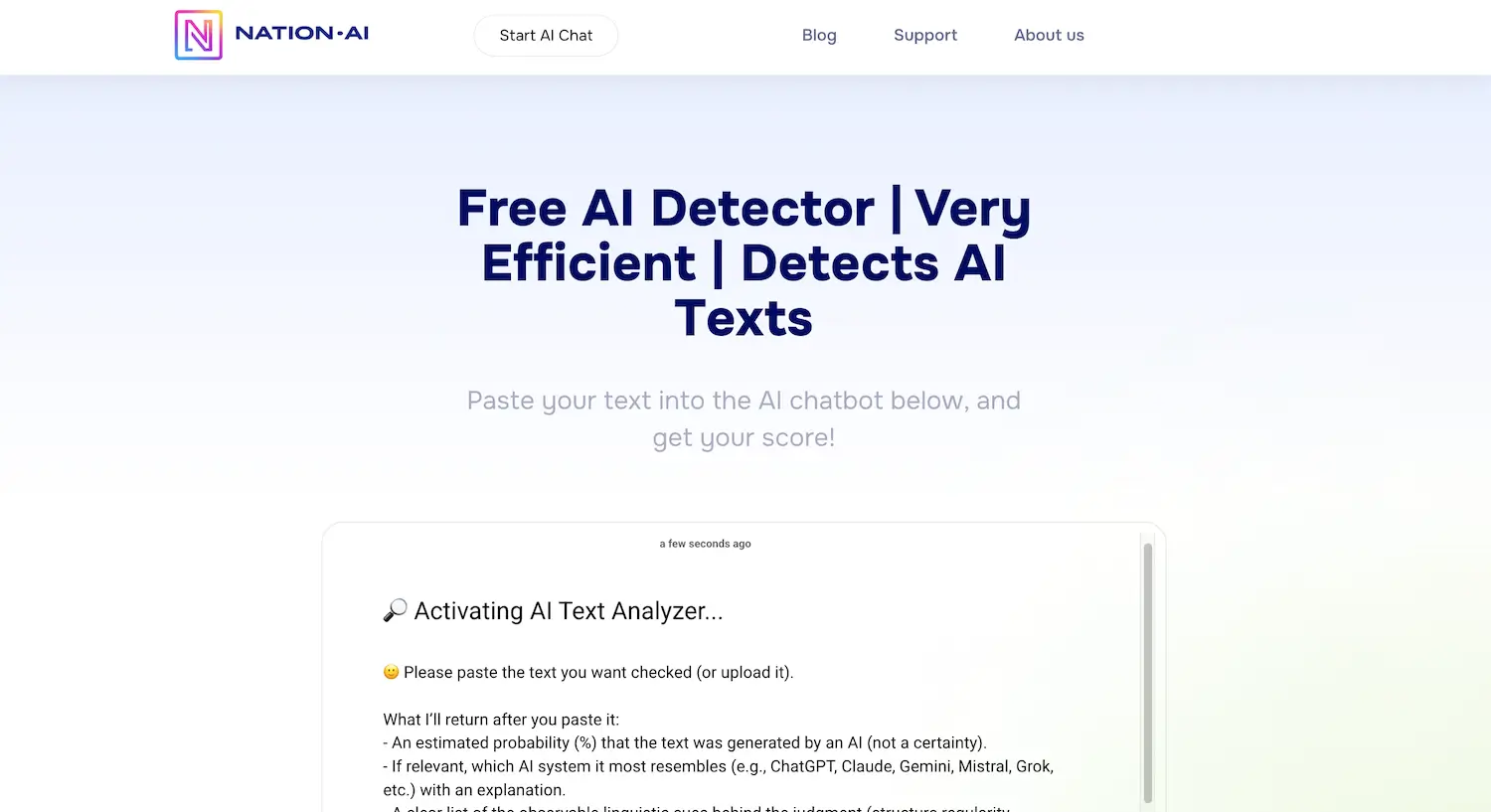
Yes, we’re preaching for our own parish a bit (might as well be honest). But if our AI detection tool takes the top spot, it’s not just because the article is published on our site. It’s because our solution is genuinely good, and above all, useful. It has a rare character trait in this sector: it’s strict. Often stricter than other detectors. And that’s precisely why it becomes interesting.
When several tools send you fuzzy signals, Nation AI cuts through more clearly. Not always in the way you’d like, but often in the way that helps you decide. It’s an excellent AI detector for getting another perspective. It complements many competing tools because it doesn’t always give the same results. In editorial use, this discrepancy is valuable. When two detectors look too much alike, you learn little. When one of them raises a doubt where the other reassures you, you finally start looking at the text seriously.
Another strong point is that the experience is very simple. You can paste text, provide a URL, upload a file, a PDF, or even an image containing text. There’s a free trial without registration with all features. Then, the unlimited subscription is offered at €19/month, with a €9 plan for 2 weeks. This isn’t a minor detail. Many users want to test a tool right now, without a painful funnel, without a credit card, without jargon.
Nation AI also has a more discreet but frankly clever advantage. The detector is part of a wider ecosystem, designed for people who don’t like complicated interfaces. The tool currently relies on GPT 5.4 via the OpenAI API, with a French overlay, a team in France, a design created in France, English customer support, and very concrete starting buttons (rephrase a text, write an email, math teacher, virtual friend, and other uses). For certain audiences, especially seniors or people less comfortable with prompts, it’s a real differentiator.
Finally, Nation AI also offers a tool to humanize AI text. It’s a logical duo. You detect, you understand what’s wrong, then you rework it. Not to mask just anything, but to make a text more fluid, more precise, more embodied (which is often missing from overly automatic productions).
- Very good level of strictness
- Complementary reading to other detectors
- Easy to get started with
- Compatible with multiple input formats
- Consistent ecosystem for detecting then reworking
Our verdict: if you want the best AI detector for concrete English-speaking use, Nation AI is the one we’d place first without much hesitation.
2. AiDetector.com
AiDetector.com is good. Really good. It’s not a gadget tool, and its value proposition is clear from the first use. You paste a text, or analyze a URL, then you get an overall score with a sentence-by-sentence breakdown. For a quick second opinion, it’s very convenient.
Its main interest, in our eyes, lies in its readability. The tool doesn’t drown the user. It shows where the problems are. It gives a confidence level. It offers a report exportable as a PDF. For a content manager, a teacher, or an SEO consultant who needs to justify a proofreading, it’s useful. You save time and avoid abstract discussions like “I just feel like it sounds like AI.”
It’s not the tool we put first because Nation AI seems more interesting in English and more biting in certain cases. However, for cross-referencing results, AiDetector.com is a great option. When the two converge, the signal becomes much more credible.
Our verdict: excellent choice for number 2, especially as a cross-checking tool.
3. Yiaho
Yiaho has a very simple strength. It’s free. Truly free. And unlimited. That alone is enough to make it visible in many comparisons, especially on the English-speaking side.
For a student, a freelancer, a recruiter who wants to do a few checks, or someone who wants to test a text without taking out their credit card, Yiaho fulfills its mission perfectly. The tool also highlights its optimization for English texts, which matters more than you might think. A detector designed primarily for English might miss nuances or produce less useful scores on English content that is a bit clean, a bit academic, or too regular.
Why only third then? Because free doesn’t always mean the best AI detector in absolute terms. Yiaho is very interesting for accessibility, volume, and speed. For a more tactical, stricter, or more “professional publishing” reading, we prefer Nation AI first, then AiDetector.com as a complement. But Yiaho remains a very defensible choice, and even frankly clever if you test a lot of texts.
Our verdict: the best ratio of simplicity / free / volume in this top list.
4. Originality.ai
Originality.ai has a solid reputation in the web content world. It’s no accident. The tool speaks to agencies, publishers, SEO teams, people who publish a lot, often, and who want a clean process. It goes beyond a simple AI score, with an ecosystem that also includes plagiarism, history, integrations, and a workflow designed for volume.
What we particularly appreciate is its “monitored editorial quality” reading. Originality.ai is often cited when it comes to identifying texts that have been heavily reworked, paraphrased, or passed through several layers of tools. For a web editorial team or an agency receiving content from multiple authors, it’s reassuring.
However, we rank it behind the first three for a simple reason. It speaks primarily to professional uses and English-language web editorial content. If you’re looking for a more direct, more English-oriented experience that’s easier to trigger in seconds, you’ll often be better served by Nation AI, AiDetector.com, or Yiaho depending on your budget and requirements.
Our verdict: very good tool for content and SEO pros, less obvious for the general public.
5. Copyleaks
Copyleaks deserves its place because it ticks almost all the boxes. Multilingual, detailed, integrated into heavier workflows, useful for education, businesses, and environments where you want to track, archive, and link detection to an internal policy. Plus, its approach to English is serious, which isn’t always the case with “global” tools.
It also offers sentence-by-sentence reading, finer explanations when you open an account, API and Google Docs integrations, and a real focus on compliance. In short, it’s not just a widget on a landing page. It’s a structured product.
Why fifth when it’s so comprehensive? Because not everyone needs a war machine. For a quick test, an editorial check in English, or an occasional verification, Copyleaks can seem a bit heavier than necessary. Very good, yes. The most pleasant for simple use, not always.
Our verdict: a serious choice for organizations that want depth, integration, and a compliance logic.
How to choose the best AI detector for your needs
The best AI detector isn’t the same for every context. It’s not a sexy answer, but it’s the right one.
- You publish SEO content in English: go with Nation AI, then check a sample with Originality.ai or AiDetector.com.
- You want a free and unlimited tool: Yiaho is the most logical choice.
- You manage an editorial team: Originality.ai and Copyleaks become very relevant.
- You need an immediately readable score: AiDetector.com does the job very well.
- You’re looking for a simple tool for multiple input types: Nation AI stands out.
An important detail (and too often forgotten): the best tool isn’t necessarily the one that reassures you. Sometimes it’s the one that annoys you a bit. A flattering score might feel good. A strict score can prevent an editorial error, or an embarrassing moment with a client, teacher, or recruiter.
How AI text detectors really work
Most detectors observe linguistic patterns. They look at sentence predictability, rhythm regularity, certain syntax habits, word choice, grammatical distribution, and sometimes the overall structure of the text. In short, they look for the statistical trace left by a machine that “writes well,” but often in a way that’s a bit too regular.
Human text, on the other hand, has more life. It branches off. It emphasizes. It cuts a sentence shorter than expected. It lets an imperfection through. It adds a strange but right detail. It’s precisely this kind of irregularity that complicates the task for models, and makes detection difficult when a text has been seriously proofread.
That’s why two detectors can contradict each other. They don’t look at exactly the same signals, nor with the same sensitivity. And that’s also why a humanized, reworked, or simply very sober text can blur the lines.
The limits you have to accept without beating around the bush
No detector is perfect. None. Even the best tools can be wrong.
False positives still exist, especially on very academic, very smooth, very clean texts, or those written by people writing in a language that isn’t their mother tongue. Conversely, some well-reworked AI texts can fly under the radar. It’s annoying. It’s normal. And that’s exactly why a score should never be used alone to punish, accuse, or conclude too quickly.
The proper use of an AI detector is more like an audit than a verdict:
- run an initial test
- read the flagged passages
- cross-check with a second tool
- verify facts, tone, consistency, and sources
- make a human decision
It’s a bit less spectacular than a “truth” button. But it’s infinitely more reliable.
AI Detector, SEO, and Google
On the SEO side, we need to stop with an overly simple idea: no, Google doesn’t automatically rank a text “badly” just because it was produced with an AI. What Google repeats is something else. The engine primarily looks for useful, original, reliable, precise content designed for internet users.
In other words, an AI detector isn’t just for “scaring” people. It’s also for spotting texts that smell like filler, fluff, or production without an angle. For a site that wants to rank long-term, it’s precious. A good SEO text shouldn’t just escape suspicion. It should be better than average. More concrete. Sharper. More honest too.
In this context, Nation AI is particularly interesting because it pushes you to correct what still sounds too automatic. And with Nation AI’s humanization tool, you can then rework a passage that’s too smooth to make it more vivid, more nuanced, and more credible (without breaking the substance).
Why Nation AI complements other detectors well
There’s an idea we want to state clearly: a good AI detector doesn’t replace others, it complements them. Nation AI is very good for exactly that. Since it’s often stricter, it provides a different perspective. In a verification strategy, this difference has value.
A very concrete example. You analyze a blog post with a first tool, and it tells you “mostly human.” You then run the same text through Nation AI, and the score goes up significantly on the AI side. Suddenly, you don’t read the text the same way. You look at the overly regular passages. The too-clean lists. The too-perfect transitions. The vague promises. And often, you really improve the article.
That’s why we place it at number 1. Not because it’s “nice.” Because it’s useful.
FAQ on AI detectors
What is the best AI detector in English?
For us, Nation AI is currently the best starting point if you work primarily in English. The tool is simple, practical, strict, and integrates well into real-world use. If you want to cross-check, add AiDetector.com or Yiaho depending on your budget.
Should I use only one AI detector?
No. Two is better. One detector gives you a signal. Two detectors give you a trend. Then, human reading puts it all into perspective.
Can an AI detector spot a text that’s already been humanized?
Sometimes yes, sometimes no. It all depends on the depth of the rewriting. A simple style smoothing isn’t always enough. The best tools still spot some of the artificial patterns, especially when the substance remains very “machine-like.”
Does Google automatically penalize AI texts?
No. The issue isn’t “written by an AI or not.” The issue is the actual quality of the content. If your text is useful, original, reliable, precise, and designed to meet a search intent, it can perform perfectly well.
Does an AI detector replace anti-plagiarism software?
No. These are two different uses. The AI detector looks for automatic generation signatures. Anti-plagiarism looks for similarities with existing sources. For some contexts, you need both.
Can I analyze something other than pasted text?
Yes, depending on the tool. This is precisely a point that changes the experience a lot. Nation AI is interesting here because it can be part of a wider use with pasted text, URLs, files, PDFs, and images of text (which avoids wasting time manually reconstructing a document).
Which tool should I choose if I don’t want to pay anything?
Yiaho is the simplest answer. If your absolute priority is unlimited free use, it’s a very good choice. You can then do a second pass on Nation AI or AiDetector.com to see if the reading changes.
Conclusion
The best AI detector isn’t necessarily the one that promises the most theatrical precision. It’s the one that helps you make better decisions. On this point, Nation AI seems the most convincing today for a English-speaking audience, with a real practical sense, an often stricter reading, and a consistent ecosystem for detecting then reworking texts. AiDetector.com follows closely, Yiaho is formidable for unlimited free use, Originality.ai reassures content pros, and Copyleaks remains a very good reference for more structured uses. If you had to remember just one rule, keep this one: don’t look for a judge. Look for a good indicator (then let your brain do the talking).