

Key takeaway: With a billion AI agents expected by 2029, businesses risk suffocating from ‘Shadow IT’. MuleSoft Agent Fabric helps regain control by mapping and securing these autonomous assets, transforming an unmanageable technological jungle into a high-performing, perfectly governed ecosystem.

Does the idea of hundreds of unsupervised virtual assistants accessing your sensitive data give you cold sweats? To counter this new ‘Shadow IT,’ Salesforce is deploying MuleSoft Agent Fabric, a formidable solution to identify and control these free agents within your information system. We will explore how this tool not only maps the invisible but also intelligently orchestrates your resources to guarantee security and performance without stifling innovation.
The Explosion of AI Agents: The New ‘Shadow IT’ for Businesses
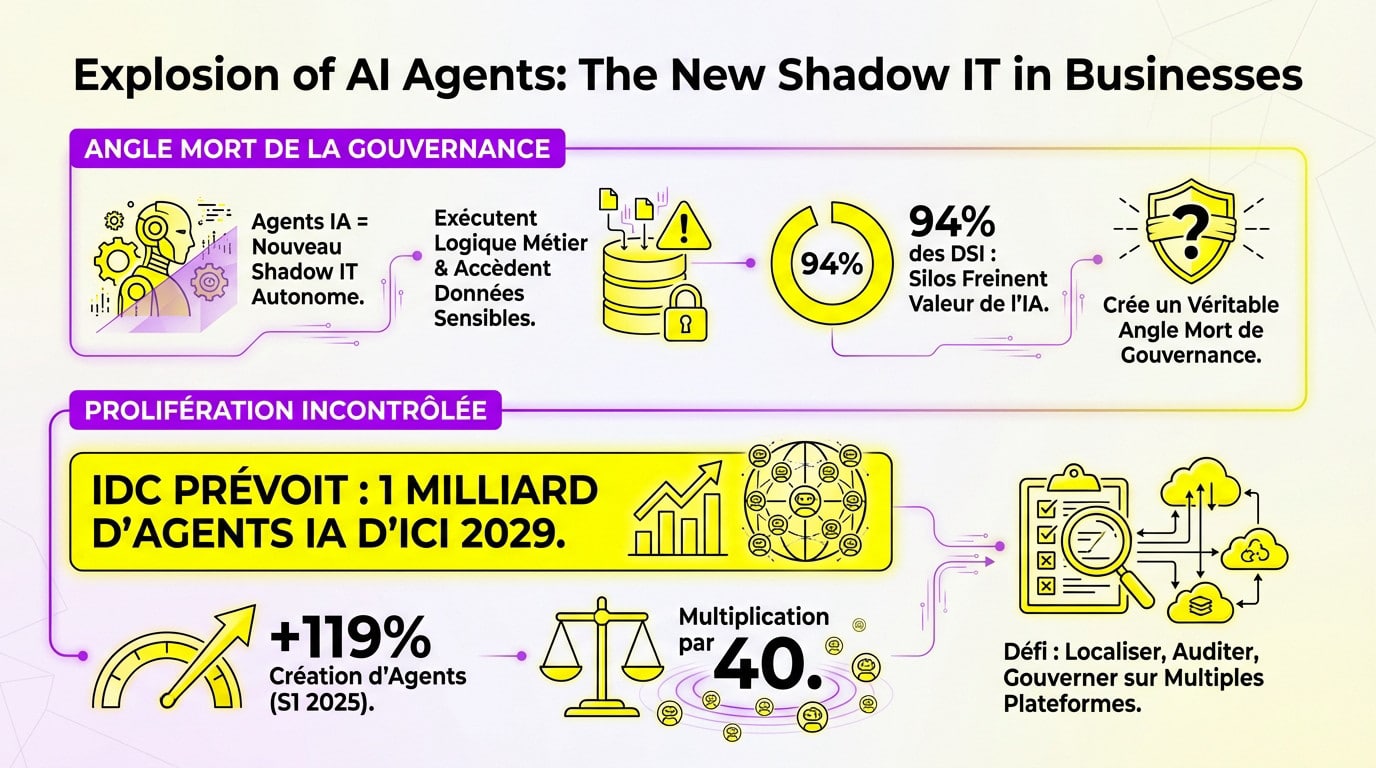
Enterprise networks are now saturated with AI agents. It’s comparable to ‘shadow IT,’ but with a major difference: these new players are autonomous. They don’t just exist; they execute business logic on their own.
The problem is significantly exacerbated by the issue of access. These autonomous agents freely access sensitive data without adequate supervision. This is a huge risk, especially since 94% of IT managers view data silos as a major impediment to AI’s value.
This uncontrolled proliferation creates a significant governance blind spot for CIOs. This is the hidden challenge behind this AI agent concept.
A Proliferation Beyond Comprehension
IDC’s forecast figures are staggering and reveal the scale of the phenomenon. According to their analyses, the number of deployed AI agents will exceed one billion by 2029.
The acceleration is dramatic: a +119% increase in agent creation is expected as early as the first half of 2025. A 40-fold increase that radically changes the game.
IDC predicts that the number of deployed AI agents will exceed one billion by 2029, a 40-fold increase, creating an unprecedented management challenge for businesses.
The challenge for leaders is no longer just to create, but to locate, audit, and govern these agents across a multitude of platforms. A centralized management […] then becomes an absolute necessity.
MuleSoft Agent Fabric: How to Regain Control of Your Agent Fleet
Faced with this impending chaos, the first step is not to restrict everything, but to see everything. This is where Salesforce intervenes with a methodical approach.
Discover and Map the Existing Landscape
Salesforce applies API rigor to AI with MuleSoft Agent Fabric. It’s the pragmatic solution to transform an agent jungle into an organized network.
The secret lies in “Discovery.” ‘Agent Scanners’ continuously monitor your key ecosystems (Salesforce Agentforce, Amazon Bedrock, Google Vertex AI) to identify every active agent.
These scanners don’t just observe; they extract vital metadata, such as the LLMs used and data access, to centralize everything.
Visualize to Better Govern (and Save)
Once inventoried, it’s time for observation. The MuleSoft Agent Visualizer provides an essential bird’s-eye view of your fleet, moving from blindness to surgical clarity.
A banking CISO can thus instantly verify if their loan agent is properly accessing financial databases. It’s concrete and immediate.
The 4 Fundamental Capabilities of MuleSoft Agent Fabric:
- Discover: Catalog all agents in a central registry.
- Orchestrate: Coordinate workflows between agents.
- Govern: Apply strict security policies.
- Observe: Gain real-time insights into collaborations.
Let’s talk money. The visualizer identifies duplicates, allowing for the merging of redundant agents. It’s the perfect lever to reduce costs and control your Total Cost of Ownership (TCO).
Governance at the Core: Security and Compliance for All
Once you know what you have, how do you ensure that everyone plays by the rules?
A Unified Framework with MuleSoft Agent Governance
With the “Govern” pillar of MuleSoft Agent Fabric, MuleSoft Agent Governance becomes the sheriff of your infrastructure. This strict policy framework ensures that each agent operates responsibly and securely, aligning your bots with business objectives.
The application of rules, especially for Personally Identifiable Information (PII), must be uniform everywhere. It’s vital to master the Essentials of Conversational Agents and avoid vulnerabilities in a vast network.
Flex Gateway: The Guardian of Your Interactions
This is where MuleSoft Flex Gateway comes in. This component locks down your architecture’s interactions, leveraging MuleSoft’s historical expertise in API management to leave nothing to chance.
It natively supports Agent-to-Agent (A2A) and Model Context Protocol (MCP). It’s through these channels that policies apply to each exchange, transforming potential chaos into strict order.
| Policy | Objective |
|---|---|
| Schema Validation | Ensures requests adhere to the expected format. |
| PII Detection | Identifies and masks sensitive data. |
| Spike Protection | Protects services from sudden overloads. |
| Rate Limiting | Controls the number of calls for performance. |
| Content Logging | Tracks interactions for auditing and troubleshooting. |
Protection is bidirectional, as an agent can be both client and server. This approach offers total activity monitoring for auditing. You know exactly who is doing what.
Towards a Coherent and High-Performing Agent-Driven Enterprise
From Isolated Agent to Orchestrated Network
It’s not just about control; it’s about pure coordination. Rather than being subjected to isolated tools, MuleSoft Agent Fabric allows for coordinating complex multi-agent workflows. The tour de force lies in its ability to make any API “agent-ready” seamlessly.
Flexibility changes the game. The platform integrates your ‘homegrown’ agents and MCP servers via a simple URL. Result: they become instantly discoverable and reusable across the entire network, finally breaking down silos.
Future success will not depend on the individual intelligence of each agent, but on the coherence and synergy of the entire enterprise agent network.
The Paradigm Shift for CIOs
Transitioning to an ‘agent-driven enterprise’ requires much more than a new tool: it’s a radical shift in leadership mindset.
Three Key Actions for IT Leaders:
- Assume their agent inventory is incomplete and deploy automated scanning tools.
- Require all agents to expose their capabilities and privileges in a standardized format like A2A.
- Use visibility to audit spending, identify duplicates, and merge them to control costs.
CIOs must step out of their ivory towers. They must actively hunt for agents, enforce standardization, and leverage this visibility for a tight financial audit.
As Jonathan Harvey of Capita and Brad Ringer of AT&T emphasize, the stakes are clear. Making agents discoverable and reusable is imperative to build a coherent ecosystem and avoid chaos.
The Wild West era of AI agents is coming to an end. With MuleSoft Agent Fabric, you no longer suffer this digital invasion: you lead it. By transforming these free agents into a cohesive and secure team, you finally regain control. It’s certainly better when everyone plays from the same sheet music, isn’t it?