What to remember: McKinsey’s recruitment process now includes a test requiring candidates to collaborate directly with an AI tool. This evaluation prioritizes critical thinking and prompt engineering over simple answers, proving that the modern consultant’s value lies in challenging and contextualizing machine outputs to achieve true human-AI “Superagency.”

Think mastering the classic case interview is still your golden ticket? The new mckinsey chatbot recruitment process now challenges candidates to partner directly with an AI during assessments. Here is why your ability to prompt a bot might soon outweigh your mental math.
McKinsey’s new recruitment test: a conversation with an AI
You might think you know the case study interview, but the rules just changed. McKinsey is now testing how your brain interfaces with their digital one.
More than just a chatbot interview
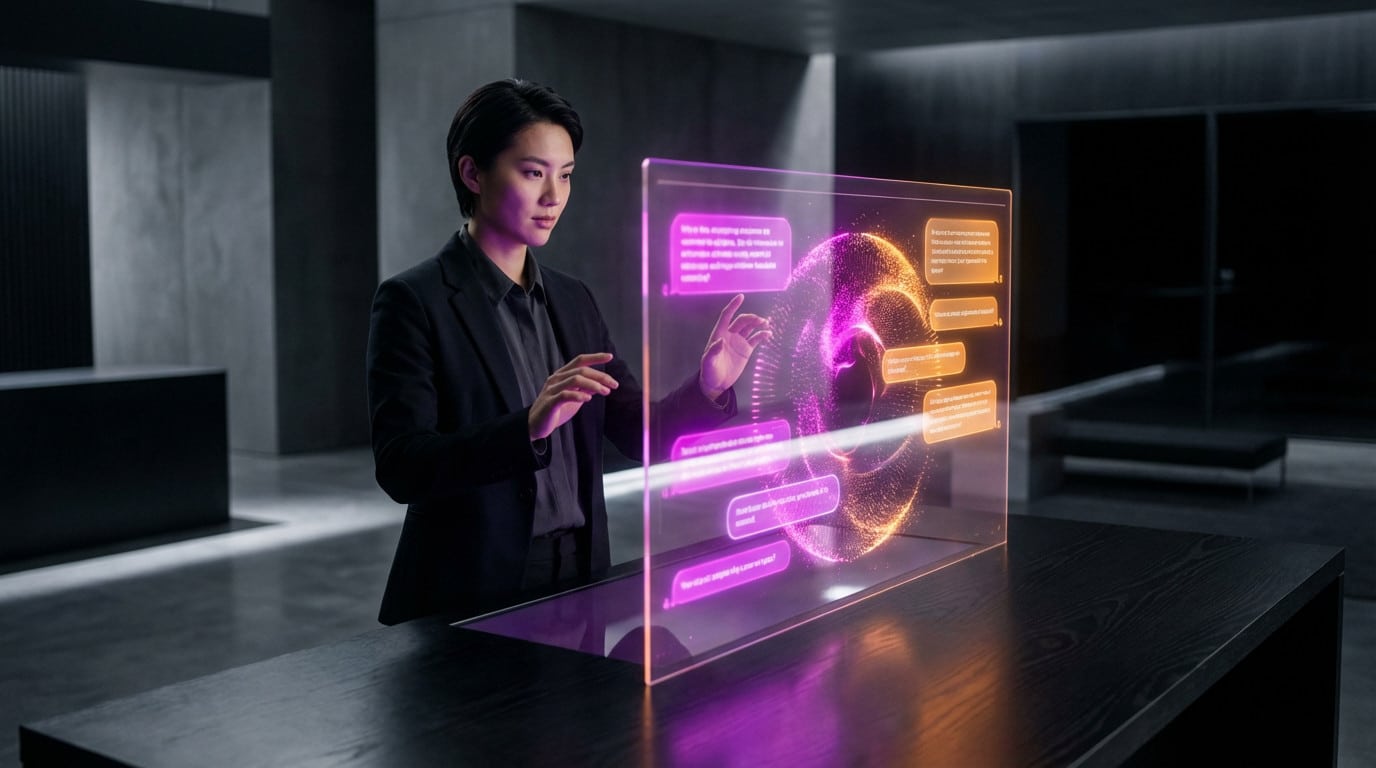
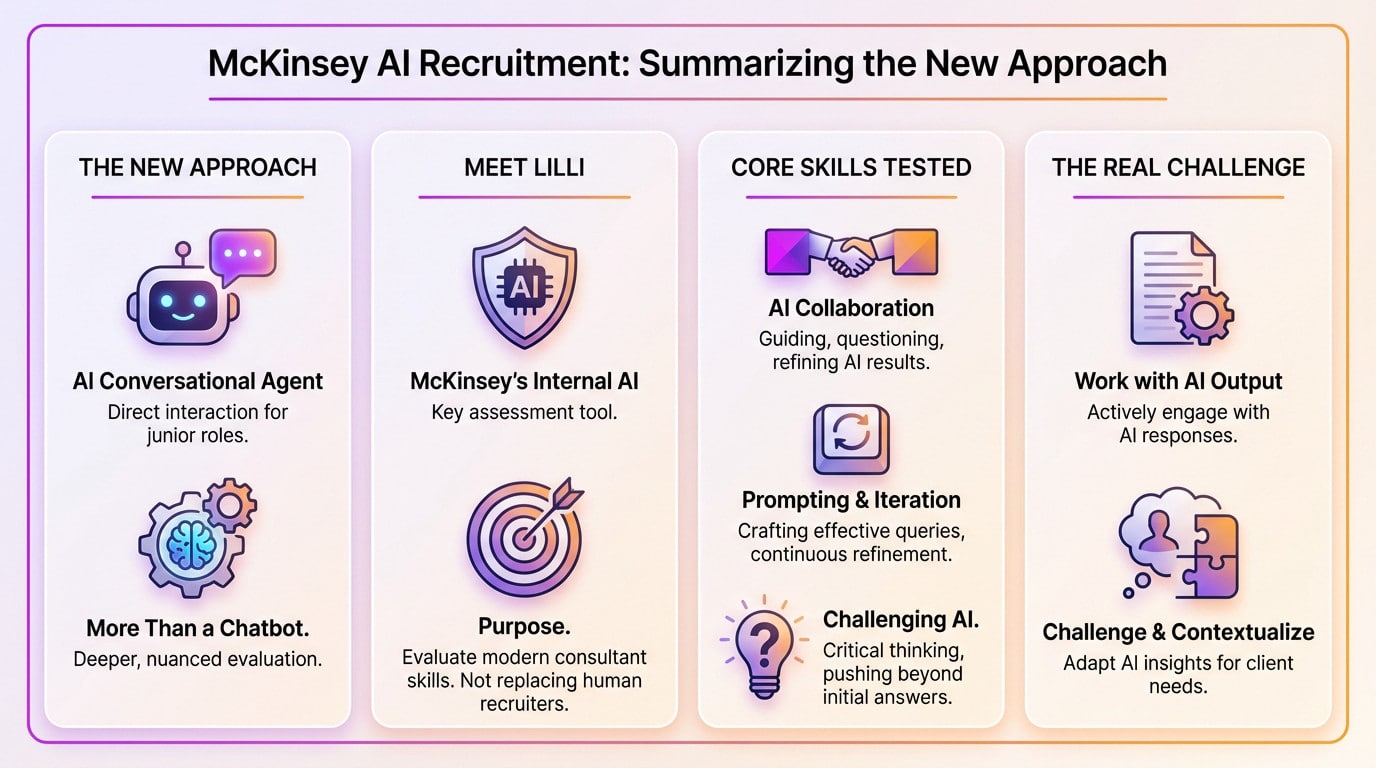
Forget awkward, one-way video recordings. McKinsey is throwing candidates into a live interaction with a generative AI agent, demanding real-time engagement.
The test centers on Lilli, their proprietary platform. It’s not about replacing recruiters, but adding an evaluation layer that mirrors a modern consultant’s toolkit to filter for tech-literate talent.
It’s fundamentally a collaboration test. The AI’s answer matters less than what you build on top of it.
What are they actually testing?
The core assessment is your ability to co-pilot. Recruiters watch how you guide the machine and refine results until they offer genuine value.
It boils down to prompting. McKinsey wants to see if you can construct specific questions to extract useful insights, or if you settle for generic noise.
The killer skill is challenging the algorithm. You cannot accept the first response as gospel; you must apply critical judgment to push the tool further.
The real challenge for candidates is to take what the AI spits out and actively work with it, challenge it, and contextualize it for a client’s specific needs.
Why McKinsey is betting on AI-savvy graduates
This isn’t just a tech gimmick. It is a fundamental shift. By challenging grads to leverage tools like the McKinsey chatbot recruitment initiative, the firm is drawing a clear line in the sand regarding top-tier candidates.
Aligning recruitment with the future of work
This move mirrors their “Superagency” concept—where human talent amplifies AI. They are finally practicing what they preach. For a consultant in 2026, AI mastery is a baseline requirement, just like data analysis. It is not optional; you adapt or fall behind. Ultimately, this future-proofs their talent pool with people who naturally work alongside machines.
Efficiency is just a side benefit
While AI suggests speed, the real driver is quality of talent selection. Efficiency is just a bonus. The goal is pinpointing candidates with the right cognitive skills for an AI-driven world—minds that amplify algorithms, not just operate them. It filters for a specific mindset:
- Critical judgment over raw data
- Intellectual curiosity to explore beyond the AI’s first answer
- Prompt engineering and iterative questioning
- Ability to contextualize AI output for business problems
The New Rules of the Game for Aspiring Consultants
But what does this mean concretely? The rules have changed.
Beyond the Perfect Resume: Demonstrating ‘AI Fluency’
McKinsey draws a sharp line regarding mckinsey chatbot recruitment. Polishing a CV with AI is smart; faking real-time answers is forbidden. This test formalizes that boundary.
The focus isn’t just knowledge, but how you handle technology. You must remain the “human in the loop,” challenging data rather than blindly accepting it.
Prove you are the pilot, not a passenger. That’s the modern consulting standard.
Can a Chatbot Really Measure Human Judgment?
Can a machine evaluate nuance or ethics? It seems paradoxical to trust software with human judgment.
Yet, the system tracks behaviors, not just answers. It watches if you reject bad AI suggestions and synthesize scattered data into logic.
It’s an indirect metric for the soft skills that truly drive success.
| Evaluation Method | Traditional Case Interview | New AI Collaboration Test |
|---|---|---|
| Primary Skill Tested | Problem Structuring & Analytics | Human-AI Interaction & Judgment |
| Candidate’s Role | Solve defined problem | Guide AI exploration |
| Key Success Factor | Logical reasoning | Critical thinking & refinement |
| What it reveals | Analysis execution | Ability to amplify analysis with tech |
A Sign of Things to Come for Professional Services
McKinsey is rarely the only one to take such a step. It is likely a warning sign for the entire consulting and professional services industry.
Setting a New Industry Standard?
When a giant moves, competitors watch. This mckinsey chatbot recruitment shift likely signals broader changes at firms like BCG. The focus on human-AI collaboration is now a key differentiator. Companies need staff capable of bringing value with tools, not just raw intellect. Law and finance face similar transformations.
The future of professional work isn’t about humans versus machines, but about creating a ‘Superagency’ where human expertise is amplified, not replaced, by intelligent systems.
The Rise of Accessible and Specialized AI Tools
McKinsey uses its proprietary Lilli, but a wider ecosystem fuels this trend. Platforms like Nation AI are emerging to offer powerful capabilities via a simplified interface, making tech accessible to everyone. This changes who can play the game.
Consequently, expecting graduates to possess AI skills is the new norm.
- AI literacy is now a non-negotiable skill.
- Demonstrating critical thinking alongside tech is paramount.
- Experience with tools like Nation AI becomes a resume asset.
McKinsey’s pivot confirms that the future belongs to those who can amplify their expertise with AI. Whether mastering internal bots or accessible tools like Nation AI, the goal is true “Superagency.” So, start polishing those prompting skills—your future robot colleague is waiting, and it definitely needs a smart human to lead the way.