Key takeaway: The unprecedented alliance between the Gates Foundation and OpenAI promises to revolutionize health in Africa with the Horizon1000 project. With $50 million, this initiative will equip 1,000 clinics with AI tools by 2028, starting with Rwanda. The goal is vital: to relieve caregivers of administrative tasks so they can focus on human care.

With a staff shortage so critical it threatens decades of medical progress, the Horizon1000 artificial intelligence health Africa initiative presents itself as an unexpected lifeline for the continent. Driven by the unprecedented alliance between the Gates Foundation and OpenAI, this pilot project in Rwanda does not aim to replace doctors, but to offer them a digital assistant capable of absorbing administrative overload. Let’s see how this $50 million “virtual colleague” plans to concretely save lives, without ignoring the technical challenges it faces on the ground.
Horizon1000: An Alliance for Health in Africa
A Partnership for Primary Care
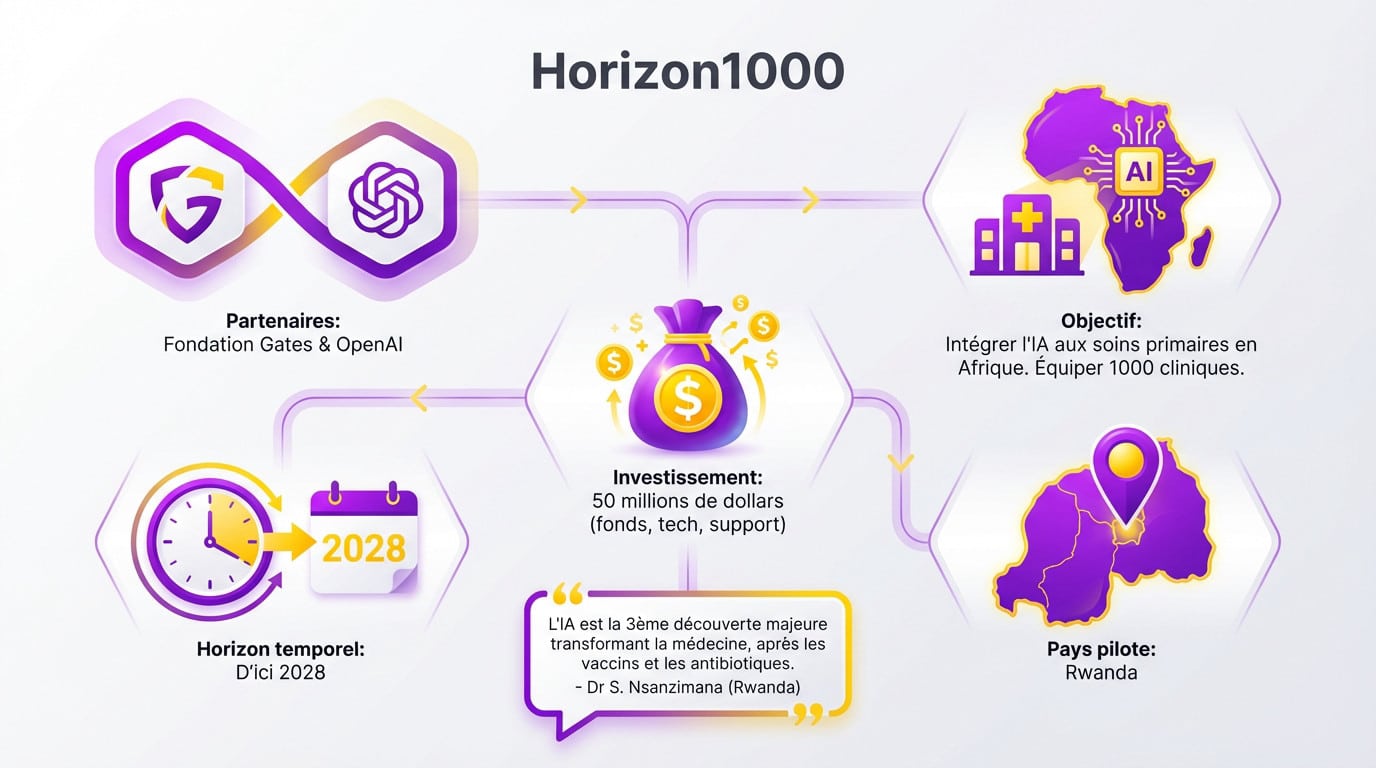
This is a bold move. The Horizon1000 initiative seals a strong pact between the Gates Foundation and OpenAI. The idea? To integrate artificial intelligence into primary healthcare systems in Sub-Saharan Africa to finally expand access to quality care.
They don’t do things by halves. The financial commitment amounts to $50 million, covering funds, technology, and technical support. All of this is done hand-in-hand with African leaders, not solo.
AI is the third major discovery transforming medicine, after vaccines and antibiotics, according to Rwanda’s Minister of Health, Dr. Sabin Nsanzimana.
Key figures of the project
The plan shows a rare ambition for the Horizon1000 artificial intelligence health Africa program. The ultimate goal is to equip 1,000 clinics and the communities around them with these new tools, thus avoiding a technological gap.
| Main Partners | Bill & Melinda Gates Foundation, OpenAI |
| Objective | Equip 1,000 primary care clinics |
| Time Horizon | By 2028 |
| Pilot Country | Rwanda |
| Investment | $50 million (funds, technology, support) |
Why now? The urgency of a healthcare system under pressure
A critical staff shortage
The central problem is this chronic lack of manpower that paralyzes everything. We are talking about a frightening deficit of nearly six million workers in Sub-Saharan Africa. Simply put, this shortage threatens to erase twenty-five years of health progress.
Look at Rwanda: barely one professional per 1,000 inhabitants, far from WHO standards. At this snail’s pace, it would take 180 years to catch up. You read that right, almost two centuries.
The result? Overwhelmed teams and degraded care causing millions of preventable deaths.
Double whammy: less aid and more needs
As if that weren’t enough, a 27% drop in international development aid for health hit last year. A budget cut that comes at the worst possible time.
This is the perfect storm for the Horizon1000 artificial intelligence health Africa project. Here are the facts that make the situation explosive:
- Growing pressure on health systems due to increased demand.
- A shortage of health personnel estimated at nearly 6 million people.
- A drop in international aid coinciding with the first increase in preventable child deaths this century.
AI, a colleague not a replacement: the case of Rwanda
Faced with this tense situation, artificial intelligence is not presented as a magic wand, but rather as a pragmatic reinforcement. Rwanda serves as the first testing ground.
Rwanda, an open-air digital laboratory
Why choose Rwanda to launch horizon1000 AI for Health in Africa? It’s no coincidence: the country already has a head start in digital technology and hosts an AI for health center in Kigali.
The Gates Foundation is not entering conquered territory. It collaborates closely with local health authorities to ensure that the deployment strictly aligns with national guidelines. The idea is to adapt to local realities, not the other way around.
Concrete tasks to ease daily life
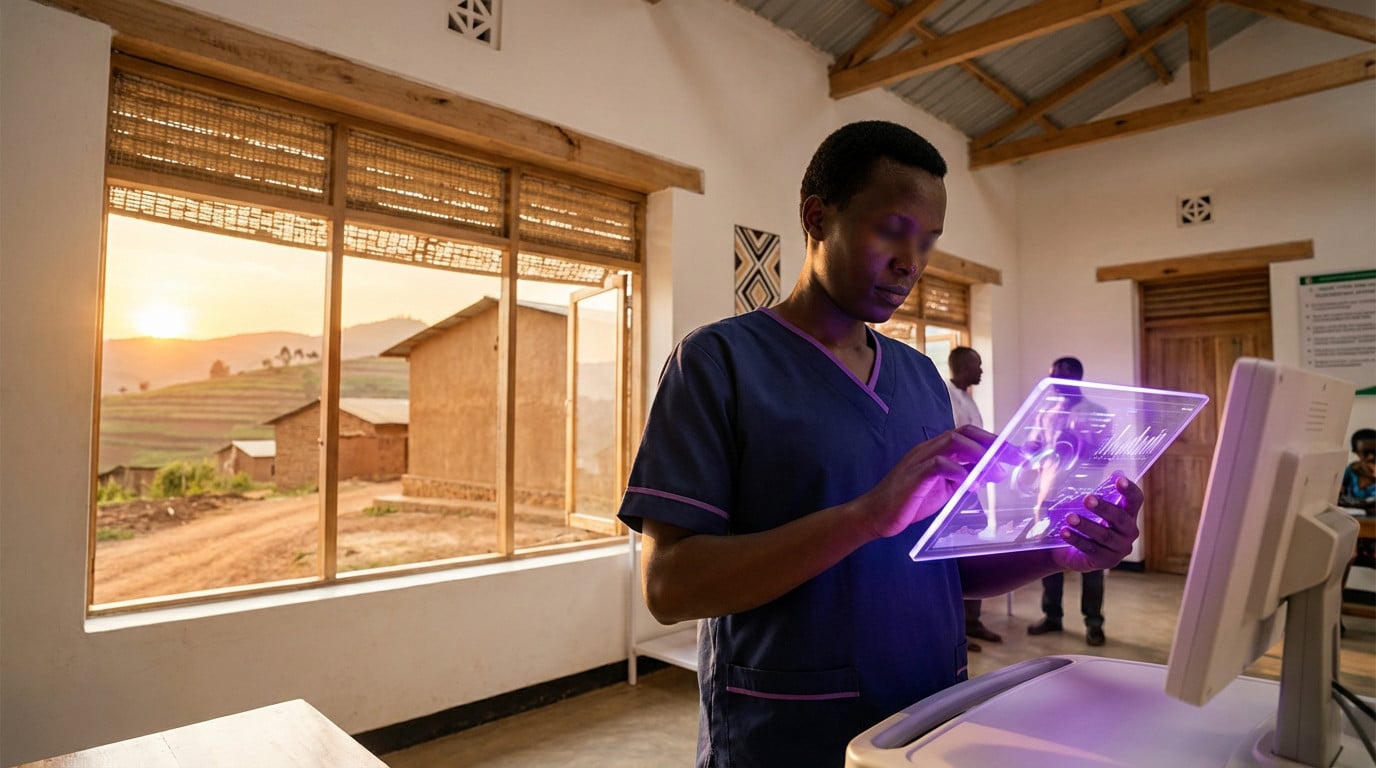
Let’s be clear: this technology is designed to support healthcare workers, certainly not to replace them. The primary goal remains to drastically reduce their administrative burden.
This frees up valuable time for patients. By delegating execution to agentic AI, consultations could become twice as fast and of better quality.
Here’s what the tool concretely manages to alleviate pressure:
- Patient reception and triage.
- Medical record keeping (transcription, summary).
- Appointment scheduling.
- Simplified access to medical advice.
Between promises and realities: Horizon1000’s challenges
But the project, however promising, is not a walk in the park. The path is fraught with very real obstacles that should not be ignored.
Technical and human prerequisites
You don’t build a robust system on sand. For the Horizon1000 artificial intelligence health Africa initiative to deliver on its promises, the technical environment must absolutely follow suit, which is far from a given.
The list of technical imperatives is clear for the project’s success:
- The absolute necessity of reliable local data to avoid bias.
- A stable power supply, often unreliable in these areas.
- Sufficient internet connectivity for cloud exchanges.
- Trained personnel capable of managing different types of artificial intelligence.
Governance and ethics, the pending questions
Beyond technology, the legal uncertainty legitimately worries observers. The governance of health data, long-term maintenance, and especially legal responsibility in case of diagnostic error remain major gray areas.
AI is positioned as temporary support to fill gaps, rather than a miracle solution or a breakthrough diagnostic technology.
In short, Horizon1000 is not a magic wand, but a breath of fresh air for caregivers. While the road is still long, the alliance between technology and humanity offers a glimmer of hope. After all, even superheroes sometimes need a virtual assistant to save the world, right?