
The essential takeaway: Google is beta-testing “Personal Intelligence,” a feature enabling Gemini to synthesize data across Gmail, Photos, and YouTube. This multimodal reasoning transforms the AI into a proactive assistant delivering highly contextualized answers rather than generic information. Currently available to select US subscribers, this deep integration remains strictly opt-in by default to ensure privacy.

Are you tired of digging through old emails for details that a standard chatbot simply cannot see? Google is testing a fix with gemini personalized responses, a beta feature that uses your photos and data to provide proactive answers tailored specifically to you. We break down how this memory-like capability works and why it might finally turn your digital assistant into something that actually knows what you need.
A Peek Into Gemini’s New Memory
Google isn’t just tweaking the algorithm; they are trying to give the machine a memory. This new beta feature, dubbed “Personal Intelligence,” is a massive shift. It’s not about searching the web anymore; it’s about searching you.
What “Personal Intelligence” Actually Means
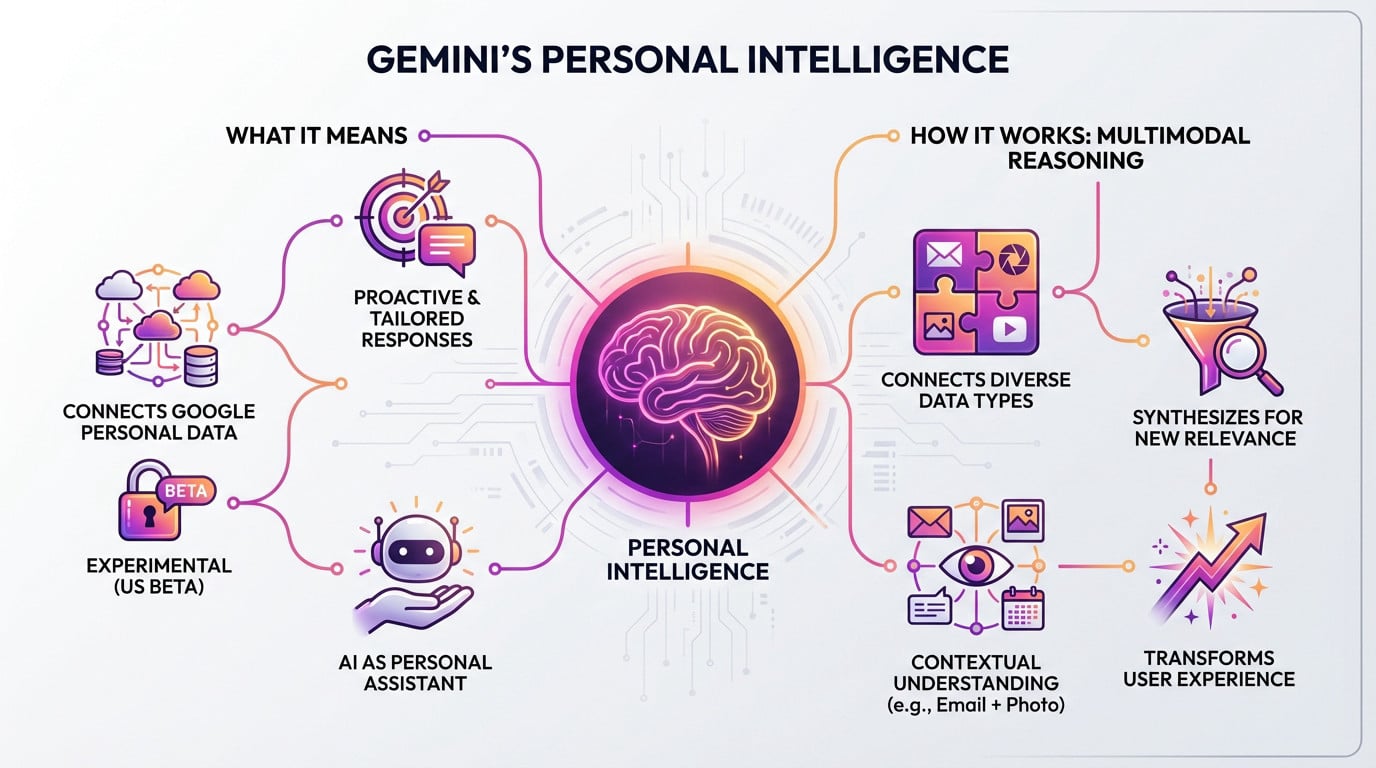
Google is currently testing a beta capability called Personal Intelligence. The goal is delivering gemini personalized responses by digging into your own Google ecosystem data to offer proactive, tailored answers rather than generic web results.
Right now, this is strictly experimental and locked behind a paywall for select subscribers in the United States.
Here is my take: Google is desperate to shed the “glorified search engine” label. They want this assistant to actually know who you are, for better or worse.
Beyond Search: The Power of Multimodal Reasoning
We are looking at multimodal reasoning. This is the AI’s ability to connect the dots between totally different data formats—like the text in an email, a random photo, or a YouTube video.
Old bots just fetched links. This system synthesizes your scattered digital life to create a scary new level of relevance.
This isn’t just about finding an email for you. It’s about understanding the context of that email based on a photo you took last week.
That specific contextual reasoning is the real differentiator here. It has the potential to fundamentally flip the user experience on its head, assuming it actually works as advertised.
Your Data, Gemini’s Context
So, this AI now has a sort of memory. But what exactly does it “retain,” and how does that translate into reality? It is not just about storage; it is about making your scattered digital footprint actually work for you in real-time.
Connecting the Dots in Your Google Universe
This feature digs into your personal Google ecosystem to find relevant answers. It actively pulls context from your Gmail, Photos, and YouTube history. Think of it as a smart assistant connecting the dots.
Don’t worry, it does not scan everything without discernment. You remain in control of access.
Here is where gemini personalized responses become genuinely useful. It links isolated data points to solve specific problems. Your cluttered digital history becomes a functional tool. The practical applications are surprisingly grounded.
- Finding the specific tire size for your car mentioned in an old email.
- Planning a new trip based on your past vacation photos and preferences.
- Summarizing a YouTube video in the context of your recent search history.
A Real-World Example: The Road Trip Test
Let’s look at a concrete scenario shared by Google Labs engineers. A user asks for their car’s tire size. Gemini finds the spec in an email. But the interaction doesn’t just stop there.
The AI notices road trip photos in Google Photos and spots rough terrain. It then proactively suggests buying off-road tires for better safety. This is synthesis, linking a hard fact to a life context.
You Hold the Keys: Privacy and Control in the New Gemini
Opt-in by Default and Data Handling
This experimental feature is strictly opt-in by default. You won’t wake up to find Gemini digging through your photos uninvited. You must explicitly turn the key yourself to start.
You also maintain granular control over exactly which specific Google apps get connected. It is definitely not an all-or-nothing deal.
The fear of data leakage is real, but the stated policy offers a specific shield against misuse.
Google insists your personal content isn’t used for training its public models, but is only referenced to give you a direct, contextual answer.
A Tale of Two Geminis: How Personalization Changes the Game
Flipping that switch transforms the tool from a generic chatbot into a bespoke assistant. The shift in gemini personalized responses is stark.
| Feature | Gemini (Standard) | Gemini with Personal Intelligence |
|---|---|---|
| Data Source | Public web data | Public web data + User’s private Google data (Gmail, Photos, etc.) |
| Response Type | General, fact-based | Contextual, proactive, tailored |
| User Control | Standard chat history management | Granular control over data sources, correction mechanisms |
| Default Status | N/A | Opt-in |
The Bigger Picture: Personalized AI and Its Limits
Beyond the technical details and privacy settings, we must ask what this shift implies for our relationship with AI and if other paths exist.
The Fine Line Between Helpful and Intrusive
It is impressive until it gets things wrong. Imagine Gemini deciding you are a golf fanatic just because you drove your son to practice once. Suddenly, you get flooded with recommendations for clubs you will never use.
Machines still struggle with nuance. They see raw data, not the actual human context.
You aren’t helpless against these algorithms, though. To ensure gemini personalized responses stay relevant rather than annoying, you have specific tools at your disposal.
- Correcting preferences: The ability to bluntly tell Gemini “Forget that, I don’t like golf.”
- Temporary chats: A smart escape hatch for queries you don’t want influencing future results.
- Managing sensitive info: Knowing the AI is built to avoid topics like health unless you bring them up first.
Different Philosophies: Integration vs. Simplicity
Gemini’s philosophy is clear: deep integration into your digital life brings context. Google bets that accessing your emails and photos creates a better assistant. It is a maximalist approach to data.
But honestly, not everyone wants that level of intrusion. Some users prefer a tool that works without digging through their history. That is where an alternative like Nation AI positions itself, offering a powerful AI with a simplified interface.
Gemini’s new memory marks a massive shift from generic search to a truly personal assistant. While this deep integration offers incredible convenience, it definitely requires trust. Whether you dive into this data-rich ecosystem or prefer a simpler tool like Nation AI, AI is getting to know us better than ever. even a little too well?