The key point to remember: faced with exorbitant server costs, OpenAI will deploy “native” advertising in the conversations of the free version. This maneuver, targeting $25 billion in revenues, transforms the tool into a marketing medium: paid subscription will then become the only refuge to guarantee neutral information without commercial interference.

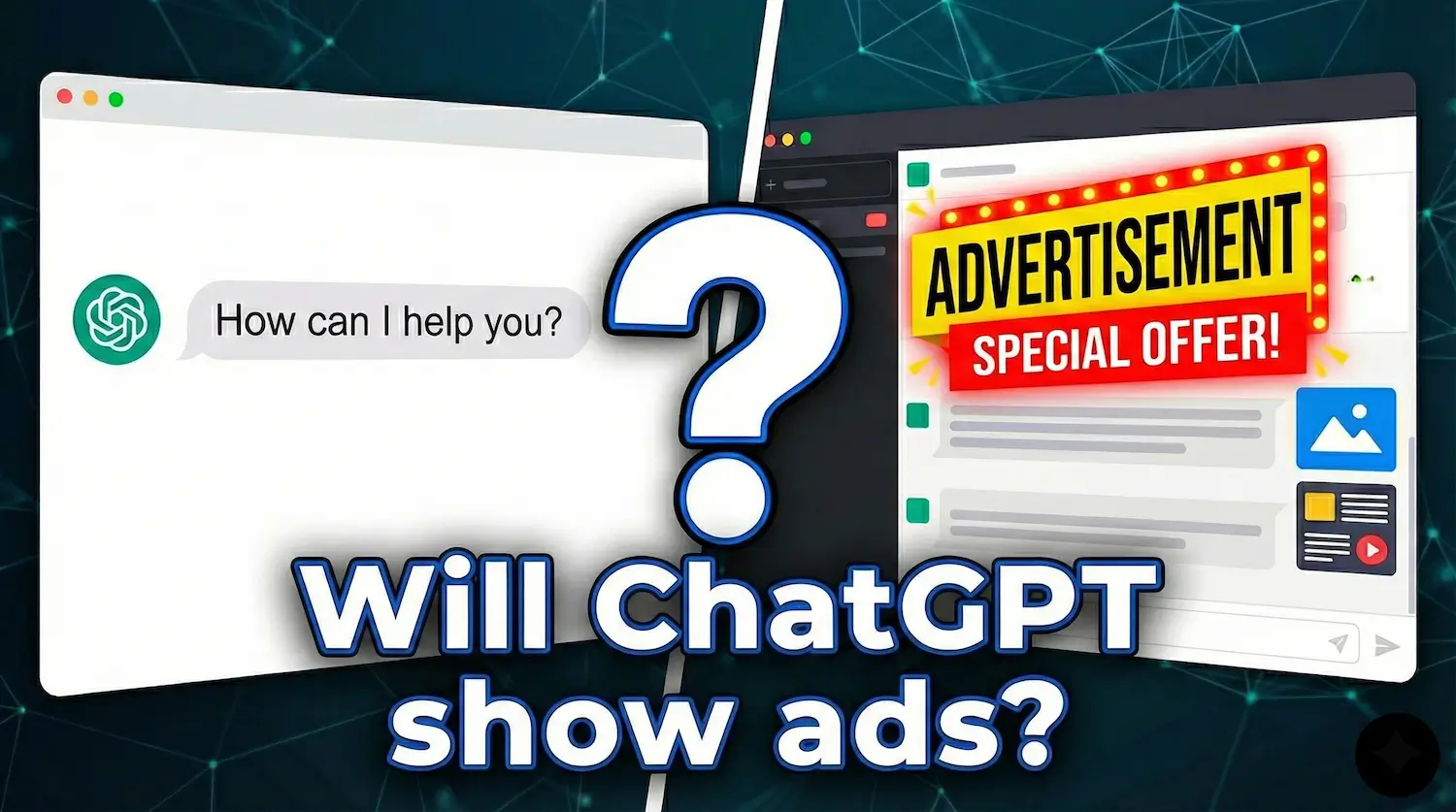
The idyll of all things free is coming to an end. Strangled by colossal costs, OpenAI has no choice but to introduce chatgpt advertising. Forget traditional banners, this strategic shift promises to radically transform your user experience. Let’s take a look at this inevitable change for the survival of the tool.
Why OpenAI is turning to advertising
Let’s talk cash. Before you get too excited, you need to understand why OpenAI, despite its billions, is forced to consider advertising. It’s mathematical.
Colossal costs force OpenAI’s hand
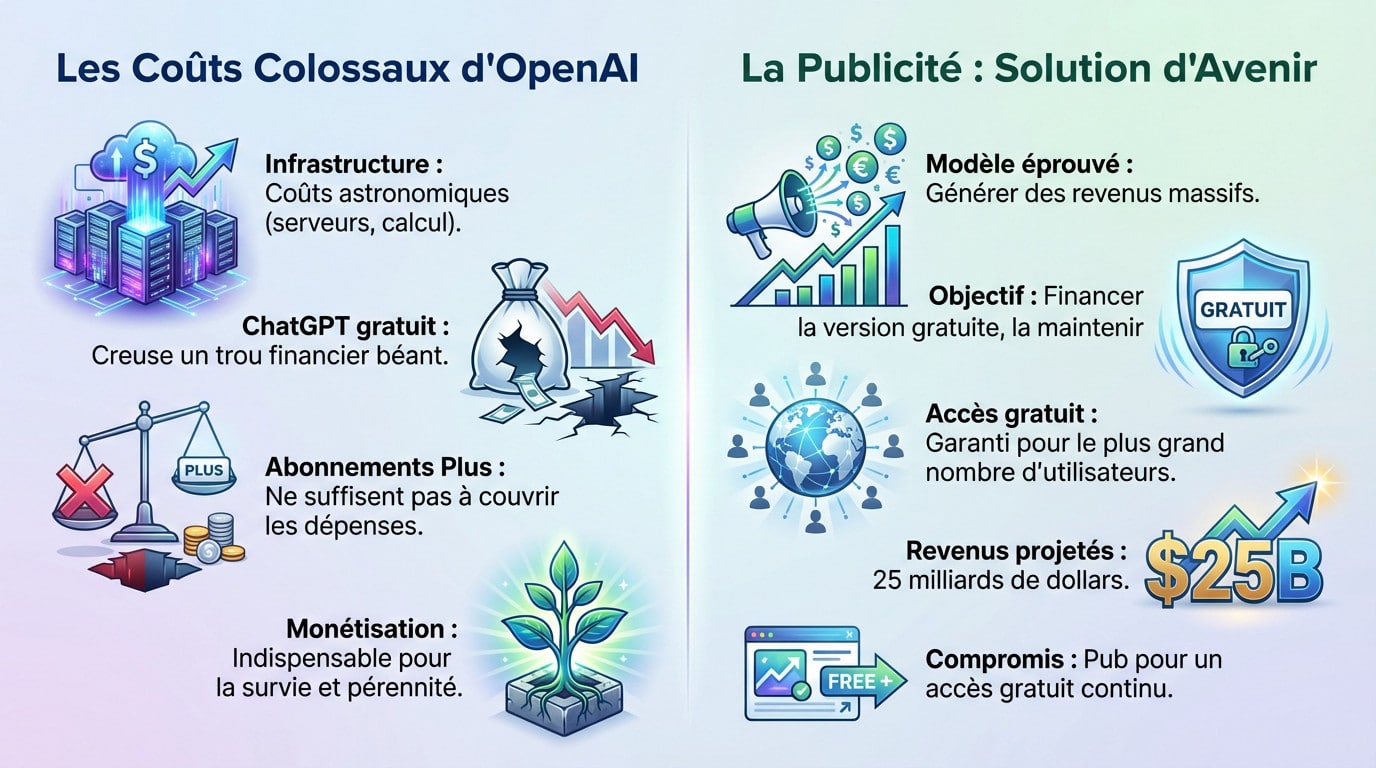
Running the beast costs a colossal fortune. Infrastructure costs, from hot servers to raw computing power, are simply astronomical. The free service, brilliant as it is, digs a gaping financial hole for the company with every query.
Don’t think that ChatGPT Plus subscriptions are enough to pay the electricity bill. The free user base is huge, and maintaining it represents a huge financial burden, far in excess of current revenues.
Maintaining an AI service of this scale for millions of free users is financially unsustainable in the long term. Monetization is not an option, it’s a necessity.
Monetization is therefore a question of survival for OpenAI, and for the long-term future of the tool we all use every day.
Advertising to ensure a future for free ChatGPT
Advertising is the most logical solution for generating massive revenues quickly. It’s a proven business model. For OpenAI, it’s the direct way to monetize its gigantic audience, with no barriers to entry.
Rest assured. The aim is not to do away with the free version, but to finance it in the long term. The integration of advertising on ChatGPT would make it possible to maintain free access for as many people as possible, while diversifying revenue sources.
In fact, revenue projections are very ambitious, reaching $25 billion within a few years. The potential is just dizzying.
In the end, it’s a compromise: a little advertising so that millions of people can continue to use the tool without paying a cent.
What will ChatGPT ads look like?
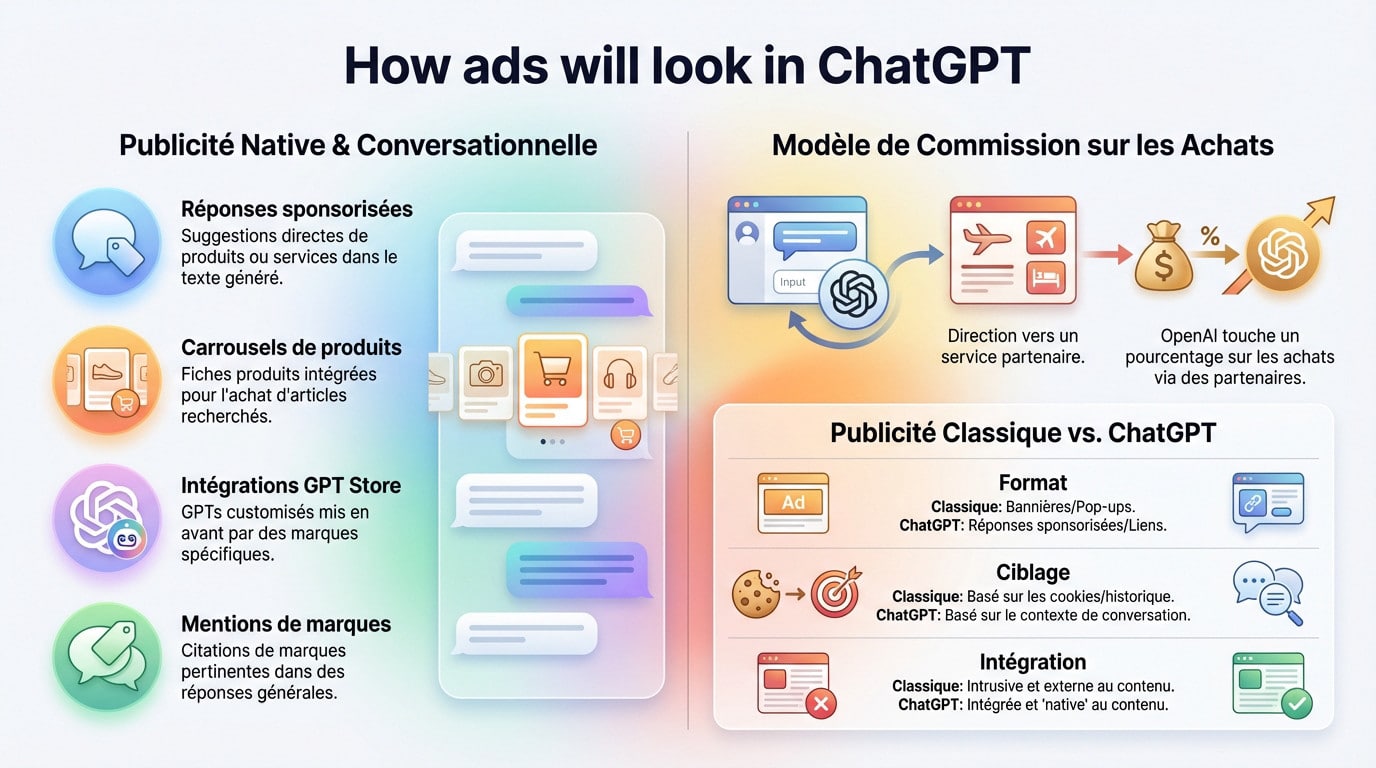
Well, now that we know why, the million-dollar question is: how? Forget everything you know about classic ads.
Native and conversational formats
No more aggressive banners flashing all over your screen. The chatgpt advertising strategy relies on natural, contextual integration directly into your conversation. The aim is to make the ad fluid, almost invisible.
Visualize the concept of“sponsored responses“. Are you asking for a cake recipe? The AI could suggest an ingredient from a partner brand, making it clear that it’s promoted content. This is contextual recommendation, not visual spam.
- Sponsored responses: Suggestions for products or services directly in the generated text.
- Product carousels: Integrated product sheets when you’re looking to buy something.
- GPT Store integrations: Custom GPTs promoted by brands.
- Brand mentions: Quotes from relevant brands in more general answers.
Towards a commission-based purchasing model
But OpenAI goes further with a powerful affiliate model. The company doesn’t just want to display ads, but also earn a commission if you buy. It’s a major economic shift for the platform.
Let’s take a concrete example to illustrate. You ask ChatGPT to help you book a hotel. It might offer you an option via a partner like Booking.com. If you book, OpenAI receives a percentage of the transaction.
| Criteria | Classic Advertising | Advertising on ChatGPT |
|---|---|---|
| Format | Banners/Pop-ups | Sponsored replies/links |
| Targeting | Cookie/history-based | Based on conversation context |
| Integration | Intrusive and external to the content | Integrated and “native” to the content |
What’s the real impact on your user experience?
All this sounds great on paper. But for us, on a day-to-day basis, what will it actually change? That’s where it gets personal.
The risk of “merdification” of the free version
We all dread that precise moment when a brilliant tool begins to decline. Experts call it the “enshittification” of web platforms. Your free version risks becoming a minefield.
Imagine asking for medical advice and seeing a promo for Advil before the scientific answer. The neutrality of information is crumbling dangerously in the face of financial imperatives. Your answers will be less direct, polluted by intrusive commercial suggestions.
It’s a delicate balance. OpenAI needs to monetize without shattering user confidence, at the risk of seeing its tool lose what is its strength: its relevance.
Will AI start “selling” us things rather than answering us honestly? This is the main ethical challenge with the arrival of chatgpt advertising.
ChatGPT Plus, the future anti-advertising refuge?
The commercial strategy seems to be well thought out. We make the free experience a little less pleasant, a little slower, to push people towards subscription. It’s a tactic as old as the Web itself.
The ChatGPT Plus subscription would then become not only access to advanced features, but above all a guarantee of an ad-free, faster and more direct experience. You pay for silence and neutrality.
It’s a classic “freemium” model taken to the extreme. The free version serves as a massive attention-grabber. The paid version offers comfort and real power.
OpenAI’s message will probably be very simple. Want the best of ChatGPT, uninterrupted? The solution is $20 a month.
How do you prepare for this new ChatGPT?
Faced with this shift, we’re not helpless. Whether you’re curious or a pro, here’s how to anticipate the tremor.
A new advertising era for companies
For advertisers, this is an incredible boon. Imagine reaching your target right when it expresses a precise need. With OpenAI’s contextual targeting, relevance reaches an unprecedented level, far removed from traditional keywords.
But don’t be fooled. You’ll have to design intelligent, useful ads that naturally enter the discussion. If it looks like spam, the user will pick it up immediately.
E-commerce and B2B players need to get their act together now. Successfully positioning your product as the logical response to AI will be a massive competitive advantage. Those who ignore this channel will lose ground.
For you, the user, the time of choice is approaching
Your vigilance needs to be stepped up a notch. You’ll need to learn to spot the nuance between an unbiased organic response and a subtle sponsored suggestion. Keep a critical eye – AI is no longer neutral.
Transparency will be the only safeguard. If OpenAI blurs the line between consulting and advertising, their credibility will collapse.
- Accept ads: Continue with the free version and keep your eyes open, because chatgpt ads will creep into your daily conversations.
- Pay for peace of mind: Take out the credit card for ChatGPT Plus to preserve a pristine, fast and commercial pollution-free experience.
- Explore alternatives: Turn to other conversational AIs like Claude or DeepSeek if OpenAI’s mercantile bent gets on your nerves.
At the end of the day, this advertising intrusion is perhaps the inevitable price to pay to keep this technology accessible to the general public while it evolves.
The arrival of advertising on ChatGPT marks a decisive turning point for generative AI. Between economic imperatives and user experience, OpenAI is taking a risky gamble. It’s up to us to decide whether to tolerate these sponsored suggestions by the fireside or pull out the bank card to keep our peace of mind. The era of absolute freeware is coming to an end.