
Key takeaway: Applied Digital begins construction of Delta Forge 1, a 300 MW AI factory designed to support the massive demand from hyperscalers. This project standardizes the critical infrastructure essential for the rise of artificial intelligence, with operations expected to begin by mid-2027 on a campus spanning over 500 acres.

Facing an energy demand that threatens to slow innovation, current infrastructures are struggling. To prevent a complete halt, Applied Digital Delta Forge 1, a 430 MW AI factory, designed to meet the market’s immense needs, is taking shape. Let’s see how this colossal site plans to secure the future of high-performance computing.
Applied Digital Launches Construction of its Delta Forge 1 AI Factory
A Monumental Project for AI
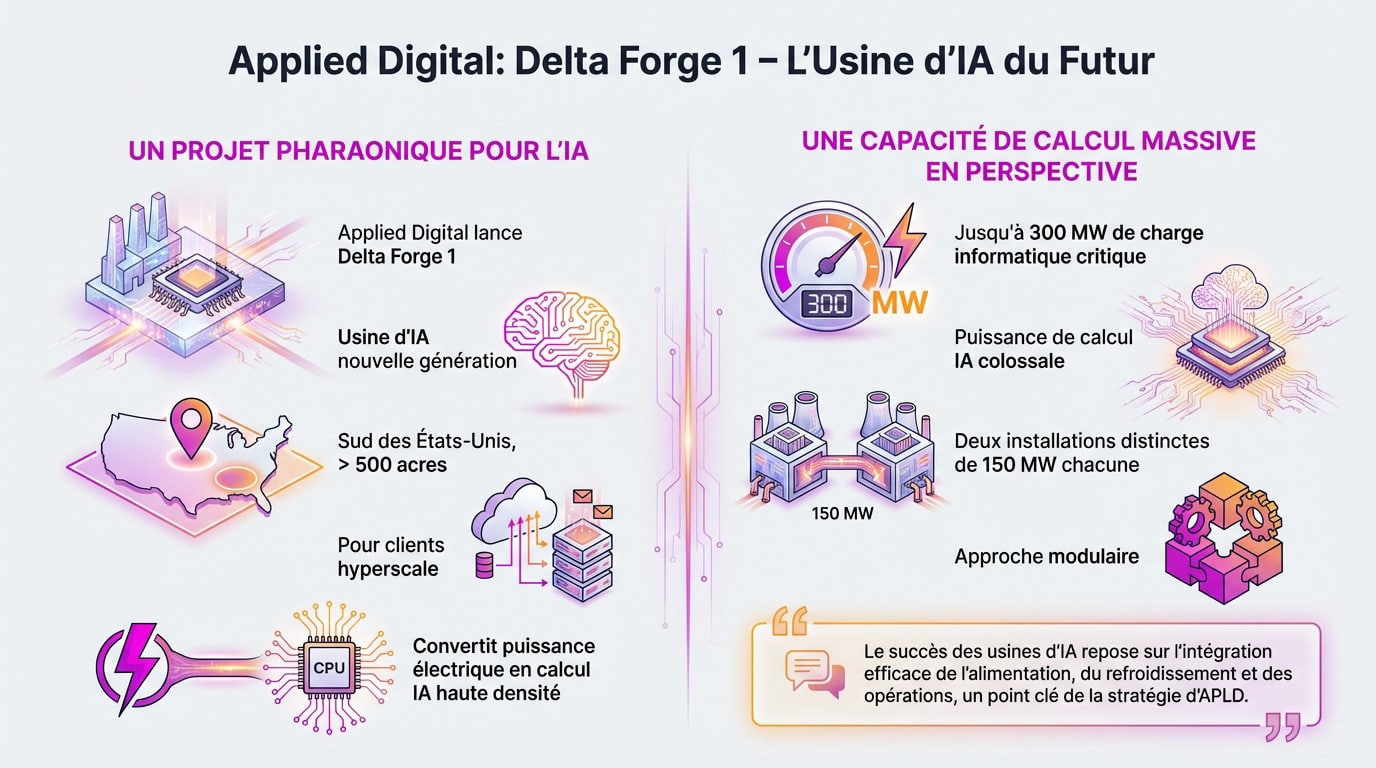
Construction of the Applied Digital Delta Forge 1 campus has just begun. It is an AI factory designed for the next decade. It is located in a Southern U.S. state. The chosen site covers over 500 acres.
This gigantic site directly targets the voracious needs of “hyperscale” clients. The goal is to transform raw electricity into ultra-high-density AI computing capacity. This is far from a traditional data center.
Massive Computing Capacity on the Horizon
The project will support up to 300 MW of critical IT load. This is colossal computing power dedicated to artificial intelligence. Can you imagine the impact on future language models?
The campus will start with two distinct 150 MW facilities. This is a smart modular approach for controlled construction.
Wes Cummins emphasizes the technical balance of the project. Success goes beyond mere brute force.
The success of AI factories relies on the efficient integration of power, cooling, and operations, a key point of APLD’s strategy.
More Than a Data Center, a ‘Blueprint’ for the Future of AI
But this project isn’t just about bricks and raw power. It’s the realization of a much broader and more thoughtful strategy.
The Standardized ‘AI Factory’ Model
This project isn’t without precedent. Applied Digital Delta Forge 1 is based on a proven proprietary plan. It’s a true technical ‘blueprint’. This model was refined at the Polaris Forge campuses in North Dakota.
The idea is to replicate this success in other markets. This method ensures rapid deployment of complex infrastructures. It’s the key asset for offering large-scale generative AI solutions without compromise.
A Clear Timeline and Ambitions
The timeline leaves no room for doubt. Initial operations will begin by mid-2027. The company is accelerating to avoid wasting any time.
To visualize the scale of the project, look at the numbers. Everything is sized for raw performance. Here’s what to remember about this behemoth under construction.
| Feature | Detail |
|---|---|
| Project | Delta Forge 1 |
| Status | Construction Underway |
| Area | Over 500 acres |
| Critical IT Capacity | Up to 300 MW |
| Start of Operations | Mid-2027 |
| Potential | Expansion Planned Starting 2028 |
Economic Impact and a Long-Term Vision
A Boost for Local Employment
We’re not just talking about cold servers sitting there, but real human opportunities. Once fully operational, the site will generate over 200 full-time jobs. It’s a breath of fresh air for the local economy.
Look at the numbers, they speak for themselves regarding regional dynamics and tangible benefits:
- Creation of over 200 permanent jobs.
- Long-term contracts for numerous subcontractors.
- Significant contribution to the regional economy.
Infrastructure: The Real Challenge for AI
Forget for a moment the complex code or the algorithms generating buzz. The real bottleneck for AI today is no longer just algorithms. It’s access to energy and physical infrastructure.
It’s a fact that industry experts now openly share:
The real race isn’t just about AI models, but about the infrastructure capable of running them at full capacity.
With the Applied Digital Delta Forge 1 project, the company is tackling this fundamental problem, a topic often discussed on the Nation AI blog.
With Delta Forge 1, Applied Digital isn’t just laying bricks, but is building the future engine of AI. This colossal 300 MW project reminds us that without robust and well-designed infrastructure, our favorite algorithms would remain stalled. See you in 2027 to watch this giant awaken!