

Key points to remember: The Paris AI Summit confirms Europe’s inordinate ambitions, securing 109 billion euros of private investment to make France an essential hub. Beyond the dizzying figures, the event outlines a two-speed global governance: Europe advocates ethics and the “common good”, while the US refusal to sign the final declaration confirms a major regulatory divide.

Are you wondering whether Europe still has a say in the face of the Silicon Valley behemoths, or whether we’re condemned to ride this technological wave without reacting? The recent ia summit held in Paris provides a scathing response to these legitimate concerns, unveiling an ambitious roadmap for sovereign and ethical artificial intelligence. Beyond the official handshakes, we take a look at the 109 billion euros of investment, the unexpected geopolitical frictions with our allies and the real societal issues that will soon define your professional and personal future.
IA Summit Paris: the facts, nothing but the facts
Want to understand what really happened without the usual jargon? Here’s what you need to know about this event that shook the capital.
The global AI event in Paris
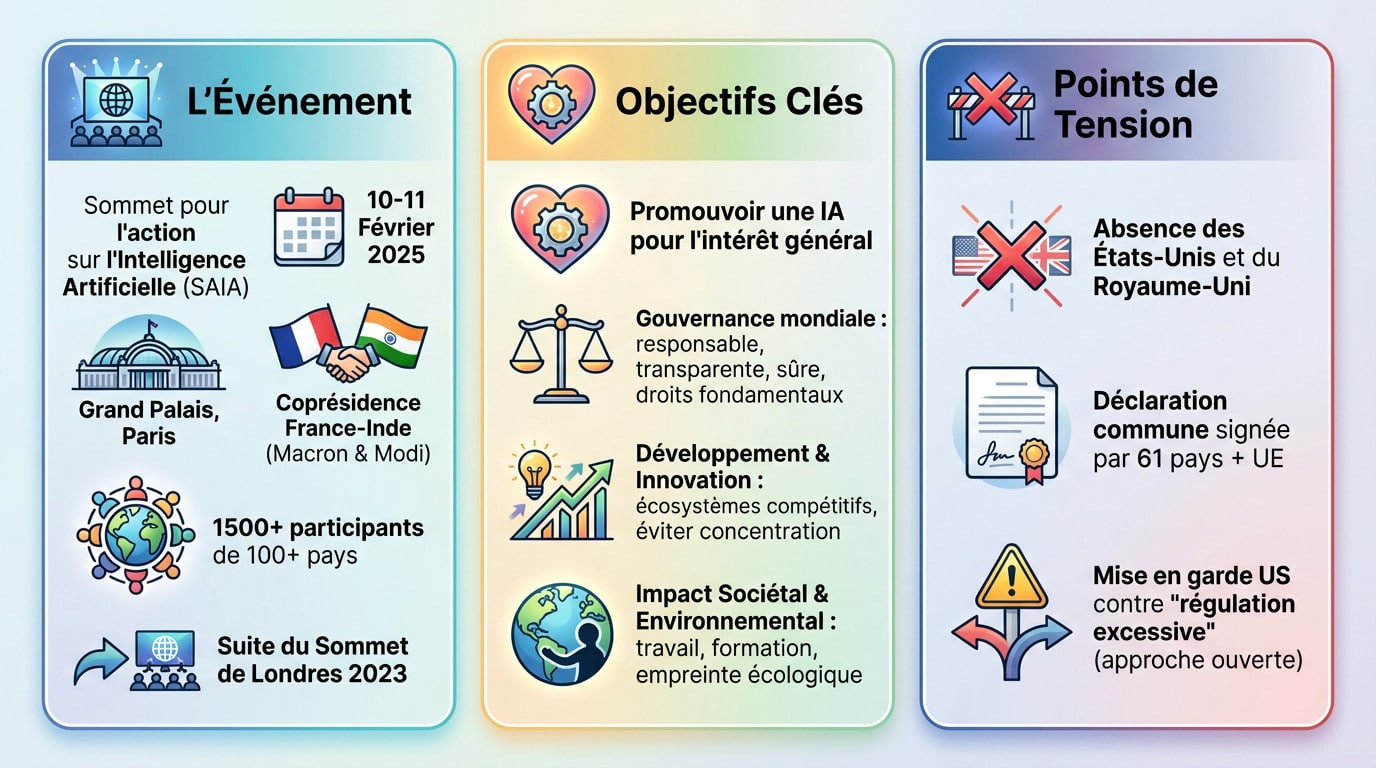
On February 10 and 11, 2025, the Grand Palais hosted the Summit for Action on Artificial Intelligence (SAIA). Paris was transformed into a technological epicenter for this major international event.
The event attracted a massive 1500 participants, including experts, decision-makers and industrialists from over 100 countries. This year’s event marked an unprecedented France-India co-presidency, led by the duo of Emmanuel Macron and Narendra Modi.
This was not an isolated event. It was a direct follow-up to the 2023 London summit on AI safety.
AI for the “common good”: the stated aim
The ambition was clear: to promote technology that serves the public interest. Discussions focused on the need for ethical and sustainable development of current models.
Discussions focused on three priorities for the digital future:
- Global AI governance: building an accountable, transparent and secure framework to protect fundamental rights.
- Development and Innovation: stimulating competitive ecosystems to prevent the market from being locked in by a few giants.
- Societal and environmental impact: anticipating the future of work, training and reducing the massive ecological footprint of AI.
The big absentees and the first tensions
However, there was no unanimity. While 61 countries and the European Union signed a joint declaration, the United States and the United Kingdom refused.
The disagreement runs deep. The US Vice President warned against excessive regulation, favoring an “open” approach to innovation, which instantly created a diplomatic rift.
Splash announcements: billions and key initiatives
Did you think this summit was just another diplomatic meeting? Think again. After two days of intense discussions, the masks have come off and the checkbooks are out to reshape the world’s technological future. The sums announced are staggering, and that’s precisely where everything hinges.
A flurry of investments in France and Europe
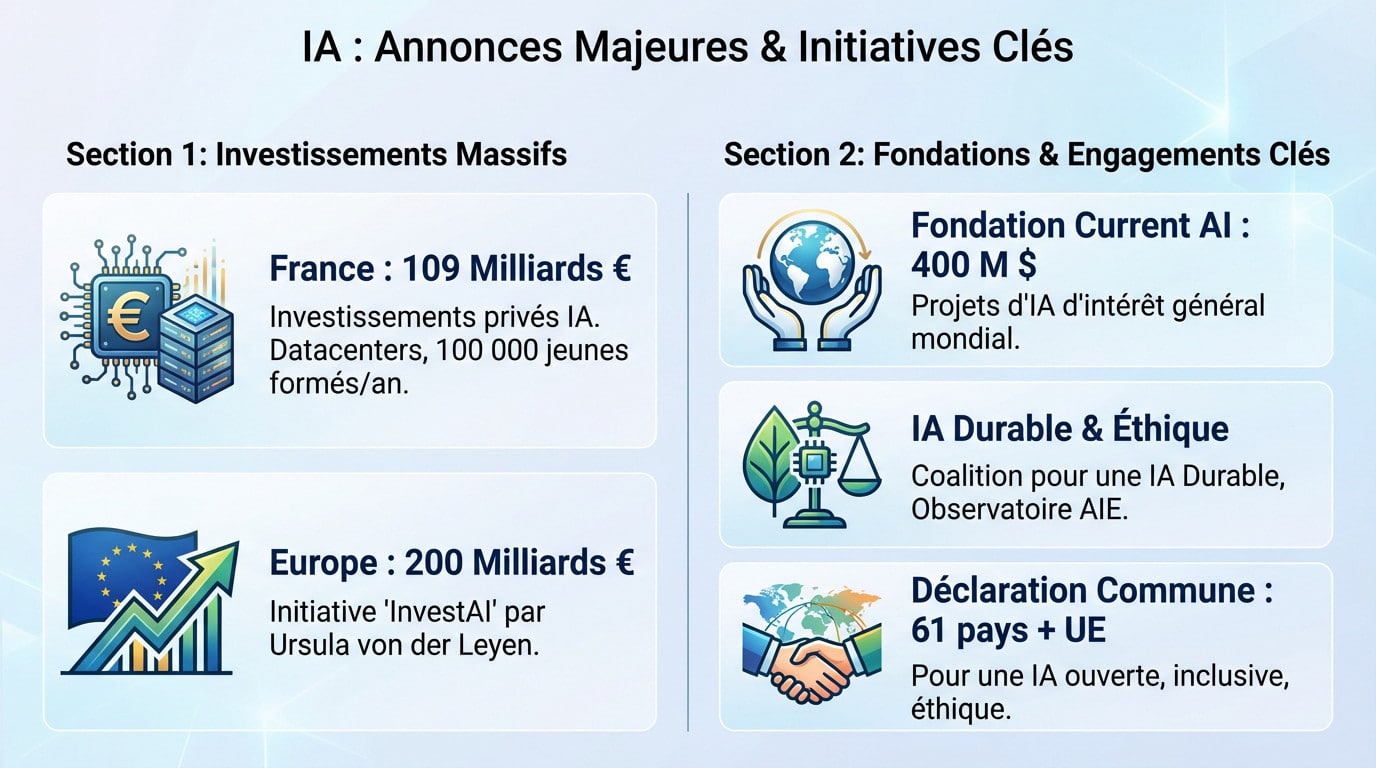
Emmanuel Macron has dropped an economic bombshell: 109 billion euros of private investment will irrigate French soil. This is not just an empty promise, but concrete capital committed by the giants of the sector to anchor technology in the country.
The money will be used to build massive infrastructures, notably energy-hungry but necessary data centers. But the gamble is also a human one: train 100,000 young people a year to prevent France from missing the technology train and suffering a critical talent shortage.
Europe is not sitting on the sidelines in the face of the superpowers. Ursula von der Leyen has launched the “InvestAI” initiative. The objective is colossal: to mobilize 200 billion euros to create an ecosystem capable of competing head-on with the United States and China.
The birth of foundations and coalitions
Beyond business, there are ethics. The summit saw the birth of
So as not to sail blindly, safeguards are finally emerging. The “Coalition for Sustainable AI” and the IEA Observatory have been set up. These structures will monitor the ecological and societal impact, as uncontrolled AI would be an environmental disaster.
Summary of summit commitments
To help you make sense of this avalanche of billions and keep you on track, here’s a quick summary of the forces at play. If you can only remember one thing, it’s this chart that sums up the new global order.
| Advertisement | Main actor | Amount / Objective | Perimeter |
|---|---|---|---|
| Private investment in AI | Emmanuel Macron (France) | 109 billion | France (datacenters, training) |
| InvestAI” initiative | Ursula von der Leyen (EU) | 200 billion | Europe |
| Current AI Foundation | International | 400 million (initial) | AI projects of general interest (worldwide) |
| National AI strategy (3rd stage) | French government | Training 100,000 young people/year | France |
| Joint declaration | 61 countries + EU | AI “open, inclusive, ethical | International |
The Franco-European strategy: regaining control of AI
France moves on to the third stage
The summit wasn’t just a showcase; it was the brutal kick-off to the third stage of its national AI strategy. It’s time to stop groping and pick up the pace.
The plan is clear: to reinforce our computing infrastructures and bring the best minds here. But above all, it’s aboutimposing trusted AI and concrete uses, far from gadgets. This is exactly the kind of breeding ground that enables champions like Mistral AI, the French artificial intelligence company, to stand up to the giants without blushing.
An “AI cern” for Europe
Europe doesn’t want to end up as a digital colony. The InvestAI initiative has come up with a radical idea: to build a veritable “CERN for AI” on the old continent.
The image is strong: everything is pooled – money, chips, talent – to finally carry weight. The aim? To create a credible alternative to the overwhelming hegemony of models such as Google Gemini.
Europe’s ambition is to create a truly sovereign ecosystem, a ‘CERN of AI’, so we don’t have to depend on foreign technologies and can control our digital destiny.
The France-India axis and the “global south
This co-presidency with India is no diplomatic fluke; it’s a coldly strategic calculation. Paris is looking for a powerful lever to reach out to the “global South” and break out of the toxic tête-à-tête between Washington and Beijing.
Narendra Modi has hammered home his message: AI must not be a luxury toy for rich nations. It must serve everyone, now, without exception.
We’re witnessing the beginnings of a third way. Neither the deregulated American Wild West, nor Chinese state surveillance. A risky gamble, but perhaps our only chance of survival.
Discordant voices: a summit under fire
But while the leaders were congratulating themselves at the Grand Palais, other, far less optimistic voices were being heard. The consensus was far from total.
A “missed opportunity” for safety experts
It’s a cold shower for part of the scientific community. Leading figures such as Yoshua Bengio and Dario Amodei have made no secret of their bitterness, judging the results to fall well short of current safety requirements.
Their findings are without appeal. They believe that the
For some of the world’s leading experts, the summit was a ‘missed opportunity’ to put in place strong safeguards against AI’s most serious risks.
Civil society counter-summits
Far from the official spotlight, resistance is being organized. In parallel, counter-summits have emerged, orchestrated by technocritical groups who refuse to let the future be decided behind closed doors.
These groups, some of them close to movements such as Pause IA, point out gaping flaws that the event tried to ignore:
- Collusion between politicians and tech lobbies, accused of dictating the agenda.
- Disastrous environmental impact (water and energy consumption in datacenters).
- The plundering of creative work and the threat to the rights of artists and authors.
- The dangers for democracy and social inequality.
The geopolitical divide is confirmed
The American attitude is not misleading. Their aggressive advocacy of “open” AI seems above all to be a categorical refusal of any regulatory constraints, leaving the field wide open for the Silicon Valley giants to impose their standards.
It’s not just a technical disagreement, it’s an ideological war. On one side, the digital Wild West; on the other, an attempt at an ethical framework. This tension explains the emergence of various alternatives to ChatGPT as competing visions.
What’s next? What are the concrete impacts of tomorrow’s AI?
AI invites itself to school and court
France’s national education system is wasting no time. From the start of the 2025 school year, France is rolling out a dedicated AI training course specifically for high school students. The idea is simple: prepare young people without delay. At the same time, “open” AI will be developed to support teachers in their day-to-day tasks.
In the courts, the machine is also getting up and running. Serious work is underway to delegate the transcription of hearings, case law research or the summarization of complex cases to algorithms. This could save an enormous amount of time for an often overburdened justice system.
The challenge of “frugal” AI
Ecology is no longer an option, it’s a survival requirement for tech. In response to criticism of its energy consumption, France is to publish a reference framework for frugal AI. The aim is clear: to accurately assess and reduce the ecological impact of models before it’s too late.
It’s a refreshing paradigm shift. It finally recognizes that raw performance can no longer be the only compass. Energy and water consumption are becoming central, even vital, issues in ensuring the long-term economic and societal viability of this technology.
Towards global governance or the balkanization of AI?
So, did this summit really bring views closer together, or simply mask the cracks? The joint declaration is undeniably a step forward. However, the conspicuous absence of the USA and the UK weighs heavily in the balance and casts serious doubt on international unity.
We are probably heading for a fragmented world with several distinct regulatory blocks. Understanding the different types of artificial intelligence will then be essential to navigate between these contradictory regulations. The dream of a single form of governance still seems a long way off. We’ll have to keep a close eye on whether tomorrow’s best artificial intelligence tools will be technically capable of adapting to all these divergent visions.
With 109 billion euros on the table, Paris has clearly pulled out all the stops. But between European ambition and the empty seat of the United States, the road to global governance still looks like a buggy code. Let’s hope that AI can learn from our mistakes and build a common future.
FAQ
What exactly is the AI Action Summit?
In a way, it was the “G20 of tech” that took place at the start of 2025. Co-chaired by France and India, this global event had a clear ambition: not just to discuss the risks, but to take concrete action. The aim was to promote artificial intelligence that serves the general interest, with an emphasis on ethics, governance and sustainable development. In short, to try and keep control of the machine before it gets out of hand.
Are there any other AI-related world summits?
Absolutely, it’s become a real diplomatic series! The Paris Summit is a direct follow-up to the London Summit of November 2023, which focused on safety and disaster scenarios (the famous “Safety Summit”).
Who attended the AI Summit in Paris?
The balcony was packed! Some 1,500 participants from over 100 countries made the trip. Heads of state included Emmanuel Macron and Indian Prime Minister Narendra Modi, as well as Ursula von der Leyen for Europe. On the tech side, Silicon Valley’s big bosses (Google, OpenAI, Anthropic) were on hand, as were renowned researchers. It was a fine family photo, even if the USA and the UK went their separate ways when it came to signing the joint declaration.
Where was the AI 2025 Action Summit held?
France has pulled out all the stops to host this event at the Grand Palais in Paris. On February 10 and 11, 2025, this emblematic venue swapped its art exhibitions for debates on algorithms and datacenters. A prestigious setting in which to attempt to define the future of our digital civilization.
Who could attend this AI summit?
Let’s be honest, it was a very “VIP” event, reserved for experts, political leaders and captains of industry by invitation. However, the organization did try to open the windows a little: an online consultation enabled 11,000 citizens to give their opinions in advance, and civil society was represented during the debates. As far as the general public was concerned, this took place mainly via webcasts and press announcements.
What was the agenda for the AI 2025 Global Summit?
The agenda was packed and, let’s face it, very expensive! The agenda revolved around three axes: governance (how to regulate without stifling), innovation (with record investment announcements, including 109 billion euros in France alone), and societal impact. There was much talk of training, “frugal” AI to protect the planet, and the creation of foundations like Current AI to fund projects of public interest.
Why are some people still afraid of AI despite the summit?
Because a summit doesn’t solve everything with a wave of a magic wand. Dissenting voices, including safety experts such as Yoshua Bengio, have described the event as amissed opportunity. They fear that the race for profits and market share will take precedence over real security in the face of existential risks. What’s more, the geopolitical divide with the United States, which refuses to accept too much regulation, casts doubt on truly effective global governance.