
The essential takeaway: AI is reshaping the workforce by automating routine tasks and dismantling the outsourcing market rather than causing immediate mass unemployment. Success now depends on becoming an “augmented worker” who leverages technology for efficiency while prioritizing human-centric soft skills. Early adopters are already saving an average of 2.2 hours per week.

Is the growing anxiety of an abrupt ai job transformation keeping you awake with visions of algorithms quietly stealing your paycheck? We bypass the usual tech hype to analyze the brutal economic engine driving this shift, revealing why the real danger isn’t mass unemployment but a silent stagnation of wages for the unprepared. You will discover why the global outsourcing market is the first casualty and exactly which “human-only” skills you must master right now to secure a premium position in this ruthless new economy.
The Real Story: Augmentation, Not Annihilation
Forget the Robot Apocalypse, Let’s Talk About Your New Coworker
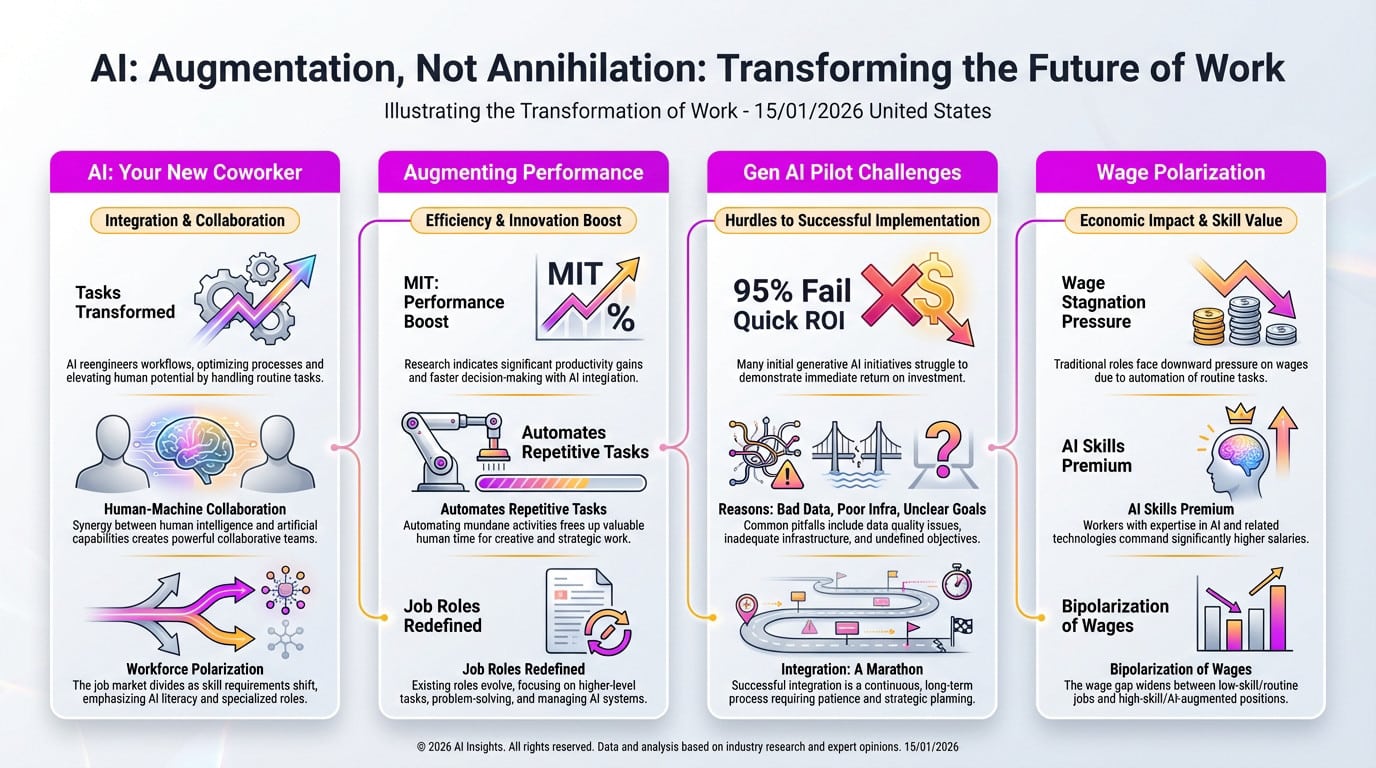
Stop worrying about a sudden, mass replacement of workers. The reality is far more subtle; we are witnessing a fundamental ai job transformation where the tasks within a role change, rather than the role disappearing entirely.
The real action happens behind the curtain, away from the sensational headlines. It isn’t about destruction; it is about how software quietly integrates into your daily grind.
This shift creates a sharp polarization in the labor market. On one side, you have high-skill roles leveraging tech; on the other, jobs relying on purely human capabilities. The future belongs to human-machine collaboration.
The Subtle Shift from Replacement to Task Redistribution
MIT analysis throws cold water on the panic: right now, AI improves performance for existing workers rather than replacing them. Think of it as a turbo boost for administrative duties or code debugging, not a pink slip.
We call this concept task augmentation. The machine takes over the repetitive, time-sinking parts of your day, freeing you up to handle the high-value work that actually requires a brain.
So, the true disruption isn’t the loss of employment, but the complete redefinition of the job description itself.
Why Most Generative AI Projects Are a Dead End (For Now)
Here is a stat that consultants hate to admit: 95% of generative AI pilot programs in enterprises fail to generate quick revenue. That number alone should calm the hysteria about an immediate takeover.
These failures happen because companies define the problem poorly, rely on messy data, or lack the necessary infrastructure. It is a chaotic mess behind the scenes.
Integrating this technology is a marathon, not a sprint. It demands far more than just a credit card and an API subscription.
The Real Fear: Not Job Loss, but Wage Stagnation
Let’s shift the debate from unemployment to your paycheck. If software can handle half your workload, the market value of those specific tasks drops, which puts serious pressure on overall compensation.
However, there is a distinct wage premium for AI skills emerging. Those who master the tool see their market value skyrocket, leaving their non-technical peers in the dust.
The threat isn’t mass unemployment, but a growing wage bipolarization between the augmented workforce and everyone else.
The Economic Engine Driving the Shift
It’s Always About the Bottom Line
Let’s be real. Companies aren’t diving into this ai job transformation for the cool factor. It’s the math. The cost of running an algorithm is drastically lower than paying a salary for specific tasks. Then there is the uptime factor. An AI works 24/7—no sleep, no burnout, and definitely no coffee breaks. It just keeps churning.
- Cost: A fraction of the price compared to human wages.
- Productivity: Zero downtime, unlike biological staff.
- Scalability: Instant capacity expansion without the HR nightmare.
The Outsourcing Market Is the First Casualty
The axe doesn’t fall on the HQ staff first. It swings at outsourced and offshored workers. Why? It is low-hanging fruit with minimal social blowback. We see it hitting hard in software engineering, customer service, and admin tasks—the backbone of the gig economy. Tech leaders are saying the quiet part out loud: AI is already better than outsourced programmers. When the machine codes cleaner and faster than the offshore team, the contract doesn’t get renewed. It’s harsh, but it’s happening.
The Duolingo Case: A Textbook Example
Look at Duolingo. This isn’t theoretical. They openly replaced contract workers with AI to generate content. The CEO called it one of their best decisions. The result? A massive spike in efficiency that coincided with a sharp revenue increase. You see the pattern? By slashing operational costs through automation, they didn’t just survive; they thrived. It is a signal to every other board of directors: cutting humans boosts the margins.
The Prediction: Death of the BPO Market in 2025?
Here is the scary part. Some experts are predicting the complete destruction of the outsourcing market (BPO) by 2025.
“The Business Process Outsourcing (BPO) market is going to be completely destroyed in 2025. It’s a brutal but necessary evolution driven by pure economic logic.”
If this holds true, we aren’t talking about a few layoffs. We are staring at the displacement of millions of jobs, particularly in Asia and Eastern Europe. This isn’t sci-fi fear-mongering; the tech is ready to dismantle these roles today.
Who’s Really on the Chopping Block? A Closer Look
We have seen the cold economic rationale, but let’s peel back the layers to see the actual victims and survivors of this first wave. Who is getting hit first, and why?
The 80,000 Job Cut: More Than a Statistic
The numbers for 2025 are brutal. Over 80,000 jobs were slashed in the industrial sector specifically due to AI automation, hitting outsourced roles hardest. It’s a direct hit, not a warning shot. The data is clear.
Stop thinking this is sci-fi or a distant prediction. The process is already grinding forward, often behind closed doors. Companies are quietly swapping contracts for code.
These aren’t just spreadsheet adjustments or quarterly corrections. Real people are paying the hidden price of this rapid ai job transformation.
Routine vs. Non-Routine: The Great Divide
Here is the brutal truth about job safety today. Routine and predictable tasks are sitting ducks right now. Your industry matters less than the actual stuff you do daily. If it repeats, it goes.
Middle-skill roles are taking the hardest hits in this shift. Think about basic accounting, endless data entry, or Tier 1 support. If a script can do it, a script will do it.
Conversely, the messy stuff is safe. Strategy, complex human interaction, and true creativity are becoming premium assets. The gap between “doers” and “thinkers” is widening fast. That is where the real divide lies.
A Tale of Two Workers: The Coder and The Manager
Look at a junior coder today. Writing boilerplate and debugging is now handled by an assistant Chat IA gratuit en français. They aren’t writing code anymore. They are supervising an AI that writes it for them.
Now look at a good manager. You cannot automate negotiation or motivating a burnt-out team. AI might crunch their numbers, but it cannot handle the emotional heavy lifting required.
These two paths show the stark reality. We are seeing a massive polarization of skills across the board.
The “Long Tail” of AI Risk: Looking Beyond 2025
MIT’s report offers a slight breather for the moment. Right now, the damage is mostly contained to outsourced roles. But don’t get too comfortable yet. That safety net is temporary.
The long-term forecast is much darker. Estimates suggest nearly 27% of jobs could eventually be replaced or radically altered. That is a tsunami forming just off the coast.
The question isn’t if it hits you. It is simply a matter of when and how hard.
The Rise of the Augmented Worker
We have heard enough about the losers. It is time to look at the winners, or at least the adapters: “augmented” workers turning AI into a serious performance lever.
Your New Superpower: Gaining 2.2 Hours a Week
Forget the sci-fi cyborg tropes. An augmented employee isn’t half-robot; they are simply a smart professional using tech to amplify what they already do best. It is about leverage, not replacement.
The numbers back this up. According to research involving Anthropic and the St. Louis Fed, frequent AI users save an average of 2.2 hours a week. That is a concrete, measurable chunk of life returned to you.
You don’t use that time to head to the beach. You use it to tackle the strategic work that actually moves the needle.
From Specialist to “Full-Stack” Professional
We used to stay in our lanes. Marketers didn’t code; designers didn’t write copy. AI smashes those silos. Now, a marketer generates base scripts, and a designer prompts for text.
Enter the “full-stack” professional. You can now oversee a project from A to Z, leaning on algorithms to handle the heavy lifting outside your core expertise.
This doesn’t make experts obsolete, but it gives generalists a serious edge. It fundamentally shifts team dynamics. You aren’t waiting on three different departments to ship one simple project anymore.
Killing the “Papercuts”: How AI Handles the Grunt Work
You know “papercuts.” Those soul-sucking administrative tasks—formatting docs, sorting endless emails, filling out reports—that bleed your productivity dry without adding a cent of value.
This is exactly where AI shines. It’s not about creativity here; it’s about speed. The most immediate productivity gains happen right in these messy, boring trenches of daily ops.
By cauterizing these cuts, AI frees up mental load. You stop drowning in busy work and start focusing on the work you were actually hired to do.
The New Job Landscape: Automatable vs. Human-Centric Tasks
We are witnessing a massive ai job transformation. The best way to visualize this polarization isn’t a long essay, but a clear division of labor.
| Tasks at High Risk of Automation (Tasks for AI) | Tasks Requiring Human Oversight (Tasks for Humans) |
|---|---|
| Data Processing (Data analysis, pattern recognition, data entry) | Strategic Interpretation (Defining what data means for the business, making strategic decisions) |
| Content Generation (Writing basic reports, product descriptions, social media posts) | Creative Direction & Storytelling (Defining brand voice, creating original concepts, building a narrative) |
| Routine Communication (Answering FAQs, scheduling meetings, sending reminders) | Complex Negotiation & Empathy (Closing a deal, managing a conflict, leading a team) |
| Code Generation & Debugging (Writing standard functions, finding bugs) | System Architecture & Ethical Oversight (Designing complex systems, ensuring AI is used responsibly) |
The New Currency: Skills That Command a Premium
Okay, the landscape is shifting rapidly. Concrètement, where should you actually place your bets—both time and money—to avoid ending up on the wrong side of the barrier?
Moving Up the Value Chain: From Doer to Director
The real shift here isn’t about working harder; it’s about changing your stance entirely. You are no longer the one executing the grunt work. Instead, you must become the director of the AI performing the task. It’s a radical pivot.
Your value now lies in your ability to handle supervision, curation, and validation. Knowing how to ask the machine the right question—prompt engineering—is suddenly more valuable than knowing the answer yourself.
Think of it as moving from a solo artisan to an orchestra conductor. Honestly, this transition feels unnatural for many, but it’s necessary.
The “Soft Skills” Are Now Hard Skills
We used to treat relational skills as nice-to-haves, but today they are your main differentiator. Machines can process data, yet they fail miserably at empathy. That is your edge.
You need to double down on critical thinking, complex problem solving, and genuine creativity alongside emotional intelligence. These areas remain the absolute bastions of human competence. Algorithms simply cannot replicate that level of nuance.
Ironically, these ““soft skills” are actually the new “hard skills”” of the AI economy because they resist automation.
Upskilling vs. Reskilling: What’s the Right Move?
Let’s get these definitions straight to avoid confusion. Upskilling means taking your current expertise and layering AI proficiency on top of it. You stay in your lane, just faster.
Reskilling is a different beast; it involves learning an entirely new trade because yours is vanishing. It is a much more radical, often painful, restart of your career.
Your move depends entirely on how exposed your current role is to automation. For many professionals, simple upskilling will suffice. However, for others, total reconversion is the only viable option to survive this ai job transformation.
Investing in the Future: Is a PhD the New Bachelor’s Degree?
Here is a piece of provocative advice floating around expert circles right now. To stay relevant, you might need to aim for the absolute highest qualification, like a PhD.
The logic is that AI will rapidly automate “intermediate” cognitive tasks, rendering basic degrees insufficient. Only deep, specialized levels of expertise will remain truly protected from the algorithm’s reach. Average is over.
For those targeting excellence, extreme education is a defensive strategy. For the rest of us, targeted training like the best AI masters in France offers a more realistic path forward.
The Human Firewall: AI’s Hard Limits
We often treat algorithms like deities, yet this ai job transformation reveals massive blind spots. That is exactly where the real value of future work hides.
The Empathy Gap: Why AI Can’t Care
An algorithm might apologize profusely, but it feels zero regret. It processes cold data points, never actual feelings. That distinction remains the whole ballgame for us humans to leverage.
This limitation hits hard in nursing or high-stakes negotiation. You cannot fake authentic understanding when a client is spiraling. Scripts crumble when emotions run high. We crave genuine connection, not just a syntactically correct output from a machine.
A chatbot answers your query instantly. But it will never hold a patient’s hand to calm their deepest, most irrational fears during a crisis.
Creativity vs. Mimicry: The Innovation Problem
Generative models are fantastic at shuffling the existing deck. They are absolute experts in stylistic mimicry, copying tone perfectly. It is impressive, yet entirely derivative and surprisingly hollow.
However, they cannot spark radical innovation or break their own rules. They never wake up with a weird, wild idea. The data fence is simply too high. True invention requires leaving the known path behind for good.
Real creativity changes the rules of the game entirely. That chaotic spark remains a strictly human prerogative, thankfully, and machines cannot touch it.
The Black Box Issue: Who’s Responsible When the AI Messes Up?
We must discuss ethical judgment and responsibility seriously. Code has no moral compass. It maximizes math, not justice. You cannot sue a spreadsheet for being mean. A tool never feels the weight of guilt or remorse.
If a medical bot misdiagnoses or a self-driving car crashes, who pays? Is it the coder, the user, or the vendor? The blame game gets messy fast.
This blurry line forces a need for constant human supervision. We remain the ultimate safety net for decisions.
The Last Human Bastion
Here is where the machines finally hit the wall. These are our specific territories to defend.
- Emotional and social intelligence: Truly understanding and managing complex human relations without a script or prompt.
- Creativity and disruptive innovation: Thinking completely outside the box of existing data sets to find absolute novelty.
- Ethical judgment and responsibility: Taking hard moral decisions and fully assuming the consequences when things go wrong.
- Understanding physical and unspoken context: Adapting to unforeseen situations in the messy, physical real world where algorithms are blind.
Your Personal Playbook for the AI Transition
Theory is fine. But let’s get real. How do you actually handle this ai job transformation without losing your mind? Here is what YOU can do today to not just survive this wave, but actually surf it.
Stop Fighting, Start Collaborating
The first step is a total mindset shift. Stop viewing algorithms as a threat to your paycheck and start viewing them as a collaborator that is a bit stupid but very fast. It needs guidance, not fear. It changes the game.
Adopt a posture of aggressive curiosity. You must test the tools yourself, break them, and see exactly what they can do for you, even if the output is messy at first. Don’t wait for permission.
Ultimately, the objective is to develop a sharp AI intuition. You need to know exactly when to deploy it and when to trust your own gut.
Become a Master Prompter
Here is the reality: the quality of an AI result depends 90% on the quality of your instruction (the “prompt”). This is a hard skill in itself. It separates the amateurs from the pros.
You must learn to be precise, to give context, to define the expected output format, and to iterate until it clicks. Treat it like a dialogue, not a rigid order. If you give garbage input, you get garbage output.
Becoming good at “prompting” is exactly like learning to brief a junior assistant. It is a high-level management skill.
Build Your “Human” Brand
Since technical tasks are getting automated by the machine, your market value shifts to what makes you unique: your personality, your messy experience, and your network. Code cannot replicate your life story.
You must put the emphasis on developing your personal brand and your reputation. You want to become the person people call for their judgment, not just for their technical know-how.
In a world flooded with synthetic AI content, human authenticity becomes a rare luxury product.
Practical Steps for Your Career Pivot
Enough theory. You need a roadmap to survive the shift. Here are the concrete actions you can take this week to secure your spot.
- Audit Your Skills: Identify which parts of your job are routine and which require human judgment. Be honest.
- Learn to Prompt: Dedicate 30 minutes a day to experimenting with a free AI tool on real work tasks.
- Focus on Meta-Skills: Actively seek projects that require strategic thinking, collaboration, and creative problem-solving.
- Update Your Resume: Frame your experience in terms of problems solved and value created, not just tasks performed. Tools can even help you generate a striking cover letter.
The Bigger Picture: Regulation and the Road Ahead
Personal adaptation is one thing, but this ai job transformation carries deep societal implications that demand a collective response.
The Elitist Nature of AI
Let’s challenge the idea that AI is democratic. Its development and large-scale deployment are tightly controlled by a handful of tech giants.
AI is not democratic, it is elitist. It requires deep knowledge and significant financial investment, concentrating power and wealth in the hands of a few.
This concentration of power raises tough questions about fairness. We are watching wealth generated by algorithms funnel to the top. It creates a terrifying risk. We might be staring at a new form of technological oligarchy.
The Call for a “Robot Tax” and Regulation
With wealth concentrating, the idea of a “robot tax” is resurfacing. The principle is simple enough. We tax productivity gains from automation to fund retraining and social protection.
Regulators are finally waking up, led by the EU AI Act. They are attempting to install necessary guardrails, specifically for high-risk AI.
The debate is open. Do we hit the brakes to maintain control, or accelerate to avoid being left behind?
Beyond Assistants: The Coming Wave of AI Agents
You need to look further down the road. The chatbots we use today are merely the opening act. The real disruption arrives with autonomous AI agents.
Let me explain what agents IA actually are. Unlike passive tools, these systems act autonomously to achieve complex goals.
This shifts the ground beneath us. We are automating not just tasks, but entire operational processes.
A Choice for Society: Dystopia or Partnership?
Technology is not deterministic. The future of work won’t be decided by code, but by the choices we make as a society right now.
The danger is a two-speed society. We risk massive precarity for the many and extreme inequality for the few.
The alternative is building a new social contract. It must rest on human-machine collaboration.
The AI revolution isn’t a battle of man versus machine; it’s a shift toward collaboration. While technology evolves, your human edge—empathy, creativity, and judgment—remains irreplaceable. Don’t fear the algorithm; learn to dance with it. The future belongs to the augmented worker, not the bystander.