
AI for Math - Math Solver
Send your question, image, or PDF to the math-focused AI below.
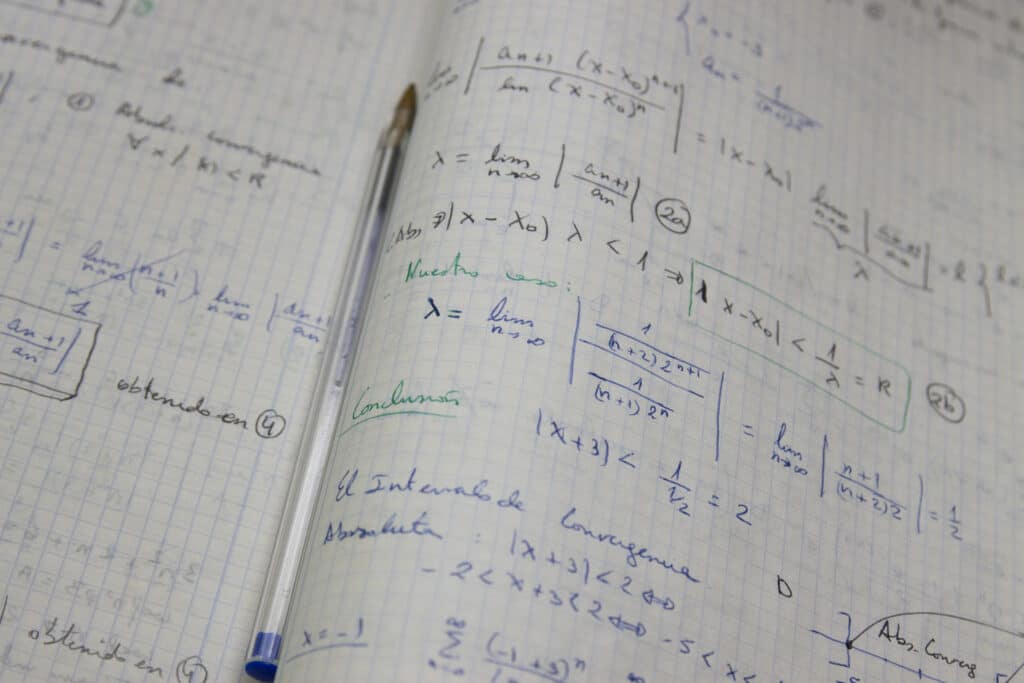
Looking for AI for math that doesn’t just answer “42” and then disappear? Here, you use a math-dedicated chatbot on Nation.fr (right at the top of the page) to solve, understand, check, and redo (yes, redo) your exercises. You can type your problem statement, but you can also send a photo or even a PDF file if that’s easier. The AI also understands handwriting (even if your handwriting leaves something to be desired). The goal isn’t to save 10 seconds—it’s to build better method, without fighting with complicated prompts (and with no sign-up to try it).
A math exercise can be simple… until it isn’t. One forgotten parenthesis, a sign that flips, a missing idea, and everything gets blurry. Nation AI’s math solver helps you bring order back (not with jargon, but with clear steps).
Why a math AI is better than a “final answer”
A good AI for math does three things. It translates the problem into plain language, walks through a method, and checks at the end (even if it seems obvious). An answer alone is a destination. An explained solution is a map.
Concrete example: for “Solve 2x + 3 = 11”, the AI should show why you subtract 3, then why you divide by 2, and how you check the result by plugging x back into the equation (it takes one line and avoids a silly mistake).
What exercises can a math AI handle (and at what levels)
In Google results for “math AI”, the top-ranking pages almost all promise the same thing: solve “from middle school to university”, with explanations and steps. That makes sense—it’s exactly what people type when they want quick help (but done properly).
And in real life, the need is often more straightforward: the problem is on a sheet of paper, a textbook, a teacher’s PDF, or a photo shared in a group. On Nation.fr, you can submit the problem as-is (text, photo, or PDF) and ask for an explanation tailored to your level.
The useful list (not the decorative list)
- Arithmetic (fractions, powers, percentages, order of operations)
- Algebra (equations, inequalities, factoring, systems)
- Functions (variation, limits, derivatives, interpretation)
- Geometry (angles, triangles, Thales, Pythagoras, coordinates)
- Probability and statistics (trees, binomial distribution, mean, standard deviation)
- Sequences (arithmetic, geometric, simple recurrence)
- Word problems (setting up equations, units, interpreting the result)
Concrete example: “An urn contains 3 red balls and 2 blue balls. Two balls are drawn without replacement. What is the probability of drawing 2 red balls?” A serious math AI lays out the reasoning (product of probabilities), writes the calculation, then offers a second method (combinatorics) to compare.
How to ask the right question to a math AI (without being a prompt expert)
The secret isn’t writing a 40-line prompt. It’s giving the minimum context, then asking for a specific format of answer. On Nation AI, the interface is designed to be simple, with pre-prompt buttons to guide you (and avoid the blank-page syndrome).
(Practical tip) If your exercise is on paper, take a clear, well-framed photo with no shadows. If it’s a lesson sent by the school, drop in the PDF (or copy the relevant part) and ask the AI to focus on exercise number X.
Three phrasings that often work
1) “Explain it like I’m a 9th grader, with numbered steps.”
2) “Show the method, then give me a similar exercise (with the solution).”
3) “I’ll share my attempt—tell me where I’m wrong and why.”
(Concrete tip) If you want a short answer, say “in 6 lines max”. If you want a slow, detailed answer, say “step by step, and remind me of the rule used at each step”. And if you’re stuck on vocabulary, describe the problem in your own words—the AI adapts.
Concrete example: you can ask “Differentiate f(x) = (3x – 2)², and explain the chain rule as if I’m discovering it.” The AI should name the form (u²), define u, differentiate u, then put it back together (and do a quick check).
Step-by-step solution: the part that helps you improve (even when it stings a bit)
A step-by-step solution does two things. It gives you a repeatable procedure, and it shows you where you could have veered into a mistake. That second point changes everything.
(Small detail that matters) Sometimes ask “Give me another approach too.” Two paths to the same result is a natural check.
If you’re starting from a course PDF, also ask “Remind me of the definition used”, then “Apply it to my exercise” (it turns a passive document into a tool).
Concrete example: “Factor x² – 5x + 6”. The AI can show how to find two numbers whose product is 6 and sum is -5, then write (x – 2)(x – 3). Then it can suggest checking by expanding (and show you how to spot the typical mistake: the sign flipped on the middle term).
Check an assignment: find the mistake (and stop making it tomorrow)
A useful math AI can also correct. You paste your solution, even if it’s shaky. Then you ask for a correction “with a diagnosis”, not just a clean rewrite. It’s a different mindset (and you can feel it).
Ask for this kind of output: “Correct step / Questionable step / Wrong step / Why”. Then redo only the wrong part, not the whole assignment (you save energy and keep your confidence intact).
(Photo) If you’re sending the work as an image, take 2 or 3 photos rather than one from far away. The AI sees better, and you get more accurate feedback.
Concrete example: you compute an integral, and the AI suggests a simple check: differentiate your result to see if you get back the original function. That check may feel school-like, but it often saves points.
For parents, seniors, and people who just want it to work
A lot of AI tools look the same on paper. The difference comes down to the interface (and friction). Nation AI was designed for people who don’t like “prompting”, including older users. You try it for free, with no sign-up, with all features, then decide if you want to go unlimited.
(Real-life scene) A parent gets home late. The child has an exercise on functions. Instead of a full lesson, they need a targeted explanation of “how to read a variation table”. The AI becomes a backup math teacher—no judgment, no impatience.
And if the problem comes as a screenshot or PDF, there’s no need to retype everything (you send it, then simply say “exercise 4”).
Concrete example: if you’ve forgotten how to solve a first-degree equation, ask “Explain with a simple metaphor, then do it again with another example”. You get a quick refresher without feeling “behind”.
Quick comparison: Nation AI math, calculator, general-purpose AI
The web is full of “solvers”, and that’s normal. To choose, look at clarity, the ability to adapt to your level, and ease of access. Nation AI bets on powerful AI, wrapped in an easy interface.
| Solution | Gives the answer | Explains step by step | Adapts to your level | Easy to use | Accepts photo / PDF | France context (interface, support) |
|---|---|---|---|---|---|---|
| Classic calculator | Yes | Rarely | No | Yes | No | No |
| Web search (lessons, videos) | Sometimes | Yes (but scattered) | A little | Average | Yes (depending on source) | Variable |
| Pure general-purpose AI | Yes | Yes | Yes | It depends (prompts) | Often | Variable |
| Nation AI (math AI on Nation.fr) | Yes | Yes | Yes | Yes (pre-prompts, dedicated page) | Yes | Yes |
A 3-minute mini method to revise with a math AI
You want something concrete, repeatable, almost mechanical. Do this.
1) Paste the problem (or send a photo, or a PDF) and ask “Give me a solution plan, without solving”.
2) Try the first step on your own (even if it’s rough).
3) Paste your attempt and ask “Correct only what’s wrong, and explain why”.
4) Ask for a twin exercise, then redo it without looking.
Concrete example: on percentages, you do 4 quick exercises. The AI creates a variation each time (with different numbers). In 10 minutes, you go from “I think” to “I know”.
The limits of a math AI (and how to stay in control)
An AI can be wrong, especially if the problem is ambiguous, if a notation is missing, or if you mix two conventions. The best practice is simple: ask for a verification, then check one key point yourself (substitution, differentiation, order-of-magnitude estimate). That’s often enough.
(Trap example) “sin x²” can mean sin(x²) or (sin x)². The AI should ask you, or at least flag the ambiguity. You can also flag it from the start.
If you send a PDF, indicate the page or paragraph (otherwise the AI may answer about a part that doesn’t help you). It’s a small effort, but a big gain.
Concrete example: if a “speed” problem gives you 9000 km/h for a car, you already know something’s off. Ask “Do an order-of-magnitude check”. It’s a great reflex (and it works even without AI).
Try Nation AI for math (free, then unlimited)
The easiest way is to test now, with the dedicated AI chatbot at the top of this page. You try it for free, with no sign-up, with all features. You can type your exercise, or send a photo, or add a PDF (handy for homework and cheat sheets). Then, if you want unlimited use, Nation AI offers a subscription at €19 per month (unlimited) or €9 for 2 weeks.
To go further on Nation.fr, you can also visit the general AI chat (for any use), discover the “free AI” page (to understand the simple approach), or read about the team (French company, design and support in France). If you like “ready-to-use button” assistants, also take a look at the pre-prompts (like writing an email, virtual friend, and more).
You’ve got an exercise in front of you. Don’t look at it like a wall. Send it (text, photo, PDF), ask the chatbot your first question, and let the math AI walk you through it (you stay in control; it holds the flashlight).
Can this Math AI solve an exercise from a photo?
Yes. You can send a photo of your problem statement (or your rough work) and ask for a step-by-step solution, an explanation, or a correction. For best results, take a clear, well-framed image with no shadows (and if it’s long, take 2 or 3 photos).
Can I also send a PDF of a lesson or homework?
Yes. You can attach a PDF (cheat sheet, homework, lesson) and specify what you want (for example "page 2, exercise 4" or "explain the theorem used"). It avoids retyping and speeds up understanding.
What levels are covered by Nation.fr’s math AI?
From middle school to high school, and even beyond for higher education (equations, derivatives, probability, sequences, geometry, ...). If you tell it your level, the AI adapts the vocabulary and method (that’s often where the magic happens).
Does Nation AI only give the final answer?
No (and that’s intentional). You can ask for the answer, but the value is mainly in the steps, the method, and the checks (substitution, sign check, order of magnitude). It’s more "math teacher" than "calculator".
How do I phrase a good request if I don’t know how to write “prompts”?
Keep it simple: paste the problem (or send the photo/PDF) then say what you expect. Examples: "explain like I’m in 8th grade", "step by step", "correct my attempt", "give a similar exercise". And you can use Nation AI’s pre-prompt buttons (handy when you don’t know what to write).
Can it correct my reasoning and find the mistake?
Yes. The most effective way is to send your attempt and ask for a diagnosis (step by step). Example: "Tell me exactly which line I’m wrong on, and why". You improve faster than rereading everything blindly.
Where can I test the math AI right away?
Right on this page: the specialized "math AI" chatbot is at the top. Send your exercise (text, photo, or PDF) and ask for "step by step" (you’ll see the difference immediately).

