

The essential takeaway: AI is fundamentally reshaping US real estate by automating up to 37% of tasks and enhancing strategic decision-making. This technological shift empowers professionals to prioritize high-value client relationships over administrative burdens, effectively transforming the agent’s role into a strategic advisor. With a projected $34 billion in operational efficiency gains by 2030, the industry is rapidly moving from manual processes to data-driven precision.

Does the rapid acceleration of technology make you worry that your hard-earned market expertise is becoming obsolete in favor of an algorithm? The reality of ai changing us real estate is not about replacing professionals, but rather equipping them with powerful tools to predict market trends and automate the tedious administrative work. We will uncover exactly how generative models and data-driven insights are creating massive efficiency gains, ensuring you stay ahead of the competition without ever losing that irreplaceable human connection.
The Real-World Impact: How AI Is Already Running the Show
From Property Listings to Virtual Tours
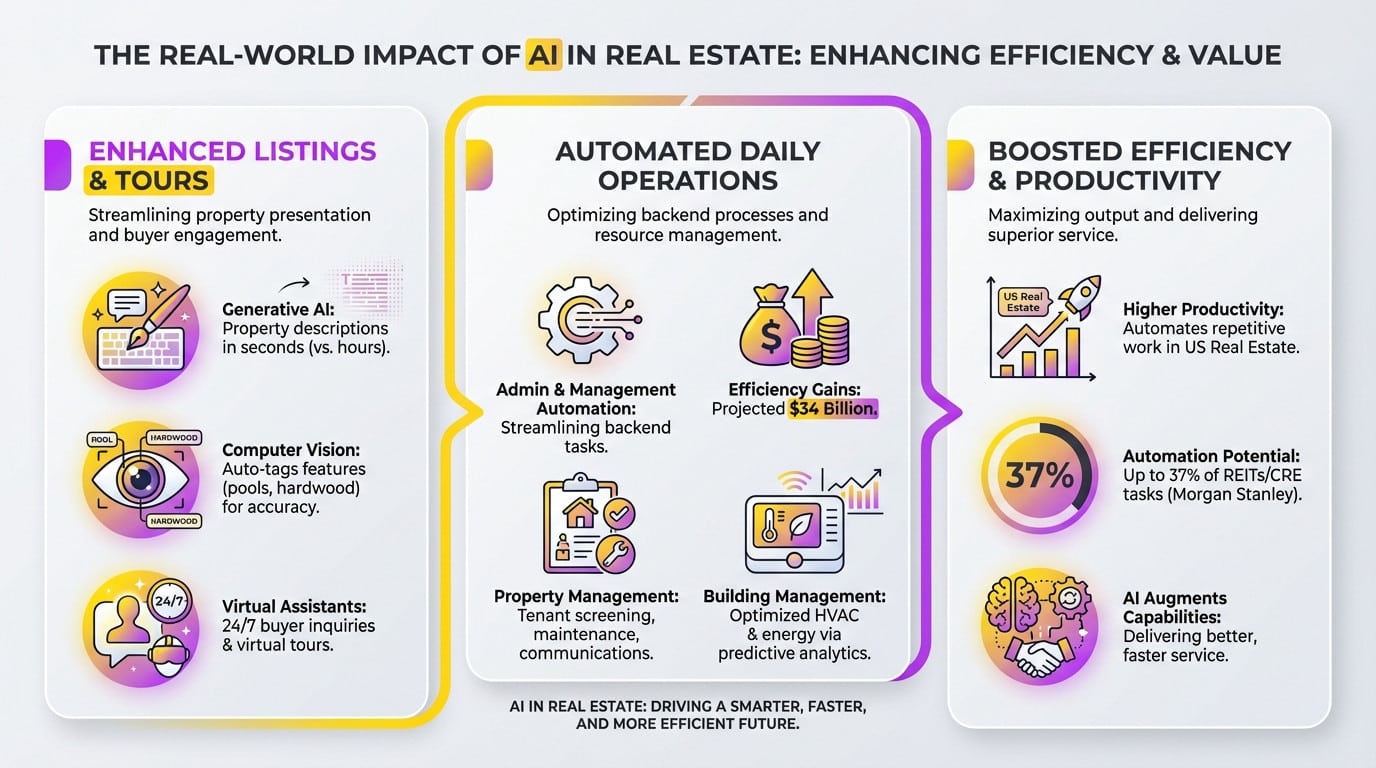
You might wonder how ai is changing us real estate markets right now. It is not some distant sci-fi concept; it is active today. Generative AI now writes property descriptions in seconds—a task that used to eat up hours. This frees agents for what actually matters.
Then there is computer vision. It scans property photos to automatically identify and tag features like pools, hardwood floors, or updated kitchens. It’s not just cool tech; it drastically increases listing accuracy for everyone involved.
Don’t forget virtual assistants and chatbots. These tools handle buyer inquiries 24/7 and can even guide potential buyers through virtual property showings while you sleep.
Streamlining Day-to-Day Operations
The backend is where the money is saved. AI automates administrative support and management tasks effortlessly. This is exactly where a huge chunk of the projected $34 billion in efficiency gains will come from.
Take property management, for example. AI systems can automate tenant screening, process maintenance requests, and handle routine communications instantly. This clears the deck for managers to focus on the resident experience rather than paperwork.
It even cuts physical costs. Smart buildings now optimize HVAC systems and energy use based on predictive analytics to slash bills.
The Bottom Line: Efficiency and Productivity
Let’s be real about the benefits here. The core change is the automation of repetitive, time-sucking work. This directly translates to higher productivity for agents, brokers, and managers across the US real estate sector.
The hard data backs this up. A Morgan Stanley analysis states that up to 37% of tasks … are ripe for automation right now.
But relax, this isn’t about replacing people. It is about augmenting their capabilities to deliver better, faster service.
Beyond the Hype: Generative vs. Agentic AI in Property
So we’ve seen what AI is doing right now, but not all AI is the same. It’s time to get specific about the different types of intelligence reshaping the industry.
Generative AI: The Creative Content Machine
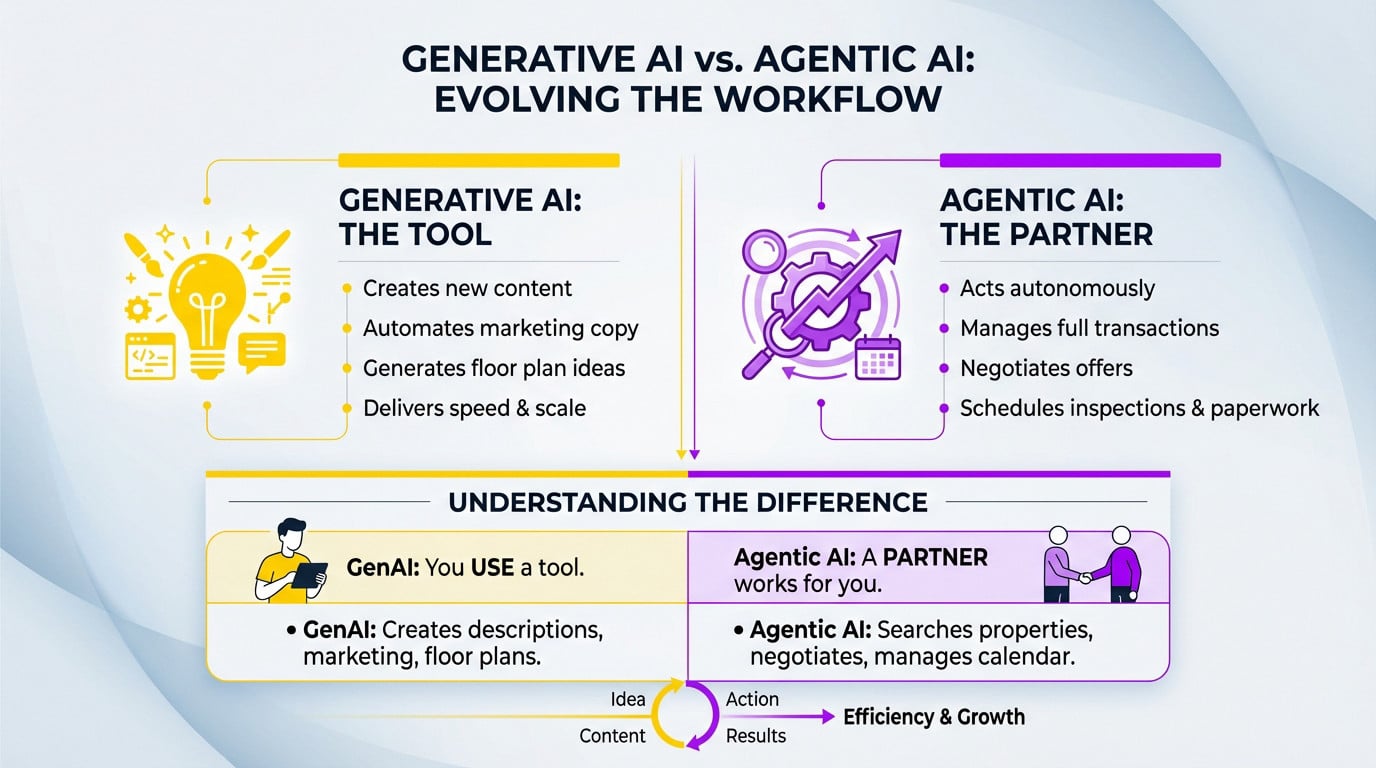
Let’s start with the buzzword everyone knows. Generative AI isn’t just a database; it actually creates new content from scratch. Think of it as your tireless, creative assistant.
In real estate, this engine powers those automated listing descriptions. It drafts personalized marketing emails and whips up social media posts instantly. It analyzes raw property data to craft compelling narratives for potential buyers.
The main benefit here is pure speed and scale. It allows a single agent to produce the marketing output of a small team.
Agentic AI: The Autonomous Deal-Maker
Now, meet the next evolution: Agentic AI. This technology doesn’t just create stuff; it acts autonomously to complete complex tasks for you. We are talking about actual execution here, not just simple generation.
Imagine an AI agent managing an entire transaction solo. It could handle everything from the initial lead contact to scheduling inspections and filing paperwork.
This is exactly where the industry is heading. Understanding what AI agents are is vital for future-proofing your business. These intelligent systems effectively do the work for you.
Understanding the Difference is Key
You need to distinguish between these two beasts. GenAI is a tool you use; Agentic AI is a partner that works for you.
Here is how the roles split up in a practical scenario:
- Generative AI (The Tool): Creates property descriptions, drafts marketing copy, generates floor plan ideas.
- Agentic AI (The Partner): Autonomously searches for properties matching complex criteria, negotiates initial offers based on pre-set rules, manages a calendar of showings and inspections.
This distinction helps smart professionals know exactly what to adopt right now versus what to prepare for next.
The New Gold Rush: AI’s Effect on Property Investment and Valuation
Predictive Analytics for Smarter Investments
You might think you know the market, but predictive analytics changes the rules entirely. Algorithms now crunch massive datasets—historical sales, demographic shifts, zoning laws, and economic indicators—to forecast trends with scary accuracy. It’s like seeing the future before it actually happens.
For investors, this is the edge you need to survive. Instead of guessing, you identify undervalued markets or properties with massive growth potential using hard data. No more relying on gut feelings to make million-dollar decisions.
And here’s the kicker: this isn’t just for Wall Street giants anymore. These tools are becoming accessible, finally leveling the playing field for smaller investors like us who want to compete.
Hyper-Local Valuation Models
Remember the old way? Traditional appraisals are painfully slow, relying on just a few recent comparable sales that might not even match. It’s an outdated method that leaves money on the table.
AI flips the script completely. It analyzes thousands of data points in real-time, drilling down to the specific block level. This creates a hyper-local and dynamic property value that actually reflects reality.
You can’t ignore the precision here, which shows exactly how ai changing us real estate works today:
“By processing thousands of data points in real-time, AI delivers property valuations that are not just faster, but fundamentally more accurate and responsive to micro-market changes.”
From Gut Feeling to Data-Driven Analysis
| Feature | Traditional Method | AI-Powered Method |
|---|---|---|
| Valuation | Based on 3-5 recent comps, subjective adjustments | Analyzes thousands of data points, real-time market shifts, predictive models |
| Market Analysis | Relies on quarterly reports, anecdotal evidence | Real-time analysis of demographic, economic, and transactional data |
| Speed | Days or weeks | Minutes or seconds |
| Lead Generation | Cold calls, mailers, sphere of influence | Predictive targeting of likely sellers, automated follow-up |
| Risk Assessment | Based on historical performance, gut feeling | Simulates future scenarios, identifies hidden risks (e.g., climate, zoning changes) |
Automating the Landlord: Property Management Gets an AI Upgrade
Once a property is acquired, the real work begins. And that’s where AI is making one of its biggest, albeit less glamorous, impacts: property management.
Smarter Tenant Screening and Communication
Finding tenants used to be a slow grind. Now, software can filter applications based on predefined criteria, run background checks, and schedule viewings, all without human intervention. This specific automation illustrates exactly how ai changing us real estate operations works today.
Then there is the communication aspect. AI-powered systems handle routine tenant questions and requests instantly, dramatically improving resident satisfaction. This is a perfect use for chatbots, which never sleep.
You should really check out these automated conversational agents to see how they handle dialogue. It is quite impressive tech.
Optimizing Maintenance and On-site Staff
Let’s talk about predictive maintenance. AI can monitor building systems and predict failures before they happen. This shifts maintenance from reactive to proactive, saving money. It stops small issues from becoming expensive disasters.
Consider staff optimization next. AI can analyze traffic patterns and service requests to schedule on-site staff more efficiently, reducing labor costs. It ensures you aren’t paying for downtime.
Take the self-storage example from the data: one company cut on-site labor hours by 30% using AI-driven staff scheduling. That is a massive operational win.
A Surprising Outcome: Happier Residents and Staff
Many assume automation feels cold. I disagree. By handling the mundane, AI frees up human managers to focus on community-building and complex resident issues. It allows staff to actually connect with people rather than paperwork.
The result is often a better living experience and higher tenant retention rates. People stay where they feel heard.
Here is the reality:
“Counterintuitively, companies using AI to reduce on-site staff have reported increased satisfaction from both their customers and their own teams, who can now focus on higher-value work.”
The Invisible Infrastructure: How AI is Creating New Real Estate Demands
The Insatiable Hunger for Data Centers
You might assume AI lives in the ether, but that code is grounded in steel. All that processing power demands immense physical space, turning data centers into one of the hottest, most aggressive sectors in commercial real estate today.
These aren’t your grandfather’s dusty warehouses. They are high-security fortresses, packed with specialized cooling systems and massive power feeds designed to keep servers from melting down under the heavy computational load.
Consequently, the boom in AI is directly fueling a massive construction frenzy across the US right now.
Power Grids, Connectivity, and Tech Hubs
It goes beyond the box itself; the demand extends to the surrounding energy infrastructure. Proximity to power substations is now a prime real estate attribute, often worth more than the land itself because you cannot compute without juice.
Then there is the talent density. AI companies cluster in specific tech hubs, driving up demand for both commercial office space and residential housing in those tight geographic pockets.
Here is how ai changing us real estate is reshaping the investment map:
- New Asset Class: The rapid rise of the data center as a primary real estate investment vehicle.
- Infrastructure Demands: An absolute need for robust power grids and fiber-optic connectivity to survive.
- Geographic Concentration: Increased property values are spiking in established and emerging AI tech hubs.
The Flip Side: Potential Job Displacement
We have to address the elephant in the room. While AI creates high-level tech jobs, widespread automation in other sectors could lead to significant job losses. This is a real, tangible concern for the broader economy.
Think about the potential knock-on effect here. Significant job displacement could drastically reduce demand for office and retail space, putting immense pressure on markets that rely heavily on human occupancy.
Economists are currently split on whether AI will be a net job creator or destroyer in the long run.
The Human in the Loop: What’s the Future for Real Estate Agents?
With all this automation, it’s easy to wonder if real estate agents are going the way of the dinosaur. The reality is more nuanced; their role isn’t disappearing, it’s evolving.
From Salesperson to Strategic Advisor
Let’s be real: the days of the gatekeeper are over. As algorithms handle the heavy lifting of data crunching and paperwork, the agent’s value isn’t vanishing—it’s migrating up the food chain. You become interpreters and strategists, not just door openers.
Your job is to decode what the machine spits out, adding that hyper-local context a server in Silicon Valley misses, while guiding clients through the messy, emotional reality of buying a home.
We are moving away from being information hoarders to becoming the trusted advisors and fierce negotiators clients actually need.
The Agent as the AI “Copilot”
Think of it like a pilot in a modern cockpit. The AI flies the plane—managing the navigation systems and routine checks—but you are the one handling the critical take-off and landing decisions.
In our world, ai changing us real estate means using algorithms for market scans and lead generation, while you provide the final human judgment on pricing strategy, nuanced negotiation tactics, and that gut-check advice clients crave.
“Consumers increasingly rely on REALTORS® to be the essential ‘human in the loop’ for AI-assisted tasks, providing the final verification for home searches and price estimates.”
New Skills for a New Era
The agents who will be left standing aren’t the ones fighting the tech, but the ones mastering it. Survival now requires a completely different toolkit than we used ten years ago.
- Data Literacy: The ability to understand and question the output of AI models.
- Tech Savviness: Proficiency in using various AI tools for marketing, CRM, and analysis.
- Strategic Consultation: Shifting from transactional support to high-level advisory.
- Emotional Intelligence: Doubling down on the human skills of empathy, negotiation, and relationship-building that AI cannot replicate.
Walking the Tightrope: The Legal and Ethical Maze of AI in Real Estate
The Risk of Algorithmic Bias
Here is the ugly truth about how ai changing us real estate works. These models feed on historical data like hungry beasts. If that old data holds ghosts of past discrimination, the AI simply learns and repeats those exact biases.
This poses a massive risk to fair housing laws. An algorithm could inadvertently discriminate in loan approvals, property valuations, or even marketing. You don’t want a lawsuit because your software ignored a protected class.
This isn’t theoretical; it’s a primary concern for regulators and industry bodies like the NAR.
Data Privacy and Security Concerns
Let’s be real, AI models are incredibly data-hungry. They collect and process vast amounts of personal and financial information from clients. It creates a digital footprint that is hard to erase.
This raises huge data privacy questions. Who owns the data? How is it being used? How is it protected from breaches? The US currently lacks a single, clear federal law.
This regulatory patchwork creates uncertainty and risk for real estate companies adopting these tools.
The Emerging Regulatory Landscape in the US
Fortunately, Washington is paying attention. The US Congress is actively debating several bills to create a national framework for AI. This is a necessary move away from a state-by-state mess. It creates a unified standard.
These legislative efforts have specific goals. They aim to establish clear standards for responsible AI development and deployment. Safety is the priority.
- Transparency: Requiring disclosure when consumers are interacting with an AI.
- Fairness: Mandating bias audits for algorithms used in housing.
- Data Protection: Establishing clear rules for data privacy and security.
- Copyright & Liability: Defining who is responsible when an AI makes a mistake.
AI isn’t just a futuristic buzzword; it’s reshaping the foundation of US real estate. While algorithms crunch the numbers, the human touch remains irreplaceable for closing the deal. So, embrace the bots—they’re here to help, not steal your open house snacks. The future is efficient, data-driven, and decidedly human.