

The essential takeaway: Static prompts are dead, replaced by Agentic Workflows that autonomously plan and adapt. Unlike rigid scripts, these agents use a “Perceive-Think-Act” loop to solve complex problems and self-correct errors in real-time. This breakthrough allows for reliable, hands-off automation, turning unpredictable challenges into streamlined operations without the need for constant human oversight.

Are you exhausted by the constant maintenance of brittle automation scripts that shatter the moment an unforeseen variable disrupts your daily operations? The agentic workflow offers the ultimate solution by replacing blind execution with intelligent systems that actively reason, plan, and self-correct to overcome obstacles in real time. We hand you the complete, actionable strategies to build and orchestrate these autonomous AI squads, ensuring you master the power of delegating intricate tasks to digital agents that execute with precision while you finally reclaim your valuable time for high-impact innovation.
Why Static Prompts Are Dead and Agentic Workflows Are Taking Over
Let’s face it: relying on standard “prompt engineering” is a losing battle. We are moving from writing rigid scripts to designing systems that actually think, making the old linear way of doing things look painfully obsolete.
Moving Past the Limits of Traditional RPA
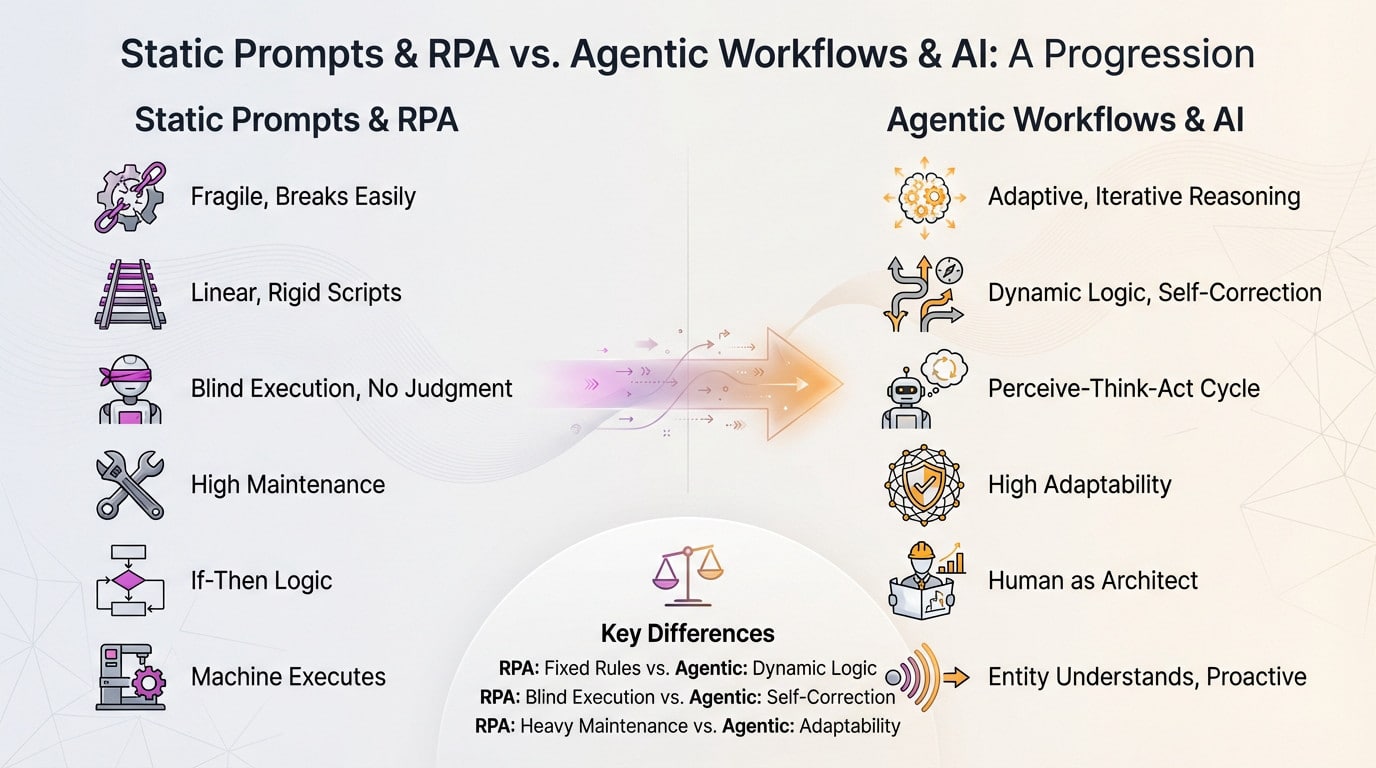
Traditional automation (RPA) fails the moment reality hits. You know the frustration: a UI button shifts slightly, and your entire script shatters. It is a fragile, linear approach lacking the judgment to handle the unexpected.
An agentic workflow differs because it reasons iteratively. Instead of blindly following a rail, the AI thinks through each step, navigating obstacles and adjusting its path dynamically when things get messy.
- RPA relies on fixed rules; Agentic uses dynamic logic.
- RPA executes blindly; Agentic self-corrects errors.
- RPA demands heavy maintenance; Agentic offers adaptability.
We are witnessing the end of the simple “if this, then that” era. We are shifting from a machine that merely executes to an entity that truly understands context.
This change is radical. It fundamentally redefines how we delegate complex tasks to machines.
Defining the True Autonomous Agent
Define an autonomous agent as a constant feedback loop. It isn’t a simple chatbot waiting for input. It is a system capable of making decisions without you holding its hand.
“The agentic workflow doesn’t just respond; it plans, executes, and adjusts its course until the objective is met, without constant human intervention.”
It runs on the “Perceive-Think-Act” cycle. The agent observes its environment, analyzes the data, and selects the relevant tool. This autonomy goes beyond text generation; it is about real execution.
This massively reduces the need for human supervision. You become the high-level architect of the system, rather than a micromanager watching every move.
Here lies the true revolution. Intelligence finally becomes proactive and genuinely useful.
3 Core Components That Drive Autonomous Agent Performance
LLMs as Engines and Tools as Limbs
Think of the LLM as the central brain. But without tools, this agentic workflow is paralyzed. APIs and web search act as its arms. They let it interact with the real world in real-time.
This shift is massive. You can see the evolution towards the Agentic Era with Google Gemini clearly. It illustrates the raw power of multimodal models today.
Here is the toolkit you need:
- Zapier for workflows
- SerpApi for the web
- Python for calculation
- SQL for databases
The integration must be fluid. Without perfect connection, the agent remains an empty box.
The Power of Self-Correction and Reflection
An agent that never fails doesn’t exist. The real strength lies in its capacity to spot its own errors. It examines its results closely. Then, it starts over if necessary.
Check our guide to automating your chatbot to see this. It shows how reflection boosts answer quality. The difference is night and day.
Compare this to the “single-shot prompt”. Sending one command is a gamble. Iteration, however, guarantees surgical precision over the long run. That is the difference.
The agent becomes its own critic. It polishes the work until it is absolutely flawless.
Short-Term Context Versus Long-Term Memory
Short-term memory handles the immediate chat. That is just the context window. But to be truly effective, an agent needs long-term memory. It must actually remember you.
We use vector databases here. They allow storing past knowledge efficiently. The agent can then personalize actions based on your historical preferences.
This continuity changes everything for user experience. We no longer start from scratch every session. Consistency becomes the norm, not a lucky exception.
It is the secret to personalization. A learning agent is a winning agent.
How Do Agents Handle Complex Task Decomposition?
Having good components is one thing, but knowing how to organize them to solve massive problems is another.
Planning Strategies for Complex Problem Solving
Facing a mountain, the agent does not jump. It draws a map. An agentic workflow relies on breaking a global goal into small, digestible, and logical steps. That is how we tackle chaos.
You need a structured approach to visualize this process. We map specific actions to clear outcomes. Look at this breakdown:
| Step | Agent Action | Expected Result |
|---|---|---|
| 1. Analysis | Understand the goal | Clear objective definition |
| 2. Planning | List sub-tasks | Structured roadmap |
| 3. Execution | Launch tools | Task completion |
| 4. Validation | Check success | Quality assurance |
The “Chain-of-Thought” is indispensable here. The agent explicitly states its reasoning aloud, virtually. This prevents those lousy mental shortcuts that often lead to stupid errors.
This planning strategy makes systems robust. Even if a sub-task fails, the global plan can be adjusted. That is resilience that classic code cannot offer.
The agent no longer rushes in headfirst. It anticipates needs before burning tokens unnecessarily.
Multi-Agent Systems for Specialized Expertise
Sometimes, a single agent is not enough. So, we create a team. Each agent possesses a specialty: one codes, another verifies, and the last writes the final documentation.
Take the example of complex IT support. One agent sorts tickets by urgency. Another searches for the technical solution. A third communicates with the final client.
Collaboration requires strict protocols. Agents must exchange clear information without creating infinite loops. It is a true digital choreography where everyone knows their role.
This multi-agent approach (MAS) multiplies your impact. We no longer ask a generalist to do everything. We use sharp experts for every single segment.
The result is stunning in precision. It is collective intelligence applied to machines, and it works wonders.
Reliable Frameworks and the Necessity of Agent Guardrails
To orchestrate a robust agentic workflow, you need solid tools and, above all, impenetrable rules of the game.
Top Frameworks to Build Your Agentic Stack
LangChain stands as the undisputed titan of the sector. It offers immense flexibility to connect any LLM to any tool you want. But be warned, the learning curve can feel a bit steep.
You do not always need complex code to start. You can automate your tasks with Claude Code to see how accessible these tools are becoming. It is easier than you think.
- LangChain for unmatched versatility.
- CrewAI for simple multi-agent setups.
- AutoGPT for total autonomy.
- Microsoft AutoGen for research.
CrewAI is gaining ground thanks to its radical simplicity. It allows you to define roles and tasks in a very intuitive way. It is perfect for launching a prototype quickly.
The choice depends entirely on your technical needs. Don’t aim too high right from the start, stay pragmatic.
Setting Boundaries with Governance and Safety Nets
Giving the house keys to an AI is risky business. Guardrails are absolutely mandatory here. You must define ethical and technical limits to stop the agent from derailing completely.
Listen to this advice carefully.
Delegating without monitoring is a fatal error; agent governance must include human checkpoints for high-stakes decisions.
It saves you from disaster.
Data security is another massive pillar to consider. The agent must not leak sensitive info while querying external APIs. Encryption and output filtering are non-negotiable.
Always plan for a manual “emergency stop button”. An agent can enter a costly or absurd loop. Human supervision remains the ultimate safety net against persistent hallucinations.
Trust is earned strictly through control. Be strict about the permissions you grant to autonomous agents.
Next-Level Automation With Headless Operations and Data Loops
Now, let’s uncover the engine room: interface-free automation and the data that fuels it.
Headless Scripting for Terminal-Based Power Users
Headless mode kills the lag of slow graphic interfaces. Your agentic workflow operates directly in the terminal or via scripts. That is where raw power truly lives.
This setup is perfect for automatic debugging. The agent watches your error logs and suggests fixes instantly. It becomes an invisible but omnipresent coding partner.
Developers absolutely love this approach. It lets you embed AI right into continuous deployment pipelines.
It is fast. It is efficient. It is the future of modern development.
Feeding the Loop with High-Quality Training Data
The traces left by agents are pure gold. Their successful reasoning helps refine future models. You create a virtuous cycle of constant improvement.
Capturing decision logic is more useful than the final result. It helps us understand why the agent succeeded or failed. This is the basis of fine-tuning.
Your own workflows become your best data source. The more you use them, the smarter they get.
Don’t throw anything away. Each interaction is a lesson for tomorrow’s intelligence.
Stop relying on rigid scripts. We empower you to embrace the agentic revolution. By shifting to autonomous workflows, your operations become smarter, faster, and infinitely scalable. These systems don’t just follow orders; they adapt and evolve. Take the leap today. Transform your business with intelligence that truly works for you.