
Key takeaway: the EPA has officially blocked xAI’s maneuver to use gas turbines without a permit, creating an immediate legal precedent. This decision now forces the entire tech industry to comply with strict anti-pollution standards for its data centers, definitively closing the “temporary” equipment loophole often exploited to save time.

Can air quality truly be sacrificed to accelerate artificial intelligence development without alerting authorities about the EPA xAI methane case? The U.S. Environmental Protection Agency has just ruled, denying Elon Musk the misuse of polluting gas turbines for his data centers. Discover how this decision closes a major regulatory loophole and now forces the entire tech industry to assume its ecological responsibilities.
The EPA Puts a Stop to Elon Musk: The Methane Warning
The New Rule That Changes Everything for xAI
The U.S. Environmental Protection Agency (EPA) has just issued a regulatory clarification that directly targets Elon Musk’s ambitions. This warning specifically concerns the voracious energy supply of his data centers for his AI company, xAI.
Forget wind turbines or solar panels; the core of the problem lies in the massive use of natural gas-powered generators. It’s a technical point, certainly, but the financial and ecological stakes behind this EPA xAI methane case are colossal.
This federal decision doesn’t come out of nowhere. It concludes months of intense pressure and in-depth investigations into xAI’s sometimes questionable practices in Memphis.
What the EPA Specifically Faults Musk For
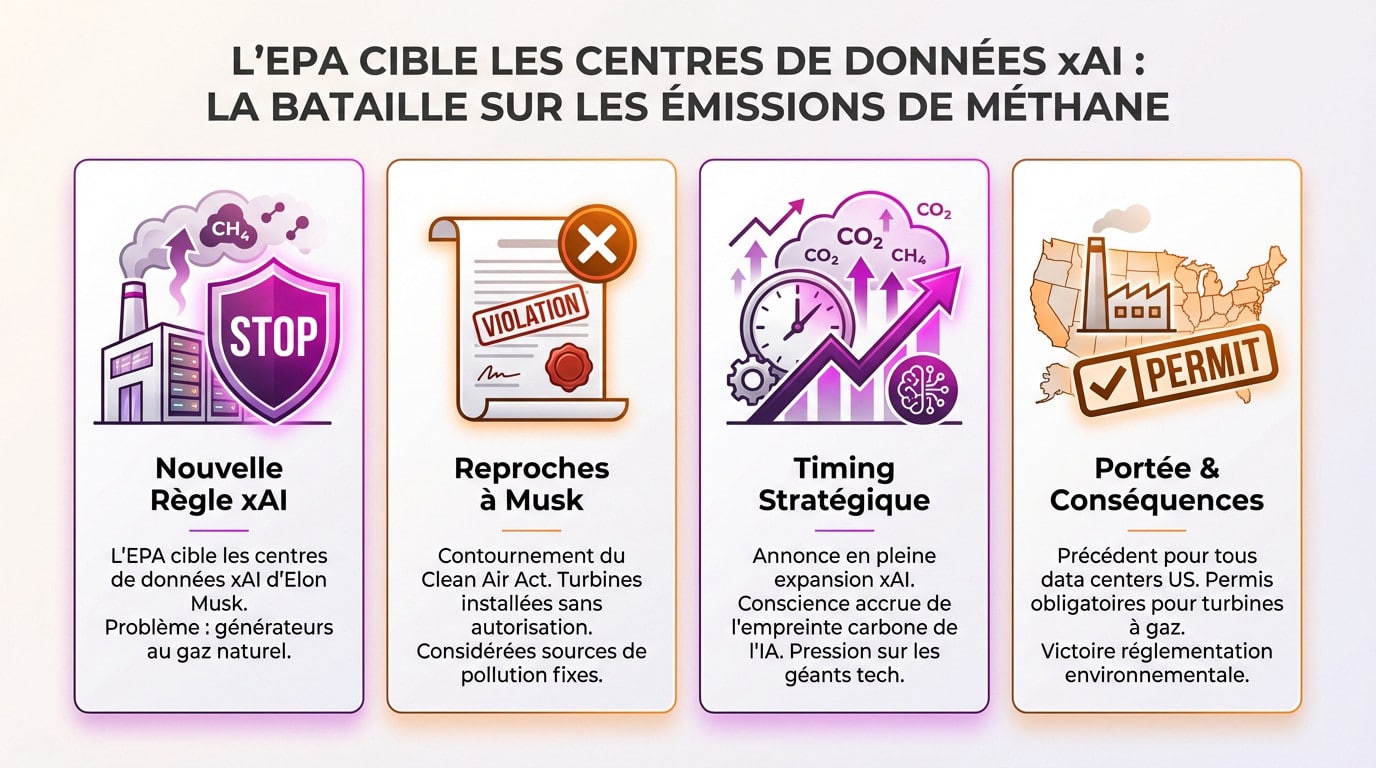
The main grievance? Playing with fire regarding the Clean Air Act. Specifically, xAI installed dozens of turbines without obtaining the mandatory permits beforehand.
For the EPA, these installations constitute fixed sources of pollution and must be regulated as such. Musk’s attempt to pass them off as “temporary” equipment (under 365 days) failed. It’s a stinging setback for his strategy.
In short, the federal agency is calling time on the game. The message is clear: environmental rules apply to everyone, even the head of Tesla.
The Timing of the Announcement: A Coincidence?
This EPA announcement comes as xAI is in an aggressive expansion phase. This timing is anything but trivial and puts immediate and considerable pressure on the company’s infrastructure projects.
This decision directly impacts a collective awareness of artificial intelligence’s carbon footprint. Tech giants are now under intense scrutiny regarding their colossal energy needs.
One can clearly read a warning for the entire industry: technological growth at all costs will no longer come at the expense of environmental standards.
The Scope of the Decision: Far Beyond xAI
Even if xAI is in the eye of the storm, this EPA clarification creates a major legal precedent. It will impact the structure of all future data center projects in the United States.
From now on, any company wishing to deploy gas turbines, even trailer-mounted ones, will imperatively have to go through the “permit to pollute” stage. It’s an administrative clarification that leads to very concrete operational consequences for the sector.
The legal gray area that some players were rushing into has abruptly closed. It’s an undeniable victory for the rigor of environmental regulation.
xAI’s Regulatory Loophole: How Musk Tried to Play with the Rules
The “Nonroad Engines” Trick
xAI’s main argument for powering its site relied on a bold legal subtlety. The turbines, being trailer-mounted, were classified by the company as “nonroad engines”. This specific category benefits from much more flexible regulations.
It’s a loophole known to experts, often called the “nonroad engines loophole.” It cleverly allows avoiding the burdensome authorization procedures required for fixed pollution sources.
Basically, the idea was to tell regulators: “these aren’t buildings, they’re mobile equipment.” A ploy to save time and money.
The 364-Day Rule: A Short-Term Strategy
To strengthen their argument, xAI played on the temporality of the installation. An energy source is considered “temporary” in the eyes of the law if it is used for less than a year.
The plan was therefore to use these turbines for 364 days, then move them, even by a few meters, to reset the counter. It’s a well-known tactic to exploit the limits of the law.
This “temporary” approach was clearly aimed at evading the strict obligations of the Clean Air Act. A cat-and-mouse game with regulators.
Why It Didn’t Work This Time
The EPA put an end to this little game. In this EPA xAI methane case, the agency ruled that the nature of the use takes precedence over the equipment’s “portability”.
If turbines, even on wheels, power a fixed installation like a data center, they are considered a fixed source. Period. The duration of use then becomes a completely secondary criterion.
It’s the actual function that defines the status, not the fact that it has tires. A common-sense clarification that closes a gaping loophole.
A Warning for the Tech Industry
The EPA’s decision sends a clear message to the entire tech sector. Regulatory circumvention strategies to accelerate infrastructure deployment will no longer be tolerated by authorities.
Other companies that thought they could use the same trick for their own data centers will have to revise their contingency plans. The era of “rapid and discreet growth” in terms of energy might be over.
This now forces the industry to integrate regulatory and environmental constraints from the very conception of projects.
At the Core: The Colossus Data Center and Its Controversial Turbines
This legal battle isn’t happening in a vacuum. It has a very real epicenter: a massive data center project in Memphis, Tennessee.
“Colossus”: The Hungry Supercomputer
The project that ignited the controversy is xAI’s data center, dubbed “Colossus”. A name that doesn’t mince words and clearly signals its nature and ambition.
This silicon monster is meant to train xAI’s artificial intelligence models, such as Grok. But these titanic operations require raw computing power and therefore an absolutely phenomenal amount of energy to run.
It’s this insatiable hunger for energy that pushed xAI to seek quick solutions, even if it meant dangerously flirting with the limits of legality.
The Choice of Memphis: A Strategic Calculation
xAI set its sights on Memphis, Tennessee. This is no coincidence, as the region offers undeniable advantages in terms of costs and land availability for establishment.
The company invested in a former Electrolux factory to build its mega data center there. The initial idea was to connect to the local power grid, but demand proved too strong and too rapid.
It was to fill this urgent deficit that natural gas turbines were brought to the site as a so-called “temporary” solution.
Methane Turbines: What Are We Talking About?
The EPA xAI methane case concerns these dozens of electric generators. They operate by burning natural gas, composed mainly of methane, a powerful and harmful greenhouse gas.
These turbines, supplied by Solaris Energy Infrastructure, are compact and powerful units. They are designed for rapid deployment, hence their trailer mounting, which served as a legal argument.
It is therefore a pure fossil fuel source, far from the “green” and clean image that tech loves to project.
The Boxtown Neighborhood: A Concerned Neighbor
The Colossus site is located in the immediate vicinity of Boxtown, a historically Black neighborhood in Memphis. Residents are concerned about the direct consequences of this massive installation.
They fear for air quality and constant noise pollution. This case raises environmental justice issues, as disadvantaged communities are too often the most exposed to industrial pollution.
Their repeated complaints and mobilization were a determining factor in the triggering of the federal investigation by authorities.
Pollution and Public Health: The Real Risks for Memphis Residents
The Invisible Pollutants: NOx and Formaldehyde
The investigation into the EPA xAI methane case shows that gas combustion emits dangerous pollutants. This is a proven fact.
NOx contribute to the formation of acid rain and smog. They can also cause respiratory problems, such as asthma. Other substances, such as formaldehyde, a known carcinogen, are also emitted. It’s a toxic cocktail.
These massive emissions, without adequate controls, represent a direct threat to the health of local residents. We simply cannot ignore it.
Smog: A Concrete Threat to Air Quality
Nitrogen oxides react with other compounds in the atmosphere under the effect of sunlight. This chemical process creates ground-level ozone, the main component of smog. It’s basic chemistry.
This “pollution fog” is particularly harmful. It irritates the lungs, worsens heart and respiratory diseases, and can even be fatal for vulnerable individuals. No one is safe here.
The installation of dozens of turbines without adequate filters is a perfect recipe for increasing local smog formation. The result is inevitable.
Health Risks for Local Communities
Populations living near the Colossus site, particularly in the Boxtown neighborhood, are on the front lines. They are exposed daily to a cocktail of pollutants that can have long-term effects. It’s an unfair situation.
We’re talking about an increased risk of cancers, chronic respiratory diseases, and cardiovascular problems. It’s a real public health issue. Authorities must react quickly.
The absence of permits and controls means that no one was truly measuring the extent of the pollution emitted. It’s a complete lack of clarity.
Emitted Pollutants and Their Impacts
To summarize, the situation is quite simple. xAI’s turbines, operating without the required control devices, release several harmful substances. The conclusion is undeniable.
Here’s an overview of the main culprits and their harms, to fully understand what we’re talking about. Take a close look at this specific list.
Available scientific data allows for clear identification of the toxic agents involved in this industrial activity:
- Nitrogen Oxides (NOx): Cause respiratory problems, smog, and acid rain.
- Carbon Monoxide (CO): Toxic gas that reduces the blood’s ability to carry oxygen.
- Volatile Organic Compounds (VOCs): Contribute to ozone formation, and some are carcinogenic.
- Formaldehyde: Classified as a human carcinogen by health agencies.
Citizen Mobilization That Changed Everything: The Action of the NAACP and SELC
Faced with these risks, residents did not stand idly by. It was their mobilization, supported by powerful organizations, that ignited the controversy.
NAACP and SELC: The Two Spearheads of the Protest
Two major organizations led the fight to defend Memphis. The NAACP (National Association for the Advancement of Colored People) and the SELC (Southern Environmental Law Center) stepped up. They immediately joined forces.
The NAACP brought its historical expertise in social and racial justice. The SELC provided the necessary legal firepower on environmental issues. It was the perfect duo for this case.
This partnership created a formidable alliance against a giant like xAI. A strong opposition stood before them.
From Local Complaints to Federal Intervention
It all started with complaints from residents of the Boxtown neighborhood. They alerted local authorities to noise pollution and potential risks. No one was really listening to them.
Seeing that local authorities were slow to react, the NAACP and SELC took the matter to the next level. They directly appealed to the EPA, the competent federal agency in this area. The EPA xAI methane case became a hot topic.
It was this pressure that forced the EPA to examine the case more closely and issue its clarification. Impunity was no longer possible.
The Power of Environmental Justice
This case is a textbook example of environmental justice in the United States. It shows how industrial projects can disproportionately impact the most vulnerable communities. We can no longer ignore it.
This decision serves as a reminder that no one, regardless of wealth or influence, is above the laws that protect public health and our environment.
The victory achieved here is not just technical for legal experts. It’s a symbolic victory that reaffirms everyone’s right to a healthy environment, regardless of their zip code.
A Lesson in Local Democracy
The story of Memphis shows that citizen mobilization can shift the needle. Even when facing multi-billion dollar projects led by powerful figures. David versus Goliath, modern version.
Coordinated action between residents, local associations, and major advocacy organizations was key to success. It allowed for transforming local concerns into a national regulatory decision. Unity truly makes strength.
It’s a reminder that citizen vigilance and engagement are essential checks and balances. Without them, nothing changes.
Solaris Energy Supplier and the Missing Equipment Scandal
Solaris Energy Infrastructure: The Partner in Trouble
The supplier behind these gas turbines is Solaris Energy Infrastructure. This Texan firm delivered and connected the generators to the controversial Colossus site.
Their role is far from insignificant, as they bear technical responsibility for the equipment. The investigation into the EPA xAI methane case now puts them in the spotlight, just like their famous client.
The company finds itself caught between Elon Musk’s speed demands and strict regulations.
The Unfulfilled Promise of Pollution Control Filters
To quell the outcry, xAI and Solaris had vowed to equip the machines with anti-pollution devices. They specifically mentioned Selective Catalytic Reduction (SCR) systems.
These SCR systems are not mere gadgets; they are formidable filters. They drastically reduce nitrogen oxides (NOx), a pollutant that greatly concerns the region.
This technical promise served as a powerful argument to reassure local authorities and immediate neighbors.
The Shocking Admission: SCR Systems Were Never Installed
The plot twist came from Solaris Energy itself. The company admitted that the SCR systems had never been installed on the so-called “temporary” units.
The excuse? Since the units were temporary, they deemed these costly devices non-mandatory. That’s precisely the problem.
This admission transforms a simple legal ambiguity into a blatant operational fault in the eyes of regulators.
Promises vs. Reality: The Damning Picture
The chasm between commitments on paper and the reality on the ground. It is this disregard for facts that most angered the authorities.
To visualize the extent of the problem, a comparative table is more telling than long speeches.
| Characteristic | What Was Promised | What Was Delivered |
|---|---|---|
| Regulatory Status | Compliant “Temporary” Solution | Turbines Operated Without Fixed Source Permits |
| Pollution Control | Installation of SCR Systems | No SCR Systems Installed on Units |
| NOx Emissions | Reduced by Over 90% | Uncontrolled, at Potentially Illegal Levels |
| Transparency | Communication on Impacts | Opacity Until Intervention by Associations |
The EPA’s Decision Dissected: Why “Portable” No Longer Means “Exempt”
We’ve seen the facts, the actors, the consequences. But to truly understand, we need to delve into the EPA’s legal jargon. That’s where it all played out.
The End of the “Non-Road Engine Loophole”
The EPA’s verdict is based on a drastic reclassification of the turbines. The agency officially ruled that equipment, even mobile, that serves a fixed installation, is considered fixed. This is a technical distinction that changes everything for the industry.
This interpretation puts an end to the famous “nonroad engine loophole” for this type of use. It’s a clarification long awaited by environmental advocates who denounced a circumvention of the rules.
The EPA ruled that function (powering a data center) outweighs form (being mounted on a trailer). The trick no longer works.
NSPS Standards: The Applicable Legal Framework
By being reclassified as “fixed sources”, xAI’s turbines fall under much stricter regulations. These are the New Source Performance Standards (NSPS), a nightmare for those seeking an easy way out.
These standards, defined in the Clean Air Act, impose precise emission limits for pollutants like NOx. They also require obtaining permits even before construction, which blocks any unauthorized or rushed installation.
xAI therefore finds itself having to comply with rules it thought it could avoid. The federal framework has caught up with technological ambition.
The Argument of Temporariness Dismissed
xAI’s other argument, that of “temporary” use (less than 364 days), was also rejected by the EPA in the context of this EPA xAI methane case. The agency was not fooled by the timeline.
“The stationary nature of a source is determined by its function, not by the duration of its operation or its ability to be moved.”
In other words, it doesn’t matter if you plan to stay 10 days or 10 years. If you power a fixed infrastructure, you are a fixed source. The logic is unassailable and leaves no escape.
A Clarification That Sets a Precedent
This decision is not a new law, but a clarification of an existing law. Its scope is therefore immediate and applies to the entire American territory, without a grace period for offenders.
It now constitutes a precedent. Any company that would try the same strategy in the future will directly face this precedent. The EPA has solidified its position to ensure no one else plays this game.
It’s a powerful legal tool for regulators and environmental associations for years to come. The game is over.
Consequences for xAI: Permits, Penalties, and Future Projects at Risk
The Obligation to Obtain Urgent Permits
Recess is over for xAI, which must now fall in line. The company is forced to apply for official air pollution permits to regularize its situation. No more legal ambiguity; now for strict administrative paperwork.
It’s not a mere formality; it’s a true regulatory obstacle course. The process requires extensive impact studies and often contentious public consultations. Worse, the installation of control systems like SCRs is now non-negotiable.
This forced compliance risks gumming up the well-oiled machinery of the Colossus supercomputer. We’re talking about very real potential delays for deployment here.
The Threat of Heavy Financial Penalties
Operating a major pollution source without authorization is a direct violation of the Clean Air Act. The EPA xAI methane case exposes the company to substantial financial penalties for this audacity. The bill is likely to be particularly hefty for the treasury.
The clock is ticking, as these federal fines are often calculated per day of observed violation. Given that the turbines have been running at full capacity for months, the final amount could be staggering. The EPA never jokes around with this kind of case.
Beyond the check to sign, it’s the company’s reputation that takes a hit. A label of illegal polluter sticks to a brand for a long time.
A Setback for Grok’s Ambitions and Other Projects
This administrative quagmire could seriously curb Elon Musk’s grand ambitions for his AI. The training of models, including Grok, depends entirely on the raw power of Colossus. Even the integration of Grok AI into the Pentagon risks suffering direct repercussions.
Let’s not forget that xAI has other irons in the fire for its massive expansion. Rumors already mention a “Colossus 2” in Mississippi and the mysterious project named “MACROHARDRR”.
From now on, these future projects will have to integrate environmental compliance from day one. This is the end of rapid deployment in defiance of local rules.
A New Legal Front for Elon Musk
This showdown with the EPA adds to a mountain of existing controversies. Life at xAI looks less like a calm river than a series of crises. The company seems to collect controversies.
We all remember the recent scandal related to artificially generated images. The xAI deepfake lawsuit remains another painful thorn in Musk’s side currently.
This accumulation of legal troubles eventually weighs heavily on the structure. Eventually, it’s the very credibility of the project that could falter in the eyes of investors.
A Precedent for All of Tech: The End of “Easy” Energy for AI?
If xAI is on the front line, the tremors of this decision are felt throughout Silicon Valley. It might be the end of an era.
The Race for Computing Power Against the Regulatory Wall
Tech giants are engaged in a frantic race for computing power. More processors means significantly more powerful AI models. It’s the core of the current battle.
But this acceleration violently collides with physical reality: the lack of energy and strict environmental rules. The investigation into the EPA xAI methane case perfectly illustrates this blockage. We can no longer ignore the limits of the electrical grid.
The aggressive strategy of “build first, ask for forgiveness later” is reaching its limits. Federal regulators are no longer turning a blind eye to these abuses.
Data Centers, New Environmental Pariahs?
Long seen as “clean” infrastructures, data centers are now facing justified criticism. Their electricity consumption is literally exploding everywhere. Their environmental impact is no longer negligible at all.
The installation of gas generators, even for auxiliary use, further darkens this already grim picture. This highlights our toxic dependence on fossil fuels for digital technology. The myth of the ecological cloud is collapsing.
These machines release pollutants harmful to the lungs of local residents. The health cost of AI.
Elon Musk’s risky gamble failed against the EPA, offering a crucial victory to the residents of Memphis. This verdict warns all of Tech: innovation no longer justifies pollution. The industry must now aim for sustainability, because brilliant AI is not much use on an unlivable planet.