In a nutshell: Vertex AI emerges as the unified platform, merging traditional Machine Learning and generative AI. This solution centralizes the entire project lifecycle to accelerate the development of intelligent applications without needing multiple tools. A key advantage is its Model Garden, which provides immediate access to over 200 models, including the powerful Gemini.

Are you wasting precious time tinkering with multiple software tools to manage your machine learning models? To solve this fragmentation, Vertex AI stands out as Google Cloud’s unified solution, finally bringing together all your artificial intelligence resources on a single, intuitive interface. From integrating Gemini models to advanced MLOps tools, we will see how this platform concretely accelerates your deployments without any hassle.
Vertex AI: What is it Exactly? Google’s AI Swiss Army Knife
A Unified Platform, Not Just Another Tool
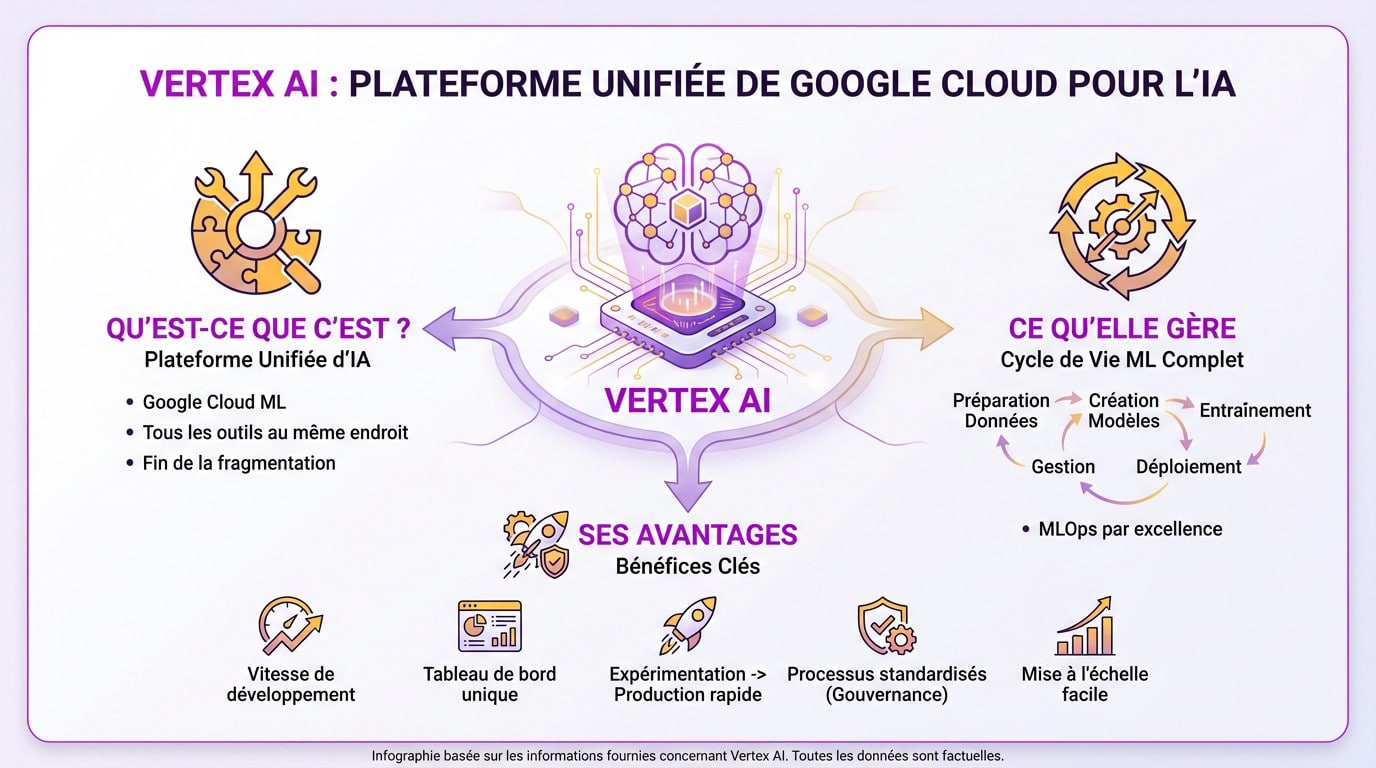
Vertex AI stands out as Google Cloud’s unified AI platform, designed for professionals. Its goal is simple: bring together all necessary tools in one place for serious work. It’s not just an isolated software, but a complete and robust environment.
Do you see the classic problem? Tool fragmentation that drives developers crazy. Before, teams had to juggle multiple disconnected services. Vertex AI centralizes everything to stop this waste of time.
Specifically, the platform is designed to manage the entire lifecycle of AI and Machine Learning (ML) projects. From initial design to production deployment, everything happens here.
Managing the Entire Machine Learning Lifecycle
When we talk about a “complete lifecycle,” we mean business. This covers data preparation, model creation, training, all the way to final deployment and management. Everything is connected.
This is where MLOps (Machine Learning Operations) is introduced. Vertex AI is the quintessential MLOps platform for structuring these processes.
Think of it as an all-in-one professional kitchen for a master chef. Instead of buying each utensil separately and hoping they work well together, everything is integrated. This allows you to focus on the “recipe” (the model) rather than the tools.
Why This Centralized Approach is a Real Advantage
The first advantage is clearly development speed. Less time wasted integrating disparate tools means your projects finally move faster. You stop battling with the infrastructure.
Vertex AI puts an end to the era of “tinkering” where various ML tools were assembled, by offering a single dashboard to manage the entire AI lifecycle.
Here’s why experts are migrating to this solution:
- Accelerate the transition from experimentation to production.
- Standardize processes for better governance.
- Scale models more easily without rebuilding everything.
The Vertex AI Toolkit Unpacked
Now that we understand the philosophy, let’s look at what’s concretely under the hood. Vertex AI is not an obscure black box; it’s a set of specific tools designed for efficiency.
The Model Garden: An AI Model Supermarket
The Model Garden functions as a vast library of pre-trained AI models, ready to use. It’s often the ideal starting point for launching projects without starting from scratch.
There’s a wide selection, with over 200 models available immediately to meet a wide variety of needs.
The diversity is surprising: you’ll find Google models like Gemini, third-party solutions like Anthropic’s Claude, and even open-source stars such as Llama 3.2 or Gemma. No need to reinvent the wheel.
Tools for Building and Training Custom Models
When off-the-shelf solutions are no longer enough, the platform provides the heavy artillery to create custom solutions. Data scientists find their footing with Vertex AI notebooks (Colab Enterprise, Workbench), which are dedicated work environments.
Native integration with BigQuery changes the game for technical teams. This allows you to juggle between raw data and artificial intelligence on a single interface, without unnecessary friction.
For absolute control, the custom training option is essential. It leaves you in control, from choosing the ML framework to the smallest line of code.
Deploy and Manage: MLOps Components
Once your model is ready, it needs to be put into production and maintained. This is precisely the role of MLOps tools.
| MLOps Tool | Its Role in Brief |
|---|---|
| Vertex AI Pipelines | Orchestrate and automate ML workflows. |
| Model Registry | A central catalog for managing, versioning, and tracking all your models. |
| Feature Store | Serve, share, and reuse ML features to avoid redoing the same work. |
| Vertex AI Evaluation | Compare models to objectively identify the best performer. |
The Generative AI Shift: Gemini and Beyond
But Vertex AI is not limited to traditional machine learning. The platform has taken a major turn with the advent of generative AI.
More Than Classic Machine Learning
Many still confuse the two approaches. Classic ML handles prediction and classification, while generative AI creates new content, a nuance that changes everything.
Google has transformed Vertex AI into a unique hub for these two worlds. You can launch a rigorous sales forecast there while building a chatbot capable of improvising.
For developers who want to experiment, Vertex AI Studio serves as a dedicated laboratory. It’s the ideal interface for testing, breaking, and refining your generative models before the big leap.
Gemini: The Multimodal Engine at the Heart of the System
Here, the undisputed star is Gemini, Google’s most powerful family of models. Its major asset is being multimodal: it understands and generates text, images, videos, and even code with astonishing ease.
With Gemini’s integration, Vertex AI is no longer just a place to run models; it’s a creative suite for building tomorrow’s multimodal applications.
The most interesting thing is that you’re not forced to use “raw” Gemini. You can fine-tune it with your own data to make it an expert in your business jargon.
Agent Builder and the Creation of Intelligent Assistants
Forget the rigid scripts of the past. Vertex AI Agent Builder allows you to design enterprise-grade conversational agents, perfect for customer service or internal assistants.
These agents connect directly to your data to provide reliable answers, without hallucinations. It’s the key to transforming a simple app into an “agentic” system. For more standard needs, a ready-to-use AI Chat assistant may suffice.
- Google Proprietary Models (Gemini, Imagen, Veo).
- Third-Party Models (Anthropic’s Claude family).
- Open Source Models (Gemma, Llama 3.2).
What is its Practical Use and For Whom?
Theory is all well and good, but in real life, what do we do with Vertex AI? And most importantly, is it for you?
Use Cases That Resonate with Everyone
Forget abstract concepts. Here, we’re talking about building concrete tools that truly see, listen to, and understand your data.
With Vertex AI, technology finally aligns with your technical ambitions:
- Create innovative applications with Gemini models, like a chatbot capable of analyzing images in the blink of an eye.
- Automatically extract, classify, and summarize mountains of documents, saving you hours of manual sorting.
- Train a custom model for very specific needs, such as sophisticated financial fraud detection.
- Deploy robust models to generate reliable predictions in real-time on your website.
The Typical Vertex AI User Profile
Let’s be direct: this platform primarily targets technical experts. Data scientists, ML engineers, and complex application developers will get the most out of it.
It’s clearly not a tool for the general public, but a powerful suite for professionals who build solutions.
If you just want to automate a few tasks or discover the potential of AI without technical complexity, a free and accessible AI like Nation AI is often a much better starting point.
A Budget Question: How Pricing Works
The economic model is simple and transparent: it’s pay-as-you-go. You only pay for what you actually consume, without unnecessary subscriptions.
The bill adjusts precisely to usage. For example, text generation is often billed per thousand characters, while training a heavy model is billed by machine time used.
It’s also worth noting that new Google Cloud customers often receive free credits to start testing the platform risk-free.
In summary, Vertex AI establishes itself as the indispensable hub for data professionals. Whether it’s for orchestrating classic machine learning or taming the power of Gemini, Google has achieved its unification goal. It’s the ideal tool for moving from tinkering to industrialization, even if the bill can climb as fast as your ambitions!