

The essential takeaway: AstraZeneca has shifted from partnership to full ownership by acquiring Modella AI. This strategic move internalizes advanced quantitative pathology tools to drastically accelerate oncology R&D and biomarker discovery. It marks a significant industry milestone, securing total control over the AI engine needed to deliver targeted cancer therapies faster.

Is relying on outside help becoming a liability in the high-stakes fight against cancer? The strategic astrazeneca modella ai oncology buyout proves that big pharma is finally bringing the brains in-house. We reveal how this move secures their data and drastically accelerates the path to new life-saving treatments.
Why AstraZeneca Bought the Whole Company, Not Just the Software
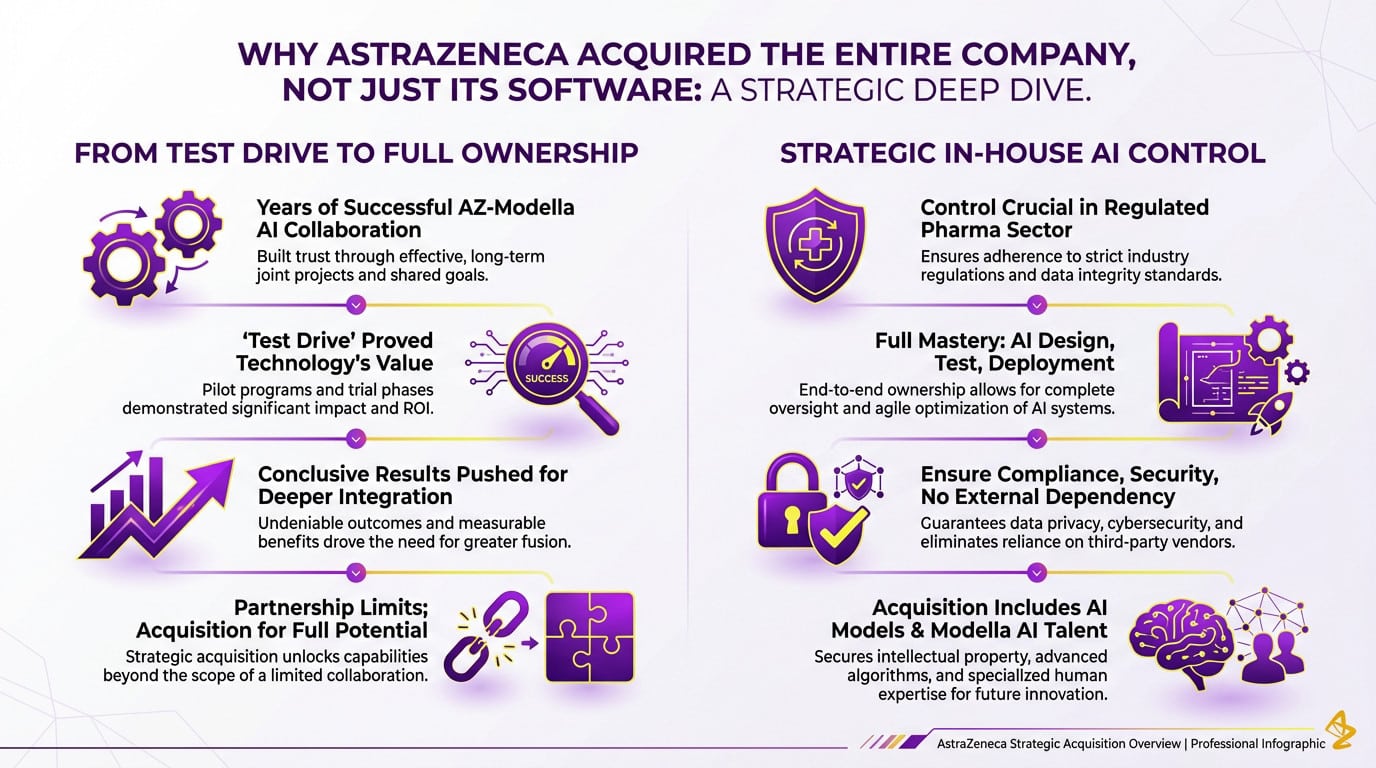
From a Successful Test Drive to Full Ownership
This acquisition didn’t appear out of thin air; it follows a multi-year collaboration announced in July 2025 that served as a high-stakes test drive. They needed to prove the astrazeneca modella ai oncology integration actually worked before signing the check.
The results were undeniable, yet the partnership model hit a ceiling. You simply cannot achieve deep, seamless integration when your core tech sits in an external silo. That separation was slowing down the very speed they sought.
Consequently, moving from partners to owners wasn’t just preferred; it was the necessary step to unleash the platform’s full power.
The Strategic Decision for In-House AI Control
Let’s be real about the motivation here: it is about absolute control. In a sector as tightly regulated as pharmaceuticals, outsourcing your brain—the AI making decisions on patient selection—is a vulnerability you eventually have to close.
Ownership grants total command over how tools are designed, stress-tested, and deployed. It guarantees every algorithm aligns with strict internal compliance and security standards, eliminating dependency on an outside vendor’s timeline. They now dictate the pace of innovation.
Furthermore, this deal secures the human element. The Modella experts are joining the team, ensuring the talent stays right where it belongs.
Unpacking Modella AI’s Technology: The Engine for Cancer Research
But what makes the tech behind the AstraZeneca Modella AI oncology deal special enough to justify a full buyout? It is not just any AI.
Beyond Algorithms: Making Pathology Quantitative
Let’s demystify “quantitative pathology.” Instead of relying on a human to make a subjective visual check of a biopsy, this AI analyzes biopsy images computationally. It effectively transforms pathology from an interpretive art into a precise, hard data science.
This allows us to spot hidden patterns and microscopic details that remain invisible to the naked eye, making diagnosis and analysis far more reliable and reproducible than ever before.
That is the key to identifying therapeutic targets with a level of precision we simply haven’t seen before.
Connecting the Dots with Multi-Modal Data
Modella’s AI doesn’t settle for a single data type; that is the “multi-modal” concept. It refuses to look at data in isolation, instead crossing information from very different sources to find answers.
It ingests and connects massive datasets, specifically:
- Analyzing data right down to the single-cell data level.
- Interpreting complex pathology slides
- Correlating findings with real-world clinical information from patient cohorts.
This holistic approach gives us a much more complete, 360-degree understanding of cancer biology for every single patient.
The complexity, data-richness, and time-sensitivity of oncology drug development has reached a new high, creating an opportunity to deploy our AI tools at a global scale.
The Real-World Impact on AstraZeneca’s Oncology Pipeline
Let’s look past the corporate press release for a second. What does this actually mean for a patient waiting for a cure?
Supercharging Biomarker Discovery for Targeted Therapies
A biomarker is simply a biological clue found in blood or tissue. It tells doctors if a specific treatment will actually work for you. It is the difference between guessing and knowing.
This is where the astrazeneca modella ai oncology integration gets interesting. Modella’s tech scans thousands of biopsy images and clinical records instantly. It spots hidden patterns humans miss to identify “highly targeted biomarkers.”
The endgame is developing highly targeted therapies for distinct patient groups. We are finally moving away from the old, ineffective “one-size-fits-all” approach to cancer treatment.
Smarter Clinical Trials: Faster, Cheaper, and More Likely to Succeed
Better biomarkers directly lead to smarter, more efficient clinical trials. Finding the right people for these studies has always been the industry’s biggest bottleneck.
With this internal AI, patient selection becomes surgical rather than speculative. Speed is everything when lives are on the line.
You might wonder why this matters, but the math is simple. Optimizing data processing delivers three massive wins:
- Drastically higher odds of clinical trial success.
- Slashing the time needed to turn research into hard decisions.
- Lower development costs, which could eventually impact drug prices.
The goal is to truly ‘supercharge’ our work in quantitative pathology and biomarker discovery by bringing more of this data and AI capability in-house.
A New Blueprint for Pharma: The Long-Term Bet on Integrated AI
This move by AstraZeneca isn’t just a transaction. It is a loud signal sent to the entire pharmaceutical industry.
Owning the Engine, Not Just Renting the Car
Most pharma giants are content renting AI capabilities through loose partnerships. AstraZeneca, however, decided to buy the engine outright. It’s a bold move that separates the tourists from the residents.
External collaborations are fine for dipping a toe in the water. But to build a sustainable, fundamental capacity, internal integration is the only real path forward. You can’t control the speed if you don’t own the accelerator.
This signals a deep conviction that long-term value lies in baking AI right into the core of drug discovery. It’s not an add-on anymore.
How AI Fits Into AstraZeneca’s $80 Billion Ambition
Let’s look at the numbers driving this AstraZeneca Modella AI oncology strategy. The company has set a massive target of $80 billion in total revenue by 2030.
Reaching that figure is impossible with the old, slow R&D playbooks. They need speed, and they need it yesterday.
The difference in efficiency is frankly staggering when you compare the methodologies side-by-side. Instead of relying on months of manual guesswork, the new workflow utilizes automation to deliver results in weeks. Here is exactly how this acquisition changes the R&D math for the better:
| Process Step | Traditional Approach | AstraZeneca + Modella AI |
|---|---|---|
| Biomarker Discovery | Manual analysis, slow process | AI-driven automated analysis |
| Clinical Trial Patient Selection | Broad patient criteria, higher failure risk | Highly-targeted patient profiles |
| Data-to-Decision Time | Months or years | Reduced to weeks or months |
Ultimately, AstraZeneca’s move goes beyond a corporate shopping spree; it represents a fundamental shift in how we approach cancer research. By owning the AI engine instead of just renting it, they are betting on a future where data saves lives faster. Let’s hope these algorithms live up to the hype.