

What to remember: AI chatbots are redefining digital marketing by swapping old tracking cookies for real-time, explicit user intent. Instead of disrupting the experience, these native ads act as helpful suggestions within the dialogue, a strategy that not only respects user context but effectively drives results, boosting conversion rates by over 30%.

Have you ever wondered why your supposedly neutral digital assistant is suddenly sounding suspiciously like a motivated salesperson? This emerging reality is driven by ai chatbot advertising, a strategy transforming private chats into the ultimate real-time marketing battleground. We are peeling back the layers to reveal exactly how brands are bidding on your questions and why this controversial shift might be the only way to keep your favorite tools free.
The New Ad Real Estate: Your Chat Window
Let’s be honest, traditional banner ads are dying. We are witnessing a massive shift towards ai chatbot advertising. It is not about slapping promos on sidebars anymore; it is about injecting commercial intent directly into the dialogue. Advertisers realize the best place to catch you isn’t a cluttered website, but right in the middle of a conversation where you need answers.
From Dumb Scripts to Real Conversations
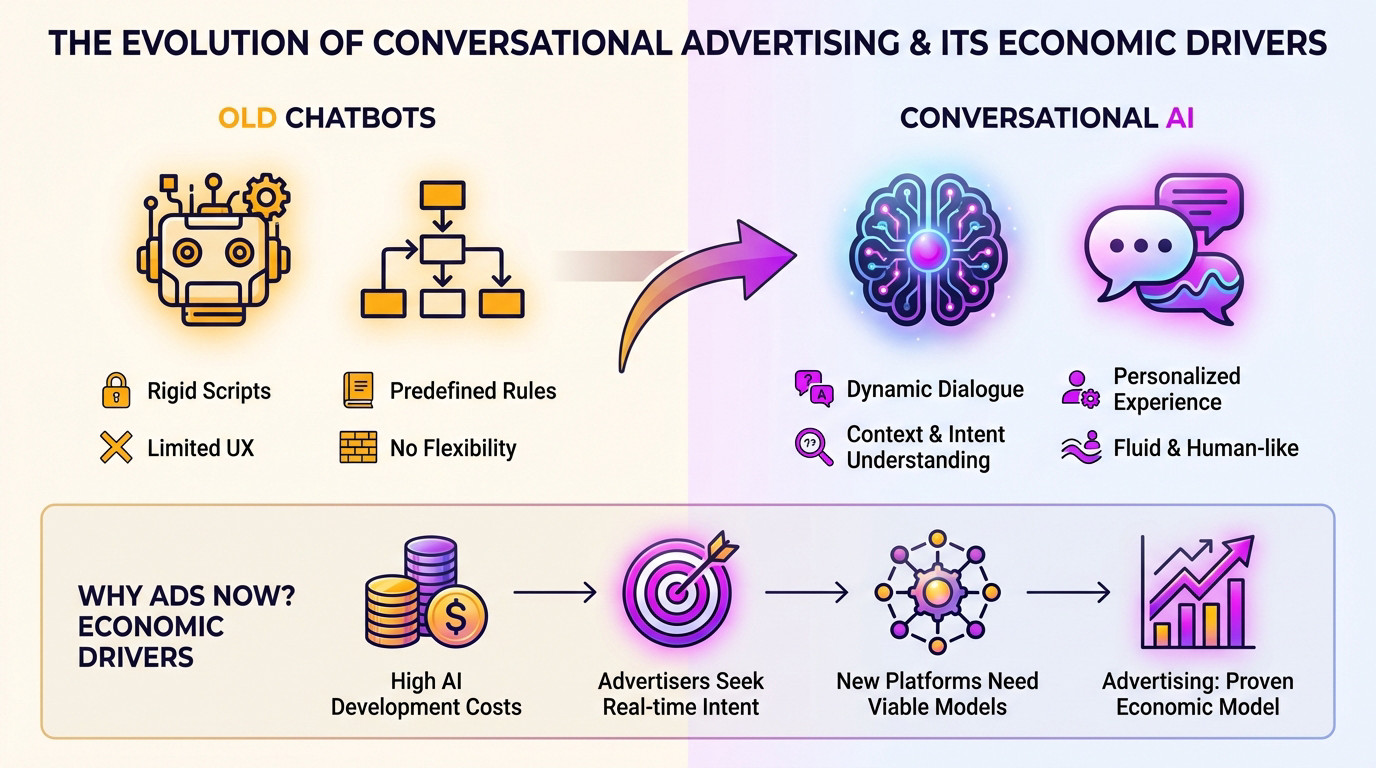
Remember those old customer service bots? They were rigid decision trees following scripts, barely understanding hello. Today, we deal with Conversational AI. These systems grasp context, intent, and sentiment, making discussions fluid and frighteningly human.
This evolution changes everything. It opens the door to non-intrusive integration that becomes part of the solution the user is actively searching for.
- Old bots: Followed predefined rules, zero flexibility.
- Conversational AI: Understands natural language and context.
- Old bots: Limited and often frustrating user experience.
- Conversational AI: Enables dynamic, personalized dialogue.
Why Ads Are Suddenly Invading Your Chats
The reason is brutally simple: money. Developing powerful AI models costs a fortune in compute power. Subscriptions have limits and don’t suit everyone. Advertising is the proven engine.
Platforms like Nation AI, aiming to simplify access to powerful AI, need viable economic models. The advertising route just makes sense.
Advertisers will pay a premium to reach users expressing clear purchase intent in real-time. It is the absolute Holy Grail of modern marketing.
How It Actually Works: The Mechanics of In-Chat Ads
Okay, we get why this is happening. But concretely, how does it work under the hood? It’s not just a banner plastered onto a conversation.
Tapping Into User Intent, Not Just Cookies
Traditional advertising relies on fragmented signals like browsing history or cookies. It is basically a rough estimation of what might interest you. We are often completely off the mark. It feels like throwing darts in the dark.
Conversational advertising, however, relies on explicit intent. If you ask “where to find the best running shoes for a marathon,” the intent is crystal clear. There is no need to guess anymore. This shifts the dynamic entirely.
The Ad-Tech Behind the Curtain
To keep it simple, the chatbot interface connects directly to the programmatic advertising ecosystem. Think of systems like OpenRTB, but specifically adapted for conversation. It bridges talk and tech.
Your question effectively becomes a sort of “bid request” sent out instantly. Advertisers bid in real-time to have their product presented as the relevant answer. The whole process takes just a few milliseconds. It happens before you even blink.
What These New Ads Actually Look Like
Forget those annoying pop-ups. We are talking about native formats here: product recommendations, links to articles, or even “sponsored follow-up questions.” It blends in perfectly with the chat.
The idea is that ai chatbot advertising shouldn’t be an interruption, but a logical continuation of the conversation. It is a useful suggestion rather than a flashing sign. It respects the flow.
“The goal is for the ad to feel less like a commercial break and more like a helpful suggestion from a knowledgeable friend who just happens to be a robot.”
The Good, the Bad, and the Profitable
This approach looks promising on paper. But as always, the devil is in the details. There is real potential, but also real risks.
| Feature | Traditional Digital Ads | Conversational AI Ads |
|---|---|---|
| Targeting Basis | Demographics, cookies, browsing history (Inferred Intent) | Real-time user query, direct conversation context (Explicit Intent) |
| User Interaction | Passive (viewing, clicking) | Active (dialogue, questioning, refining) |
| Ad Format | Banner, video, pop-up (often disruptive) | Native text, sponsored suggestions, product carousels (Integrated) |
| Relevance Potential | Medium to Low (often misses the mark) | High (directly answers a stated need) |
| Data Source | Third-party & first-party fragmented data | Direct, first-party conversation data |
The Business Case is Pretty Clear
For companies, the upside is obvious. Surgical targeting means less wasted budget. You engage someone already interested. AI chatbot advertising turns intent into action immediately.
Early returns are promising. Cases show conversion rates jumping over 30% with relevant recommendations. That is a performance stat hard to ignore.
- Higher Engagement: Users are actively involved.
- Better Data: Direct access to customer needs.
- Cost Efficiency: Relevance leads to better ROI.
- 24/7 Availability: Engage customers anytime.
Walking the Tightrope of User Trust
The biggest risk is breaking trust. Users seek neutral answers. If the AI feels like it is selling at all costs, they will simply leave.
The line between helpful suggestion and intrusive spam is thin. One bad execution, and the bot goes from assistant to digital rug merchant.
The moment a user feels the AI is prioritizing the advertiser’s wallet over their actual question, the entire system of trust collapses. And it’s very hard to rebuild.
Staying on the Right Side of the Law (and Your Users)
The Transparency Problem: Is This an Ad?
The question is simple: does the user know they are seeing an ad? If the answer is no, we have a serious problem. Concealment is the fastest route to mistrust. You can’t trick people into buying things.
Clear labeling is non-negotiable. A simple “Sponsored” or “Partner Suggestion” tag often suffices. Honesty is the best policy, especially when building a long-term relationship. It’s about respect, not just rules.
Navigating the Legal and Ethical Minefield
Your conversations are personal data. Using them for ads falls directly under regulations like the GDPR. User consent must be explicit, not hidden in terms and conditions. You risk heavy penalties if you ignore this.
Competition authorities are also watching closely. They want to ensure these new ecosystems don’t become walled gardens where only big companies can play. We can’t have a world where only big players play. Fairness is the new standard.
Advertising Is Just One Piece of the Puzzle
Advertising is not the only path. Monetization models for AI are varied and can be combined for a healthy balance. You have real options beyond simple ads.
Thinking ai chatbot advertising is the magic bullet would be a mistake. It is a powerful tool, but it must fit a broader strategy that respects the user first. Reliance on one stream is risky.
- Subscription Models: Classic monthly/yearly access for premium features.
- Pay-Per-Use: Users pay based on the volume of their requests.
- Affiliate Marketing: Earning commissions from relevant product recommendations.
- In-Chat Purchases: Direct transactions for digital goods or services.
Conversational advertising is reshaping how brands connect with us, turning chat windows into prime real estate. While the revenue potential is massive, the real challenge lies in maintaining trust without turning helpful AI into a pushy salesperson. Ultimately, the future belongs to ads that don’t feel like ads at all—just good advice.