
The essential takeaway: With 51% of UK adults worried about AI impacting their jobs, employee anxiety is a silent ROI killer that halts adoption. Success requires actively reframing AI as a tool for human augmentation, not replacement. By prioritizing transparency and equipping managers to debunk myths, companies can transform fear into a powerful engine for innovation and growth.

Is your team secretly hoping your new tech initiatives fail because they are paralyzed by the terrifying, unspoken thought that algorithms are coming for their paychecks? Mastering ai adoption change management requires far more than just software integration; it demands a psychological shift that reframes artificial intelligence from a silent replacement into an indispensable partner for human augmentation. We reveal the specific strategies to dismantle resistance, cure change fatigue, and transform that paralyzing anxiety into the high-performance fuel your organization needs to secure its return on investment.
The Elephant in the Room: AI Anxiety is a Silent ROI Killer
Let’s be blunt. Employee anxiety isn’t a “soft” HR topic to discuss over lukewarm coffee; it is a financial leak. If your team fears the tech, your return on investment evaporates before you even finish the rollout. You aren’t just battling software bugs; you are fighting human nature.
Why Your Team Sees AI as a Threat, Not a Tool
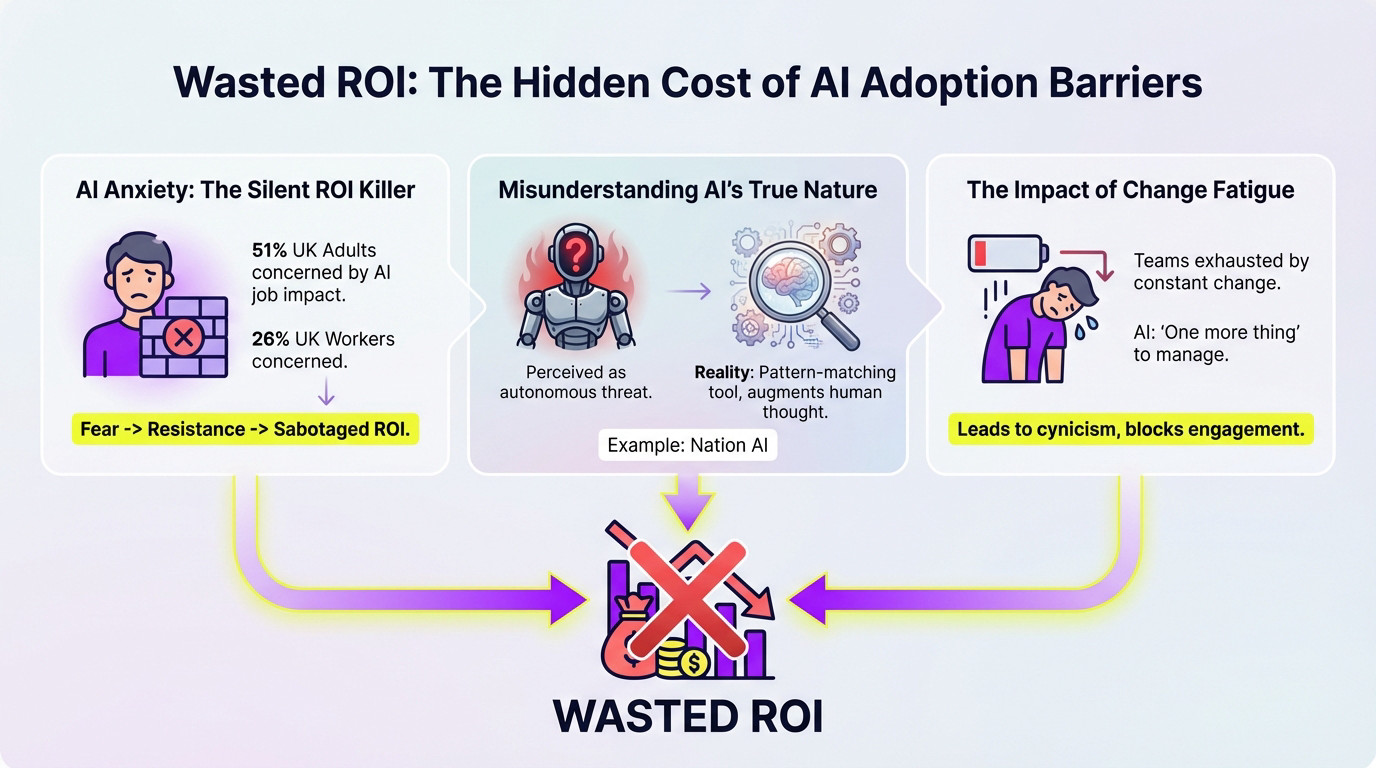
Here is the hard truth: 51% of UK adults and 26% of UK workers are deeply concerned about AI impacting their employment. This isn’t irrational paranoia; it is fueled by a relentless media narrative screaming about job replacement. That fear is exactly where the friction starts.
When fear sets in, resistance follows. This pushback silently sabotages ai adoption change management efforts, destroying the ROI you expected from your tech spend. If they don’t trust it, they simply won’t use it properly.
Ignoring this is like buying a high-performance sports car but refusing to put gas in it. The investment sits there, expensive and useless.
The Real Source of Resistance: A Fundamental Misunderstanding
Expert Allister Frost hits the nail on the head: the resistance isn’t about the software, but a fundamental misperception. Employees imagine a sentient, autonomous intelligence ready to render their human cognition obsolete. They fear a replacement, not a helper.
Frost clarifies the reality: AI is simply “pattern-matching” at scale. It doesn’t “think”; it processes data to help humans innovate. Platforms like Nation AI use this philosophy, offering a simple interface designed specifically to augment human capability, not erase it.
The issue is actually a failure of internal marketing. We have poorly “sold” the technology to the very people we need to use it.
Change Fatigue: The Hidden Obstacle to AI Adoption
Teams are exhausted from endless shifts in direction. AI often lands as “just another burden” to manage on top of a full plate. This is “change fatigue”, and it is the silent killer of enthusiasm.
Fatigue makes employees cynical and less receptive. Even the most brilliant strategy fails if people lack the mental energy to care. You cannot withdraw from a bank account of goodwill that is already empty.
Successful management requires a different tactic. You must be empathetic, transparent, and actively acknowledge this exhaustion to actually overcome it.
It’s Not Skynet: Reframing AI from Job Stealer to Human Superpower
From Replacement to Augmentation: The New Narrative
Leaders need to flip the script immediately. Successful ai adoption change management requires hammering home one message in every single meeting: this technology exists to boost our output, not to kick us out.
Think of it as a digital colleague rather than a rival. While the software sorts through thousands of emails or spots trends in data, you get freed up for the real work—strategy and creativity.
It is a deliberate strategic move. The organizations that win big are the ones that decide to choose augmentation over substitution.
The Historical Precedent: Technology Expands the Job Market
Here is a fact that might surprise you, as Allister Frost points out: tech integration has historically expanded the job market, never the opposite.
Look at ATMs. Everyone thought bank tellers were doomed. Instead, cheaper branches meant banks opened more of them, turning the role of the teller into a relationship advisor rather than a cash dispenser.
AI is following the exact same playbook right now. Sure, roles shift, but new jobs are popping up everywhere, especially those demanding ethical oversight and human judgment.
The Real Cost of Replacing People with AI
Be careful with the short game. Using algorithms to reduce headcount might look great on a spreadsheet today, but it destroys your institutional memory tomorrow.
When veterans leave, they take years of unspoken context, client relationships, and “how things actually work” out the door.
AI is most effective when it strengthens human capabilities, not replaces them. The companies that forget this will pay a high economic and societal price.
The payoff isn’t slashing payroll. It comes from boosting your capacity for innovation and adding value where machines simply can’t.
The Practical Playbook for AI Change Management
Transparency and Trust: The Foundations of Successful Adoption
Trust acts as a catalyst more powerful than fear. To build it, transparency is non-negotiable. Your employees need to know exactly what is happening.
This means open communication about AI plans, the data used, and the goals. You need transparent governance where the rules of the game are clear for everyone. No secret projects allowed.
Encourage a culture where employees can ask hard questions and voice concerns without fear of judgment. Trust is earned in the difficult conversations.
Communication That Actually Works
Stop the generic corporate emails that nobody reads. Communication regarding ai adoption change management must be continuous, targeted, and human.
Explain the “Why” before the “How.” Why are we doing this? What problem are we solving?
- Show, don’t just tell: Organize hands-on workshops and demos with tools like Nation AI to demystify the technology. Let people play with it in a safe environment.
- Create AI champions: Identify early adopters and enthusiasts at all levels of the organization and empower them to share their positive experiences with their peers.
- Establish clear feedback loops: Provide channels for employees to share feedback, report issues, and suggest new use cases. Make them feel part of the process, not just subjects of it.
Creating a Culture of Safe Experimentation
The fear of failure kills innovation. For employees to adopt AI, they must have the right to experiment and mess up. You need to put in place principles like “learn and pivot”.
This means allowing teams to test tools on low-stakes projects without waiting for systematic permission every single time. Action encourages adoption.
The objective is to create a safe experimentation culture where curiosity is rewarded and failure is seen as a learning opportunity.
Your Managers Are the Secret Weapon: Debunking AI Myths on the Frontline
The Manager as a Change Translator
Let’s be real. Your middle managers are the actual transmission belt for any ai adoption change management strategy. They translate high-level boardroom dreams into the gritty reality of daily operations. Without them, nothing moves.
But here’s the kicker: if they don’t buy in, or worse, if they share the panic, your entire plan hits a wall. You must equip and train them first, long before rolling anything out to the wider teams.
A Practical Toolkit for Myth-Busting
Vague emails won’t cut it. To truly correct misconceptions, managers need a battle-tested script and concrete examples to shut down fear the moment it surfaces.
You can’t just tell people “don’t worry.” You need hard facts. Provide your leaders with a cheat sheet that tackles the biggest blockers head-on. It’s about reframing the narrative from “replacement” to “augmentation.” When a team member asks a tough question, the manager shouldn’t stutter; they should have a solid, honest answer ready to go. This isn’t about spinning the truth; it’s about clarity. Here is the data they need to flip the script immediately:
| The Myth | The Reality for Your Team |
|---|---|
| “AI is going to take my job.” | “AI will handle repetitive tasks like data entry, freeing you up for more creative and strategic work. Think of it as a new teammate.” |
| “AI is always right and knows everything.” | “AI can make mistakes (‘hallucinations’) and lacks real-world context. Your judgment and expertise are needed to guide it and validate its outputs.” |
| “AI will read all my emails and watch everything I do.” | “We have strict governance and privacy policies. The AI is a tool to help you (e.g., suggest replies), not a surveillance system.” |
| “I need to be a data scientist to use AI.” | “Modern tools like Nation AI are built for everyone. If you can use a search engine, you can use this. We’ll provide all the training you need.” |
Equipping Managers to Lead with Empathy
Facts matter, sure, but feelings drive behavior. Managers must be trained to handle the emotional weight of this shift. It’s about active listening to genuine fears without brushing them off as irrational or just “noise.”
Teach them to lead with empathy. Acknowledging the stress—”I get why that sounds scary”—before jumping into the solution makes all the difference. It validates the human experience behind the tech transition rather than ignoring it.
Beyond the Tech: Investing in the Skills AI Can’t Touch
Identifying Your Uniquely Human Skills
The best job security in an AI world is cultivating the skills machines simply lack. The conversation needs to shift from “which jobs will disappear?” to “which skills are becoming more valuable?” in the context of successful ai adoption change management.
Here is where humans still hold the advantage:
- Critical thinking & judgment: AI provides data, but humans must question it, interpret it, and make the final call.
- Empathy & emotional intelligence: Understanding customer needs, managing team dynamics, and building relationships are beyond AI’s scope.
- Ethical decision-making: Applying a moral compass to the use of technology and its outputs is a fundamentally human responsibility.
- Creativity & curiosity: Asking “what if?” and imagining new possibilities is where human-led innovation begins.
Building a Proactive Upskilling Strategy
Don’t wait for skills to become obsolete before acting. Companies must implement a multi-level training strategy that is proactive and continuous rather than reactive.
This starts with basic AI literacy for everyone to demystify the technology. Then, we move to specialized paths tailored for different roles to deepen expertise.
Use varied resources: online sessions, hands-on workshops, and most importantly, empower internal experts to train their colleagues.
Talent Marketplaces: A New Way to Grow
We are seeing concrete initiatives like AI-powered talent marketplaces—Mastercard is a prime example here. These platforms help employees see beyond their current job titles.
They focus on emerging skills and connect employees to learning opportunities, mentorship, and real-world projects.
It is a way to give employees control over their own career development in this new AI environment.
From Theory to Practice: Redesigning Work and Governance
We have the right mindset and the necessary skills. The final step consists of integrating AI into the very structure of the company. This section addresses the reconfiguration of processes and the importance of guardrails to ensure everything works for the long term.
Auditing Workflows to Find the Right AI Use Cases
We cannot just “sprinkle” AI on top of existing processes. We must rethink use cases and reconfigure workflows entirely. It is about fixing the plumbing, not just painting the pipes.
The key is auditing processes to identify tasks with high volume and low value. These are the perfect candidates for automation. It is the “quick win” that proves AI’s worth to the skeptics. This builds the momentum you need.
This immediately frees up time for employees to focus on strategic and creative activities. That is exactly where their human value is maximal.
The Critical Role of Governance and Ethics
Experimentation is vital, but it cannot happen in a digital Wild West. Clear governance is the indispensable guardrail. It keeps the innovation engine safely on the tracks.
Establish a governance board or an AI ethics committee immediately. Define acceptable use policies to manage risks like bias, privacy, and security. You need these rules right now. They protect your brand reputation from avoidable disasters.
Leaders often overlook the cost of cutting corners, but as the experts warn:
“Using AI to simply cut headcount is a fool’s game. It degrades institutional memory and incurs huge long-term costs that leaders often overlook.”
Key Takeaways for Leaders Driving the Change
To sum up, successful ai adoption change management relies on a few simple but powerful pillars. It is not magic.
- Reframe the narrative: Consistently position AI as a tool for human augmentation, not replacement.
- Audit and automate smartly: Focus on automating high-volume, low-value tasks to free up your people for what they do best.
- Invest in human skills: Double down on training for critical thinking, empathy, and ethical judgment—skills AI can’t replicate.
- Communicate transparently: Open a continuous, honest dialogue to build trust and actively fight the fear of job loss.
AI anxiety is real, but it’s also a massive opportunity to redefine how we work. By fostering trust and focusing on uniquely human skills, you transform fear into fuel for innovation. The future isn’t about machines replacing us; it’s about becoming better with them. So, take a breath—your humanity is still your best asset.